
By Mene Agbofodoh
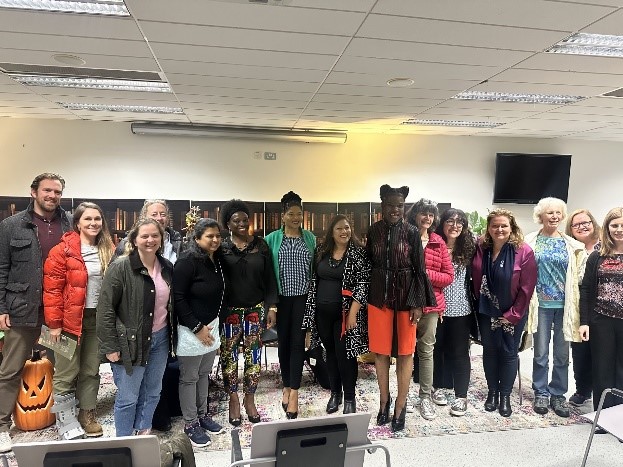
The Red Line Book Festival held a book conference for influential Black Women in Ireland to celebrate Black History Month.
The Red Line Book Festival is a cultural event that happens once every year.
It is held to appreciate and celebrate literature, storytelling, and creativity.
It aims to bring people together from across Dublin and Ireland, spark conversations, and inspire the next generation of writers and readers.
The Red Line Festival is normally held throughout an entire week with multiple events happening throughout the week. and one of the events was ‘Stories of Black Women in Ireland’.

Dr. Ebun Joesph, a special rapporteur for racial equality and racism Ireland and founder of Anti-Ireland and Black Studies was also in attendance for the talk.
Melissa Bosch, (Head of Diversity, Equity, and Inclusion at where?, Eya Lawani, a Special Needs assistant who has a background in assisting charities for Black Irish children, and Carline Thompson, a nurse, researcher, entrepreneur, and activist, also attended to talk about their new book, ‘Equity in the Workplace Stories of Black Irish Women in Ireland’.

Photo: Mene Agbofodoh
The purpose of the book was to amplify the voices of black Irish women and examine their experiences within the Irish labour market.
It aims to uncover the challenges they face and their perceptions of achieving equity in the workplace.
Despite progress in gender parity, disparities still exist, with women being underrepresented in leadership roles and facing lower pay, poor working conditions, and instances of bullying and harassment.
Dr. Ebun Joesph spoke about the importance of women finding their voices within the workplace.
“I think it is important that us women find our voice especially us black women, so that our stories can be heard, to be told and not told from a perspective that doesn’t truly represent us,” she said
Melissa Bosch talked about understanding the power your voice has.
“When you see something that is wrong along the lines of racism and discrimination, your voice is so powerful and when speak out against these things, it can drive change,” she said.
“If we do not speak about things like this and if we don’t open our minds, our hearts to create those spaces for this kind of level of dialogue, we are not going to change anything. Ireland won’t be able to move forward”.
Melissa Bosch’s chapter in the book revolved around trying to help people see their place in the world and what they can do to help marginalized people.
“Whatever ethnic background you come from, whatever demographic background you come from, you have the power to make that change, it’s about understanding your privilege and position in this world.”.
Carline Thompson spoke about the challenges of writing her chapter in the book.
“One of the challenges I had when writing my chapter wasn’t the 2,500-word count even though I only had a week to do it, it was how do I write so much about this topic without exceeding the limit?”
“People think racism only happens in the workplace however, it’s everywhere around you. It’s in the supermarket where you feel you’re being watched by security whilst you’re shopping, it’s in the library, it’s in the restaurant when you’re going out to eat with family and you get stares throughout the night”.
Eya Lawani also spoke on her challenges when she was writing her chapter.
“My problem or challenge about writing my chapter was I didn’t know how I was going to convey the message that systematic racism is the problem in our society without blaming white people as a whole.”
“It was a very difficult topic to write because I had to relive certain moments in my life that made me feel belittled, moments when applications were rejected despite having my bachelor’s degree from Nigeria but because it wasn’t an Irish degree it wasn’t good enough”.
“I struggled with the fact people in society were willing to accept I could be discriminated against because I was a woman but If I said I felt discriminated against because I’m black suddenly it couldn’t possibly be because I’m black and having to convey that in my chapter was very challenging.”
Black History Month is observed in Ireland from the 1st of October until the 31st.
You must be logged in to post a comment.