Tag: Data

  • Number of new electric vehicles up 81% from last year.

    Number of new electric vehicles up 81% from last year.

    By David Seagrave

    The number of vehicles registered in Ireland for the first time has decreased from the same period last year, new figures from the Central Statistics Office show.

    Conversely, the number of cars using electric-based engines has gone up, with Plug-in Hybrid Electric Vehicles (PHEV) the only type of electric-based vehicle to be registered less than last year. 

    Electric vehicles and hybrids both saw an increase in the number of registrations, with petrol and diesel both showing a decrease in new registrations. 

    The number of used petrol vehicles has reduced by less than 2%, while new diesel vehicles have reduced by 59%. The drop in diesel vehicles could also be attributed to the NOx levy and the introduction of VAT from cars imported from the UK, excluding Northern Ireland.

    Diesel vehicles have also reduced due to the impact of the cost of living crisis, as diesel prices have soared to more than €2 per litre. 

    Electric vehicles and PHEVs showed a drop in used registrations, while hybrid vehicles showed an increase of 17.5%.  

    The number of new cars registered in Ireland from January – September has dropped by just 1%, while the number of second-hand cars imported has dropped by a significant 35%. 

    The most popular brand of new private cars registered was Volkswagen, accounting for 17% of all new cars on the road. Kia, Hyundai, Skoda and Tesla also make up the top five respectively, accounting for just under half of all new car sales in Ireland. 

    Lower emissions vehicles make up the bulk of new cars registered in Ireland, with 82,929 of all cars falling into emission bands A1 – B2, meaning they have less than 140 grams of carbon per kilometre (g/km).

    Goods vehicles have also seen a decrease of 20% in new registrations, and another 29% in used registrations, following protests last December, and a second round of protests in April over spiralling fuel prices.

    Band G, which is anything above 226g/km, only registered 108 new cars, with 105 of those coming from petrol and diesel engines.

  • Number of new cars bought this year down 26 percent

    Number of new cars bought this year down 26 percent

    The Central Statistics Office (CSO)  have recently released the number of vehicles that have been registered for the first time this year. Erin Killoran explores the actual effects of these statistics.

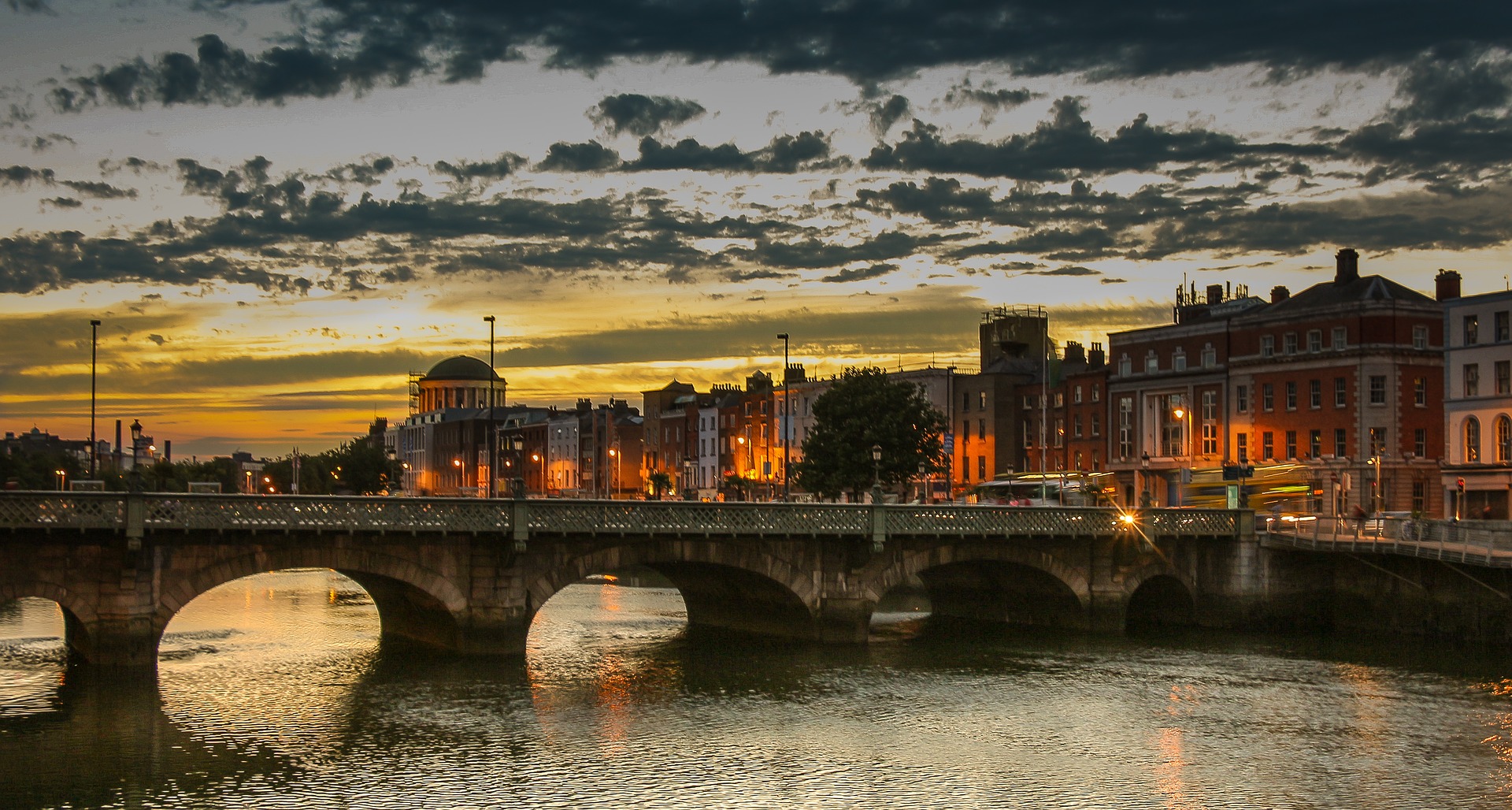
    Copyright free photo taken by user JCT 600 on Flickr.

    The Central Statistics Office (CSO)  have recently released the number of vehicles that have been registered for the first time this year. These figures show 81,809 new private cars were purchased by the Irish public. This demonstrates a large decline of 26.2% in comparison to this time last year, where 110,900 new private cars were licensed for the first time. The number of imported private cars also declined by 32.2% when compared with 2019.

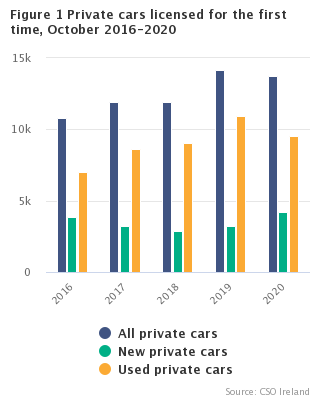
    However, there was a stark increase during the month of October of this year. The graph bellow shows sales were up 30.3% in comparison to last year as 975 more cars were registered in October 2020 than October 2019.  

    Figure 1 Private cars licensed for the first time, October 2016 - 2020

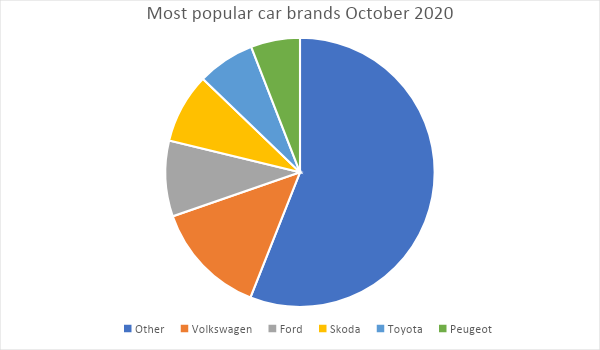
    The CSO also reported the most popular car brands for newly registered cars during the month of October 2020. Volkswagen was the most popular with 574 newly registered cars sold, followed by Ford 382, Skoda 350, Toyota 291 and Peugeot 247.

    Covid-19 has affected many businesses and industries, which could potentially be the main catalyst for the decline in the purchasing of new cars this year.  Studies have shown that 14% of people have lost their jobs due to the pandemic and a large number of people have been temporarily laid off. So perhaps, the financial insecurity that Covid-19 has provided has caused a significant decline in the number of new private cars that have been purchased. 

    Speaking to Paul Egan, sales executive at Sheehy Motors, Naas county Kildare, he said: “ We have experienced a downturn in sales, but not by much. In fact, we still beat our target set out by the brand for 2020.”

    With regards to any impact due to the pandemic, he said: “Covid did have an effect but the motor industry is also going through radical changes with technology. Customers are a bit confused about buying electric cars and the future of petrol and diesel cars.” 

    The CSO figures show that there has been a growth of electric and hybrid cars this year. 1,644 more hybrid cars and 625 more new electric cars were purchased this year compared with last year. Additionally, 35,067, new diesel cars were purchased throughout the first 10 months of 2020, which shows almost a 33% decrease from last year. 

    Egan spoke about his company’s plan for the final month of 2020. “Compared to last November, the pre-order intake for 2021 is approximately 15% behind. However, December orders should be stronger than last year because we are back open from December 1. Car sales are not considered essential retail so our showroom was closed during November. Any sales done until now were through email or phone.” Egan also stated that he believes that his company’s car sale figures are also representative of car dealerships nationwide. 

  • Nationalities of international undergraduate students in Ireland’s ‘Big 3’ Universities revealed for academic year 17/18

    Nationalities of international undergraduate students in Ireland’s ‘Big 3’ Universities revealed for academic year 17/18

    University College Dublin (UCD) has 7,869 international undergraduate students, making up 27 percent of total undergraduate student numbers in that college for the academic year 2017/2018.

    The college had another 21,257 Irish undergraduate students in that time.

    Meanwhile, Trinity College Dublin (TCD) has 3,192 international undergraduate students while National University of Ireland Galway (NUIG) has 2,467.

    The figures were obtained via the Freedom of Information Act from the three universities.

    According to the figures, the United States is the country with the most students pursuing undergraduate education in these three universities. TCD has 687 US national students; while UCD has 1,753 and NUIG has 812.

    Students from Britain form the highest numbers from Europe attending Ireland’s top universities. The numbers are 506 in TCD; 579 in UCD; and 172 in NUIG. Canadian, French and German students are also attracted by these universities.

    In Asia, countries like China, Malaysia consistently have the most students coming to Ireland for a university education. Notably however, Singapore, a relatively small country, has 226 Singaporean undergraduate students at TCD, the most amount of Asian students in Ireland’s premier university.

    From the African region, Nigeria is the country with the most students coming to Ireland with TCD (33), UCD ( 64), NUIG (73). Its numbers are significantly higher than other African countries. On the other hand, Australia is the main country representing the Oceania region, with 40 at TCD; 77 at UCD; 35 at NUIG.

    The international undergraduate students that come from South America and Africa and Oceania make up the minority of international students.

    The tables below show the top ten nationalities of international undergraduate students studying at each of the universities for the academic year 17/18.

    TheCity has compiled the data received, and categorised the countries into their respective geographic regions.

    For the convenience of categorisation, we labelled countries that are located in the Caucasian states into the classification of ‘Asia’. The geographic location of Russia meanwhile has been much debated whether it is in Europe or Asia. We decided to categorise Russia to Asia, based on its majority landmass being located there.

    The data compiled shows that TCD has the most international undergraduate students coming from Europe (1,583), followed by North America (839) and Asia (645).  

    UCD, with the highest number of total international undergraduate students, has the most students coming from Europe (2,839), closely followed by Asia (2,418) and North America ( 2075). There are 139 ‘unknown’ students which were not categorised.

    NUIG has the most students coming from North America (975). European (792) and Asian (488) nations are the other main contributors for international undergraduate students in the college.

    TCD said: “We benefit from our international collaborations with universities around the world in developing both research links and opportunities for our students to study abroad during their programmes.”

    On the recruitment of students, NUIG said: “NUI Galway has focused its international recruitment efforts on the US, India, Gulf Cooperation Council (GCC), and South East Asia. We plan to target West Africa and South America as part of our next recruitment drive.

    “International students of which there are 3,000 in NUI Galway represents a significant economic contribution to Galway City and its hinterland. This cohort also adds diversity to the city.”

    UCD has been contacted for comment, but had yet to respond at the time of publication.

    The universities examined here are the highest ranked universities in Ireland, according to the QS World Rankings 2019.

    According to the World Rankings, TCD is currently 104th in the world. UCD is 193rd place while NUIG is 260th place.

    The latest data from the Higher Education Authority (HEA), shows that of the overall international students population in 2017/2018, 41 percent comes from Asia; 29 percent from North America; 20 percent from the EU; and 10 percent from the rest of the world.

  • A losing battle? Legal broadcasting versus illegal streaming

    A losing battle? Legal broadcasting versus illegal streaming

    The advances made in recent web-based technology is quite remarkable, with almost everything you could possibly desire available to you on your smartphone, laptop or any other device.

    As a football enthusiast, I still remember the frustration of my favourite football team not having their game broadcast on live TV, and instead having to check for any score updates using ‘Teletext’. Although I was grateful for this technology at the time, I can’t honestly say it’s something I miss using.

    Luckily, I was probably among the last generation who would have to resort to such ‘caveman’ technology.

    Today, you are only ever a few gentle thumb-presses on a screen away from viewing almost anything you want online. Twitter, one of the internet’s biggest successes at the moment, has even recently teamed up with Periscope, a live-streaming application which streams directly from the device of its users, so that they can broadcast anything to any number of people.

    There is no doubt that these two online ‘giants’ teaming up is great for us, as we are getting visual news and insights that we may previously have been starved of, and we are getting these insights almost as soon as they happen; quicker than ever before.

    However, as with almost all things good on the internet, there are many ways in which these live streams can be exploited in a way that breaks the law, and in turn, takes viewers away from legitimate broadcasts. This is something that is regularly happening in the English Premier League.

    In a survey completed by the UK-based sports industry (SIG) it was revealed that 54% of those aged between 18 and 24 years admitted to using illegal sports streams in order to watch their favourite team.  A third of this group also admitted that they use illegal streaming for football regularly.

    With only 4 percent of over 35s admitting to using online streaming to view football matches, it is hardly a surprise that the age group (which is almost three times more likely to be unemployed than the UK’s national average) is evidently far less likely to pay subscription fees for sports. Such subscriptions with Sky Sports and BT can cost up to €69.50 per month for a basic sports package. It is also the same age group that’s more likely to have the requisite skills in modern technology to comfortably bypass any TV subscription to watch whatever they desire.

    In 2017, Sky Sports released their viewing figures which revealed they were down a staggering 25 percent since 2010. Their flagship ‘Super Sunday’ had also seen a huge decrease in viewing, with the afternoon kick-offs averaging 1.1 million views in 2017/18 season compared to 1.7 million in 2011/12.

    SteStat1

    Denial

    Both Sky Sports and BT repeatedly decline to admit that this downfall in viewing figures was caused by illegal streaming. Instead, they pointed at other major events that occurred in particular years and claimed that regular viewers may have had other interests.

    However, in November 2017, BBC Radio 5 Live Daily surveyed 1,000 Premier League fans which again proved that illegal streaming was becoming more and more popular.

    According to the poll, “Nearly half of fans say they have streamed a match online through an unofficial provider – just over a third do so at least once a month and about one in five at least once a week.”

    The Main Reasons:

    • Other family member/friend is streaming and they just watched
    • The quality of streaming was of high quality
    • Sports packages were not viewed as good value for money
    • Fans ‘not knowing’ it was illegal to stream

    Following this report by BBC 5 Live, research company ComRes then proceeded to do a survey of 1,000 adults who reported to being regular viewers of all Premier League football.

    What were the survey’s results?

    • 34 percent of supporters said they streamed live Premier League matches online through an unofficial provider at least once a month, and 21 percent at least once a week.
    • 45 percent of these fans had illegally streamed a match using an illegal provider at least once.
    • Younger fans (aged 18-34) are considerably more likely than their older counterparts to say they stream live football matches online through an unofficial provider – 65 percent do so at least once a month compared to 33 percent of 35-54 year olds and 13 percent of those aged 55+.
    • Of those fans who stream matches illegally, the most popular reasons are because a friend/family member does it and they just watch (29%); because the quality of online streaming is good (25%) and because sports TV packages are not good value for money (24%).
    • 12 per cent of Premier League fans think it is legal to stream games online (not through an official provider), while 34 percent think it is always illegal and 32 percent don’t know; 4 percent believe it is not breaking the law but Sky or BT could fine you if they find out, 7 percent think it is sometimes illegal, and 10 percent believe it is legal to watch but illegal to upload a stream.

    SteStat2

    Since these surveys, both Sky and BT have begun a legal battle against all illegal streams which broadcast their footage to viewers who do not pay for the content.

    Matthew Hibbert, head of litigation at Sky UK has said that the Sky company have become successful in cutting off all illegal streams thanks to a recent court ruling granting them greater power to go after server providers and shut down illegitimate providers.

    Hibbert now claims that “live streams of the premier league can no longer be easily found in the UK.”

    In 2018, the High Court issued a “blocking order” which will force internet providers to cut streams throughout the 2017/18 Premier League season.

    However, there should be room for concern in this statement that illegal football streaming is becoming tougher to gain access to. While some popular streaming sites may have been targeted, meaning you can no longer stream matches on their sites, I personally have never struggled to find a stream when needed, and there are still many ways of finding these illegal streams all over the internet.

    I surveyed twenty men in my local pub, ranging in ages from 18 to 55 years old. All twenty admitted that they have often used illegal streaming sites to watch football matches.

    One twenty-year-old said: “Any time Liverpool aren’t live on TV I’ll try stream it. I don’t think I’ve ever struggled to get a good stream, I mirror my phone onto the telly and honestly you wouldn’t know I was watching a stream. That’s how good the streams are.”

    Another soccer fan had a similar outlook. He said: “My son downloaded an app onto my phone for me and it’s brilliant. It streams every sports channel from anywhere in the world. I do have a sports package at home but sometimes a match I want to watch won’t be on so I use my phone to stream it instead.”

    The only thing certain about the future of legal and illegal broadcasting is that app-makers will always find a way. With streaming applications and sites being both widespread and easily accessible, legal broadcasting stations are fighting an uphill battle.
  • Male unemployment down from 6.9 percent to 5.5 percent since last year

    Male unemployment down from 6.9 percent to 5.5 percent since last year

    In October 2018, the unemployment rate was 5.5 percent for males, down from 6.9 percent in the same month last year, according to the latest seasonally adjusted CSO figures. 

    The seasonally adjusted number of males unemployed was down from 88,800 to 71,800 from October 2017 to October 2018.

    IanStat
    Source // CSO

    The largest increases in employment in the second quarter of 2018 took place in construction, the wholesale and retail trade, accommodation and food service activities, and professional, scientific and technical activities, according to the latest Labour Force Survey figures. 

    In comparison, the seasonally adjusted unemployment rate for the entire population of the United Kingdom in September 2018 was at 4.1 percent, according to figures released in November by the U.K.’s Office for National Statistics.

    In August 2018, the Department for Business, Enterprise and Innovation announced the Future Jobs program, which will be introduced in 2019 to succeed the Action Plan for jobs and to maintain the momentum in employment growth. 

    Earlier this year, the Minister for Business, Enterprise and Innovation Heather Humphreys supported the continued efforts to tackle unemployment and believes the Government’s successful annual Action Plans for Jobs has played a key role in the continued improvement in the job figures.

    The Action Plan for Jobs was created in 2012 – when unemployment was at its peak of 16 percent across everyone in the country. Since the first quarter of 2016, 174,200 jobs were created, with 65 percent of these coming outside of Dublin.

  • Social media is the main source of news for Irish secondary school students

    Social media is the main source of news for Irish secondary school students

    Half of secondary school students use social media as their main news source, new figures from the Central Statistics Office show.

    The CSO said that from a total of 2,200 students, 50.2 percent said social media was where they found out what was happening in the news as part of the CensusAtSchool survey which took place between September 2017 and August 2018.

    Ianstat2

    Almost three in five (56.2%) female students chose social media, while only two in four male students (40.7%) did the same.

    Another area of the study covered trust in media, and despite using social media the most, it was ranked second to magazines for lowest levels of trust from the students. Radio and television ranked highest in terms of trust level in the questionnaire.

    In July, the Taoiseach Leo Varadkar launched the Government’s Action Plan for Online Safety, stating that the internet has ‘transformed our lives’, but also emphasised the importance of knowing that ‘illegal and harmful content’ can be accessed online.

    “While the State has a role to play [in online safety], it cannot act alone. Individuals, parents, educators, industry and law enforcement all have roles to play in making the internet a safer place,” he said at the launch.

    Other aspects of the study covered sports and student’s ideal physical ability.

    In terms of student reasons for playing sport, ‘having fun’ came out on top, with ‘to win’ being the least important reason to participate. ‘Skill’ was the most common answer for ideal physical ability, with ‘agility’ being least popular.

  • Homeless numbers increased by over 15 percent

    Homeless numbers increased by over 15 percent

    The Department of Housing, Planning and Local Government has released their latest figure for homelessness in Ireland. The report shows the number of people that are trying to access local authority managed emergency accommodation.

    According to the monthly reports, as of September 2018, there is a total of 9,698 people homeless. This is a 15.8 percent increase from just one year before when 8,374 people were without housing in Ireland.  

    There are currently 5,869 adults looking for shelter throughout Ireland. The majority of these are male (3,275) as against 2,594 females.

    The report also shows more than two-thirds of homeless are between the ages of 25-44 (3,507). There were over 893 adults aged 18 to 24 living in emergency homeless accommodation.

    Map 2017

    This represents an 11 percent increase when compared to the figures from September 2017 (806). Overall, 52 percent of the homeless looking for shelter were in supported temporary accommodation which includes hostels, with on-site professional support.

    Across the Dublin region there is enormous pressure in providing emergency accommodation. Dublin has the highest rate of homelessness in Ireland and the report shows that there were 3,940 adults seeking shelter.

    Map 2018

    The northwest of Ireland including Donegal, Leitrim and Sligo, is the region with the lowest figures of people seeking shelter (54). Leitrim was the only county that accounted for nobody accessing homelessness accommodation services.

    It was announced that €2.3 billion would be dedicated to housing for the 2019 budget although this has been criticised by many charities. Focus Ireland claim that the budget “is not a game changer for people who are homeless”.

    A spokesperson for the Department of Housing, Planning and Local Government told TheCity: “The budget [for] 2019 reflects the commitment to dealing with homelessness by allocating an additional €30 million for homelessness services – bringing to €146 million the total for 2019 – €60 million extra in capital funding for additional emergency accommodation and €1.25 billion for the delivery of new social homes. This will deliver 10,000 new social homes next year.

    “A national Director of Housing First was appointed in February to work with the most vulnerable of the homeless population and a National Implementation Plan is in place. This plan seeks to extend the programme nationwide with targets for Housing First tenancies in each local authority. Combined, the plan will result in almost 1,000 former rough sleepers and long-term users of emergency accommodation having their housing and support needs met.

    “The numbers [for] homelessness are too high.  However, despite the high levels of homelessness, results are being achieved.  Over 4,700 adults exited homelessness into an independent tenancy in 2017. That does not include the children who were with these families. We are on target to achieve over 5,000 exits this year,” said the spokesman.

  • Imports Overtake New Buys in Irish Car Market

    Imports Overtake New Buys in Irish Car Market

    Fewer motorists are licensing new vehicles this year, with Irish road users turning increasingly towards the second-hand and import market in 2018, according to figures released by the Central Statistics Office.

    A total of 5,086 new vehicles were licensed in October, a decrease of 4.8 percent from October 2017. Altogether, 2,874 new private cars were licensed last month compared to 3,255 in October 2017, a decrease of 11.7 percent. However, there were more new goods vehicles licensed this October, with a 10.4 percent increase from 1,466 last year to 1,619 in 2018. The licensing of both new tractors and motorcycles has increased from October of this year to last, up 14 and 28 percent respectively. Vehicles in Ireland are licensed when a valid motor tax disc is issued for the first time.

    Figures for January to October of 2017 and 2018 show an overall decrease in the total number of new vehicles licensed in the country this year – down 2.7 percent from 157,285 to 153,001, a decrease of over 4,000 vehicles. Overall from January to October the licensing of new cars is down 4.9 percent this year to last, while an additional 1,327 new goods vehicles licensed in 2018 brought an increase of 5.9 percent on corresponding figures for 2017.


    While less new cars are being licensed this year, 2018 has seen an increase in the number of licensed used private cars, the majority of which are imported from abroad. From January to October of this year 84,502 used private cars were licensed, an increase of 8.7 percent on the 77,734 licensed in 2017.

    Figures for the licensing of used goods vehicles have also risen in 2018 – up 6.2 percent on 11,781 to 12,509. In total from January to October this year 106,874 used vehicles were licensed compared to 99,285 in 2017, showing an increase of 7.6 percent with the licensing of an additional 7,589 used vehicles.

    Of the 118,732 new private cars licensed from January to October of 2018, the majority were diesel engines, followed by petrol engines and electric cars, while just one single diesel & electric hybrid was licensed.


    The CSO defines a private car as a privately licensed vehicle, including hire, fleet vehicles and some commercial vehicles.  ‘New vehicles’ refers to vehicles which are licensed for use in a public place, in this country, for the first time, while ‘used vehicles’ refers to vehicles which are licensed for use in a public place, in this country, for the first time, mainly imports. In the first ten months of 2018, 1.3 percent of imported private cars licensed were less than one year old, while 4,045 (4.8 percent) were ten years or older.

    Certain vehicles fall under an ‘exempt’ status, meaning that these vehicles are licensed for the first time in this country but are exempt from paying road tax. Exempt vehicles are divided into four categories – state-owned, diplomatic, fire services and disabled drivers.

    A total of 203,234 new and used private cars were licensed for the first time in 2018 – with Volkswagen proving the most popular manufacturer. Overall, 23,873 new Volkswagens were licensed between January and October of this year, followed by 20,519 Fords and 17,089 Toyotas. Over 500 less BMWs have been licensed this year compared to last, while Hyundai has also seen a decrease in popularity of 13 percent on 2017 figures. At the other end of the scale, 257 Subarus were licensed, while 86 licenses being issued saw Ssangyong bringing up the rear as the manufacturer with the least number of vehicles licensed.


  • Over eight million people visited Ireland in the first nine months of 2018

    Over eight million people visited Ireland in the first nine months of 2018

    Over eight million overseas visitors came to Ireland during the first nine months of 2018, new figures show.

    Information released by the Central Statistics Office portrays a visitor increase of seven percent on the same period for last year.

    A total of 8,203,500 people came from outside the state to visit Ireland from January to September of this year, 542,300 more than 2017.

    British visitors represent a third of all overseas visitors for the year so far, with 2,842,000 Britons venturing across the Irish Sea.

    2,976,200 Europeans have visited so far in 2018, more than 270,000 above the total from the same period in 2017.

    With 2017 being Ireland’s best ever year for tourism, according to Tourism Ireland, and with visitor figures on the rise, there is every possibility that 2018 will be even better for tourism figures on the island.

    Fáilte Ireland’s CEO Paul Kelly welcomed this, saying: “2018 has been an exceptional year for tourism. Our latest estimates now show that we will have welcomed over 9.6 million overseas tourists and 9.8 million domestic trips this year, generating €7.8 billion in revenue. There is now an impressive 260,000 people estimated to be employed in the sector, an increase of 20,000 since 2017.

    “The tourism industry is vitally important for Ireland, particularly when you consider that this growth in revenue and jobs is generated in many parts of the country where many other major industries do not exist.”

    In September of this year, the collective number of trips to Ireland by overseas residents increased by 2.3% to 968,200 – an overall increase of 21,600 compared to twelve months earlier.

    British nationals visited 9.1% less than they did the previous year with figures dropping from 327,300 to 297,600, however, trips by residents of European countries other than Great Britain rose by 6.9% from 321,400 in 2017 to 343,500 in 2018.

    Residents of Canada and the USA willing to make the long trip across the pond to Ireland rose 11 percent from 235,500 to 261,400.

    Recently, Fáilte Ireland published its annual list of Ireland’s most popular visitor attractions for 2017. This list looks at both free and paid for spots, with the Guinness Storehouse topping the former and the National Gallery of Ireland topping the latter.

    TV and film exposure has been named as a contributing factor to the high levels of incoming visitors over the past number of years, with Game of Thrones and Star Wars having major scenes shot on the island. Skellig Michael, an ancient monastic settlement off the west coast of Ireland features heavily in Star Wars: The Last Jedi released in 2017. As well as this, spots such as Castle Ward in County Down and The Dark Hedges in Co Antrim feature in Game of Thrones, which averaged 30.6 million viewers per episode in its seventh season.

  • Public Safety on Irish Rail – Part Two

    Public Safety on Irish Rail – Part Two

    In the second of a two-part series, The City’s Keith Horan looks at incidents of anti-social behaviour on Intercity Irish Rail services, using figures obtained under the Freedom of Information Act.

    2018 looks set to be the worst year since 2015 for incidents of anti-social behaviour on Intercity Irish Rail services, with 280 incidents reported by October, more than the final year figure for any of the previous three years. Already this year, there have been 100 more incidents reported than in the whole of 2016. And overall, a total of 964 incidents of anti-social behaviour were reported on Intercity Irish Rail services since 2015.

    The most common complaint of anti-social behaviour made by Intercity Irish Rail customers is to do with disruptive passengers, with a total of 628 complaints – a whopping 65% of all total reports made. Like the rising total yearly trend, incidents involving disruptive passengers have been on the up since 2016 when 120 reports were recorded, to 153 in 2017, escalating to 186 by October of this year.

    According to the figures obtained for disruptive passengers on InterCity services, you are most likely to run into problems on the Galway line, which holds the title for most reports since 2015 with 105. At the other end of the scale, you are least likely to run into a disruptive passenger on the Kildare line, with only 17 reported incidents over four years. The total figure for disruptive passengers on the Kildare line since 2015 is lower than every individual yearly figure of similar reports on the Cork, Galway and Sligo lines.

    The next most common complaint around anti-social behaviour centres on reports of intimidation. Since 2015, there have been 164 reported incidents of intimidation, although this figure is skewed somewhat by a totally disproportionate 31 incidents in Longford in 2017, more than treble the yearly complaints of intimidation on every other line.

    Unsurprisingly, Longford has the highest number of reports of intimidation since 2015, with 58 made – Dundalk with 20 has seen the second highest number of reported incidents of intimidation, followed by Cork and Sligo with 16 each. Compared to Longford, if you want a care-free train journey free of intimidation, the Rosslare Europort service is ideal, with only two incidents of intimidation being reported on the line in the last four years.

    Acts of vandalism are the third most reported incident of anti-social behaviour on Intercity services, with a total of 65 reported since 2015. However, vandalism seems to be a receding problem, with reported incidents since 2016 all lower than a high of 26 in 2015.

    Longford again takes the unwanted position of number one for reports of vandalism on InterCity services, with a total of 21 incidents since 2015. Like with incidents of intimidation, Longford has a disproportionate figure in incidents of vandalism – the 11 reported in 2015 being more than double the figure reported in any year on any other line. Dundalk had the second most reports of vandalism with 13, while at the other end of the scale, the Belfast and Westport services have seen no reported incidents of vandalism being made from 2015 to October of this year.

    Incidents of theft aboard Intercity services in 2018 look set to be the highest since 2015, with more than double the amount of theft recorded in 2017. There have been 16 reports of theft made by October of this year, compared to a total of six last year. The Longford and Cork services share the position of number one in terms of reports of theft with ten each, while your bags and belongings should be perfectly safe on the Tralee and Belfast lines, with both without a report of theft in that time.

    Longford also tops the table for reported assaults on Intercity Rail services, with eight such incidents reported since 2015, closely followed by Dundalk with seven. Again, 2018 looks set to be a bad year for safety on Intercity services, with the eight reports of assault by October of this year equalling the same number for the whole of 2015. The Westport service is closest to Longford and Dundalk, with a total of three reported assaults, while both the Galway and Sligo services have yet to see an incident of assault being reported.

    Speaking to The City NRBU General Secretary Dermot O’Leary said that “the situation of anti-social behaviour on Irish Rail services is an escalating problem, with incidents rising year on year.” Mr O’Leary also said that NRBU members have been both physically and verbally assaulted on rail services, and that while issues around anti-social behaviour are a wider societal problem, he appealed to Minister for Transport Shane Ross and Minister for Justice Charlie Flanagan to intervene and deal with the problem on Irish Rail services across the country.