There is no legal framework in place specifically for au pairs working in Ireland, according to citizensinformation.ie. However, it is generally understood that there should be some specific written agreement in place between the family and the worker in relation to how many hours per week they will work and how much they will be paid.
Unfortunately, this does not seem to prevent the exploitation of the, more often than not, foreign students who come to Ireland hoping to improve their English, both through academic courses and practical interaction.
Roberta*, a 21-year-old from Brazil was one of these students. While studying, she began to run short on money and, taking into account the conditions of her visa allowing her to work twenty hours a week, she decided to get a job as an au pair.
She moved in with a family and agreed to look after a two year old girl, Sarah*, on weekday mornings before attending her English classes in the afternoon.
“In the beginning it was fine, I woke up at 7am and made breakfast for Sarah, dressed her and prepared anything she might need for the rest of the day. Sometimes her mother would ask me to come to the supermarket with her and the children. Sarah didn’t like this and would often behave very badly, her mother rarely disciplined her for this and I had to distract her,” Roberta explained.
As the months went by conditions became more difficult for Roberta.
“They didn’t provide me with a lock for my room or cabinets and I noticed that sometimes things would be in a different position than when I left them. One day I returned to see my perfume smashed on the floor, when I asked her mother what happened she said that Sarah had gotten into my room when she wasn’t looking and had broken it.”
Although the agreement was that Roberta would only work on weekday mornings, she was put under pressure to get up with Sarah on Saturday and Sunday mornings too.
“I ended up working Saturdays and Sundays with Sarah, and I was also asked to clean the house while the family were gone. I was paid €120 per week regardless of how many days I worked and I rarely had any time to myself as I was studying every day too.
“At that time I had very little English and no confidence to confront them about how unhappy I was,” she reveals.
Roberta was later told that her services were no longer needed as Sarah’s mother couldn’t afford to pay her anymore.
“She let me stay for one week and I had to argue with her to pay me for that week as I was still minding Sarah. I stayed for three months in total, but it was the worst experience of my life.”
Founder of the Au Pair Rights Association, Jane Xavier, reveals that she has dealt with cases much worse than this one, where domestic workers work forty hour weeks and get paid as little as €3 an hour.
“Domestic workers are an historically vulnerable group. Despite doing essential and important caring and cleaning work in all societies, facilitating others to work outside the home, domestic workers are undervalued, underpaid and overworked,” she explains.
To improve conditions, Xavier says a fair wage is key and also that the National Employment Rights Authority (NERA) keeps a close eye on au pair agencies.
“NERA has the power to inspect the employment conditions of anyone working in a private home. They must work closely with families employing au pairs to protect and uphold our rights and protections under the law, in addition to tackling au pair agencies who are in breach of employment laws.” *Sarah and Roberta’s names have been changed to protect their identities
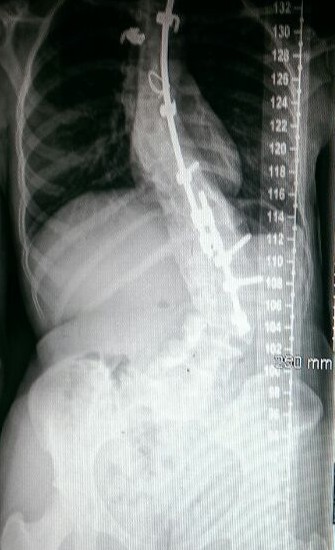
At only 21, Niamh O’Donoghue has already had three spinal operations and nine epidurals. She, is optimus spine. This image shows the change to her spine over the years. (Image courtesy of Niamh O’Donoghue)
Scoliosis is a disorder that affects less than two per cent of the world’s population. It causes the spinal cord to grow into an ‘S’ shape, rather than being straight. TheCity.ie’s Amy Grehan spoke to Niamh O’Donoghue about her experience with the condition.
“I still remember the night before it happened: It was a warm Friday night in September 2006 and I was out playing football. I had done nothing out of the ordinary. The next morning I was getting into the shower and I stood staring at my scrawny body. Something just wasn’t right. My hip was elevated so high that my two feet couldn’t touch the ground together, I had a hump on my back, and I was completely lop-sided. In less than eight hours, my spine had gone from the normal curvature of less than 20 degrees to almost 80 degrees.
“I was brought to Temple Street where even the doctors were baffled at how fast my spine had twisted around my body. My curve was so severe that surgery was the only option. I had no idea what was ahead of me. What killed me was that I could no longer take part in the things I loved – horse riding, dancing, and football. I had to give it all up.
“Then the pain started to set in. I was in first year in an all-girls secondary school, and I didn’t want any unwanted attention. I had to use a bag on wheels to take the pressure off of my lungs (which I got horrendously bullied for), and I had to constantly carry cushions around with me.”
Niamh on the morning of her first operation (Image courtesy of Niamh O’Donoghue)
My first surgery was due for April 11, 2007 in Cappagh Hospital. It was pretty routine surgery: I would have two titanium rods screwed into place on each side of my spine, which would straighten and support it. The rods would eventually fuse and act as one giant bone. Unfortunately the surgery went horribly wrong.
“The surgeons performed an ‘awake test’ during the surgery where they subconsciously wake you up to check that you can still move your arms and legs. I could not. When the second rod was being screwed in, a major nerve was cut that controlled my motor censors. Miraculously, when the second rod was taken out I was able to move my legs again, but now I was left with one limp rod to support my spine that was being dragged sideways by gravity. On top of that, I had lost every ounce of blood and had to have several blood transfusions after bleeding out profusely. My parents and family were told to make ‘the call’ – something I only learned last year. Cappagh hospital didn’t have the facilities at the time to deal with my huge blood loss, so mid surgery the decision was made to transfer me to Temple Street where specialists were waiting for me.
“Even though I was unconscious, I still remember hearing the sirens of the ambulance. The feeling of waking up was so surreal. My mam was beside me holding my hand telling me where I was. What was a routine operation turned into an 11 hour nightmare. I had three tubes in my mouth and I was hooked up to a ventilator. There were wires and drains and bags of clear fluid everywhere. My tiny hands were covered in sticky tape to keep all six needles in place, and I had to turn my neck a certain way to avoid the large needle that was sewn into an artery. Then there was the sickness. There is nothing worse than violently heaving with a massive fresh wound down your back.
“But this was only the start of my journey. They don’t tell you about the aftermath of the operation, they just tell you that they will make you better. I had to learn how to walk again, how to sit, climb stairs- you name it. On top of it all I had to wear a Plaster-Paris cast that went around my torso for eight months. If ever I thought there was a hell I was living it then! The itch alone drove me crazy. I was totally dependent on other people, not to mention that I had to adjust to not being able to bend again. Recovery time was long but I looked forward to being a ‘normal’ teenager.
“So life went on and a year later I was back enjoying life. However there was the constant threat that my spine would buckle under the pressure without the second rod; and then it did. It was the summer of 2010, I was on our trampoline when suddenly I heard an almighty crunching sound. I just got up and shook it off though. It wasn’t until that September when I was standing in my school uniform that my mam noticed my shoulders starting to tilt again. An x-ray confirmed my fears that the rod had snapped in half and revision surgery would be needed. So I was booked in again for April 2011. The thought of going through the whole process again put me through hell. You don’t just wake up and go in for surgery, there is months of planning ahead. You have to donate blood in case of emergency, you have to get your body ready to be cut open and tampered with, you have to take supplements; the list is endless.
Again I learned how to walk, how to dress myself, how to wash myself; and again I was totally dependent on others around me. I missed out on a lot of teenager stuff like going out and going to parties– and that’s stuff that I will never get back.
Niamh’s spine after her second surgery (Image courtesy of Niamh O’Donoghue)
“After my second surgery I really struggled with pain and required heavy pain medication, as well as getting spinal epidurals every few months. So far I have had nine epidurals, and they are excruciatingly painful; but it was worth it if it meant I was out of pain for a few weeks. These epidurals were not a long-term solution however, and have decreased my chances of conceiving later in life.
“At 20, it was no longer up to my parents to make surgical decisions for me. I was struggling with daily tasks and was also developing other problems such as high blood pressure, on-going kidney problems, and sensitivity to pain killers. For me, epidurals were just not enough and I needed a more solid long-term solution. Scoliosis was affecting my social life dramatically, I was falling behind with college work, there were days when I couldn’t get out of the bed, and then in December 2013 I was forced to leave my job. This was a major turning point me for; I didn’t want to continue living in constant pain so I arranged a meeting with two surgeons.
“They seemed confident that their plan would work; but there was a catch. I would lose any bit of flexibility that I had left and would only be able to bend using my knees; but they assured me that this would be my third and final operation, their confidence reassured both myself and my parents. So I was scheduled in for surgery on March 11, 2014; eight years after my first nightmarish surgery. Their plan this time was to totally fuse my spine from the top, right down into my pelvis; this would mean that my spine would become one giant mass of bone that would hopefully hold in place for the rest of my life. I was horribly frightened because of the huge risk of paralysis – I wasn’t ready to be wheelchair bound for the rest of my life.
“The morning of surgery came. Saying goodbye to your loved ones and being wheeled into a room to be put asleep is a sinister feeling and one that I will never forget. I have grown such a strong bond with the nursing staff at Cappagh that they too shed a few tears for me; they know how much I’ve been through. Surgery started at 8am and I was awake and groggy by 5:30pm that evening. Morphine does strange things to the brain; you hallucinate and see things which can be a bit frightening. I was unbelievably stiff and swollen. A few days later a young doctor got talking to me, he was so excited about me having so much metal inside my body. He wheeled me over to a big monitor to show me my latest x-ray; the colour ran from my face. I couldn’t actually believe that this was MY body. It looked like something from a horror film.
An x-ray of Niamh’s spine after her 3rd operation compared to an x-ray of her spine after her 2nd operation. This time, her spine was fused to her pelvis. (Image courtesy of Niamh O’Donoghue)
“Recovery is hard this time, and I’ll continue to be in recovery until next year. I am required to put on weight in order to stop the large screws at the bottom of my back protruding through my skin. Daily tasks have become chores and I have had to totally adapt my life.
You take the little things for granted in life; like being able to bend down and tie your shoes, or get into the bath or just be able to throw on a pair of heels and go out. It’s really not a great situation to be in, but there are people who are far worse-off than I will ever be.
“I still am in a great amount of pain some days but I know it will get easier. Hopefully this is the end of a long road for me. I’m enjoying the time off however and I have a lot of time to focus on my passion – writing. I now work alongside Scoliosis Ireland to help and counsel other families who are going through what I went through. I had nobody to talk to during my surgeries and there was no counselling available for me or my parents.”
Niamh learning how to walk again after her 3rd and final operation at Cappagh hospital. (Image courtesy of Niamh O’Donoghue)
“I am currently fighting to get a medical card and register myself as a disabled person so I can become an independent adult, and eventually return to work. I do struggle with my appearance quite a lot now and I’m quite conscious of my new body shape, my scar, and my lack of ‘curves in the right places’. But my body has gone through enough and so I have to learn to love and respect it.”
You can follow Niamh’s recovery on her blog here or find her on Twitter and Instagram @CulturedCuppa.
“My body has gone through enough and so I have to learn to love and respect it” – Niamh is now getting on with her life and is a 3rd year journalism student in DIT. (Image courtesy of Niamh O’Donoghue)


You must be logged in to post a comment.