“Why would you bother learning that? Sure, it’s a dead language” – the words many Irish speakers have heard while growing up.
However, in 2024, that could not be further from the truth.
Today, TheCity.ie speaks with Mícheál Ó Nualláin, director of Baile Átha Cliath le Gaeilge and Ola Majekodunmi, Irish language programme co-ordinator with Fighting Words, about all things Irish, and in particular, their own journeys with the language.
From schooling to job opportunities, to what they believe the Government needs to do to further progress the language, the Gaelgóirí tells all.
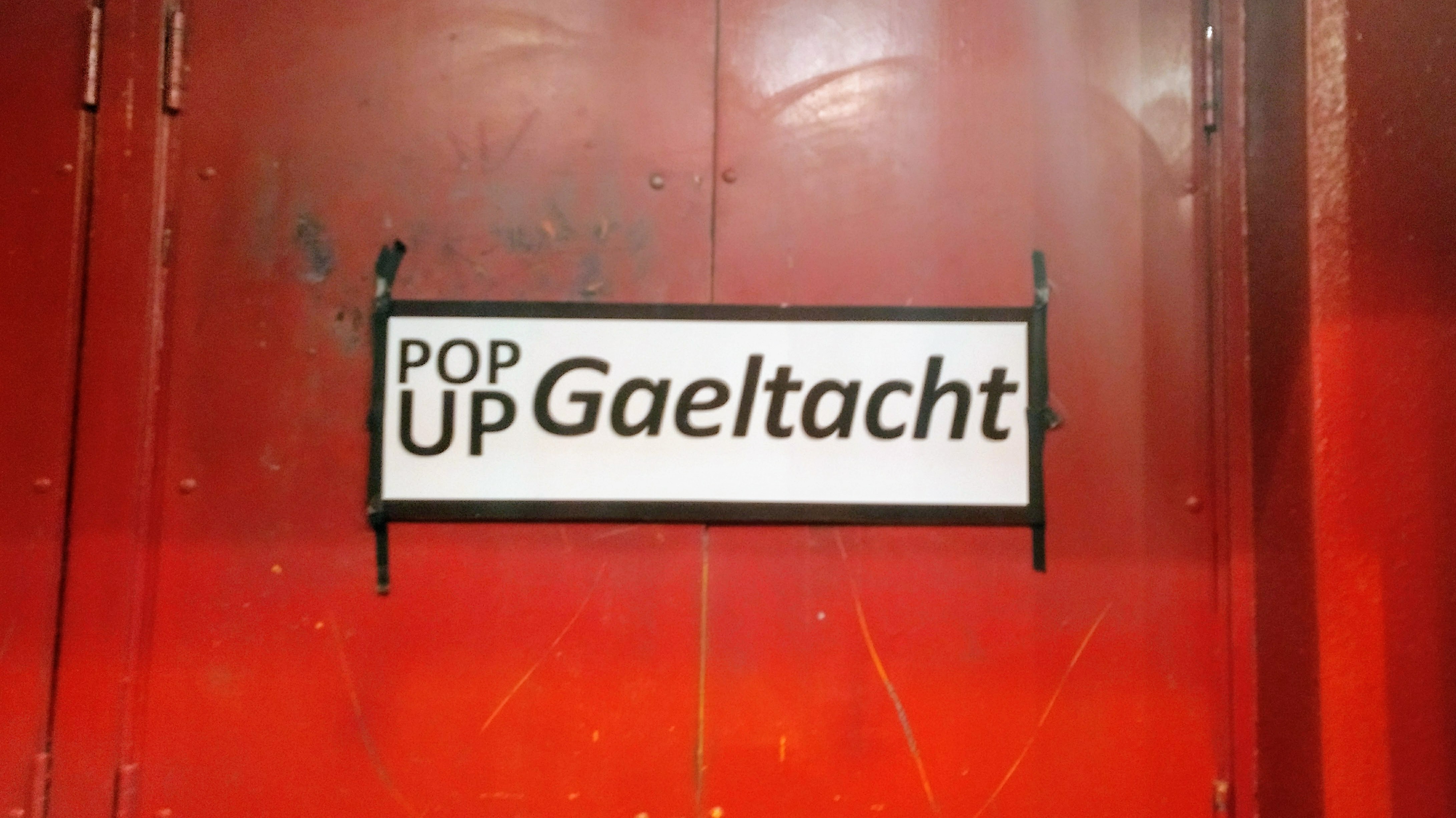
Tá an Pop Up Gaeltacht ag dul ó neart go neart, sé bhliana ónár thosaigh sé.
Six years on from its first event in Bar Rua on Clarendon Street, the Pop Up Gaeltacht is still bringing people together to speak their ‘cúpla focail’.
On the last Thursday of every month, the Pop Up Gaeltacht occurs in a different bar in Dublin. This month, Gaelgeoirí from as far as Kerry, Galway, Donegal and Belfast travelled to the Foggy Dew in Temple Bar.
Loretta Ní Ghabháin got the train from Galway to Dublin at 7:30 on Thursday morning. Ní Ghabháin speaks Irish daily, either at home with her twin daughters while reading them bedtime stories, with her friends in WhatsApp groups or at her work office. Ní Ghabháin said that speaking Irish is important to her because it is a big part of our identity and culture as a country. She said: “We can understand ourselves better as Irish people when we understand our language.”
Robert Brennan is a primary school teacher from Dundalk, he attended his first Pop Up Gaeltacht last July and it has become the place for him and his friend from home to meet once a month. “It is a great opportunity to meet and speak Irish. I’m very proud to be Irish and I know that the Irish language is an important part of our culture,” he said.
New York, Hollywood and Brussels are just a few of the other well-known cities the Pop Up Gaeltacht has taken place. It has become an international success. Conor MaCaba from the United States was accompanied by his Italian friend Maria whom he is currently teaching Irish. Although last night was their first time at the Pop-Up Gaeltacht, MaCaba started learning Irish in college and he’s still studying it now.
“The Irish language is a significant part of Irish culture. I grew up in the States but most of my family is Irish. The laboratory I work in is bilingual so we speak Irish and English together each week,” he said.
Hugh Cerr first heard about the Pop Up Gaeltacht when its organisers, Osgur Ó Ciardha & Peadar Ó Caomhánaigh spoke to his college class about it in 2016. He says it’s been an integral part of his life in Dublin ever since. Cerr has been attending the Pop Up Gaeltacht since its very beginning. Cerr explained in his lovely Donegal accent, “Without Irish, I wouldn’t have my career, my friends or my passion for stand-up comedy. It is without a doubt, the most important part of my life.”
All standards of Irish are welcome and at October’s Pop Up Ghaeltacht, comedian Michael Fry was there filming with his latest show ‘Creidim Ionat’ with RTÉ. In this show, three Irish celebrities including Marty Morrissey and Merissa Carter are supported by Irish speaking mentors in their journey toward regaining their confidence in speaking Irish.
The ‘Creidim Ionat’ campaign will run until the 11th of November 2022. If you would like to learn more Irish or support someone else to reach an Irish language goal, set a target by the end of the campaign.
You can find the time and place for the next Pop Up Gaeltacht on their Facebook page.
Daithi Ó’Cinnéide on camera and in his element. Image courtesy of Daithi Ó’Cinnéide
The year 2020 has provided highs and lows for the Irish film industry, and 2021 is already calling into question the future of our domestic productions.
This time last year it seemed Ireland was reaching new heights in the domestic film and television industries. Ridley Scott had begun shooting his next blockbuster with Matt Damon – who was spotted ‘slumming it’ in Dalkey – and Normal People was hitting screens worldwide, with Paul Mescal engrossing audiences in O’Neill’s shorts.
Like everything else, the Irish entertainment industry came to a crashing halt in March when Covid-19 struck.
The production hiatus, which at the time of the first lockdown was indefinite, meant that up to 12,000 jobs in Ireland were put on hold and some were gone for good.
Grip assistant Michael Nardone was hit hard by this hiatus.
“Everything seemed to be going great, I was hopping from project to project, then like most people I’m sitting at home wondering what to do,” said Nardone.
“Everything seemed to be going great, I was hopping from project to project, then like most people I’m sitting at home wondering what to do”
Micheal Nardone
Nardone has worked as a part of the crew in television series like Vikings, Dublin Murders, and Normal People. He had just begun exploring a new avenue, working with some fellow crew members on their own short film, when suddenly everything changed.
“It was all out the window really, and without the backing that the big productions have, it seemed like it might never happen.”
Nardone packed his bags for New Zealand.
“I had been thinking about going for a long time, but I always had a reason to stay [in Ireland].”
Productions had also been halted in Auckland, which gave him the time and opportunity to apply for work on bigger projects: “All the big productions were miles behind schedule, they were ramping up everything, preparing for reopening.”
He is currently working on a new series for Amazon and has a full schedule right up to 2022.
“It’s mad hearing stories from back home, it feels like the whole pandemic has come and gone here.”
One project, Paperboy, an independent feature film set in Belfast during the Troubles, was to begin filming in September.
The project had attracted stars Bridget Moynahan (I Robot) and Colm Meaney (Law Abiding Citizen, The Snapper), with Donald Petrie (Mystic Pizza) attached to direct.
Producer Kevin Murphy had spent the best part of two years trying to get the film made.
Unfortunately, the lockdown proved too strenuous an obstacle and the project has since ceased indefinitely.
“We are not doing much at the moment,” Murphy said in relation to production.
An uncertain future has proved detrimental to independent filmmaking in Ireland. Filmmaker’s reliance on procuring funding from multiple sources is unstable in a time when producers and companies are keen to watch their expenditure.
This is something that organizations like Screen Ireland and Screen Producers Ireland were aware of from the beginning.
Screen Ireland acted quickly, first in making sure professionals were still getting paid – repurposing funding to support writers, producers and directors.
Screen Ireland and The Department of Culture, Heritage and the Gaeltacht have implemented funding initiatives to cope with the expanding crews and assisting in the hiring of “Covid Departments” working on set.
The Covid Department monitors the sets to make sure people comply with rules like wearing masks and social distancing.
“It’s mad hearing stories from back home, it feels like the whole pandemic has come and gone here”
Nardone
This has helped to keep bigger budget films operating in the country and it was these initiatives that allowed assistant director, Daithi Ó’Cinnéide to get back to work by late august and stay there until very recently.
“The film industry seems to follow the construction industry, if they stay open, we stay open.”
The diligence of these newly-proposed crews working in Covid departments has proven the real trick in allowing the productions to carry on while most other professions remain at home.
The introduction of these protocols has helped to keep the industry running as smoothly as possible. However, at the drop of a hat operations can be shut down.
“At the moment, I had work on another TV series coming up, 12 weeks work, but that seems to be pushed back until April, just with everything going on.”
While film crews on the other side of the world get back to full swing, the future of the Irish film industry is called into question again. It may be awhile before independent Irish films grace our screens again, but the work of the governing bodies and industry professionals may provide a light at the end of the tunnel.
Dublin’s contemporary nightlife has seen an invasion of techno, hip-hop, and clubbing, filling the vacuum where traditional music and drinking culture used to be.
That being said, I am not against new music in Ireland in any sense. New music is part of a healthy culture. What I am doing is posing the question of what has been lost? There is no doubt about what is to be gained: class beats and blackouts. But to look to the future without consulting the past is foolish.
Not so long ago I witnessed the Fleadh in Drogheda, the biggest music festival in Ireland by quite a margin. The Fleadh last year drew 500,000 people … 450,000 more than Electric Picnic.
Half a million people spending seven days listening to traditional Irish music, playing traditional Irish music, and generally enjoying themselves, and none of my peers in Dublin even know what the Fleadh is.
From my experience, no one my age knows what the Fleadh is let alone about wider traditional Irish culture. I include myself in this as I did not know what the Fleadh was before attending the last one in Drogheda.
A group of young musicians that sing traditional Irish ballads called the Mary Wallopers had this to say: “Now being this age singing traditional ballads we may be pretty much alone. We only really know of a few other groups singing those old Irish ballads, like The Deadlians and a few others. Even at that they’re older than us.
“There is a big community of young people in the trad scene, from what we have seen. Now we wouldn’t be so involved in the trad scene as we are in the folk scene, which to be honest probably makes most people think of people singing softly about real sensitive stuff. Our folk music is music builders can listen to. It’s more for working class people whereas folk music has been transformed into a load of songs that don’t tackle everyday stuff like working in shite jobs, or being unemployed,” they added.
In other parts of the country, traditional music and drinking culture is much more common. The Mary Wallopers said: “If you go to the west of Ireland and start singing ballads in a pub nearly everyone has one song they can sing. In the east we don’t see that as much, unless you’re with people over the age of at least 30. Pub culture may be dying out among people our age, most pubs you can find are just blaring 80s and 90s music all over and you’ve to shout to have a conversation so you just end up standing in the smoking area roaring at each other and getting pissed.”
I have found this type of thing common on nights out. Getting drunk can be the main order of business and any sort of culture is the context in which you do it in. Maybe the primary mission hasn’t changed but the context has.
In a move towards a more globalised world, this makes sense. Less local culture and national culture in exchange for a more global culture. But what is to be gained by taking part in the global culture and what is to be lost by disengaging from our own culture?
Dublin’s young people are increasingly liberal with often socialist political opinions. Part of this movement is changing Irish society and rethinking our past. The last couple of referendums are an example of this.
However, acknowledging our past and moving away from former societal views does not mean leaving behind our music and culture too, which often times has been the voice of progress.
The Mary Wallopers said it best: “In response to a new more modern Ireland these ballads have more of a place than a lot of other things. The people singing these songs in the 50s and onwards were usually anarchists, communists, or socialists, overall being very left wing.
“These are anti war songs, and anti-government songs, even today being painfully relevant. In Toales bar in Dundalk where we hold our Wednesday session every week, they had an anti-amendment gig about the 8th amendment on the 21st of April in 1983 with a host of these acts playing.
“There’s an execution ballad written in the 1780s called The Night Before Larry Was Stretched which has bits that criticises the church. The only way forward is to write more ballads from more viewpoints. Mick Dunne is making up ever relevant songs about topics from Star Wars to Donald Trump.”
Recent figures released by the Central Statistics Office (CSO) in November this year show that the number of people speaking Irish is declining.
Information gathered during the 2016 census revealed that as of April 2016, 1,761,420 people (39.8% of the population), aged 3 and over, said that they could speak Irish.
Out of the total amount of Irish speakers recorded, 968,777 were female and 792,643 were men. Compared to 2011, there has been a drop of 0.7% (-13,017 people).
However, of the 39.8% of people who stated they are able to speak in Irish, one in four (23.8%) of them admitted to never using it, while a further 558,608 (31.7%) expressed that they haven’t used in daily conversation or for any other reason, since leaving school.
Of the percentages of people able to speak Irish, the highest numbers were recorded in Galway County at 49%. Clare closely followed with 45.9%, with Corky County (44.9%) and Mayo (43.9%) shortly behind.
The lowest percentages were found in Dublin City at 29.2%, followed by Louth and South Dublin, both at 34.1% and Cavan at 34.6%.
The number of those who say they speak Irish less often than weekly stood at 586,535 people (33.3%) compared to the lesser percent of people who attest to speaking the language on a weekly basis, (6.3%) or 111,473 people.
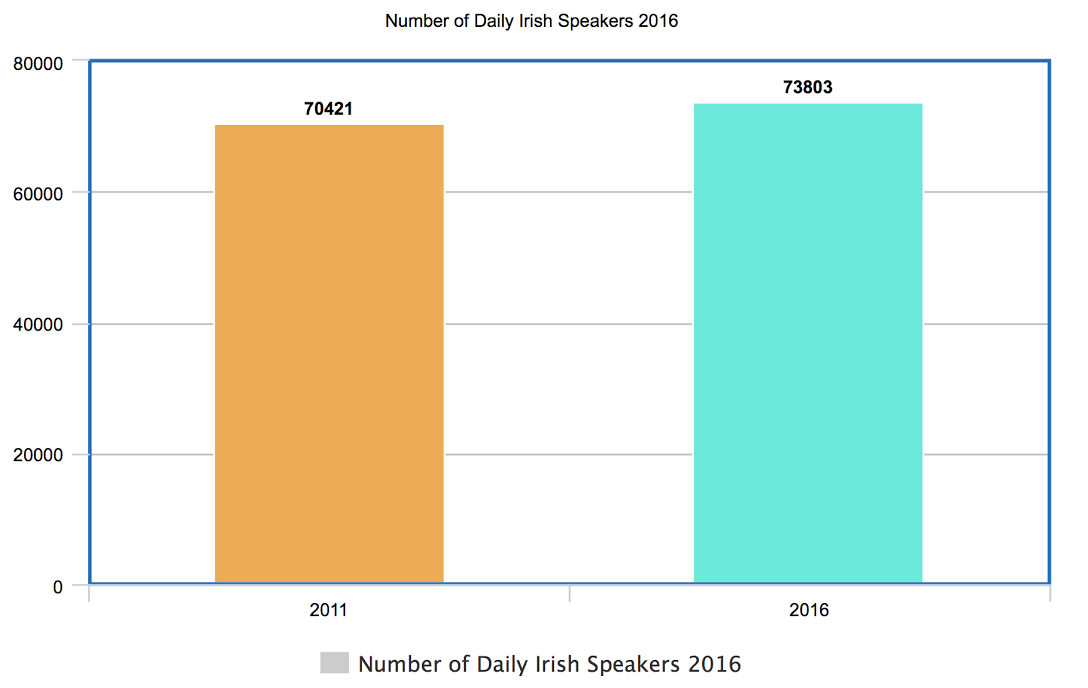
While the number of daily Irish speakers stood at 73,803, representing 1.7% of the population. This was a decline of 3,382 (4.4%) on 2011.
20.2% of the total 73,803 lived in Dublin City and suburbs. This was an increase of 674 people (4.7%) since 2011. Cork, Galway and Limerick together accounted for 6,034 daily Irish speakers (8.2%).
Outside of these cities, the largest absolute numbers of daily speakers were living in An Bun Beag-Doirí Beaga (771), followed by Letterkenny (525) and Swords (487).
Daily Irish speakers in the Gaeltacht areas of Galway County and Donegal made up almost three quarters of all daily Irish speakers in Gaeltacht areas, with 9,445 (45.9%) in Galway and 5,929 (28.8%) in Donegal.
As we come towards the end of 2017, data about trends throughout the year will begin to emerge. With this is mind we took a look at the most popular baby names in 2016, and what we expect to feature at the top this year.
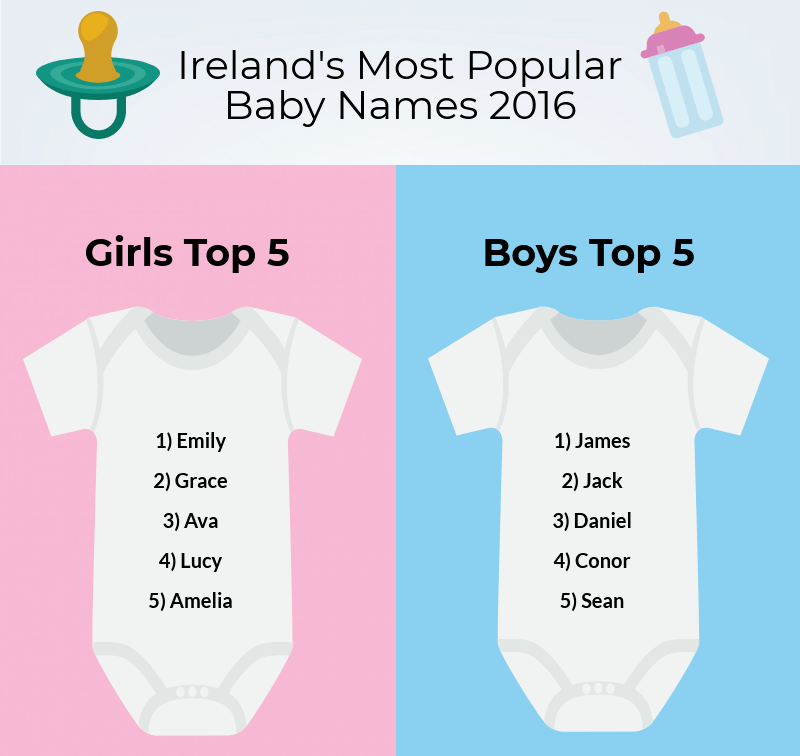
In 2016, James and Emily were the most popular names. James had been the second most popular boys name for the last five years but jumped up to first place in 2016. Emily has been the most popular girls name for the last six consecutive years.
Following James, the top 5 boys’ names were Jack, Daniel, Conor and Sean. The most popularity growth has been seen with the names Louis, Lucas, Josh and Ollie. Muhammad (ranked 83), Jason (ranked 98) and Zach (ranked 97) all entered the top 100 charts after being ranked 119, 113 and 103 in 2015.
Following Emily, the top girls’ names were Grace, Ana, Lucy while Amelia and Sophie were joint fifth.
Speaking about these trends, statistician with the CSO Marie Crowley said: “I’m not surprised that James has ranked first place for 2016, as it was always in the top five since 1988 onwards, and consistently ranked second place from 2011 to 2015.
“Emily has been the most popular girls name for six years in a row now, so I’m not surprised that it came out on top again for 2016.
“It’s difficult to predict what names might be the most popular for 2017, but looking back at the most popular names over the years, they generally feature in the top five most popular names the previous years. So, it is likely that James and Emily will come out somewhere in the top five for 2017.”
In Dublin City, Emily and James were the most popular names. While in South Dublin Emily and Jack were the most popular and in Fingal, Emily and Daniel were most popular.
As Seachtain na Gaeilge draws to a close for another year, Sarah Harford pays a visit to Dublin’s Pop Up Gaeltacht.
A cold March evening in Dublin. The streets are bustling. It’s the night before St Patrick’s Day, and the city is filled with revellers wearing green leprechaun hats and shamrock-adorned clothing.
Turning the corner onto Dame Lane, I hear laughter and exclamations of “conas atá” and “oh mo dhia”. The well-known stretch of pubs between the Bankers and Dame Tavern is packed full of people doing something slightly out of the ordinary – speaking in Irish.
‘Bat signal’
“We wanted to prove that the language was alive and well so we decided to send up a ‘Bat Signal’ to ask Irish speakers to get together in one place,” said Peadar Ó Caomhánaigh – one of the organisers of Pop Up Gaeltacht.
“Bhíomar ag iarraidh cruthú gur teanga bheo í an Ghaeilge, agus mar sin bheartaíomar sórt ‘Bat Signal’ a chur in airde chun lucht labhartha na teanga a mhealladh le teacht le chéile.”
Ó Caomhánaigh, along with Osgur Ó Ciardha, put this event together as a reaction to the current perception of the Irish language.
“Both of us noticed a lot of negative coverage of the Irish language in the media late last year, saying it was a dead, worthless language, and that no one in the city was speaking Irish,” says Peadar.
A group playing traditional Irish music entertained crowds outside the Mercantile pub. Video by Sarah Harford
Speaking to The City, as Gaeilge of course (his answers have been translated into English), he explained that the idea behind this event was very simple.
“Pop Up Gaeltacht is a social event for Irish speakers. We get together just to be together, and to speak Irish in places the language wouldn’t normally be heard.”
“All sorts of people go along. Young and old, fluent and the ‘cúpla focal’. We’d recommend, if you have any worries about your own level of Irish, to bring along a friend and just try to use whatever Irish you have.”
“Bíonn gach chineál duine ann, idir óg agus aosta, idir lucht na líofachta agus dream an chúpla focal.”
Pop Up Gaeltacht started small, with an event in Bar Rua on Clarendon Street back in November 2016. Since then they’ve held monthly gatherings which have grown in size as the word has spread. But for Seachtain na Gaeilge, Peadar and Osgur decided to be more ambitious.
“Up until now we’ve packed out bar after bar in Dublin. As part of Seachtain na Gaeilge and the St Patrick’s Festival, we decided to choose a whole district of the city. We want to fill the whole of Dame Lane with Irish on the night of the 16th,” said Peadar.
“Talk, kiss, laugh, travel, dance, fly, eat, drink, listen”, sign outside Bar Rua, Dublin. Photo by Sarah Harford
Caint agus craic
Personally, I was a little nervous entering this guerilla-style Gaeltacht. Although I’d spent 14 years learning the language at school, like most other people on this island, my Irish is a little rusty.
I thought that everyone in attendance would be hardcore Gaeilgóirs, spouting words and phrases that sounded only vaguely familiar to me. But, just like riding a bicycle, these things return to you pretty quickly.
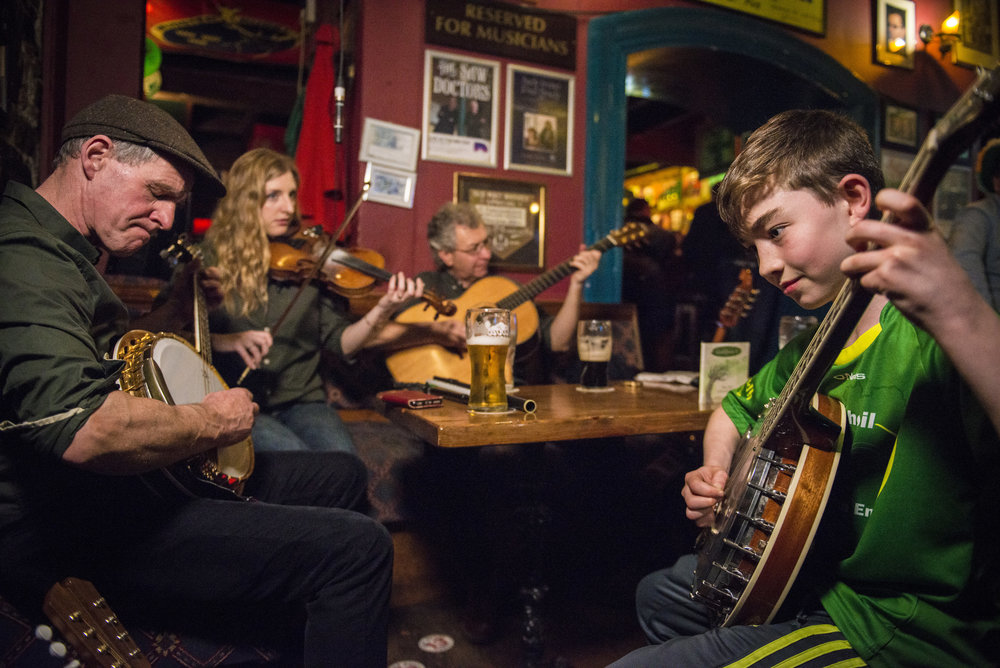
The atmosphere was welcoming, the Irish was flowing, and there was even spontaneous traditional music and céilí dancing.
From the crowds of people I encountered there, it is clear that Pop Up Gaeltacht has really caught on. It may be a simple concept, but it’s an effective way of bringing people together to speak the language in a casual setting. Mostly, however, it’s just a good bit of craic.
Crowds gather outside the Stag’s Head, Dame Lane. Image by Sarah Harford
The organisers are making no money from the event, using it only as a way to spread the Irish language. They hope that this will encourage more people to get involved.
“Pop Up Gaeltacht is an open source, so anyone in the world can organise one. There have been Pop Up Gaeltachtaí in Cork, Derry, Belfast, Limerick, New York, Washington DC, Perth…The list goes on,” said Peadar.
It seems strange that Pop Up Gaeltacht should be such a novelty when Irish is still the official language of the country.
According to the 2011 census, 1.77 million people in Ireland, approximately 40% of the population, said that they could speak Irish. However, only 82,000 people claimed to speak the language on a daily basis outside of the education system.
This makes it only the third most spoken language in the country after English and Polish, but it certainly does not imply that Irish is in decline. Long-term census data shows an increase in the number of people speaking the language in recent years.
St Patrick’s weekend saw a deluge of tourists descending on Dublin and so the city was awash with languages from all over the world, plus the ubiquitous American accents. However, it was great to hear Irish also being spoken so widely in the middle of the festivities.
With an impressive turnout and an enthusiastic response, Pop Up Gaeltacht seems to have confirmed that the Irish language is still alive and well.
Crowds in their hundreds turned up to the 3arena on Friday afternoon for the eagerly anticipated return of the UFC to Dublin, which features a predominantly Irish card.
In the week leading up to the Fight Night, UFC fans were left disappointed by the lack of quality fights after Joseph Duffy’s main event fight with Dustin Poirier was scrapped on medical grounds, after Duffy suffered a concussion in training.
This was the second main event fight to be postponed after Ben Rothwell’s heavyweight clash with Stipe Miocic was also pulled.
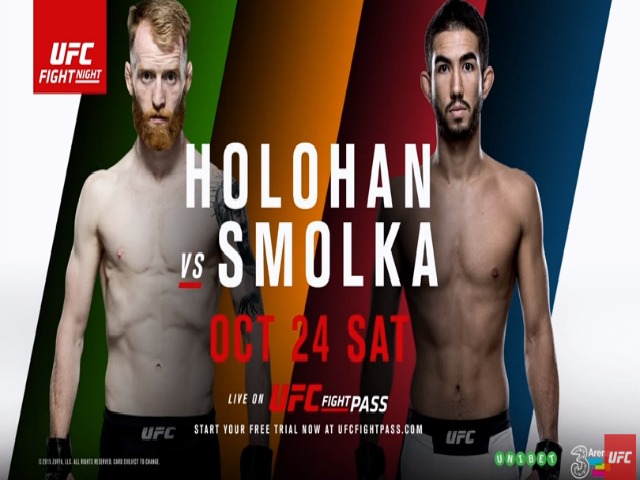
This resulted in SBG’s Paddy Holohan getting the nod to headline the night, in what looks to be a below par event. ‘The Hooligan’ faces one of his toughest challenges to date when he goes up against Hawaiian Louis Smolka.
Holohan said: “It’s a serious achievement and I’m very proud of myself and all the people who helped me get here. It’s a main event – there’s a lot up for grabs, so it will be tough. I’m looking forward to him getting that look of shock on his face when he experiences what I feel like.”
Elsewhere, Northern Irishman, Norman Parke will also feature on the main card against Frenchman Reza Madadi. There is no love lost between these two, who have been arguing on social media quite a lot recently.
The two fighters also almost came to blows at the weigh-in. UFC president Dana White had to separate the two after both fighters weighed in at 156lbs.
Another fight to watch out for is Cathal Pendred’s, as he looks to get back to winning ways against Tom Breese. The Dubliner is coming off the back of a tough loss in July and will be looking to put on a good performance in his hometown. These two also nearly came to blows at the weigh in, but once again Dana White played peacekeeper.
Ahead of the fight, the welterweight said: “I don’t think he’s anywhere near my level. He’s a young up and comer, he’s undefeated and he looks good on paper, so a win for me will look good on paper.”
Neil Seery also features on the card when he faces Jon Delos Reyes in the Flyweight division. Seery is coming off the back of a defeat to Louis Smolka (who faces Holohan in the main event) and will be aiming to get back to winning ways.
After a mixed run of fights, with two wins and two losses coming in his last four fights, Seery will be looking for the Irish crowd to help him secure victory.
Female fighter, Aisling Daly rounds off the night for the Irish contingent, as she faces Brazilian Ericka Almeida. The 27-year-old from Drimnagh is Ireland’s only female fighter in the UFC. However, she will find victory hard to come by here as Almeida has only been defeated once and is aiming to climb up the division rankings.
There are five other fights on the card, none of which have any meaning in terms of title challenges. UFC President Dana White has refused to respond to the criticism from fans regarding the lack of meaningful fights.
The event itself takes place tonight at the 3arena, and from an Irish perspective, it should be very interesting.








You must be logged in to post a comment.