
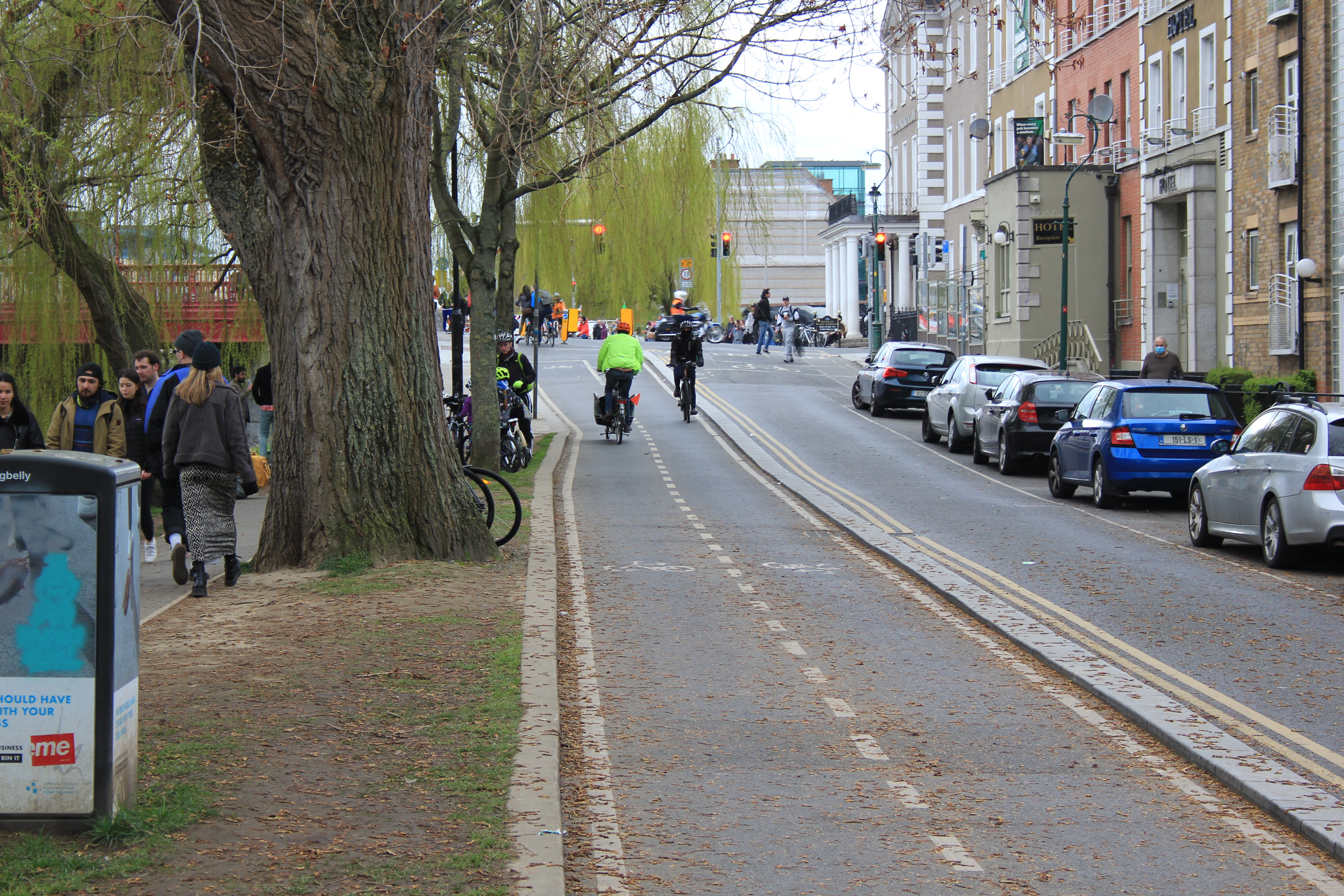

Dublin city centre sits still and quiet these days. Traffic is noticeably tamer, with less gridlock traffic at rush-hour. For cyclists, this means less jostling and narrow manoeuvring through buses and cars. A bit of breathing space.
Certainly there are fewer people cycling in to work too – as people shift to working from home. But the bike is still in-motion. For some it’s a mode of work – takeaway drivers and couriers are still zipping around. For others it’s a form of escapism: people getting out and about in the sunshine, others doing ‘wheelies’.


Some are opting for the bike in order to avoid public transport too. Indeed, this trend is not unique to the current health crisis – people were encouraged during the 1918 Spanish Flu to get peddling.
New Cycle Lanes
With the lack of footfall in the city centre since the first lockdown, space became time. There was time for Dublin City Council (DCC) to implement various new and distinctly designated cycle routes across the city.
“I don’t think anyone would say cycling has been well provided for on Dublin city streets”
Ali Grehan
Some of the new cycle lanes across the city include the implementation of the the Liffey Cycle Route along the North Quays, contraflow lanes on Nassau Street, and the more recent route up O’Connell Street Upper and North Frederick Street. All of these are provided with bollards and black and white ‘orcas’ to segregate cyclist traffic from cars, buses and trams.


“The new cycling lanes are still a work in progress,” says Ali Grehan, Dublin City Architect at DCC.
Grehan continues: “They are much needed. I don’t think anyone would say cycling has been well provided for on Dublin city streets, particularly heavily trafficked ones – so in that sense they are successful in that they’re making necessary improvements.”
While the quick thinking of DCC has been a positive for the city, it is not without its pitfalls. For instance, the Nassau Street contraflow lane suddenly stops at Dawson Street, forcing cyclists to merge with traffic suddenly – not to mention Luas tracks – at one’s peril, with any false move.
The implementation of cycle lanes is not exclusive to the city centre either. Griffith Avenue on Dublin’s Northside has seen a fully segregated lane being rolled out across parts of its 4km stretch from Glasnevin to Marino. In May 2020 the Phoenix Park closed off sections of its roads to cars for the summer months – creating more space for people to mill about on their bikes.
On the Continent
European cities have always been miles ahead of Dublin when it comes to cycling infrastructure. But, we are not alone in terms of cities that took the current opportunity to shift the emphasis to cycling – Paris being the most prominent.
It’s estimated that Paris’s cycling population grew by 65% in 2020 – significantly decreasing the CO2 emissions normally emitted from traffic. Paris authorities responded to this increase by constructing more cycle routes, and further expansion of its bike scheme.
“The problem is, while you can look at Copenhagen or Amsterdam – [which have] great cycling infrastructure – it’s difficult to transpose one city’s approach to another,” Grehan says.
“Dublin has its own particular physical and cultural context and any initiative has to understand and respect this. It’s a complex issue. An example is Dublinbikes. There was a general expectation among commentators that the system would be vandalised. People were surprised when there was virtually no vandalism and Dublinbikes became very successful, very quickly.”


The full extent of the success of Dublin’s cycle lanes remains inconclusive as the city remains less active than in normal times, Grehan concedes. But with smarter innovation and progressive steps made by campaign teams and authorities, a change to Dublin’s road culture is being paved.

You must be logged in to post a comment.