
Tag: science

  • Hope for thousands following major breakthrough in treatment for cruel disease  

    Hope for thousands following major breakthrough in treatment for cruel disease  

    By Edward Ryan 

    A team of researchers has successfully treated Huntington’s Disease for the first time.  

    The news has been described as “a game changer” by the Huntington’s Disease Association of Ireland.

    Huntington’s is a degenerative disease that kills nerve cells in the brain and has been described as a combination of dementia, motor neuron disease, and Parkinson’s.  

    It is a very rare condition that affects thousands of people worldwide.  

    But on September 24th, biomedical company uniQure announced that it had successfully treated Huntington’s in a major clinical trial.  

    Huntington’s explained

    Huntington’s is caused by a change in genes and is hereditary, passing from a parent to their children.  

    It is caused by a mutation in the HTT gene. This gene makes a protein called huntingin, which helps with the function of the nerves.  

    Huntington’s Disease restricts the DNA’s ability to produce huntingin, which causes the proteins to grow abnormally and destroy the nerves rather than help them.  

    This decay occurs in the area of the brain that affects movement and can also target the brain cortex, causing cognitive and behavioural issues.  

    Huntington’s is an inherited disease. If one of your parents has Huntington’s, then the likelihood of you developing the disease is around 50%.  

    Symptoms of the disease often begin to appear in people in their late thirties, with the average lifespan after first symptoms ranging from 10-30 years.  

    The treatment 

    The trial involved a gene therapy called AMT-130 which was administered to patients during brain surgery.  

    AMT-130 contained a virus carrying a micro-RNA that was designed to target the  huntingin gene. 

    It was administered as a one-off during complex brain surgery that lasted anywhere from 12 to 18 hours. 

    The results of the study were astounding.  

    It showed a 75% slowing of disease progression in patients who received a high dose of the treatment after 36 months.  

    The study also found that there were no new drug-related serious adverse effects observed between December 2022 and the end of June 2025.  

    This major breakthrough will bring relief to people who have the gene for Huntington’s and there is hope that early treatment may prevent the emergence of symptoms completely.  

    In a statement announcing the news on Wednesday, Walid Abi-Saab, M.D., the Chief Medical Officer at uniQure said, “We are incredibly excited to about these topline results and what they may represent for individuals and families affected by Huntington’s disease.

    “These findings reinforce our conviction that AMT-130 has the potential to fundamentally transform the treatment landscape for Huntington’s disease, while also providing important evidence supporting one-time, precision delivered gene therapies for the treatment of neurological disorders.”  

    “It’s a game changer” 

    Patricia Towey is the Service Manager with the Huntington’s Disease Association of Ireland . She was delighted with this announcement. 

    “It’s really exciting news for so many families that are really struggling with this devastating neurodegenerative disease, you know, so this news is very exciting.” 

    She added,It’s the first time that the course of the disease has stopped by up to 75% for the people that have been treated. It’s three years of data and, yeah, it’s really a game changer in so many ways.” 

    Who is uniQure? 

    uniQure is a gene therapy company with teams of researchers based across the Netherlands, the UK, and the US. 

    They have an extensive track record in gene therapy and developed the first approved human gene therapy in the western world. 

    They also have worked on treatments for Haemophilia B throughout the years. 

    The study on AMT-130 has taken many years, but there is still a ways to go before the treatment is available to the public. 

    uniQure is aiming to have the treatment available in the US some time in 2026, but costs for the treatment are expected to be very high. 

    Meanwhile, shares in uniQure jumped over 200% across various markets in the hours following the announcement. 
  • Bees, Trees and World Oxygen 

    Bees, Trees and World Oxygen 

    By Derek Price

    Planet Earth could be in serious danger of losing its main oxygen source.  

    With the Amazon rainforest continually being felled for its timber and cattle grazing at an alarming rate (since 1988, humans have destroyed an area of the rainforest roughly the size of the American State of Texas), what can Ireland do to try to offset and remedy this huge loss of oxygen- producing plants?  

    To say it is important for people to support the growth of trees, which support pollinating insects in Ireland and elsewhere, may seem like an understatement. Pollination, and having the right native trees and plants, which contribute to the ecosystem being in balance – is a vital part of nature.  

    If tree planting is knocked out of balance by human activity, it could have a devastating effect, resulting in the extinction of bats, bees, and other pollinating insects, and hence the plants that rely on them. Also, certainly, birds may be affected. This could have a domino effect, which could eventually lead to the extinction of the animal kingdom, which of course includes our own species, human beings. 

    It has been reported in the Irish Times by Ella McSweeney, that a third of all bee species in Ireland will be extinct by 2030.  

    Hanna Backmo, a beekeeper in Ireland, recently told Louise Walsh in the Irish Times, “It’s been a bad year for honey, but the native honeybees are real survivors. Two years ago, because of lack of rain, we had the worst summer in 30 years for honey production. Last year was excellent but, unfortunately, this year doesn’t look too good,” she said. 

    Orla Farrell is the project leader for the Easy Treesie organisation, whose objective is to plant and grow a million trees in Ireland by 2030. The City asked Orla her opinion on some important environmental issues currently happening in Ireland. 

    Orla Farrell, the Project Leader for the Easy Treesie. (courtesy of https://easytreesie.com)


    Do you think that Irish County Councils giving away thousands of Hawthorn, Mountain Ash and other trees natural to Ireland ahead of National Tree Week every year is a good idea? 

    Orla: “A super idea. Easy Treesie and Crann do this regularly. The members of the public are thrilled to get such a donation. We ask them only to take them if they have space and if they are going to plant them immediately. The Easy Treesie project is all about planting trees wherever we can find a corner or little spot, to put them. It is vital as a Climate Action.” 

    Do you think the public are made aware enough about the possible extinction of bees and other insect pollinators in the Irish media? 

    Orla: “Everyone my age remembers insects at the windows and on car windscreens in profusion in our youth. I was doing a tree-athalon in Sligo on Monday, discussing Yeats’ poem where ‘Moths like stars were flickering out’. Does that happen now? I don’t think so. On the day that Michael D. Higgins called for action on the extinction event that was happening during his address at the Biodiversity Conference in Dublin Castle, the report was only on page 6. The front page had the usual stories.” 

    I see you have a campaign to plant one million trees by 2030. I see this as a great objective, and I hope it is achieved. You are now halfway to that target. Do you think you will get that number planted by 2030? 

    Orla: “Yes. All we need is public land. This has been the only slow part of the project. Councils are not yet familiar with our project, so we are really happy Derek, that you are writing about our initiative. Once word gets out about how we are experiencing such success (500, 011 trees at present), we think they will find us space local to the children. We are also open to planting on a really mass scale where children have to travel to the site, though local is our preferred option where the children can easily watch the trees grow.”  

    At the end of the day, it may be preferable in the long run, for people around the world to choose to get active, and instead of preaching to the Brazilian and South American governments, plant their own trees, woods and forests, which would make a solid positive difference, to ensure planet Earth will continue to produce plenty of oxygen for many more years to come. 

  • Trinity spotlights AI innovations for European Researchers’ Night  

    Trinity spotlights AI innovations for European Researchers’ Night  

    By Ruben McCarthy 

    Start Talking About Research Today (START) landed into Trinity College, with artificial intelligence (AI) at the forefront of discussions and exhibits. 

    In celebration of European Researchers’ Night on September 29 — interactive demos and discussions highlighting the most recent developments in research opened to the public for one night only. 

    “It’s a really fast-moving area … It’s about keeping up to date with the cutting-edge research, but also always trying to keep the human-centred approach to it.” 

    Emma Clarke, Education and Public Engagement Officer at ADAPT

    The Science Foundation Ireland Research Centre for AI-Driven Digital Technology (ADAPT), showcased their own exhibition, ExploreAI, at the Douglas Hyde Gallery. 

    “ADAPT is a research centre that focuses primarily on artificial intelligence, with the real focus on human-centric AI. So, we look at the impact of AI on society, on people and on our lives in general,” says Emma Clarke, Education and Public Engagement Officer at ADAPT Centre. 

    Clarke adds, “It’s a really fast-moving area, especially now with generative AI, like ChatGPT. It’s about keeping up to date with the cutting-edge research area, but also always trying to keep the human-centred approach to it”. 

    Among the exhibits were: 

    Art or AI? 

    A mind-bending showcase challenging visitors to distinguish between artworks created by human hands and those crafted by AI algorithms. The aim was to show the blurred lines between human creativity and artificial intelligence and what the future of art may look like. 

    Art is mounted onto walls, with QR codes beside them for people to see if they guessed correctly on whether they are human-made or AI-generated. Image: Ruben McCarthy

    From virtual to reality … and back! 

    Attendees had the opportunity to step into an immersive world of virtual reality (VR). Wearing a VR visor, people could experience how it can play tricks on your body and mind into thinking you’re moving while still sitting in one position.  

    People testing out the virtual reality experience in the Douglas Hyde Gallery. Image: Ruben McCarthy

    AI Dilemma Café 

    The café provided the space for many discussions and for people to relax, grab a free coffee and reflect on how technology shapes interactions and daily life. 

    A crowd gathers in the AI Dilemma Café to listen to a talk about the development of translation technology for the Irish language. Image: Ruben McCarthy

    Attendees could also check out other exhibits in the main square of Trinity College, a short stroll away from the Douglas Hyde Gallery. Researchers from universities across Ireland had the opportunity to show the public what they were working on. 

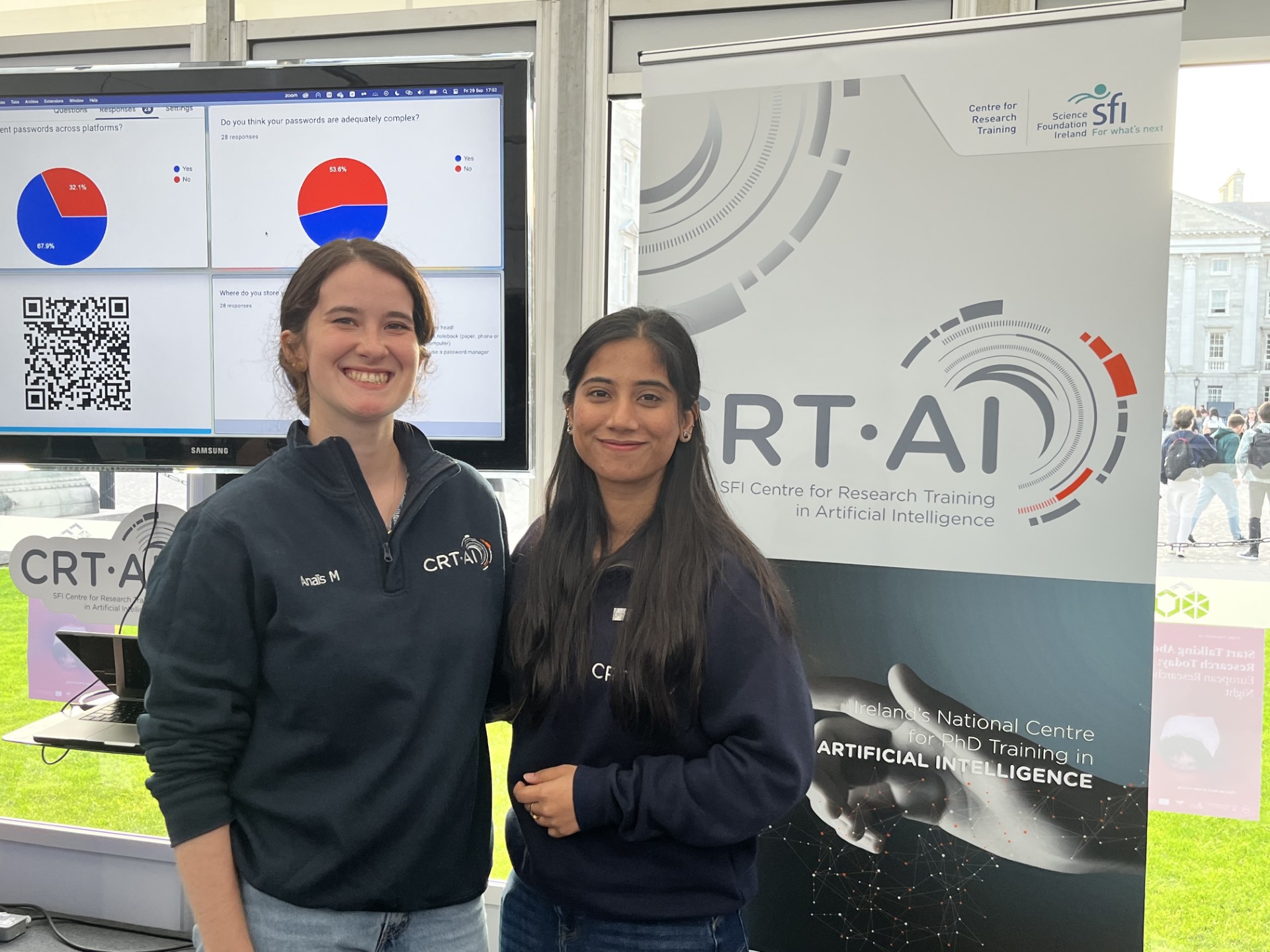
    “They are eager to learn, I think it’s our duty to show them, and this has been a really great platform to translate how our research impacts their daily lives,” says Akasha Shafiq, a first-year cybersecurity PhD student at University College Cork. 

    Shafiq and Murat interact with the public. Image: Ruben McCarthy

    Shafiq worked at the exhibit for CRT-AI, the Science Foundation Centre for Research Training in Artificial Intelligence, alongside another PhD student, Anaïs Murat. 

    Murat, a third-year PhD student at Trinity College, specialising in AI and human interactions said,

    “Doing research can be a bit of a lonely experience and very often we question what we are doing. When we see people’s responses and that they’re getting really involved and interested in it, it’s good for us.”

    “I think AI can be an amazing tool for lots of people, it might make technology a bit more human-centred and more accessible. But it still comes with a lot of challenges, like with ChatGPT and we are all trying to figure it out,” she added. 

    A video made by Linda Doyle, the provost and president at Trinity College Dublin, on X.
  • ‘Girls and women are missing out’ – Let’s talk about STEM

    ‘Girls and women are missing out’ – Let’s talk about STEM

    By Megan Gorman

    It’s no secret that a significant gender gap exists within both study and employment in science, technology, engineering and maths (STEM) sectors. In 2014, the proportion of male graduates in STEM areas in Ireland, was the highest in the EU while the proportion of female graduates in Ireland, at ten per 1,000 of the population aged 20-29, was the ninth lowest rate in the EU.

    Image Credit – Megan Gorman

    Thecity.ie spoke to Women In Technology and Science (WITS) to get a better understanding of the gender balance.

    “It’s hard to understand why we have this  gender gap. It seems to come down to culture and what we deem suitable for women and men. It is a problem for a number of reasons,” said Marion Palmer of WITS.

    “Girls and women are missing out on well paid jobs with interesting career opportunities. It is a fascinating area full of wonder and joy. Society is missing out because STEM is part of our everyday lives, part of our life and culture, and it really helps people.”

    Employment numbers can tend to differ from graduate numbers but in 2017, the STEM workforce saw a positive jump in numbers towards closing the gap.

    In a recent study completed by WISE, 61,430 more women were working in STEM areas. The number of men in STEM employment fell by 45,980 in the same period.

    Women make up 23% of those employed in core STEM occupations and there are nearly 12,000 more female engineers than in 2016 with women now making up 11% of the total sector. There are nearly 22,000 more women working as science and engineering technicians than in 2016 bringing the total up to 27%.

    Image Credit – Megan Gorman

    However, there are 7,000 fewer women working as science professionals than in 2016. This includes chemists, biochemists, biologists, physicists, geologists and meteorologists.

    “The issue for WITS is to encourage women who have chosen STEM courses to stay in STEM,” said Palmer. “That’s why we have free student affiliate membership for STEM students and run events for and with students and early career graduates.”

    “There were more women in ICT in 2004 than there is now,” Palmer continued. “The major issue is keeping women in STEM and ensuring that there are sufficient women in leadership roles such as professors in academia and senior management in business to change the environment and culture. Diversity is good for innovation.”

  • Women in Science: An imbalanced Industry

    Women in Science: An imbalanced Industry

    With new statistics revealing a lack of gender balance in science, Ellen Corrigan speaks to molecular biologist Juliana Cummins about the challenges she faces as a woman in science.

    Last week, Science Foundation Ireland (SFI) released figures on their gender redressing initiatives. Their figures highlighted that although gender discrimination against women in science has become less pronounced in the last century, inequality within the industry is still very real.

    The new figures state that 75 percent of all applications received by SFI for funding are from male researchers in Irish Higher Education Institutions. On average, successful female applicants receive smaller awards in comparison to male applicants. Female applicants also tend to request less funding.

    Historically, women in science were totally disregarded. Rosalind Franklin is a prime example of women being snubbed for their work and not receiving due credit. As an x-ray crystallographer, she was a key member of the race to uncover the structure of DNA in the 1950s. Through her practices, she achieved a phenomenal breakthrough and managed to secure a picture of DNA structure.

    While reports of how the structure was truly discovered vary depending on the source,  it’s commonly believed that she willingly gave the picture to two scientists – Watson and Crick.  The two men, who were also researching the same area, are now both household names for their work in molecular biology.

    Eventually, both scientists were awarded Nobel prizes while Franklin never received credit for her work. When her contributions were unveiled years later, she had died due to radiation exposure. Franklin is just one of many women throughout history who, despite key contributions to science, never received the recognition they deserved.

    Today, there are certainly more opportunities for women in science and technology. However, as SFI’s statistics illustrate, things still need to improve. Juliana Cummins is a molecular biology graduate from DIT, and is well aware of the challenges she faces within the industry.

    She explains: “I’ve always been interested in science, and it became a passion when I studied it in school. It felt like a natural progression for me to study it at third level, but it wasn’t until I started college that I realised I’d face a lot more difficulties than my male classmates once we graduated.

    “My course was a mixture of biology, chemistry and physics courses and the majority of students were female. Of the eighteen graduates in the final year of my course, only two of those were men. Evidently, there are plenty of women interested in science but fewer opportunities for us within the field.”

    It is a fact that there are less women than men occupied in STEM (science, technology, engineering and mathematics) jobs. According to the Central Statistics Office, there are roughly 117,800 people working in jobs that utilise STEM skills in Ireland. The proportion of women employed in these roles stand at less than 25%. While this is accepted as a given, it’s rarely asked why women hold fewer positions.

    Juliana explains: “In my opinion, gender roles play a major part in stalling or even ending a woman’s career in science. Essentially, women who take maternity leave after having children will come back into a job and be considered less qualified for a position than their male counterparts. This is because of the loss of several months or years in their field due to raising a family.

    “They may have received the exact same degree from the same university in the same year and work in the same company/academic field as a male colleague but taking leave to have children will render them ‘less qualified’ once they come back to work. Unfortunately, this means women then have to make a choice: be successful in their career or have a family.”

    Thankfully, circumstances for female scientists are improving in the western world. Availability of women-driven STEM programmes are becoming widespread and popular, such as DIT’s own WAVES society for women in engineering (Women – A Voice in Engineering Society).

    Current legislation allowing paternity leave in a lot of workplaces is a potential step in the right direction for gender equality in STEM fields. With men being offered the opportunity to stay home and take care of their children, there is now less pressure for women to choose family or a career.

    The SFI have also launched a grant management policy to accommodate female researches during periods of maternity and adoptive leave. Under this policy, researchers have the option to hire a temporary replacement to maintain consistency within their research programme.

    With such positive steps being taken to make the scientific field more inclusive for women, it’s hoped that the rate of female STEM workers will rise within the next decade and the industry will soon become completely gender balanced.

  • Tributes Pour in as Stephen Hawking Passes Away Aged 76

    Tributes Pour in as Stephen Hawking Passes Away Aged 76

    Science’s mercurial maverick has finally passed away after a 50+ year battle with ALS, writes Dylan O’Neill

    (more…)

  • Adverse reactions to HPV vaccine decrease

    Adverse reactions to HPV vaccine decrease

    The number of reported adverse reactions to the Human Papilloma Virus (HPV) vaccine looks like it will fall substantially in 2017, according to figures released by the Health Products Regulatory Authority (HPRA).

    In information released under the FOI Act, HPRA records show that forty reports of adverse reactions to the vaccine were reported from January to September 2017. So far this year, the number of reports have fallen by 68% when compared to last year.

    In 2016, 125 adverse reactions to the vaccine were reported, up from 110 reports in 2015.

    Picture1

    Source: HPRA

    The most common HPV vaccine is Gardasil.  This vaccine has been administered to girls in first year of secondary schools since September 2009.  The vaccine was also issued to sixth year students on a catch-up programme.  

    Students receive two or three doses of the vaccination.

    The vaccination is said to prevent pre-cancerous growths in the female genitalia and cervical and anal cancers.  It also protects from some sexually transmitted infections.  

    Since the introduction of the vaccine in Irish schools, there have been some reports that Irish teenagers have reported serious adverse effects to the HPV vaccine.

    These include daily headaches, chronic fatigue, memory and concentration issues, early onset of menopause and neurological issues, according to an online group who claim they or their children suffered negative reactions to the vaccine.

    There is not, however, any medical evidence that the adverse reactions reported online is directly linked to the HPV vaccination.

    However, in further documentation received under the FOI Act, the Health Service Executive (HSE) do not list any of the above complaints as an adverse reaction to the vaccine in the information provided in the package leaflet.

    The HSE say that difficulty breathing (bronchospasm), has very rarely been reported (less than 1 in 10,000 patients).  More rarely (less than 1 in every 500,000 to one million patients), anaphylaxis was seen in patients. This is when the immune system overreacts to the presence of a foreign body.

    The package leaflet says that other side effects could be experienced following the administration of the HPV vaccination. However, these are not unique to the Gardasil injection and could be experienced following the administration of any vaccination. These include muscle weakness, abnormal sensations, confusion, dizziness, vomiting, aching muscles or unusual tiredness or weakness.

    Figure released by the HSE in August 2017 showed that uptake for the vaccine had fallen by 15% in the last two years.  

    A total of 22,721 first year students received both doses of the HPV vaccine in the 2015/2016 academic year.  The previous year, 26,799 girls received both vaccines.

    Minister for Health Simon Harris has expressed concern over the falling numbers of girls receiving the vaccine.  Addressing the Seanad recently, he emphasised that the HPV vaccination saves lives in countries with high uptake of the vaccination.

    Cervical cancer is the second most common cause of death due to cancer in women aged 25 to 39 years. Around 300 women are diagnosed with cervical cancer in Ireland every year, with an average of 90 people dying from the disease.

    By Louise Burne & Gavin Hyland

  • Which New York City Subway MetroCard to Buy?

    Which New York City Subway MetroCard to Buy?

    Lorem ipsum dolor sit amet, consectetur adipiscing elit. Phasellus sagittis semper tortor. Quisque non felis elementum augue ullamcorper laoreet. Nam porta leo ut felis suscipit, vel semper lectus vehicula. Nulla vitae porta leo. Class aptent taciti sociosqu ad litora torquent per conubia nostra, per inceptos himenaeos. Fusce bibendum arcu in lacinia condimentum. Aenean id nunc quis ex congue facilisis. Proin non tempus arcu. Donec dictum elementum ex et aliquet. Praesent at pulvinar augue, ut ultricies mauris. Nulla congue nulla in semper cursus. Sed auctor condimentum sem a tincidunt. Duis rhoncus maximus varius. Nullam imperdiet imperdiet massa vel lacinia. Nam auctor odio velit, at ultricies nisi dictum quis. Vestibulum tempus tellus nec leo malesuada, in tempus quam vehicula.

    Sed nec blandit nibh. Pellentesque commodo suscipit gravida. Sed sit amet ex sed mi dignissim elementum in ut quam. Vivamus laoreet non mauris eget mattis. Nam turpis orci, consectetur vel accumsan sed, condimentum at sapien. Nunc ut egestas neque, eu hendrerit lacus. Suspendisse fermentum congue dui nec fringilla. Duis volutpat nunc lectus. Suspendisse potenti. Suspendisse egestas venenatis nunc. Donec at laoreet lacus.

  • That sinking feeling: video games for mental health

    That sinking feeling: video games for mental health

    A new gaming experience could provide support for those who experience anxiety. Zuzia Whelan learns more

    (more…)

  • Reincarnation: have we all been here before?

    Reincarnation: have we all been here before?

    The topic of reincarnation is a contentious one, with many contrasting beliefs and opinions. Aoife Loughnane investigates.

    (more…)