
By Ruben McCarthy
Start Talking About Research Today (START) landed into Trinity College, with artificial intelligence (AI) at the forefront of discussions and exhibits.
In celebration of European Researchers’ Night on September 29 — interactive demos and discussions highlighting the most recent developments in research opened to the public for one night only.
“It’s a really fast-moving area … It’s about keeping up to date with the cutting-edge research, but also always trying to keep the human-centred approach to it.”
Emma Clarke, Education and Public Engagement Officer at ADAPT
The Science Foundation Ireland Research Centre for AI-Driven Digital Technology (ADAPT), showcased their own exhibition, ExploreAI, at the Douglas Hyde Gallery.
“ADAPT is a research centre that focuses primarily on artificial intelligence, with the real focus on human-centric AI. So, we look at the impact of AI on society, on people and on our lives in general,” says Emma Clarke, Education and Public Engagement Officer at ADAPT Centre.
Clarke adds, “It’s a really fast-moving area, especially now with generative AI, like ChatGPT. It’s about keeping up to date with the cutting-edge research area, but also always trying to keep the human-centred approach to it”.
Among the exhibits were:
Art or AI?
A mind-bending showcase challenging visitors to distinguish between artworks created by human hands and those crafted by AI algorithms. The aim was to show the blurred lines between human creativity and artificial intelligence and what the future of art may look like.

From virtual to reality … and back!
Attendees had the opportunity to step into an immersive world of virtual reality (VR). Wearing a VR visor, people could experience how it can play tricks on your body and mind into thinking you’re moving while still sitting in one position.

AI Dilemma Café
The café provided the space for many discussions and for people to relax, grab a free coffee and reflect on how technology shapes interactions and daily life.

Attendees could also check out other exhibits in the main square of Trinity College, a short stroll away from the Douglas Hyde Gallery. Researchers from universities across Ireland had the opportunity to show the public what they were working on.
“They are eager to learn, I think it’s our duty to show them, and this has been a really great platform to translate how our research impacts their daily lives,” says Akasha Shafiq, a first-year cybersecurity PhD student at University College Cork.

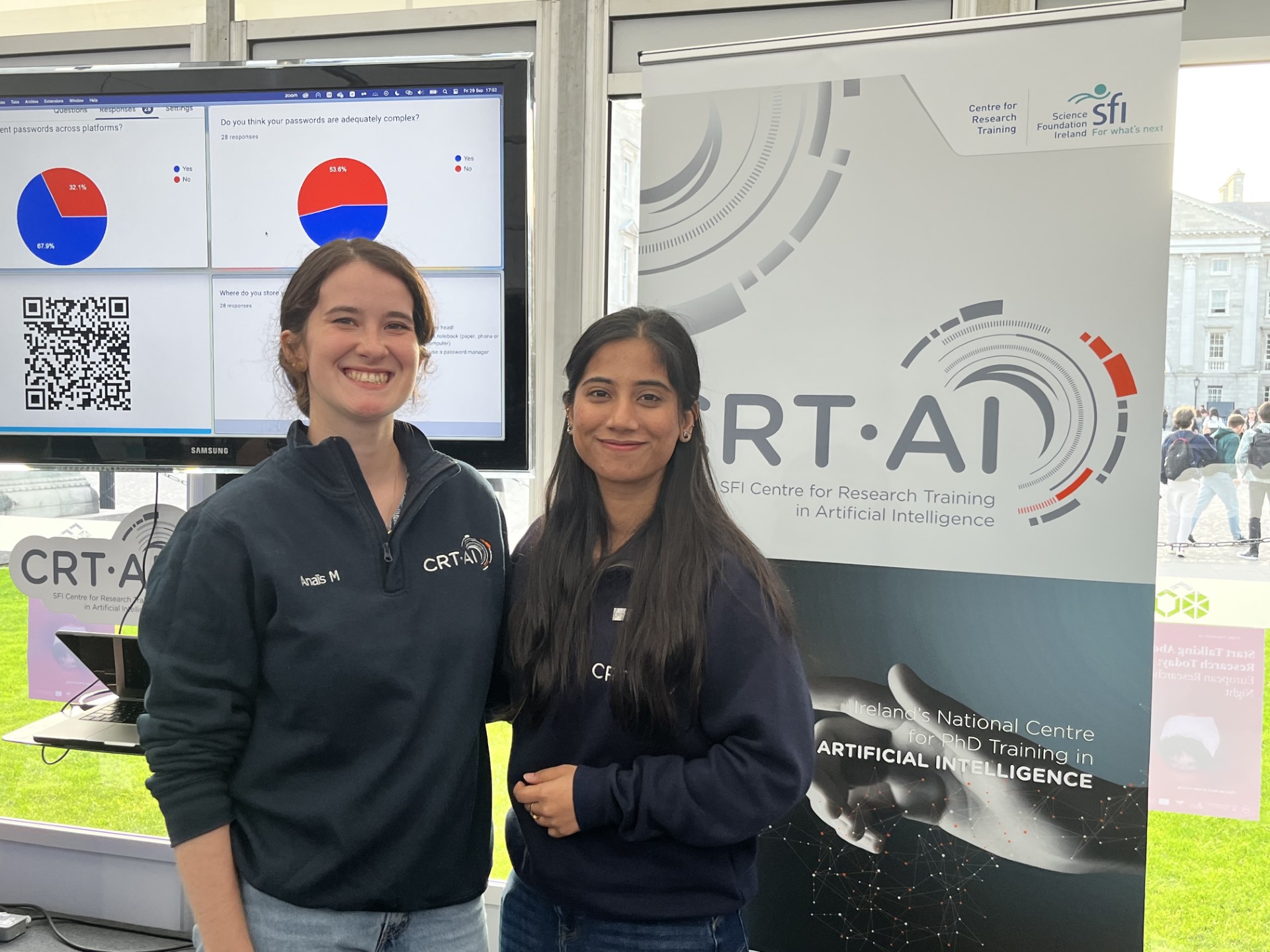
Shafiq worked at the exhibit for CRT-AI, the Science Foundation Centre for Research Training in Artificial Intelligence, alongside another PhD student, Anaïs Murat.
Murat, a third-year PhD student at Trinity College, specialising in AI and human interactions said,
“Doing research can be a bit of a lonely experience and very often we question what we are doing. When we see people’s responses and that they’re getting really involved and interested in it, it’s good for us.”
“I think AI can be an amazing tool for lots of people, it might make technology a bit more human-centred and more accessible. But it still comes with a lot of challenges, like with ChatGPT and we are all trying to figure it out,” she added.
You must be logged in to post a comment.