We took to Grafton street to find out what locals think of the proposed changes to the Presedential age requirement.
Sinéad Fitzgerald, Seraphine Habimana.
We took to Grafton street to find out what locals think of the proposed changes to the Presedential age requirement.
Sinéad Fitzgerald, Seraphine Habimana.

Harcourt Street Centre, Missing Persons location.Photo: Sinéad Fitzgerald.
Missingpersons.ie was founded in 2003 in order to provide counselling for families in the limbo of searching for missing loved ones. The site is poignant with an interactive map that shows missing people from each county. Ciarán, a spokesperson for the organisation tells me ’What a person has to do after a family member goes missing, is to go to the Gardaí immediately.’ The organisation can only publish details after a media release has been made. ‘The family talk with all friends, check bank accounts, there is a check list.’ The checklist is detailed and includes the advice to nominate one gardaí liaison and a media liaison. I ask how long a missing person’s case is kept open and am told, ‘As long as they are missing.’ Claire Dixon, mother of Paul Shine Dixon who went missing in 2009 tells me, ‘When I rang missing persons they gave me the name and number of a trained counsellor that I could call anytime. To me that was so important.’
Paul went missing at 28 years of age while travelling between France and Spain. He had been due to meet his partner in Barcelona. While on the phone to her, Paul chose to leave the train in Perpignan after claiming to have witnessed a shooting. Paul ended the call as he needed to charge his phone, but although they are aware that he was brought to a medical centre after being found disoriented by police, his family have not heard from him since.
Claire and members of her family travelled to the town where the disappearance occurred and she tells me ‘It was an experience of complete panic.’ Claire has become a board member of Missing Persons, hoping to help other families who find themselves in the same situation. Claire tells me that the French authorities provided an interpreter and took DNA samples. ‘They couldn’t have done any more for us’ she adds. But Paul’s name has not surfaced anywhere in France or Spain.
Every year, on the date of the anniversary of a person going missing, their profile is updated and highlighted though often information about individual cases is volunteered in the first five to six weeks. Missing Persons though primarily focused on emotional support and information for families, can provide access to searching organisations and Ciarán tells me, ‘We have a memorandum of understanding with different organisations and if we need to use dogs they’ll come up, from Cork, from anywhere to help out.’


In the event of a person choosing to go missing, the organisation can act as a mediary with friends or family if so the missing person can ease concerns about their wellbeing. . The website states, ‘If, for whatever reason, you have decided to live your life in a different way and different place, you may be most at ease in doing this if those who care about you know that you are safe and well. We can help in trying to ensure that this is the case.’
The Missing People’s Bureau, found through the Garda website, highlights figures of missing persons since 2003 and what stands out is that the majority of people are located. In 2013, out of 7,753 missing persons cases, 15 remain open. For those families who do not have the answers they need however, the support of Missing Persons remains vital.
Missingpersons.ie is mostly funded by the efforts of organisation members and supporters and partially by the Comission for the Support of Victims of Crime (CSVC). Volunteers interested in running or walking the women’s mini marathon on the organisation’s behalf are currently being recruited via mycharity.ie and there is a golf classic taking place in Kilenard, Co. Laois on the 26th of September. Donations can also be made via http://www.missingpersons.ie at any time.
This year, on the 21st of May, seventeen year old Molly Sterling will become the youngest Irish entry to the Eurovision since Dana. We do of course have to get through the dreaded semi finals but all going well she will take the stand on the 23rd. ‘Playing with Numbers is a haunting ballad, with depth not many would expect from a songwriter so young. Molly has received enthusiastic support as well as harsh criticism, making her an initiated Irish Eurovision entry
Although Ireland remains the country with the highest number of victories, with seven to date, the last ten years have rarely been kind. Donna and Joseph McCaul became the first Irish Eurovision act to enter a semi final in 2005 but did not qualify. Brian Kennedy upped the anti with tenth place in the final in 2006 after a breathtaking performance; basically surprising nobody. 2007 saw Dervish give a lively performance of ‘They Can’t Stop the Spring’ but the song did not appeal to voters and came in at 24th. Dustin did not get through the semi final in 2008 and the less said the better. Under a youtube video of 2009 entry, Et Cetera, the second comment reads ‘thank god that they didn’t have the turkey again!’
Et Cetera, performed by Sinéad Mulvey and Black Daisy just missed entry to the Eurovision final, finishing in eleventh place in the second qualifying round. Niamh Kavannagh’s performance of ‘It’s for you’ finished in 23rd place which was disappointing but did not prevent Jedward rocking Dusseldorf in 2011, taking the audience with them and coming in at 8th. Things went downhill in 2012 with Waterline ending in 19th place. There may be more of the duo in the future though, if their fans keep up the pressure.
@LefaSN
No Jedward reading points for Ireland? THIS IS THE WORST NIGHT EVER. (courtesy of storify).
Ryan Dolan’s ‘Only Love Survives’ came in at 26th in the 2013 final in a surprising result and the run of bad luck continued into 2014 when the catchy ‘Heartbeat’ sung by Can-linn and Kasey Smith did not come out of the semi-finals.
Ireland’s victories, between 1970 and 1996 are well documented. For those in need of a reminder:
https://vis.occrp.org/account/metro/edit/2253
Johnny Logan captured the hearts of Eurovision viewers like none before or since but anyone I’ve spoken to agrees it’s a toss up between Rock and Roll Kids and The Voice for best Irish entry.
The eurovision has seen some fantastic acts over the years with both ABBA and Celine Dion first coming to the attention of the world through the contest. It has also seen some bizarre but unforgettable acts, with Lordy, 2005, taking the biscuit.
2015 will be one to watch. Germany, who set a high standard with their 2010 winner Lena Meyer Landrut have this year experienced difficulty finding a representative, according to The Telegraph; ‘The UK’s 2015 contestant will be revealed this Saturday (March 7). Germany’s selection (announced Friday) is perhaps the most fraught, with the winner of the national talent contest (rock singer Andreas Kummert) turning down his place on live TV to shocked presenter and booing audience. Runner up Ann Sophie will now represent Germany in May.’
2014 was a particularly interesting year with Concita Wurst taking first place singing ‘Rise like a Phoenix’. Wurst’s entry to the Eurovision had sparked conservative protests in Russia with some men shaving beards and posting photos to social media. Wurst received support from a number of high profile celebrities however, including Lady Gaga and Elton John and impressed viewers worldwide with her vocals.
Congratulations to this years winner of Eurovision @ConchitaWurst. She slayed with her beautiful vocals and message of freedom and equality.
11:38 PM – 10 May 2014 (Lady Gaga, courtesy of http://www.eurovision.tv).
As the BBC point out in their article, ‘The top ten song contest controversies’, the show is not new to disagreement.
‘The 1963 contest was held in the BBC TV Centre (things were a little more low-key in those days!) During the voting it was a tight race between Denmark and Switzerland. When it came to Norway’s turn to vote, the votes were disallowed since the spokesperson had not used the correct procedure for announcing the results. The legendary presenter, Katie Boyle, informed the jury in Oslo that their votes would be collected later. In the meantime the Norwegian jury altered their votes resulting in Denmark winning whereas Switzerland would have won had the original Norwegian votes been used. There was considerable consternation in the hall and questions remain to this day about the fairness of the incident. Today the results have to be sent into the EBU before they are announced on-screen meaning that such an incident cannot happen again. New voting rules in place for 2014 mean that the process will be even more transparent with the names of jurors and their individual votes made public for the first time.’
Eurovision humour is one of the best things about the competition, as proved by Marty Whelan. Getting into the spirit of the night, it’s worth listening to soundcloud podcast ‘Eurovision for Dummies.’
The Eurovision year after year attracts music lovers, fun lovers and those who just want to see how crazy the costumes and dance routines will be this year. Whatever your reason for watching, do watch and get behind Molly. It makes for a great night with family and friends. And in particular, readers from the UK; vote for us and we’ll vote for you.
Sinéad Fitzgerald
 https://www.youtube.com/watch?v=zO7wh_kwfrI
le Sinéad Nic Gearailt
Ar an Luain seo chaite, d’fhreastail tuairim is 50,000 daoine isteach sa chathair, áit a bhí ‘Road to the Rising’ faoi lán seol. Bhí an lá bunaithe ar an saol mar a bhí sa bhliain 1915, rud a bhí suimiúil ann féin toisc gur chuir sé béim ar an gCéad Chogadh Domhanda is an bhfeachtas Suifraigéid. Bhí am chlár leagtha amach le drámaí, léachtanna agus ceolchoirm san áireamh agus laistigh den GPO bhí cuairteoirí ábalta taighde a dhéanamh ar baill chlainne agus an saol lena raibh siad gafa i 1915. Timpeall na cathrach bhí daoine, mná ach go háirithe, gléasta mar a bheadh contrapháirteanna leo i rith na hama.
Le taispeántais leagtha amach ar pháirt saighdiúrí Eireannacha sa Chéad Chogadh Domhanda, mar shampla i Gallipoli, bhí na sluaite baillaithe timpeall lár Sráid Ó Chonaill ag labhairt faoi firící nár thuig siad cheanna. Ag tarraingt mórán árd bhí tram ceilliúratha uaidh Iarsmalann Náisiúnta Iompair na hEireann. Ar an dtaobh amuigh den tram bhí an sluán cáilliúl, ‘Votes for Women’ agus ar an gcúl bhí litreacha crochta a scríobhadh go gearrad i ndiaidh an tabhairt i dtír na ngunnaí i mBinn Eadair.
Bhí páirt lárnach ag Amharclann na Mainistreach ar an lá. Bhí ceardlanna léamh filíochta, ag comóradh an tréimhse, agus féachaint siar ar litríocht a tháinig ón am chomh maith. I ndiaidh léacht dar teideal, ‘In search of the Rabble’, d’éirigh liom labhairt le Mary Harrington, scrúdaitheoir de chuid Institiúd Teicneolaíochta Atha Cliath. Bhí teachtaireacht aicí le haghaidh mná ach go háirithe, maidir le luachanna na 1900, ar fiú smaoineamh orthu anois ag teacht chomh fada leis an Reifreann.
Deis iontach a bhí anseo an stair a mhaireachtáil agus níor tháining sé roimh ama. Tá mé ag súil le rudaí móra uaidh ceilliúradh 2016. Feicfidh mé ann sibh.

Walking into the 3 Arena to see the Country to Country performances of Kip Moore, Brantley Gilbert, Jason Aldean and Lady Antebellum, I felt mild disappointment at first. The arena was almost full to capacity. According to Google, that’s almost 23,000 people, so suddenly, my music taste no longer made me particularly unique. The general age of the audience suggested that young Irish people do in fact like country and western.
I wasn’t familiar with Kip Moore but kept an open mind as he went through numbers like “Something ‘bout a truck’, ‘Pretty Girl’ and ‘Dirt Road’. My ticket was for the standing area, which Moore himself reminded us was the ‘moshing area.’ Although the crowd never started moshing, they were receptive to the music. Moore’s energetic performance of ‘Dirt Road’, a coming of age song set in his hometown in Georgia, particularly engaged the crowd. Moore held the crowd with a strong, slightly gravelly voice and uncomplicated lyrics accompanied by upbeat arrangements. He went above and beyond by meeting with fans during the time between the two final artists, and his growing popularity was signified by the queue stretching around the arena.
Brantley Gilbert led a Country-Rock theme that would later be followed by Jason Aldean. Songs like ‘You don’t know her like I do’ and ‘One hell of an Amen’ demonstrated a compelling songwriting ability and contrasted strongly with the musical tone of ‘Read me my Rights’ and ‘Take it Outside.’ ‘Bottoms Up’ was the most popular Gilbert number but his consistent interaction with the audience meant good energy levels throughout. More than any other artist he brought his band into the performance by singing and acting out song lyrics with individual members. His best work doesn’t stray too far from his country roots.

Jason Aldean has been on the Country music scene ten years now but has never before performed in Ireland. He performed ‘My Kind of Party’, a song written by Brantley Gilbert, as well as the popular ‘Two Night Town’, and hits ‘Crazy Town’ and ‘Burnin’ it down’. Aldean has a good range and a distinctive Southern voice but the performance was lacking slower numbers to keep a country focus. Aldean knows how to create atmosphere and arrived on stage to sparklers which lit again for ‘Crazy Town.’ ‘Burnin’ it down’ finished to his microphone becoming engulfed in flames.
Lady Antebellum led a very enthusiastic crowd from beginning to end of their performance. They restored a country/pop vibe to the night and heard the audience sing song after song back to them, in particular ’Just a Kiss’ and ‘American Honey.’ Charles Kelley and Hillary Scott have no trouble keeping a crowd’s attention, and at one point Kelley even walked into the crowd, surrounding himself as he sang. Kelley overdid the idea of his ‘coming home to his roots’, with the result that Scott was at times left trying to keep the show moving, but it didn’t stop them connecting with their fans on a deeper level than their predecessors. Maybe the best moment of the night was when the arena lit up with glowing screens all over the room to the sound of ‘Fall for me.’ The quality of the lead singers’ voices and the arrangements of the band’s songs will bring me back to see them live as soon as possible.
By Sinéad Fitzgerald

The conflict between Israel and Palestine was brought to the forefront of public consciousness again last summer when Israel launched an offensive on the 8th of July. Increased rocket fire into Israeli territory by Hamas sparked the reaction, which in turn was due to a crackdown on Hamas by Israel, after the disappearances and deaths of three Israeli teenagers.
The scenes of destruction and high civilian casualty rates saw strong reactions worldwide. For founders of the Trinity College Apartheid Free Campus Campaign, this has meant highlighting and protesting what they see as a compliance of Irish academic institutions in the academic oppression of Palestinians. Ciarán O’Rourke, a founder of the movement adds that the issue goes beyond the subject of the occupation itself, saying, ‘The point is to get as large a number and as wide a cross-section of staff and students on-board as possible – whether it is through the petition, through events like the poetry reading, or on social media. The whole idea is to make some noise and speak our minds about the standards that Irish universities should respect and adhere to, so the more people involved, the more people adding their voices to the campaign, the better.’
The group object in particular to associations between Trinity College and Elbit Systems, The Israeli Security and Counter Terrorism Academy, as well as between the college and the Weizmann Institute of Science. An online petition to the Board of TCD has 450 of the intended 500 signatures and before Christmas the Graduate Student’s Union passed a majority vote supporting the campaign.
In response to my question about whether the group has connected with other university opposition groups, O’Rourke says that ‘Lots of groups have been in touch, and have been stating their support for the TCD Campaign, which is great. The TCD Campaign is distinct from other similar campaigns, however, in not calling for boycott, divestment, and sanctions of Israel per se. We’ve kept this in mind when thinking about direct collaboration with pro-Palestinian groups elsewhere in Ireland, whose work we admire and in many ways follow from.
The ‘Apartheid-Free’ theme, though, is precise in advocating for a condemnation of apartheid crimes, and for a severance of research ties with institutions that contribute to their continuance. Under the terms of the TCD Campaign, Trinity could still collaborate with an institution in Israel such as the human rights organisation B’Tselem without breaking its standards of ‘apartheid-free’ research.’
TCD Apartheid Free Campus campaign is organising a Poetry for Peace reading on March 12th and on Tuesday March 10th, in a non-related event, TCD academic Elaine Bradley will give an eyewitness account of the eight months she spent in Gaza and the West Bank at 7pm in Cassidy’s Hotel on Parnell Square.
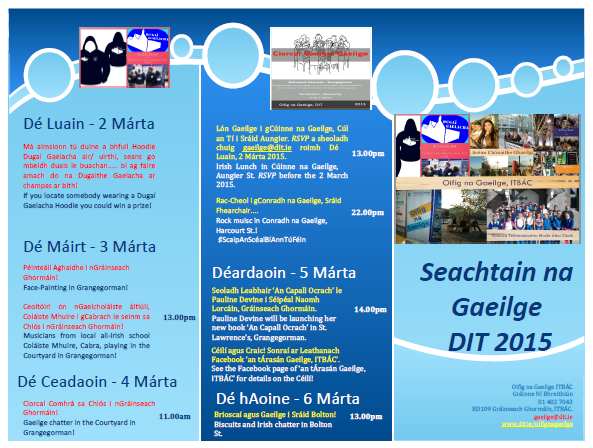

Le buíochas do Ghráinne Ní Bhreithiún, Oifigeach na Gaeilge, Institiúid Teicneolaíochta Baile Átha Cliath.
Ag an am seo den bhliain le Lá Fhéile Pádraig ag druidim linn, tá suim i gcultúr na hEirinn ag scaipeadh ar fud an domhain. Tá Seachtain na Gaeilge faoi lán seol agus is sárseans atá inti do chuid Gaeilge a chleachtadh. Laistigh de DIT, tháinig ceoltóirí áitiúla ar an Máirt go dtí Gráinseach Ghórmáin, is eagraíodh lón trí Ghaeilge i Sráid Aungier ar a haon a chlog inniú. Seans a bhí ann do dhaltaí agus múinteoirí Ghaeilge araon meascadh agus d’éirigh go maith leis. Ar an Déardaoin beidh Pauline Devine ag seoladh leabhar nua do pháistí i nGráinseach Ghórmáin ag a dó a chlog. Bronntanas deas b’fhéidir ar son iníon nó mac, nia nó neacht. Críochnóidh na himeachtaí ar an Aoine le brioscaí agus comhrá i Sráid Bolton ag a haon a chlog.
Tá imeachtaí ar siúl thar timpeall na cathrach agus b’fhiú d’éinne le roinnt ama le spáráil acu freastail ar ócáid nó dhó.
Tá liosta de na hócáidí foilsithe ag Tuairisc.ie agus is cinnte go bhfuil éigin ann do ghach éinne. Tá léir mór imeachtaí le teacht, rudaí neamh-comónta ina measc, leithéid ceardlann dearadh pláta nó cupán agus drámaí puipéad i nGaeilge. Ní chríochnóidh na hócáidí go dtí an naoú lá déag den mhí seo agus níos déanaí sa mhí beidh turas trí Ghaeilge timpeall Reilg Glasnaíon, ceardlann leis an údar Aine Ní Ghlinn, ceolchoirm, lá Gaeilge sa Dáil agus Oíche Fhilíochta i measc go leor rudaí eile. Má tá iphone nó Android agat, ná déan dearmaid an ‘app’ le haghaidh Seachtain na Gaeilge a íoslódáil. (Itunes nó Google Play). Agus ag deireadh thiar thall a chairde, ná bí imníoch bhur n-ócáidí féin a eagrú. Bí ag labhairt as Gaeilge amháin ar feadh 24 uair a chloig nó déan cumarsáid ar facebook trí Ghaeilge ar feadh na seachtaine. Eagraigh oíche amach trí Ghaeilge. Pé rud a dhéanann tú bain sult as!
PóstaerOnaGSeachtainNaGaeilge2015
Le Sinéad Nic Gearailt.
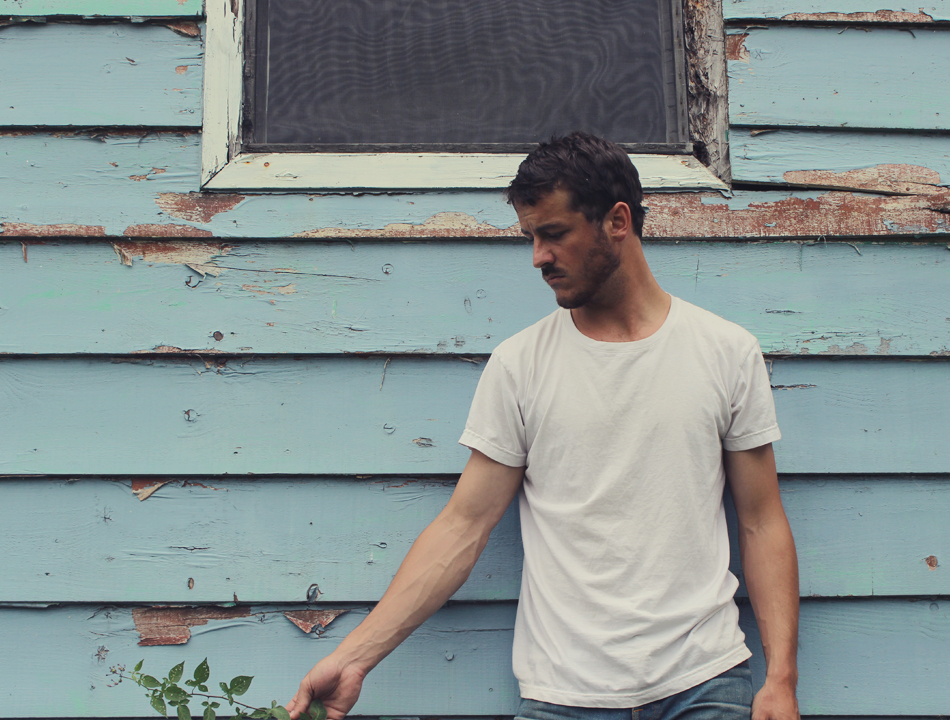

Twenty three year old Scottish folk musician Rachel Sermanni and American folk/blues artist Tom Terrell have just completed the Irish leg of their 2015 tour. They are due to perform at a number of venues in Great Britain, including Oxford, Cambridge and London. On February 14th, Valentines Day, Sermanni played alongside Tom Terrell in Whelan’s on Wexford Street.

The room was full of couples and singletons alike. Sermanni’s distinctive, soulful voice was arguably the prime draw for those at the venue but both singers showed clear stage presence, joking with the audience and sharing anecdotes between songs. Sermanni’s ‘Song for a Fox’ was particularly popular in Whelan’s and ‘Breathe Easy’ and ‘Eggshells’ are well worth listening to on her page www.rachesermanni.net.
Tom Terrell’s music is influenced by Country, Blues, Bluegrass and Folk and his style seems more mature than his tender age. Look for ‘Ghost Town’ on his website tomterrell.ca/music/. Sermanni is an acoustic guitarist and Terrell plays both the guitar and harmonica. Sermanni is building a following through playing numerous festivals and Terrell plays with the band Modern Grass. The gig began over an hour after doors opened but when it began there was no talk in the room, just total respect for the singers. Sermanni and Terrell were ably supported by contempoary/traditional Irish group Moxie.

Roseanne and Chris Brennan, parents of Jake, a six year old boy killed in a road accident outside his home in Kilkenny finish a three day protest outside the Dáil at 6.25 pm today. They have been joined by friends and family in their efforts to have speed limits in housing estates reduced from 50km/h to 20km/h.
Questions have been asked as to how the limit would be imposed but Roseann Brennan feels there is more than one answer to that issue. ‘You say to the County Council, there’s a problem with speed in our area. They come in and put in a camera for 48 hours. At the moment they judge the speed on fifty kilometres. Now they would have to judge the speed on twenty.’ Speed ramps would be used in areas where speed was judged to be excessive. As Roseanne states, ‘I’m not saying every housing estate needs them but there are housing estates crying out for them.’ Her wider aim is to change attitudes to the speed limit, saying ‘ If you fly around a housing estate now, over time it will not be acceptable.’
A motion tabled by Sinn Fein TDs Mary Lou McDonald and Dessie Ellis to lower the current housing estate speed limit to 30km/h was discussed on Tuesday evening and there will be a vote taken on it tonight.
Roseann has organised a gathering of campaigners every week and has been continuously proactive, saying, ‘I’ve been up and down over six months. I met the minister for Transport five times, the Taoiseach, the Minister for Children and the Minister for Environment.’ She adds,
‘I knocked on someone’s door and said the chap that is picking up your young lad is flying in. And she said, well I wouldn’t do fifty myself but you can’t take the law into your own hands. If he’s allowed to do fifty he’s allowed to do fifty.’

Pascal Donohoe, Minister for ~Transport last night released a statement in support of the bill but stated:
“In cases where residential roads are major traffic thoroughfares it may not be appropriate to designate these as 20 or 30 km/h zones, not least because it is unlikely that such limits would be observed. For reasons such as these, it is my view that it would be more appropriate to allow local authorities the freedom to decide where lower speed limits should apply, rather than imposing mandatory limits.’
To Roseann, the importance of the 20km/h limit is paramount. Where children are playing in housing estates she states, ‘At least if you do hit them, you’ll have more stopping distance and they will get to walk away with just injuries. Our kids deserve to be safe while they play and they deserve to make mistakes and walk away.’

The story of St Valentine’s relics has been intriguing visitors to Dublin since they were put on display in White Street Carmelite Church in the 1950s. Not least because there are up to ten places in the world claiming to house the remains of the celebrated Saint, including Glasgow, Rome and Prague. Meeting with Prior Brian McKay, he said: ‘We received a document of confirmation with the relics and we believe we have the real thing.’ Saint Valentine died in the year 269 and the relics came to the Church in 1836. Prior McKay adds that by the time they came to Dublin they were dust. ‘It’s not possible that they are anything else. Likewise a vial of blood that we also received wouldn’t resemble anything like blood.’ In 2012, the heart of St Laurence O Toole was stolen from Christ Church Cathedral in Dublin. Prior McKay states ‘Since then we’ve had the relics under a 24 hour alarm in case anyone tries to break in.’
John Spratt, founder of the Church received the relics as a gift from Pope Gregory XVI in recognition of his excellent public speaking abilities. I ask Prior McKay about the fact that there are said to have been four Valentine’s that lived during the same period and he laughs. ‘I thought that might come up. We believe we have the relics of St Valentine who brought so many couples together but there is no way of knowing for sure.’
Nonetheless it is worth your while visiting White Friar Street. The relics are kept in a glass case near the front of the church and are tastefully surrounded by candles. There is a book beside the case where visitors can petition the Saint for guidance or help. People ask for help in all kinds of things, from finding love to new direction in life. It’s another perspective on the widely marketed holiday.


You must be logged in to post a comment.