Tag: slider

  • TU Dublin feeling the rise in violence happening in Dublin. 

    TU Dublin feeling the rise in violence happening in Dublin. 

    By Mia Waterhouse

    In recent months the violence in Dublin City Centre has been top of the news agenda and it seems that violence has reached the university TU Dublin’s campus.  

    TU Dublin president, Professor David Fitzpatrick, wrote directly to the minister for justice Helen McEntee, appealing for more security around the campus for the safety of all students and staff.  

    In the letter earlier this year to then minister for justice Simon Harris, Fitzpatrick wrote to report about the anti-social behaviour and the lack of safety for students, “we have received reports that the response is slow and are also constrained by the fact that the University’s Estates and Security team cannot respond to off-campus incidents.” 

    The incidents have not been one-off attacks but have been regularly happening at the Broadstone Luas stop just outside campus.

    Luas tram in Dublin City Centre. Image: Louis Hansel/Unsplash.com

    “The Union has received increasing reports of anti-social behaviour in the Broadstone Plaza, right beside the Broadstone Luas stop, as well as the ‘main entrance’ to our Grangegorman Campus. Students do not feel safe entering and leaving the campus, particularly in the evening time,” said Brian Jordan, president of TU Dublin Students’ Union.

    The attacks have also appeared to not be random students from the college as there has been a racial element. While it appears that ‘nobody is safe’, there appears to be a distinct racial element to many of the incidents. It’s also very possible from what I’ve heard and seen that these students are targeted specifically because of their race and/or ethnicity. Several victims of attacks here have reported that racial slurs were thrown at them during the incidents for example,” Jordan added.

    With this still going on and no sign of any measures being taken by the college itself, the TU Dublin Students’ Union took matters into their own hands and held a demonstration at the Luas stop.

    TU Dublin Student Union members held a demonstration to send a message to the Government. Source: @tudublinsu

    The union said the reason they held the demonstration was to ‘show solidarity with the students who consistently feel let down by the government’ and the second reason was to apply more pressure on the government and McEntee to coordinate a far better response between the Gardaí, Transport for Ireland (TFI), and TU Dublin.’ 

    “There were several speakers, including myself on behalf of the SU, Nekesa who is our VP for Welfare & Equality, who also happened to be a mature and international student in TU Dublin, several local ‘opposition’ politicians, as well as current students within the University who felt more needs to be done. 

    We received very little communication from the University about steps being taken (an unfortunately common trend). However, after a particularly ‘viral’ incident last semester, media reported that the President of TU Dublin wrote to the then-Justice Minister requesting more policing in the area,” said Jordan.  

    The previous attacks saw some students getting pelted with eggs and racially abused and another getting her hair pulled. This all happened at busy times in the evening when students were waiting at the Luas stop. Witnesses described the offenders as all boys aged around 15 years.  

    When asked what the desired outcome Jordan said, “We want Justice Minister McEntee to provide adequate governmental support to improve the safety of the Broadstone Plaza. This means improving resourcing to policing in that area like more of a garda presence, as well as a collective response from TFI and TU Dublin. It should not be the role of the Union to constantly try to coordinate these stakeholders when we have an incredibly well-paid Government whose role that is.”

  • Focus on peace: Ireland’s pro-Palestine demonstrations  

    Focus on peace: Ireland’s pro-Palestine demonstrations  

    By Leon Thompson

    Ireland’s support during the Gaza crisis has extended following the announcement of €13 million in aid being sent to Palestine.

    Tánaiste Micheál Martin announced the aid in Dáil Éireann as an acknowledgement of the escalated violence in the Middle East. 

    Mr Martin hopes “a lasting and sustainable peace” can be achieved following Israel’s declaration of war on Hamas when Israeli citizens were attacked two weeks ago. Mr Martin has also said the Irish government unequivocally condemns the attacks made by Hamas and expresses their deepest condolences for the Israeli people affected.  

    The Ireland-Palestine Support Campaign (IPSC) is supporting demonstrations nationwide, while the national demonstration to end the slaughters in Gaza will take place in Dublin tomorrow afternoon. 

    Cork, Cavan, Clare, Kerry and Belfast will also see demonstrations tomorrow. 

    The Garden of Remembrance in Dublin 1 should expect demonstrators at 1pm on the 21st of October following IPSC’s announcement saying, “As Apartheid Israel continues pounding the captive and besieged people of Gaza with indiscriminate bombing and gets ready for a full-scale invasion, all with the blessing of Western powers, we ask you to join us at an emergency solidarity rally in support of the Palestinian people.” 

    Crowds are expected to attend while TD Mr Paul Murphy has announced his support and attendance saying, “When does Palestine get the right to defend itself? 75 years of ethnic cleansing and apartheid…17 years of a brutal siege on Gaza…10,000 Palestinians killed in the last 15 years. Stop the slaughter!”

    Demonstrators at a protest. Image: unsplash.ie

    Other counties such as Tipperary and Antrim saw protests yesterday, October 19th while counties such as Louth, Longford, Cork, Down and Armagh will hold more demonstrations throughout the month of October. 

    The last demonstration supported by the IPSC is anticipated for Co.Mayo on the 25th of October. 

    Campaigners were outside of the Dáil on October 18th with Diarmuid Breatnach in attendance calling it “a duty and a pleasure” as he anticipated the outcome of the debate happening inside.  

    In Cork, one demonstrator Patrick Hobbart said: “…it’s deeply distressing to witness the enduring hardships faced by the Palestinian people who have carried the heavy burden of apartheid and colonialism for generations. It’s imperative to acknowledge that Hamas doesn’t speak for all Palestinians. The Israeli government must heed this plea and halt their relentless assault on innocent civilians. In this conflict, there are no victors…the international community must unite to demand an immediate ceasefire.” 

    Kevin Callinan, General Secretary of Fórsa Trade Union echoed Mr Martin’s sentiments, “The killing of Israeli civilians by Hamas and the collective punishment of the people of Gaza by the Israeli government will do nothing to end the occupation and bring about peace,” he said. 

    President of the EU Commission Ursula von der Leyen’s statement declaring “Europe stands with Israel” has led to a lot of pushback from members of the European Parliament (MEP) especially  

    MEP Clare Daly commended protesters that occupied the European Commission’s Office in Dublin saying: “So proud of friends and comrades…currently occupying the European Commission offices in Dublin as we here in Strasbourg go in to vote on a shameful Parliament motion that fails to condemn Israel for its ongoing crimes against humanity in Gaza.”

    Protesters outside of Dublin’s European Commission’s Office. Image: X

    The office was occupied by concerned citizens organised into a group called Dublin for Gaza, with one member Lamia Tadjine saying: “Let us be clear—blood is on the hands, not just of the Israeli military and leadership, but on the hands of those states and institutions who have provided cover for these atrocities, such as the European Union.”

  • “Five percent for the future of Ireland”: Students rally for affordable living 

    “Five percent for the future of Ireland”: Students rally for affordable living 

    By Leonardo Parada Borda

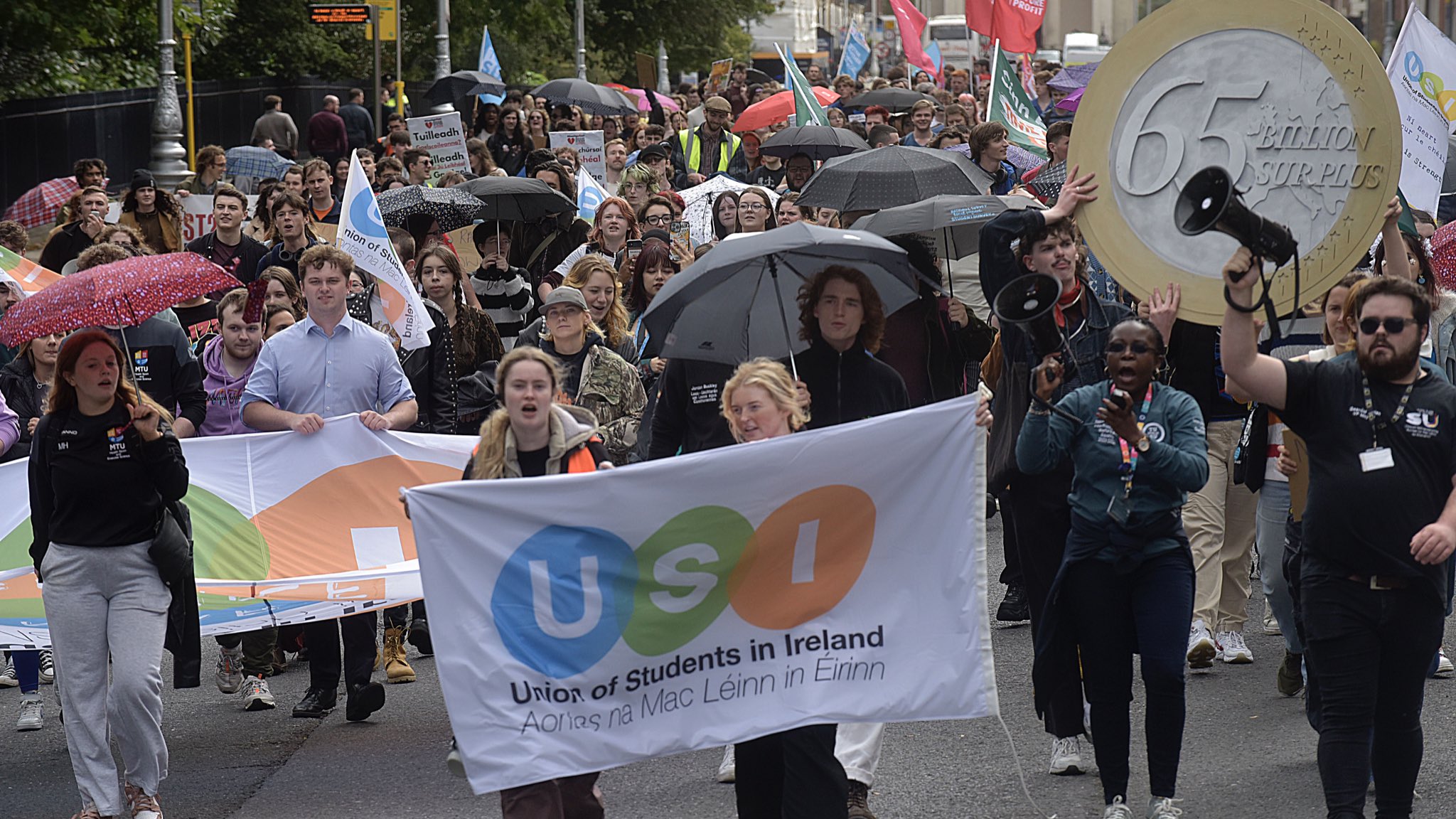
    University students took part in a national demonstration, organised by the Union of Students in Ireland (USI) last Wednesday, where they protested the €65 billion budget surplus the Government is said to accumulate over the next three years. Students nationwide were outraged to hear the surplus would be used for a ‘rainy-day’ fund instead of the cost-of-living crisis. 

    The protest began at the Garden of Remembrance and made its way down to the Dáil with students chanting and singing about the issues they face while studying in higher education. 

    The student-led demonstration was organised to highlight the issues surrounding third-level education and to offer the Government solutions to fix these problems. 

    Brian Jordan, president of the Technological University Dublin’s Student Union said, “This is a national demonstration organised by USI […] The reason we’re protesting is because we’ve seen a lack of student accommodation. The Government has failed to give [students] capital investments, even though that is a clear solution.” 

    “We have a huge amount of private rented accommodation all over Grangegorman. Students are paying up to €1,100 [monthly], and that’s because the university hasn’t built their own accommodation,” he added.


    Brian Jordan and the TU Dublin SU at the Garden of Remembrance. Image: @theusi/X

    Environmental science student, Megan Tynan described how stressful it was to find accommodation closer to college. 

    “For my second year, I was commuting an hour and a half from college. By the time you get home, you’re wrecked,” she said. 

    “I was staying at a hostel for a few days during exams because my landlord decided to sell [the accommodation].” 

    “I was staying in a room with nine people, who were all strangers. It affected me negatively because it’s embarrassing to admit that you are struggling to find a place,” she added.

    “It didn’t just fall out of the sky; it did not just happen. It was caused by Government policy.” 

    Dr Rory Hearne, Assistant Professor of Social Policy at Maynooth

    According to the Pre-Budget Submission for the Budget 2024, submitted by USI, 33% of the total student population says they are experiencing serious financial issues. In 2019, that percentage sat at 26%. 

    President of Maynooth University Student Union, Alex Balfe said that “hundreds of students”, many of whom come from Donegal and Cork, are struggling to find accommodation on campus which is not “sustainable” for students. 

    “Students are waking up at five o’clock in the morning for their commute and they’re not getting home until very late in the evening,” Balfe said. 

    “There’s absolutely no accommodation in Maynooth, considering we’re a university town with more students than residents at the moment,” she added. 

    Third-level students march to the Dáil in protest of the accommodation crisis. Image: @rosspjboyd/X

    The latest figures on Funding the Future — a document released by the Government in August 2023, mentioned that full-time student numbers are increasing and are expected to “peak” at 233,000 in 2030. It is also mentioned that there are currently 29,773 “oversubscribed” students who will not get accommodation in the 2023/2024 academic year. 

    The document mentioned that Minister Simon Harris confirmed “Government approval” for a new policy to be introduced that will provide “state assistance” to the “development of new and additional student accommodation for higher education institutions”. 

    The Government also “approved €62 million in additional funding” for 1,072 additional beds in universities like the University of Limerick (UL), Maynooth University (MU), University of Galway (UG), and Dublin City University (DCU). Assessment is still ongoing for all five Technological Universities (TUs). 

    Dr Rory Hearne, an assistant social policy professor at Maynooth said, “The housing crisis is forcing students to drop out of college, forcing them to pay unaffordable rents and to live in hidden homelessness. College days are supposed to be the best days of your life, but now, it’s a nightmare for many students.” 

    “It didn’t just fall out of the sky; it did not just happen. It was caused by Government policy.” 

    “Rents have increased by 100% since 2011, and 60% since 2020. Here’s a radical idea, in Berlin, in 2020, they reduced rents and put a five-year rent freeze in place. Why doesn’t the Government reduce all rents by 20%, back to the level they were in 2020?” Hearne said. 

    In 2021, Berlin’s Mietendeckle — a rent control law in Berlin, was declared ‘unconstitutional’ and was replaced with Mietpreisbremse — a new rent control law that limits how much rent the landlord can ask for. It is also possible to claim money that was overpaid for rent.

    Video: Elio Bonelli

    President of USI, Chris Clifford said, “How far away from reality is our Taoiseach when students and graduates are leaving the country by the plane load, when students have to decide between food and printing, and when a student’s room is the front seat of their car? That is the reality that this country has created for students.” 

    “We’re looking for the Government to fund the future of this country […] There’s a ‘rainy day’ fund of €65 billion and we’re asking for five percent of that. That five percent reduces waiting lists in hospitals, that five percent means that there’s enough childcare practitioners in this country, and it also means that there are enough civil engineers out there to get these houses, that not only students, but the public are crying out for.” 

    “Five percent for the future of Ireland,” Clifford added.

  • From likes to learning: Irish university launches new social media ‘influencing’ course 

    From likes to learning: Irish university launches new social media ‘influencing’ course 

    By Leonardo Parada Borda

    A new university course in content creation and social media was introduced last week by the South East Technological University (SETU) for people looking to become ‘influencers’.

    The programme (bachelor of arts content creation and social media) will begin in Carlow next September, with applications opening in November this year. 

    Although courses in social media and content creation already exist in Ireland, this course is slightly different. It is the first full-time bachelor’s degree (NFQ Level 7) course in Ireland, with a course duration of three years. 

    Other courses, like the social media marketing courses at University College Dublin (UCD) or the Atlantic Technological University (ATU), offer part-time courses in which you receive a diploma (not on the NFQ) or a certificate (NFQ Level 6) and runs for a duration of three months. 

    So, what makes it different to other courses like social media marketing or journalism? 

    Dr Eleanor O’Leary, the programme director of the course, said that the programme focuses a lot more on practical skills like creative writing, creative video and audio skills, journalism, and crisis management.  

    “The bachelor in content creation and social media is designed to provide students with a broad education to work in front of and behind the camera in digital environments,” she said. 

    Dr O’Leary mentions that the course intends to develop “students’ creativity and individual aesthetic”. 

    “We are also very focused on preparing students for working online and understanding the risks and challenges of operating in this space and the impact on mental health and wellbeing,” she added. 

    “Influencing has grown, and I think it will continue to grow as a form of marketing.”

    Alan Kelly, Social Media Marketing Coordinator at ATU

    With its ever-changing nature, social media poses another obstacle. Influencers must learn how to adapt to the latest trends within the industry to succeed. It’s a way for them to maintain authenticity and address cultural and societal issues. 

    “We stay up to date by working with industry experts, supporting and undertaking research, co-creating our educational offerings with students and industry leaders and reviewing what we offer every year,” Dr O’Leary said.

    Photo by: Carlos Muza/ unsplash.com

    “Having worked in media education for over a decade, you are attuned to the aspects of media industries that change and those that stay the same. Core skills are often consistent over time, and it’s about paying attention to how audiences respond to, utilise, and communicate through new media technologies,” she added. 

    Mr Alan Kelly, the course coordinator for social media marketing at ATU, mentioned that the new course integrates all aspects of marketing, business, and technology into the programme. 

    “I think the degree itself isn’t focused only on influencing, so I think it’s sustainable because it has many aspects,” Kelly said. 

    “Fair play to them. They’re trying to be seen, and by including the words ‘influencer’, they’ve managed to market the programme really well based on that.” 

    “Influencing has grown, and I think it will continue to grow as a form of marketing,” he added. 

    Kelly said the course has a promising future and will ‘continue to evolve and grow’ if there is more emphasis on marketing and business rather than influencing. 

    “I don’t think there will be that many sustainable jobs, I think a lot of people are already there, but I think the course itself offers a lot more than influencing, which I do think is really important.” 

    “You can go out there and be an influencer without doing a course. If you have some decent technical skills, you can look up a YouTube video, but people don’t know enough about the ethical issues and the legal aspects that come with it.” 

    Kelly mentioned that Meta and the virtual world will also help social media influencers stay active and have an additional platform to market themselves. 

    “It will evolve. New platforms have come out. We can look at Meta and the virtual world as an example. Marketing will migrate there, and so will influencers,” he said. 

    “I think there is still that ethical and legal minefield out there […] There will also be people who want to fight with you on social media, and the way they communicate that with you can be terrible. There are going to be problems going forward.”

  • The uncrowned mascot of the Qatar World Cup- “Metro Guy”


    A Kenyan man gets hired for a security job at the World Cup but instead has to give directions to tourists and fans. He goes viral on TikTok just for saying ‘Metro.’ ‘This Way.’

    By Nimra Ahmed 

    Abubakr Abbass, a 23-year-old from Mombasa Kenya, whose job is to direct World Cup fans in Doha, Qatar to a metro station, in the historic market of Souq Waqif has gone viral on social media. 

    He feels God had a greater purpose for him. He was excited about the World Cup and had always wanted to travel to a foreign country. So, Abbass applied for the advertised security job. He nearly missed the interview in Nairobi, Kenya because he was informed of the job a day before the deadline.

    As luck would have it, the job was his. However, when he reached Qatar, he was informed he would give fans directions to the metro station. Even though it wasn’t the job he had applied for, Abbass still decided to take it. 

    Abbass, in a reflector coat, sits in a tennis umpire chair and has a large purple foam finger. His job is to direct hundreds of people to the nearby metro station with the help of his megaphone. 

    Abubakr Abbass,“Metro Guy”- courtesy of mozzartsport

    He became an overnight social media sensation because he found an ingenious and interesting way to direct fans to the nearby metro station. His job was mundane, but he put a twist on it, and he caught the world’s attention. 

    A clip of him is even found on the FIFA World Cup’s Twitter page. Every time he says ‘Metro’, fans from different countries either repeat after him or chant, ‘This way!’.

    The way he says, ‘Metro’. ‘This way’. ‘Metro’. ‘This way,’ has now become a catchphrase. Fans are recording videos and posting them on social media platforms.

    ‘Metro Guy’, as he is now referred to, has captivated audiences with his enthusiastic calls. TikTok videos were posted showing him in action. #metroguy and #metroman, as he is dubbed, has been viewed 12.4 million times on TikTok. He brings a smile to everyone’s face and cheers everyone in person and online. 

    “Qatar has managed to make us laugh!”

    Cindy Taylor, 19, a student from Dublin. 

    The TikTok account ‘metro_man001’ that he started on Monday 21st November 2022 (on the second day of work) already  has 46,100 followers in just three days and has made Kenya, a country in East Africa, popular. Tourists and football fans are even trying to mimic his catchphrase into his own megaphone.

    He made his TikTok account after gaining popularity. #Metro Guy is busy doing his job while a Brazilian fan copies his actions and records a video.

    His employers felt the need to award him for his efforts, as he was in the limelight of the world stage and had drawn attention to the area. He was presented with gifts – a pair of sneakers and World Cup merchandise. He is touched by this gesture and notes that he was never given a gift in his life.

    Have you heard of the ‘Metro Guy’ in Qatar? 

    “Yeah, I have seen his TikToks. He is hilarious and he does a good job of lightening the mood. I want to go to Qatar just to feel the ambiance of the place and be a part of #metroman’s day! We all need some good old-fashioned laughs,” commented Steve Byrne, 22, a student from Dublin. 

    “Qatar has managed to make us laugh! In all the somber and serious allegations against Qatar about the bad treatment of workers, here is a simple man breathing fun into his job. In today’s fast-paced life, we just don’t have the time to appreciate the small things,” said Cindy Taylor, 19, a student from Dublin. 

    “There is a lot of controversy surrounding the World Cup. I can’t wrap my head around it. But there is, hope ‘Metro Guy’ lives.”, said Oliver Wilson, 28, a tourist in Dublin.

    The official mascot is La’eeb which means ‘super-skilled player’. It is a ghutra – the Arabic term for a headdress for men – popular in Arab countries. But Abbass is the uncrowned mascot of  the Qatar World Cup! 

    This can be motivating for young people to take their jobs seriously no matter how small and try to enjoy the task at hand and be innovative at the same time. Some amusement at the end of the day for tired tourists!

  • Ireland’s population has largest increase in 14 years

    Ireland has had its largest population increase since 2008 according to a report published by The Central Statistics Office (CSO). 

    By Sadhbh McDonnell

    The CSO reported an 88,000 increase in the population between April 2021 to April 2022. 

    Cathal O’Doherty, Statistician in Population Estimates and projections, stated on cso.ie that, “Ireland’s population was estimated to be 5.10 million, increasing by 88,800 persons in the year to April 2022. This was the largest 12-month population increase since 2008 when the population increased by 109,200.” 

    In the last 12 months, 60,700 babies were born whilst 33,000 people have died, creating a natural increase of 27,700 to the population of Ireland.  

    The CSO also stated that “there were 768,900 persons living in Ireland aged 65 and over in April 2022, those aged 65 and over had increased in population share between 2016 and 2022 increasing from 13.3% to 15.1% of the total volume increase of 139,100 persons.”

    Table

Description automatically generated

    Via CSO.ie

    Immigration was the highest it’s been since 2007, with 120,700 immigrants arriving in Ireland in the last 12 months. 24,300 were other EU nationals, 4,500 were UK nationals and the other 63,000 came from other nations including 28,000 Ukrainians. This comes as no surprise since Putin declared war on Ukraine on February 24th 2022. 

    Chart, bar chart

Description automatically generatedVia CSO.ie

    The CSO report also shows that more Irish people (approx. 27,600) returned to Ireland then left. Since the last annual report, 28,900 Irish natives returned to Ireland, however, this is less than the previous year, in which 30,200 Irish people returned.  

    A picture containing diagram

Description automatically generatedVia CSO.ie

    Emigration has increased in 2022, with 59,600 people leaving Ireland, compared to 54,000 in 2021. These statistics align with a recent survey carried out by Red C in association with The National Youth Council of Ireland (NYCI). The survey found more than 7 in 10 young people across Ireland are considering moving abroad to find a better quality of life. 

    NYCI’s Paul Gordon, Director of Policy and Advocacy commented on the data collected from the survey, “There is a real fear from young people about what the future holds for them. Many say they’re struggling to make ends meet and quality-of-life considerations are driving them to consider a future outside of Ireland. Government must act to ensure young people aren’t overlooked in this crisis.”

    For more information on the population and migration report visit  https://www.cso.ie/en/releasesandpublications/ep/p-pme/populationandmigrationestimatesapril2022/keyfindings/.

  • Just three people in Dublin prescribed medicinal cannabis

    By Johnny Kelly

    Medicinal Cannabis- photo courtesy of BBC News

    There are currently only three people in the Dublin area receiving medicinal cannabis according to the Health Service Executive.

    The figure was confirmed to TheCity.ie  following a freedom of information request

    The Medical Cannabis Access Programme (MCAP) was launched in the summer of 2019 by then Health Minister Simon Harris as a pilot programme for five years. 

    Barry Fuchs (30) from Swords was diagnosed with an inflammatory disease called Ankylosing Spondylitis a few years ago. The condition is a type of arthritis that causes the vertebrae in the spine to fuse. 

    Speaking to thecity.ie he describes his pain.

    “My condition causes me to be very stiff and sore, especially in the mornings there before I move around and do my stretches,” he says.  

    Once simple tasks such as tying his shoelaces or putting on his jumper have now become ordeals. 

    “I asked my GP about the medical cannabis but he told me that he doesn’t think I’m at that stage yet, so, maybe if I get very bad he might let me,” he adds with optimism. “I just think medical cannabis could help just take your mind off it at certain points during the day and also help you sleep at night.”

    Currently the MCAP only applies to people with multiple sclerosis, people with severe epilepsy or patients suffering bad side effects from chemotherapy. Researchers don’t know for certain if cannabis can ease the symptoms of arthritis, but some studies suggest it helps with pain relieve and aids sleeping. 

    TD Gino Kenny told thecity.ie that “hopefully the MCAP will be expand to include other conditions. There is an ongoing review into the programme and early next year they will announce if the programme should include any other conditions.”

    The People before Profit TD has been a vocally prominent supporter of decriminalising cannabis and legalising medicinal marijuana. Last week he introduced a bill to amend the Misuse of Drugs Act 1977 that would legalise cannabis for personal use. “Seven grams would be personal use,” Mr Kenny tells thecity.ie, adding “this [would be] emulating what has happening in Malta and Luxemburg.” 

    The bill first needs to be approved by Government TDs before going for a vote. “Hopefully early next year we will have a debate and more crucially a vote to see if the bill should progress to the next stage of the process. Even if it does progress that doesn’t necessary mean it will become law,” Gino warned.

    According to Euronews.com, medicinal cannabis has been available in Germany since 2016. The German health minister unveiled plans this month to legalise it for recreational use. 

  • Sing for Vulnerable Society at Christmas

    By Injae Kang

    With shining Christmas lights across Dublin City Centre and colourful projections illuminating 16 City Centre locations, Christmas is just around the corner.

    While many people are revelling in Christmas, which is widely regarded as the season of giving and spending time with loved ones, there are volunteers for people who are sleeping rough on the streets, not just on Christmas day.

    As the number of people who are at the risk of homeless or at risk of homelessness has increased due to the cost of living crisis in Dublin, Dublin Simon Community provides essential services for those who need support. 

    A crowd of people in a city

Description automatically generated with medium confidence

    The Christmas lights on Grafton Street have been switched on. Photo by Injae Kang

    “The number of elderly people experiencing homelessness in Dublin has increased by 28 per cent in the last 12 months. A record-breaking number of people will spend this Christmas in homelessness”, Roisin Coulter who is a community and events manager at Dublin Simon Community said.

    “As housing supply remains at an all-time low, these people will have no indication of how many more Christmases will be spent this way. Several more will spend their Christmas at home in fear that it may be their last as the cost-of-living crisis pushes more and more people below the breadline”, she said. 

    Number of People Homeless in Ireland. Source by Department of Housing, Planning and Local Government

    With over 200 volunteers, choirs, and artists who give up their time during the Christmas days, Dublin Simon Community will plan to hold upcoming Christmas events for the purpose of raising much-needed funds for those most vulnerable in Irish society who are homeless or at risk of becoming homeless.

    The Sing For Simon event will take place on the 8th of December in the Powerscourt Townhouse Centre. Wild Youth, the Lucan Gospel Choir, Curtis Walsh, and others will be performing and showing their support for the event.

    Dublin Simon Community will also have a ‘Carolathon’ event, which is 24 hours of carolling on the streets of Dublin. Where Choirs will come together in a relay to raise vital funds for the events and services.

    Also, its Christmas events will round off with its traditional Christmas Eve Busk outside the Gaiety Theatre. In the busk, “For over 10 years, some of Ireland’s favourite artists have come down to show their support and raise vital funds for our work”, she said. 

    Students from Trinity and UCD founded the Dublin Simon Community in 1969 to provide soup and sandwiches to people sleeping rough in the City Centre.

    “Dublin Simon works to prevent and address homelessness in Dublin, Kildare, Wicklow, Meath, Louth, Cavan and Monaghan. We provide services at all stages of homelessness and enable people to move to a place they can call home”, she said.

    In addition to the Christmas events, Dublin Simon Community provides a variety of services for those who are homeless or at risk of homelessness. A variety of services are provided, including emergency accommodation, soup runs, health care, and treatment.

    She spoke about one of the charity events provided by the organization: “Next year will mark the 40th year of what was the Fun Run but is now the Home Run. Home Run is a fun and challenging, five-mile race through our capital’s beautiful Phoenix Park on the first Saturday in October.

    “This is more than just a run. Each year members of the public, the business community, students, teachers, Simon staff, volunteers and clients all take part in this fantastic event. They run, walk or jog through the park; coming together as a community to challenge themselves and show their support for those living through the nightmare of homelessness.”

  • The rise of sexual abuse in Ireland during the pandemic


    The number of people reaching out to sexual abuse services has almost tripled since before the Covid-19 pandemic. 

    By Aly McGrath

    In 2020, WomensAid.ie recorded that they had 29,717 contacts with the organisation. This is a rise of 10,628 from 2018.  

    WomensAid is an organisation that works to protect women and children from domestic violence. It offers support to those who have been affected by abuse and work towards receiving justice and social change. 

    The number of contacts dropped slightly since the climax of the pandemic with it currently standing at 26,906 according to the National and International Statistics on WomensAid.ie.  

    Covid-19 was found to be one of the busiest years for organisations such as WomensAid. In 2020, Safe Ireland found that within the first six months of the pandemic 3,500 women and 600 children contacted the domestic violence service for the first time. This equates to 19 women and 3 new children every day.  

    In a press release done by WomensAid on February 15th, 2021, the organisation said that “young women experiencing abuse risk are being left behind during the covid-19 pandemic. Reports from other jurisdictions indicate that instances of image-based sexual abuse have surged since last March.” 

    In the same press release CEO, Sarah Benson talks of the dangers of online and digital sexual abuse. “We need to remember that you do not need to be living with a partner for them to target and abuse you when you can be achieved through digital and online means. This abuse can disproportionately impact young adults.” 

    Sexual abuse online or in person can have disastrous effects on a person. 84% of young women have reported that they suffer anxiety, depression and low self-esteem whilst being isolated from family and friends as a result of the abuse. Other results have been reported, such as suicide ideation and hospitalisation due to physical injuries.  

    “We cannot continue to stand over a situation where such a significant number of young women, many minors, are deeply harmed and traumatised at the hands of current and former intimate partners,” Benson explains.  

    The organisation announced a new campaign early this year called the ‘Too Into You’ campaign. It provides a wide range of tools and resources for young people including a relationship health check quiz. This quiz checks for the signs of abuse in relationships and has information on legal protection and a guide to staying safe online. The organisation hopes that this campaign may help anyone affected by intimate relationship abuse or concerned about a friend or loved one who is at risk.  

    “We encourage anyone who is anxious or worried about their relationship to reach out for support and remember if it feels wrong, it probably is.” says Benson.  

    If you have been affected or know anyone at risk of any topic in this article, please call the WomensAid 24hr National Freephone Helpline on 1800 341 900 or contact their private chat rooms to receive support and advice.  

  • Top tips to stay healthy as winter is upon us

    Top tips to stay healthy as winter is upon us

    Staying healthy during winter- your top tips from TheCity.ie. Photo courtesy of iStock

    By Johnathon Pearl

    Winter is here and exercise is more important than ever, not only for the body but also for the mind.

    With temperatures plummeting and evenings getting darker by the day, many people find motivation to exercise extremely difficult and as a result it simply gets lost in routine.

    Summer months provide people with a lot more freedom to exercise. A December night in Ireland lasts almost 17 hours and the days start about 4 hours earlier compared to the summer months.

    In Winter, particularly on weekdays it can be extremely difficult to get out for a run, go for a cycle and virtually impossible to go for a swim, unless you wanted hypothermia.

    So how do people go about exercising in the Winter?

    Strength and fitness coach Suzanne Flannagan explained just how important it is to keep up a level of exercise during the winter months and how to train efficiently.

    ‘’It is very important for young people to do some sort of exercise at all times but especially in the world we live in right now. 

    ‘’With technology so advanced it is so easy for young people to just sit inside with play stations, which keep them entertained until they go to sleep and not exercise at all.’’

    ‘’We all know it is very difficult in the winter months, (gets dark early) so planning is vitally important. Designate an hour when it is bright to exercise 4 or 5 times a day and it will make you feel so much better about yourself.”

    Suzanne Flannagan

    ‘’Any sort of exercise young people can benefit from, a simple jog out the back of the house, a workout with another family member, whatever people feel comfortable with.”

    Flannagan emphasized the need to plan before exercising.

    ‘’We all know it is very difficult in the winter months, (gets dark early) so planning is vitally important. Designate an hour when it is bright to exercise 4 or 5 times a day and it will make you feel so much better about yourself,” she explained.

    ‘’Plan a time to exercise at the start of the week or even the night before, so that you know its going to be bright while exercising.

    ‘You don’t’ have to go outside to exercise’ remarked Flannagan when asked about the shortened days.

    ‘’Equipment like an exercise bike, a treadmill or even a rowing machine can be used but even getting a matt out in a corner by yourself and doing body weight exercises is perfect. It will give a great boost to your day.

    It is well known that exercise releases happy thoughts in people’s brains. Several studies have been done showing exercising releases happy endorphins which in turn puts people into a much happier place mentally.

    Personal Trainer Gavin McCoy recently moved to Australia to study health and conditioning.

    Speaking to thecity.ie he gave tips for exercising in Winter but also commented on studying the benefits exercise can have on the mind.

    ‘’Exercise is so important, so many studies are done on it, but I still think the majority of people don’t actually realize how valuable it is.’

    ‘’Learning more about mental health over here, (Australia) makes you become such a big advocate to encourage people to have at least one piece of exercise in their daily lives.’

    ‘’A lot of fitness advocates that are big on Tik Tok and Instagram constantly talk about taking rest days, but that doesn’t mean that you can’t do yoga or stretching. I would be really big on doing a piece of exercise a day.

    ‘’Some people might not think it but for an exercise Yoga is probably one of the best things you can do. Especially with the early nights, find a peaceful place in your house bring your mat and do some Yoga, it is brilliant for the mind.’’

    ‘’Of course, running, swimming, cycling help but not everyone likes or can do them, an hour of meditating or stretching are also great ways of feeling better particularly as the days in Ireland are quite short.’’

    Talking about his studies he enlightens us on different ways to feel better about yourself and how different ways of exercising appeals to different personalities.

    ‘’Obviously, exercise is key but some of the ways I have learned that improves your mental health and day to day living are crazy.

    ‘’One of the probably eye-opening things we were told was having a cold shower at the start of every day. It is crazy because it puts you in such a good place mentally. 

    ‘’I know everyone loves a warm shower and they are nice but, the idea of having a cold shower in the morning is that it’s your first challenge of the day, the idea of a shower like that is that it isn’t supposed to be nice and relaxing it’s all about passing the first challenge of the day, it is brilliant.’’

    Gavin also stressed that ‘people should only focus on themselves and not other people.’

    ‘’I get asked about gym membership all the time, and whether or not people have to get gym membership to exercise, which just entirely isn’t the case. A lot of people focus on other people and what they are doing when all that people should be caring about is themselves.

    ‘’Going to the gym and working out with other people can be beneficial to some but it can be also quite daunting. It’s all about yourself and what you prefer, constantly thinking about what others are doing can be really difficult on people’ minds and it won’t allow you to get the best out of yourself.’’

    Exercising is one of the most important things to do in Winter. Whether it is a run, a cycle, yoga or even swimming, every little helps.