Twitter defends response to harmful content, saying it’s “educating” users rather than banning them.
Twitter has disputed claims it hasn’t done
enough to deal with abusive content on its platform after being questioned
about racist abuse directed towards a mixed race couple living in Ireland.
Meath-native Fiona Ryan (33), her fiancé
Jonathan Mathis (32) and their 22-month-old son Jonah were victims of a torrent
of online abuse via
Twitter after appearing in an advertising campaign for
supermarket chain
Lidl.
Harmful tweets were removed by Twitter after being reported by Lidl Ieland and other users, but the situation continued to escalate leading to the family leaving Ireland.
Appearing on RTÉ’s The Late Late Show last Friday, the couple said they made the decision after receiving death threats.
“The situation continued to escalate leading to the family leaving Ireland”
Appearing before an Oireachtas committee
yesterday, representatives from Twitter, Facebook and Google were questioned by
TDs about how they address harmful content on their platforms — the meeting was held as part of a
wider discussion to see if there is a need for stricter legislation in this
area.
Referring directly to the Ryan family case,
Fianna Fáil TD Jack Chambers asked if just deleting a tweet was a
“weak” response.
Karen White, Director of Public Policy at
Twitter’s EU headquarters in Dublin, said that while she could not comment
about specific individuals, she would sympathise with anyone who has
experienced targeted abuse or harassment.
White said that Twitter has robust policies in
place with a range of enforcement actions available, and that it had moved
towards a system of “educating” abusive users rather than outright banning
them.
“Progress in this area in relation to the type
of behaviour that you’re talking about is incredibly tough and I think there is
a wider societal issue that needs to be addressed here,” she added.
Responsibility
All three of the social media giants present
maintained the stance that they are not publishers and it’s up to legislators
to decide if there should be stricter regulations put in place.
“Fianna Fáil TD Jack Chambers asked if just deleting a tweet was a ‘weak’ response”
Fine Gael TD Colm Brophy accused the companies
of not accepting that they are publishers in an attempt to make more profits
and avoid legal action against them.
Brophy suggested that social media platforms
“probably have more impact on the world today than print and broadcast media
combined,” yet their current response is to remove the content after the damage
is done.
When asked directly about the Christchurch shooting incident, and artificial intelligence failing to detect the footage as it was filmed, Dualta Ó Broin, head of public policy for Facebook Ireland, said they are “learning everything we can to ensure that won’t ever happen again”.
He noted that artificial intelligence I is already successfully used by Facebook to detect and delete harmful content related to terrorism and child sexual abuse.
He acknowledged that Facebook is subject to rules and regulations as it currently stands but suggested that it’s open to stricter regulation and that the Government should tell Facebook where they want them to go further.
This year, the internet went insane with the theory that our phones are listening to us. F.B.I. spy memes went viral and conspiracy threads clogged Twitter – everything we type/say into our phones is being read and heard by Mark Zuckerberg, the government and, if some Reddit threads are to be believed, aliens too.
It’s certainly happened to many of us. Phone nearby, you have a conversation with a friend about food supplements, for example. Soon after, your Facebook and Instagram feeds are filled with ads for Holland and Barrett.
Or, you could message a friend via Facebook and make plans to meet at a certain venue. Suddenly that exact place appears on your feed as a suggested page to follow. With so many people reporting instances like this, it’s easy to assume that to some degree, we are being monitored.
Facebook issued a statement in 2016, assuring users that their conversations were not being recorded or listened to:
“Facebook does not use your phone’s microphone to inform ads or to change what you see in News Feed. Some recent articles have suggested that we must be listening to people’s conversations in order to show them relevant ads. This is not true. We show ads based on people’s interests and other profile information – not what you’re talking out loud about.”
Facebook may deny using smartphone microphones to monitor users, but what about in-app conversations via WhatsApp and Instagram? As WhatsApp and Instagram are owned by Facebook, user information may be shared between the three applications. It’s highly plausible that an algorithm exists to scan user conversations, find key-words and target ads towards the user.
With this theory in mind, we conducted our own experiment to test whether WhatsApp and Instagram direct messages are being monitored in order to reveal user preferences and personalise advertisements.
Using two iPhones, we restored them to factory settings and wiped them clean to ensure no history of data is left on the phone to determine the outcome. We also inserted two Eir sim-cards with new, unused numbers.
Following that, we created two separate Facebook accounts depicting two middle-aged women, named Anna Boyle and Margaret Freeman. We also created two Whatsapp accounts registered to our new numbers, and two Instagram accounts under the same names.
We then started conversations between both Whatsapp and Instagram accounts, including a number of pre-picked keywords: Yankee candles, Brylcreem, ice hockey, Camile Thai, Tupperware and Johnson’s talcum powder. Repeating these keywords, we continued the conversations everyday at the same time for two weeks.
Conclusion: It can be accepted that WhatsApp seems to be fully encrypted, as none of our chosen keywords appeared as ads on Facebook. However, two of the keywords we mentioned via our Instagram chat appeared as ads.
While of course we can’t declare for 100% fact that Facebook is monitoring Instagram’s messaging feature, our experiment results definitely lean towards a possible algorithm being in place. Without sounding too ‘big-brotherish’, it’s safe to say that your phone definitely knows a whole lot about you.
Half of secondary school students use social media as their main news source, new figures from the Central Statistics Office show.
The CSO said that from a total of 2,200 students, 50.2 percent said social media was where they found out what was happening in the news as part of the CensusAtSchool survey which took place between September 2017 and August 2018.
Almost three in five (56.2%) female students chose social media, while only two in four male students (40.7%) did the same.
Another area of the study covered trust in media, and despite using social media the most, it was ranked second to magazines for lowest levels of trust from the students. Radio and television ranked highest in terms of trust level in the questionnaire.
In July, the Taoiseach Leo Varadkar launched the Government’s Action Plan for Online Safety, stating that the internet has ‘transformed our lives’, but also emphasised the importance of knowing that ‘illegal and harmful content’ can be accessed online.
“While the State has a role to play [in online safety], it cannot act alone. Individuals, parents, educators, industry and law enforcement all have roles to play in making the internet a safer place,” he said at the launch.
Other aspects of the study covered sports and student’s ideal physical ability.
In terms of student reasons for playing sport, ‘having fun’ came out on top, with ‘to win’ being the least important reason to participate. ‘Skill’ was the most common answer for ideal physical ability, with ‘agility’ being least popular.
Influencer. It seems to be the term of the moment.
This single word is usually always followed by the same question; what the hell is an influencer?
To put it simply, an influencer is a social media user who has an influence over a large number of followers.
There are fashion influencers, beauty influencers, fitness influencers, and so on. You name it, someone is trying to influence it.
These influencers are often sponsored by large companies to promote their products to followers. Some of Ireland’s most successful influencers include Suzanne Jackson (So Sue Me), Pippa O’Connor Ormond, and Rob Lipsett.
Emma Doyle is a 21 year old fashion design student from Dublin who is trying to make her mark as a social media influencer in a saturated market.
Emma Doyle, a rising star in social influencers
“I started my blog the summer after I finished school in 2014,” says Emma. “I was looking at doing fashion design in college so I started it as a fashion blog and I wanted to put up different outfit pictures.
“I didn’t expect it to become anything,” she explains. “I just wanted to do it for myself to see if I liked it.
“I found out that I really liked makeup and beauty, which I didn’t realise. I started incorporating that in as well and doing reviews when I bought new makeup and products.”
It has been a challenge for Emma to establish a following. She started her blog from nothing and it has taken a lot of time and effort to build her profile. She now has 12,000 Instagram followers and 1,500 people who log on to Snapchat to watch her everyday routine.
“It’s weird because [my following] kind of goes up and down,” she says. “You get out what you put into it. If I have a busy few months when I’m in college and I’m scraping by trying to put up a post a day, I won’t get many new followers.”
Often, followers come when you least expect them. Emma explains: “Say when I’m away on holidays and I’m putting up a load of pictures when I’m away, I’ll end up getting way more followers that week.
Emma Doyle finds posts on holiday outfits attracts followers
“It might not even be blog related. It could be my outfit on holidays and that would be it. It’s weird.”
When Emma started blogging in 2014, it was the fashionable thing to do. Snapchat was in its infancy and Instagram videos or stories had not yet been introduced on the picture sharing app.
However, as technology has changed, so have Emma’s tactics.
“I feel like people don’t really read that much anymore so I rarely write on my blog,” Emma explains. “I think it’s moved to watching things. You need to Snapchat and make videos to get your point across.”
Emma believes that coming on camera and speaking to her followers creates a level of intimacy and this is why people continue to follow her.
“I have a small audience but they’re all interactive,” she smiles. “They all do really care.”
Despite her growing success, there are times the fashion design student wonders why she continues to blog.
“Sometimes I do question ‘should I keep going with this?’ and think about the things I shouldn’t do anymore,” Emma says.
Are there ever days where she’s just not bothered?
“Definitely,” Emma says with a firm nod of her head. “There are days that I feel like I’m in a rut and like you feel that you’re not improving. You’re wondering what’s the point in me doing this if it’s not going to be really successful?
“I think it’s hard because no matter how far you go, you think this. When I first started, I never thought I’d get to where I am now. Now I’m here, I feel like it’s the same and I haven’t gotten anywhere.”
It’s the small things, however, that motivate Emma to keep going.
“I get press stuff sent to me now,” she smiles. “I get sent new products and I didn’t get that at the start. So I have to think about that too and think of that as success.
“Sometimes a bigger company will reach out to you and it’s like wow. In your head you’re thinking ‘I can’t believe that this is happening’ and you’re shocked by it. You can’t even imagine it happening a month before.
“Things happen that you don’t expect and it gives you a bit of motivation.”
Talking to Emma across a small table in a Dublin coffee shop, she radiates confidence. There is an air of self-assurance that streams from her voice as she speaks passionately about what she does.
She explains, however, this was not always the case.
“Anyone who knows me knows I have never been overly confident,” Emma says. “Speaking on Snapchat and Youtube has made me a different person. I feel like I can talk to people.
“Even in college I can talk to my lecturers much easier. Before, I wouldn’t even ask a question.”
What changed?
“I just don’t care,” Emma smirks. “You grow a thick skin and now I actually just don’t care. Sometimes I’m thinking ‘should I post this? It’s a bit risky or a bit weird’. I wonder ‘should I say this?’
“Then I realise that I just don’t care and I post it.
“If I cared, I wouldn’t be where I am. At the start if I had cared when I got my first nasty message, that would have been it and I would have finished.”
Social media influencers have come under fire in recent months about the authenticity of their posts and whether they are talking about a product because they actually like it or because they are being paid to talk about it.
The Advertising Standards Authority of Ireland (ASAI) launched a new code of conduct for bloggers and influencers in January 2016. This states that influencers must say when they have been paid by a company to promote a product by writing either #ad or #sp (sponsored) on their photos and videos.
Despite these rules, influencers have gotten into hot water recently for not posting the relevant hashtags. In recent months, at least two influencers have been issued warnings by the ASAI for not disclosing ads.
Should we be questioning the authenticity of influencers?
“I question it myself,” Emma says. “Sometimes you see a post and you just know it’s sponsored. You know when you look at it. You can tell by the picture and the way it’s posed.
“I can almost predict it and then I scroll down to the caption and I see #ad I know I’m right.
“I do think that’s it fair that they’re paid,” Emma says. “I don’t think it’s bad being paid. Why wouldn’t they get paid for doing it? It is a full time job.”
She is forced to stop when I start laughing. I question whether it is a full time job.
“I think it is,” she says. “I understand how much time and work goes into it.
“For every sponsored Instagram post, they have to do their makeup and get a photographer. Say for example #IWorkWithPrimark, they have to go and shoot those looks. They get a voucher, go into Penneys, buy the stuff. Obviously you wouldn’t complain about that. That’s not a chore.
“Then you have to go hire a photographer and get them to take the photos. They have to do their makeup and style their outfits. They have to edit the photos, put them up and write a caption as well. It does take time. That’s a couple of hours out of your day. If they’re paying that photographer, that’s money out of their own pocket. It is fair they get paid.”
Is it a sustainable full time job that Emma would consider when she leaves college?
“I don’t think it’s going to be going anywhere,” she says. “I think it’s only going to get bigger. More people want to work with influencers. It’s hard to know what it will be in the future.
“I don’t know what I want to do when I finish college,” she reveals. “Last year, I was thinking about not going back to college and just seeing where it would take me. I wasn’t sure if I definitely wanted to do my course. So I was going to try and see what I could do by blogging full time.
“I decided to go back to college and finish it off because it’s only one more year. I’m happy I did go back. My course is beneficial and I need something to back me up. It’s not safe for me to do it full time yet and I need a steady income and routine.”
So what does the future hold for Emma Doyle?
“I’m not thinking about what I’m going to do when I leave college just yet,” Emma says.
“I’d love to try fashion buying or styling. I’d love to design or have my own online fashion shop.”
A classic outfit post influencers would be expected to post
It’s clear Emma will have a lot of options and opportunity when she leaves college next May. Whether she will continue to blog and “influence” remains to be seen.
What’s also clear however, is that influencers are here to stay. In fact, the influencer industry is only going to grow as we become more and more dependent on that rectangular piece of glass we carry around in our pockets.
As the business of “eat clean” grows on social media, Aoife Loughnane asks if our ideas of healthy nutrition are being influenced by what we see online.
According to a new study carried out by the National Women’s Council of Ireland, an astonishing 41% of Irish women are unhappy with their appearance compared to just 21% of men.
The presence of social media has also heightened our desire to change how we see ourselves.
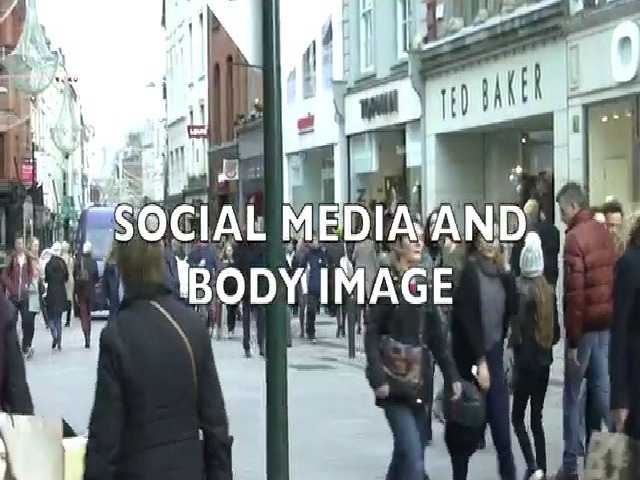
The City explores the streets of Dublin to see what the public makes of the impact of social media on body image.
By Niamh O’Donoghue, Nicola Kirwan and Marie Cogan
Although people certainly still meet others at social venues like clubs and parties, it is safe to say that tools like Facebook and Twitter have profoundly changed most people’s lives and how they interact with each other and the world around them.
Social media have forever changed the way society works, for instance the way people share ideas, the communication of news or how we express an opinion.
They also have benefits for business owners, as it allows them to reach out to their customers and get the attention of more people at lower cost and with more targetting than traditional advertising. For media companies and journalists, there are no longer overnight trips, nor will they need to communicate by phone or meet people in person, as social media provide more means to get in touch with sources.
In social media you just choose the people and groups that you want to follow on Twitter, Facebook, or other social networks. In doing this, you know who is recommending the news, and can easily communicate with that person about it. But that is not all.
Adrianna Murto is a Spanish student who is currently studying in Ireland. She says she uses Facebook to be in touch with her family and friends in Spain.
“For me, Facebook is really good and helpful. It is hard to imagine growing up without social media. All my family is on Facebook, so I am studying here in Ireland we communicate with each other every day, and we get to know each other’s news, rather than using phone calls, which are quite expensive.”
Adrianna adds that for students, social media make life easier.
“It really helps us as students, we have a Facebook page where we share all class information about exams, subjects, homework and among others.”
On top of all that, social media has been the source from which many people around the world get their news.
For many people, before they check Yahoo or Google news or an online newspaper site in the morning, they first look at the stories their friends and people they follow are sharing via Twitter or Facebook.
They are also quicker and easier ways to reach an audience rather than using press releases: you can just do a Facebook post with some images and it reaches an audience quicker.
“Facebook makes my work easier as I work for an environmental organisation and we do quite lots of press releases — we can reach an audience directly without needing to go via journalist, newspapers or magazines” says Jack Jackson, an environmental lawyer. “We can put up regular posts on Facebook and they can be shared and liked by lots of people. We can reach more than 10,000 people with decent posts.”
Jackson says he uses Facebook even more for personal reasons: keeping in touch with friends and family, and that Twitter is a work tool. “With Twitter I can keep in touch with lots of issues that are happening around the world and keep updated in terms of news and development in the area I work in.”
Even if social media make life easier, you need to think twice before posting anything online.
Andrew Jackson, the National Anti-Bullying Coordinator says social media is good for everyone’s daily life, but beware of oversharing: “You need to think twice about everything you put online because it will never get deleted, it gets shared or retweeted. So only put online what you would not mind your grandchild seeing in the future. Do not share online images or posts you will in the future be embarrassed about.”
Parents are often the worst culprits, Andrew adds. “Today we see children who cannot walk or talk but they have massive digital images shared by their parents. Before sharing their photos, parents should think about what type of information their children want to see about themselves online at a later date.”
Sharing children’s information online, Andrew says, can put a child at risk in the present and in the future.
A recent US study found that 63 per cent of mothers use Facebook; of these, 97 per cent said they post pictures of their children; 89 per cent post status updates about them, and 46 per cent post videos.
Social media, for all the positive things they bring, still need to be handled with care.
A major social networking site is setting up its headquarters in Ireland much to the disapproval of the Irish public.
Controversial site Ask.fm announced in early November that it is moving its head office from its current base in Latvia to Dublin.
The move has sparked outrage among many, including Foreign Affairs Minister Charlie Flanagan who took to Twitter to voice that the move was a “matter of concern” and would be raised with his Government colleagues.
Ask.fm is a social networking site that allows users to send questions and comments anonymously to other users, and to be questioned in return.
According to the sites official page, Ask.fm has “more than 120 million members in over 150 countries” with approximately “25 billion answers.”
The site has come under huge criticism in recent years as it has been linked to cyber-bullying resulting in a number of suicides among young people including Irish teens Ciara Pugsley and Erin Gallagher. Both girls died tragically in 2012, reportedly because they were both victims of bullying on the site.
Ciara Pugsley’s father Jonathan is now urging the Government to take action against the move and is shocked that the relocation was allowed to take place in the first place.
Speaking on the Ray D’Arcy show, the Leitrim father said the site tends to “breed vile comments.” He also added that he would “challenge anyone to go onto the site and not be on it a short period of time without seeing some horrible, disgusting comments.”
According to the sites official page , Ask.fm “have created a place for our members to have fun, share information, make friends, and express themselves freely. We want them to do this in a safe environment.” However, what has been under fire in recent times is the approach of the company to the safety and well-being of its users.
In August 2014 Ask.fm was bought by an American company, the owners of dating site Ask.com. According to head of operations and lead advisor on user safety Annie Mullins, “one of the conditions of buying that company was that the former owners left almost immediately from the day that [we] bought it.”
With the site under new management, Annie Mullins spoke on RTE’s Prime Time show about her company’s action to fight cyber-bullying and to introduce a completely different approach to user safety.
According to Ms Mullins, the new company has invested in moderation by hiring experts in internet safety both in the USA and across Europe and are looking to work in partnership with several organisations that are experienced in educating and advising parents on bullying.
Though the site has received a lot of bad publicity and has gained a difficult reputation, Ms Mullins commented that “the site is growing.” According to Annie Mullins, “anonymity is part of the functionality” of the site and again this feature is outlined on the site’s website as “something to be cherished because it gives young people the encouragement and confidence to ask the questions, have the conversations and find the answers to the challenges of growing up.”
The site states that it is in partnership with several of the world’s leading internet safety companies including Internet Watch Foundation (IWF), Insafe, and ICT coalition. On the sites safety centre page “ask anonymous questions”, “do share your thoughts with everyone” and “spread Ask.fm across the web” is encouraged, while “don’t say mean things” and “don’t be a bully” is discouraged.
Dublin South West TD Seán Crowe has said that the decision by Ask.fm to locate in Ireland has posed new difficulties and challenges for Ireland in terms of cyber-bullying and that the Minister for Children James Reilly should now do more to protect Ireland’s young from online threats.
Numerous cases of ‘catfishing’ have come to light in recent times, illustrating just how dangerous the web can be and highlighting a grave concern over just how safe an individual’s images and personal details are on the world wide web.
A ‘catfish’ is an individual who pretends to be someone they’re not using a social media account for the purpose of creating a false identity.
‘Catfishing’ is a startling reality in today’s era of digital communication and can have serious repercussions for those affected.
Many of the ‘do-no-gooders’ hide behind a computer/iPod/tablet screen as they scam their way into building a romantic relationship with unsuspecting victims.
Not only do those responsible for catfishing steal the identity of other individuals, but they post false information alongside the image they have stolen of an individual they may or may not know.
Aida Skirmantaite, a fourth year journalism student in DIT, spoke about her experience of being catfished and the terror associated with realising that someone somewhere is pretending to be you.
Aida couldn’t understand why she had fallen victim to catfishing and what had attracted the perpetrator to her page. “I asked myself why would they choose me,” she said.
For Aida the whole experience of being catfished started when the fake page was suggested to a fellow Facebook friend.
That friend happened to run the page by Aida, as he knew the profile picture was of Aida but the name underneath was far from hers and instead supposedly was that of an Irish woman.
Aida’s boyfriend added the fake page in order to discover who the personal identity thief was but to no avail. Aida then immediately reported the site to Facebook who took action by removing the page.
Since the experience Aida has tightened the security surrounding her online social media profiles and is more aware of what can happen in a realm of virtual communication. She now searches for any associations with images on her social media account through an application called ‘Tineye.com’, a “reverse image search engine” that has the ability to find out where an image online came from, how it is being used online, and if any modified images exists.
Another social media account holder Jennifer McDonald commented, “I’ve never been catfished but I get loads of friend requests and messages from profiles that are clearly fake and are people catfishing. I usually go onto the page and block them and I usually don’t write back to them but I did once and it was a weird experience so I just block them all now.”
Essentially catfishing is pretending be someone you’re not on popular social media accounts as seen in the case of 21-year-old journalist Emma Nolan whose images were uploaded to a Tinder account and used for online dating purposes.
A 2010 movie entitled Catfish brought to light this shocking scenario by telling the tale of a 28-year-old man named Nev Schulman who fell head over heels in love with a stranger’s Facebook profile picture only for her picture to be remarkably different to what she looked like in reality. The movie was a success and furthermore went on to inspire a series of documentaries on the issue.
One of the problems of modern life is that of creating and managing passwords. Many of us choose too simple a password and use the same one for multiple accounts, thus seriously compromising our online security.
And it’s not just passwords either; we also have PIN numbers for our mobile phones, bank cards and whatever else. Add them all together and the result is an impossible number of letters, symbols and digits to keep in our heads. Worse still, we then have to remember which passwords match which account and, indeed, what username we chose for that account in the first place.
I am a pretty average user and at a rough estimate have about 25 such combinations to remember. Rather unsurprisingly I often don’t.
So what’s the answer? How best to create, organise and remember all the tricky little blighters without making it too easy for the hackers? Help is at hand, but before we begin please, please, please do not be clever and use ‘password’ or ‘backdoor’ or similar as your password. Lots of other clever people do that, and lots of other equally clever people will consider them worth a guess to see if you’re not as clever as you think you are.
Having got that out of the way, we give answers to your most frequently asked questions:
I know I shouldn’t use short passwords but my dog has a fairly long name and it’s easy for me to remember, so why not?
Okay, a complete stranger might not know the dog’s moniker but what about friends and acquaintances? Also, have you ever posted a picture of your pampered pooch doing something endearing on Facebook with his name included? You have, haven’t you? Anyone looking at your page already knows your name; now all they need is your password. A quick guess at ‘Marmaduke’ will do the trick. Prepare to be fraped.
What about those preset security questions for when you’ve lost your password; surely the same applies?
Good point. “Where did you go to school?” and “What was your mother’s maiden name?” are both eminently Googlable. The more you interact on the internet the more information about yourself you’ve put out to add to whatever’s out there already. Consider password reset questions carefully.
I have a special password for important stuff like my online banking; for all the rest I use the same password.
Congratulations on keeping your money safe, but consider this: You’ve attempted to log onto one of your accounts, let’s say it’s Netflix, and you’ve forgotten your password. You click forgotten password, follow the prompts and a message is sent to your inbox allowing you to reset it. Fine. But now suppose I have your email address and password (your email address is easy to find and I know your dog’s name remember), not only can I go in and watch movies at your expense; I’ve also caused you future inconvenience by changing your password in order to do so. And of course the same principle applies to any other accounts you might be subscribed to.
Your email password is more important than you might think; it can be the key to all the rest. Guard it carefully.
I store all my information on my phone, that way it’s always to hand.
Fine, just don’t lose it.
And just in case you do, for heaven’s sake make sure you have a security lock on it.
I’ve thought about what would happen if I lost my phone, so I back up my information in The Cloud where it’s safe.
Good for you, but bear in mind that even if your files are high above and out of reach in the stratosphere, or wherever this Cloud thing is, they can still be hacked. Just ask certain recently under-dressed and overexposed celebrities. You’re probably all right though; it’s highly unlikely that professional hackers are desperate to uncover saucy photos of your dog.
Okay, I get the message: I need long convoluted passwords incorporating higher and lower case letters, numerals and symbols and a different one every time. I’m never going to be able to remember them all, putting them on my phone may not be the best of ideas, storing on-line or on my computer carries risks of hacking, so what the heck am I supposed to do?
That is a very good question to which I do not have a definitive answer. You could try doing what I do and write them all down on a piece of paper.
Of course, security buffs would say that this is not a good idea either because burglars might break in and make off with your precious details. It is probably safest to put it in a locked lead-lined casket and bury it at the bottom of the garden, only to retrieve it at dead of night when the neighbours aren’t watching.
Just make sure the dog isn’t looking either in case he digs it up; there’s nothing more embarrassing than being hacked by a family pet.
———————
We went out onto the streets of the city to find out how people do actually manage their passwords…








You must be logged in to post a comment.