Tag: UN Technology

  • Deliveroo cyclists want priority for pedals

    Deliveroo cyclists want priority for pedals

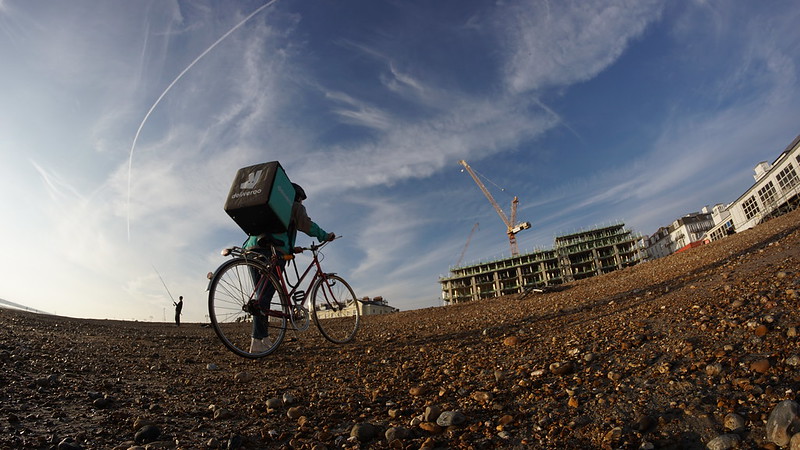
    Deliveroo cyclists have been left scrambling for hours as motor delivery drivers get first priority. Rebecca Daly explores the impact of Deliveroo’s technology on their riders.

    Photo taken by Jon Crel. Sourced from Flickr.

    Food delivery service Deliveroo was launched in 2013 and now operates in 13 countries around the world. They work with over 35,000 restaurants and have more than 30,000 riders who make the service come together. 

    The company is technology-centred in the sense that their business is based on the use of smartphones to place orders and to allow their riders to be offered them. 

    To make this all possible, Deliveroo uses an algorithm named “Frank” after a character on American TV show It’s Always Sunny in Philadelphia. Launched in 2017, it allowed order times to be reduced significantly – by 20% to be exact. 

    On the company’s website under a section named “Driven by technology,” they detail how this new technology meant that “riders are able to complete more deliveries per hour and increase their earnings, restaurants are able to increase their sales, and – of course – customers get their food even faster”. 

    However, to what extent does this digital technology actually impact its riders? 

    George, who did not want to reveal his real name, is originally from Brazil, but has been living in Inchicore, Dublin, for three years. He’s been a Deliveroo rider for two and a half years. 

    For him, Deliveroo is the ideal job occupation. He said, “We are our own bosses and we work as many hours as we want.”

    In 2019, a change came to the app which meant that the priority of drivers had shifted slightly, but with huge consequences. Deliveroo wrote to its riders by email saying, “You may have noticed that your self-service booking statistics now include a small priority for motorised vehicles.” 

    The change in priority was brought in to support long-distance deliveries but affected the business of cyclists delivering for the company. However, George says that cyclists are actually the ones left with longer deliveries of 5 or 6 kilometres, rather than the cars or motorcyclists. 

    Bicycle deliveries are excluded from the 11 am working time-slot and pushed to 3 pm or even 5 pm. This means that there are fewer hours left to choose from. 

    Full-time delivery drivers like George have certainly “felt this problem of having few orders”. At the weekend, they get more orders because the app itself is busier, but this does not translate into weekdays. 

    For example, George could get three or four orders done per hour on a busy day. On quieter days, this number drops to two per hour.

    “We are making less and less orders on the bike because of this scheme. [Deliveroo] keep opening accounts and more accounts. They no longer have many orders for us on bikes,” he said. 

    So, while “Frank” aims to optimise the number of deliveries for its riders, the app’s priority scheme seems to do the exact opposite for those who operate on bicycles – the original method of food delivery for the company. 

    Instead of all of its delivery drivers benefitting from this 20% increase in order times, Deliveroo’s technology has actually hindered their cyclists.

    The previous description of how this algorithm positively impacts riders is somewhat questionable as a result. Not all of their riders are able to complete more deliveries or increase their earnings because of how the app has been designed. 

    *Deliveroo were contacted for comment about this issue but did not reply.
  • Behind data centres: powering your everyday life

    Behind data centres: powering your everyday life

    Technological changes have enabled personal development in both the workplace and at home, better decision making and a growth in knowledge. However, do you know how these technologies have been enabled? Andrew Blair White talked to Niall Franklin, the Marketing & Communications Manager at Hanley Energy about how this technology makes it to our homes everyday.

    Copyright free photo sourced from Pixabay.

    Technology is at the forefront of many modern developments, with data centres being a main provider of how we consume new technology daily. However, do you know how these technologies have been enabled? What is powering your television at home, what is powering Google to search? The answer is data centres – whose energy is provided from many different companies.

    Niall Franklin said, “Our business over the last decade, serving big data centre clients across the globe, has gone from strength-to-strength due to digitalisation and demands placed upon cloud-computing.” 

    The increased demand for more and more internet, streams and power have made the technology industry skyrocket in recent years all over the world. “We develop technology and provide the necessary product, software and service which underpin our clients core business practices,” said Franklin. 

    With every business, they are extremely keen to keep customer satisfaction at the top of their list of priorities. As a result, they offer a very wide range of services for every business that uses their services. 

    Therefore, the work that takes place at companies such as  Hanley Energy is absolutely crucial for businesses, and for our overall satisfaction of using technology. This has allowed them to grow their business, they provide the energy for data centres to allow quick and reliable technology to take place. “What sort of impacts does it have on our everyday lives, where would we see this technology taking place?” I asked. 

    Franklin said, “Every day, provide the essential functions they need to trade and keep their business power on without any fuss. The businesses we work with could be streaming live sport, or operating everyday technology such as smartphones, smartwatches, websites and more – it is crucial that they can operate without disruption.”

    Hanley Energy has expanded into a global company over the last number of years. “For companies such as Hanley Energy, how crucial is it to have a big base of workplaces and where can they be found?” I asked.

    “Our Headquarters is in Ireland, where we have three state of the art manufacturing sites, spanning 60,000 square feet where we try to innovate and create all the time. We have a dedicated, future-spaced facility named our ‘Global Competence Centre’ (GCC) near Dublin,” said Franklin.

    These centres allow for all the behind the scenes work to be carried out to try and create new products everyday. I asked, “How many new products and services are tested in the GCC and how important is it?” 

    Franklin replied, “In the GCC, we can test some of our new products and services before we release them into the market for businesses to use. Due to this, we can add more value to the market. We also have business operations similar to this across the United States, Sweden, Germany, Australia and South Africa.”

    As the technology industry has continued to grow, so has Hanley Energy. I asked where the association with Cricket Ireland stemmed from. Hanley Energy CEO, Clive Gilmore said, “Hanley Energy share Cricket Ireland’s passion for the development of the sport and are excited by the progress of the Irish team. Ireland’s recent achievements and displays of world-class potential reflect our own ambitions and accomplishments – most recently the opening of Ireland’s only Data Centre research and development hub.”

    The requirement for technology worldwide is only furthering the enhancements of companies such as Hanley Energy. I asked Niall Franklin, “What is their company’s core message?” Franklin said: “To increase customer profitability through innovation.” 

    The data centres that they power play such a massive part in everyone’s day to day lives, which is something to bear in mind next time you use your phone or your laptop.

  • Will robots take over the world? Behind artificial intelligence

    Will robots take over the world? Behind artificial intelligence

    While artificial intelligence might sound like a scary thing of the future, we use it everyday. Erica Carter sat down with Professor Alan Smeaton, an AI expert, to chat about how artificial intelligence affects us.

  • Technology causing differing opinions on working from home

    Technology causing differing opinions on working from home

    2020 has seen a severe change in how we work and more importantly, where we work. People have had to learn how to use new technologies as working from home and remote working has become essential to keep people safe against the coronavirus. Eibhin Kavanagh talks to workers about the pros and cons of working from home.

    Love it or hate it, we’ve all experienced a change in how and more importantly where we work this year. Image: Pixabay

    Working from home is a term we are all more than familiar with by now. However, it is something that people certainly have differing opinions on.

    Ireland had one of the highest numbers of people working from home during the coronavirus pandemic, according to labour market think tank Eurofound.

    The technology available to people at home is different than what is available in a work environment. Reliance on your own internet or own equipment can either be something that can be very beneficial or can negatively impact your work.

    TheCity.ie talked to a number of people on this topic to see if working from home works for them.

    Emma Read, UJ Virtual assistant and Mailchimp partner, has been working from home for five years now. “Working from home is much better for my mental health and wellbeing,” Read said.

    As Read is self-employed, she supplies her own technology to work from home, so there has not been an adjustment from office work to working from home. “I choose my own hours, work in my own space, whether that be at my desk, on the sofa or in the garden in summer. There are no office politics to deal with, no commute,” Read said.

    “Why anyone would choose to work any other way beats me!” she said.

    Izzy Glazzard is a marketing manager for Reworked. Glazzard has also seen the benefits of working from home and how employee attitudes have also adapted to this major change in how we work.

    “Working from home has really challenged my ability to manage my time and multiple projects consecutively,” Glazzard said.

    There have also been reductions in businesses expenses, such as office maintenance that has benefitted Glazzard and Reworked.

    “I think overall I’ve gained some really valuable skills. I can see a shift in employed attitudes towards working from home  as they realise the mental health benefits for staff,” Glazzard said.

    Lisa Murphy, who works for a research organisation, has been working at home since the pandemic began in March.

    “It’s extremely frustrating,” Murphy said. Her work provided her with the technology required to work from home, but her internet can cause issues and even something like the weather can affect it and impact her work.

    “The thing for me is just more about how isolating it can be you know, I’m very social,” she  said. Murphy only started her job 3 months before lockdown and feels like working from home has impacted her ability to get to know her colleagues.

    Mhairi Cochrane, 22,  co-founded her own business, Lilypads. Cochrane graduated from University amongst the “Covid chaos” and went straight into working from home on her own business.

    “I would say the main challenge was trying to learn a lot of new skills and use a lot of new online tools,” Cochrane said.

    “I have never been that tech savvy, also when my Wi-Fi at home has a mind of its own and regularly just crashes. Me and my co-founder were not even able to meet and help each other out, we had to just chat over Zoom.”

    Working from home has not been Cochrane’s favourite experience, as someone who “loves being around people and someone who hates boring routine”.

    Living in a family home when working from home has also added to Cochrane’s opinion on working from home.

    Going walks and mixing up where I work in the house – floor, kitchen table, standing chester drawer make-shift desk – has definitely helped,” Cochrane said.

  • Digital technology that connects people

    Digital technology that connects people

     Digital technology has become such an inseparable part of people’s lives that most of the time it’s hard to notice the improvements that always-changing technology brings. People from different groups of society find different ways of employing technology for their own needs. Laura Matjusaityte discusses how digital technology and especially use of social media have impacted the lives of immigrants.