
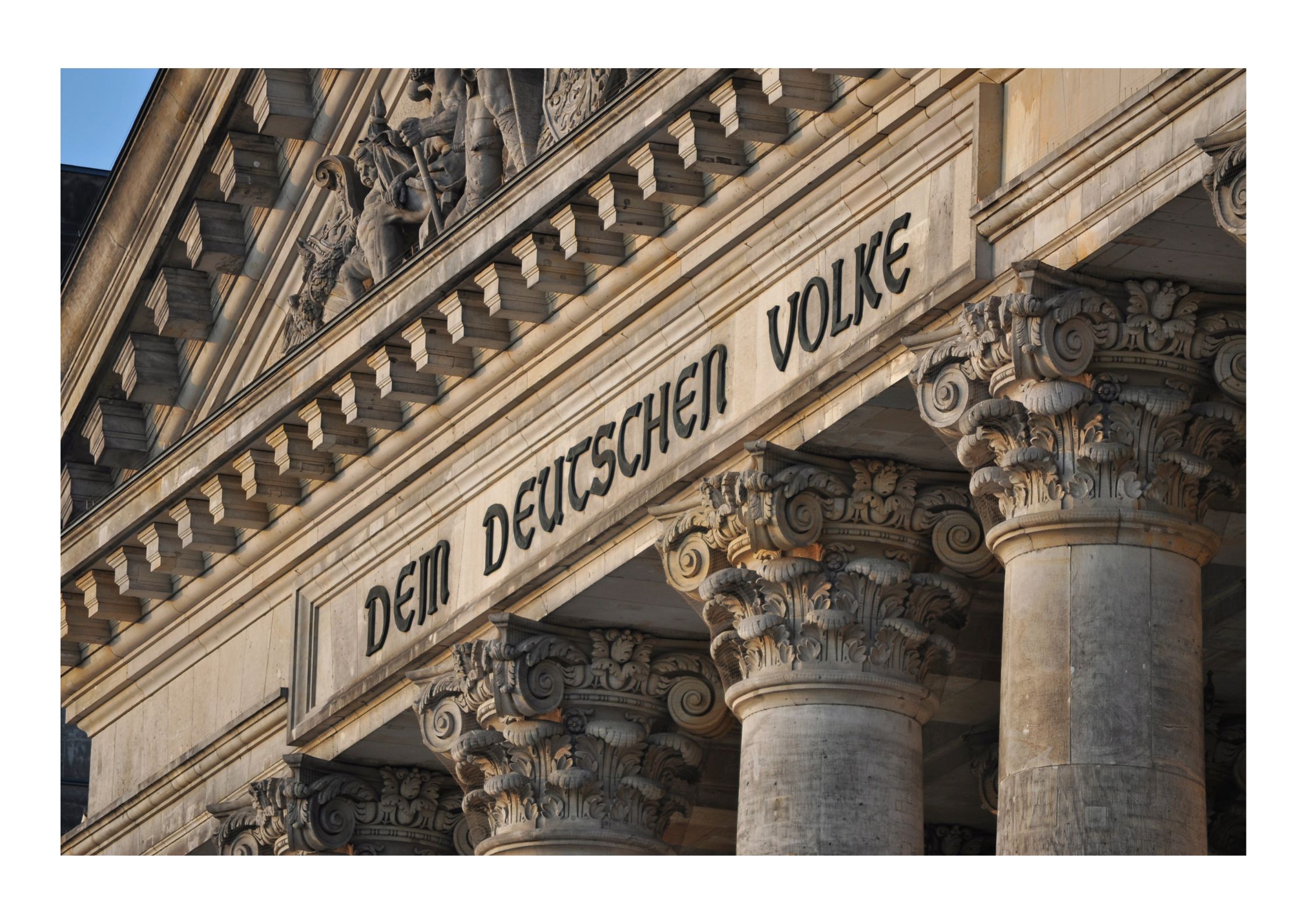
Last week, the German Christian-democratic party crossed a line that hasn’t been crossed on a federal level since 1949 – they voted with the far right. Consequently, parallels to Germany’s extremist past are once again being brought into the open.

In a parliamentary meeting on January 29, the conservative CDU presented a plan to drastically reduce migration to Germany and achieved a majority only thanks to the far-right party Alternative für Deutschland (AfD).
Journalist Martin Böhmer of the nonpartisan media outlet CORRECTIV said:
“The CDU introduced this draft bill knowing that the AfD would support them, and this has never happened before on a federal level. This is why a lot of left-wing parties and activists called out the CDU and their head candidate, Friedrich Merz, for breaking this so-called rule that they wouldn’t vote together with the AfD.”
Germans refer to this barrier as the ‘Brandmauer’, or firewall. Although there is disagreement on whether the CDU permanently tore down this wall – since their proposal was non-binding – it certainly seems to have cracked.
While the media speak of a ‘historic moment’ and ‘breaching a taboo’, some are making more direct comparisons to Nazi Germany – even current chancellor Olaf Scholz. In the debate leading up to Merz’ proposal, Scholz said:
“The right to asylum is the direct response to the horrors of Nazi rule. Back then, it was Germans and European Jews who were turned away at foreign borders. This must, as history teaches us, never happen again, Germany must never allow it to happen again.”
Martin Böhmer also felt that he’d seen Merz be called a neo-Nazi more often in these last weeks, as well as a “Steigbügelhalter”, or ‘stirrup holder’, referring to “a person or a party who’s enabling fascist or right-wing politicians to gain power”.
“Conservatives were labelled this in 1933, when Hitler and the Nazi Party came to power, and we’re seeing these comparisons being made again,” he said. “And the CDU are also being dubbed as Nazis.” This mostly happens during street protests, according to Böhmer, rather than in actual political discourse.
Historically, German politicians have often used comparisons with Nazi figures or methods rather than the term itself. In the 1970s, conservative Franz Josef Strauß (CSU) was likened to Nazi propagandist Joseph Goebbels. Strauß himself used the same insult against left-wing protesters, accusing them of being Goebbels’ best students and “the best Nazis that ever existed”.
“[Strauß] was inverting the meaning of ‘Nazi’ – a method that the AfD still applies today,” according to Maximilian Kreter, political scientist at the Hannah Arendt Institute for Totalitarianism Studies.
Kreter sees great value in drawing parallels between current events and history – in a scientific context.
“But most comparisons that are used in public discourse are not really justified or useful because, in most cases, they’re instrumentalised for political purposes,” he said.
He does not, however, believe that things should be represented as less severe than they are. “When somebody acts like a Nazi, speaks like a Nazi and behaves like a Nazi, it is a Nazi. And some of the current politicians of the AfD, that is what they’re doing.”
One of the media outlets calling the party out for their extremist views and actions is CORRECTIV, where Martin Böhmer works. In one of their biggest investigations to date, they looked into the AfD’s ties to extremist groups, exposing secret meetings where members allegedly planned mass deportations.
Although CORRECTIV’s Nazi allusions have been criticised, Böhmer insisted on a precise use of language.
“The term “Nazi” is extremely loaded in Germany – quite rightly so. There is no point in immediately labelling everything that is right-wing and conservative as Nazi. That doesn’t help democracy, it doesn’t help the discourse. And it is also simply journalistically wrong.”
Without using the Nazi label, Böhmer still warned against the rise of the AfD. “They’ve just become more and more extreme, and I feel we need to be very careful for democracy.”
AfD members are, of course, not a monolith, but many members share extremist views, as the government has found. As of now, the Federal Office for the Protection of the Constitution officially considers the AfD to be right-wing extremist in some states, and they’re under surveillance on a federal level, according to Maximilian Kreter. “It’s only a question of when they are qualified as a right-wing extremist party,” he said.
The AfD has repeatedly denied racism allegations and ties to the extreme right over the years. In their manifesto, they describe themselves as “liberals and conservatives”, “free citizens”, and “devoted democrats”.
In the upcoming election on February 23, they are estimated to receive 20 to 22% of all votes, according to Statista – which would make them the second strongest party, the first being the conservative CDU.
You must be logged in to post a comment.