
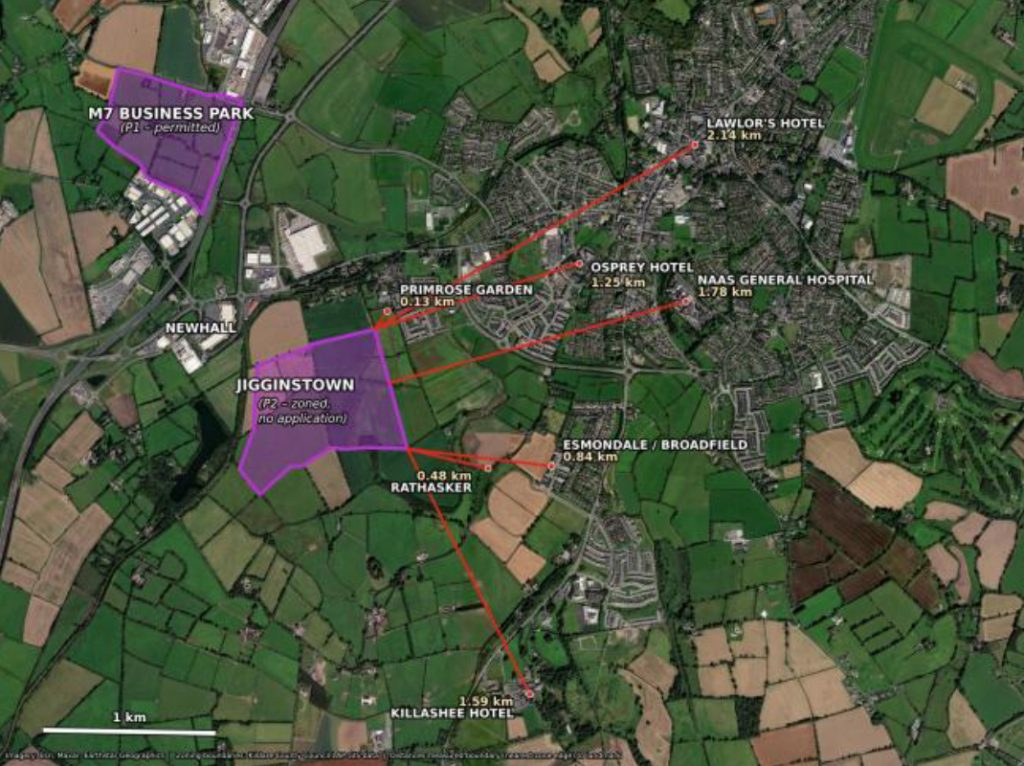
Photo courtesy of Data Centre Awareness Kildare
Plans for large-scale data centre developments in Kildare are facing opposition over their demands on electricity infrastructure, their environmental impact and the number of permanent jobs they are expected to create.
At the centre of the dispute is a proposed €3 billion campus near Naas, where developer Herbata Ltd received planning permission for six data centre buildings in August 2025.
The decision was appealed by environmental objectors. The case remains before An Coimisiún Pleanála, according to the published planning record.
The scale of the project is set out in planning documents submitted by Herbata. Each of the six buildings is designed to accommodate 30 megawatts of information technology capacity, giving the campus a total IT capacity of 180 megawatts. That’s enough power for around 100,000-150,000 homes.
A separate submission by Herbata to the Commission for Regulation of Utilities describes each building as having a total electrical power demand of up to 40 megawatts. The distinction matters, as IT capacity and total electricity demand are not the same measure. IT capacity is the energy required for specifically powering the data centre itself, whereas the total electricity demand includes on-site infrastructure such as cooling fans and pumps.
The plans include gas turbines, a gas engine, battery storage, rooftop solar panels and connections to the gas and electricity networks. Herbata’s environmental documentation says on-site gas generation would supply the majority of the electricity needed to operate the centres.
The proposal has drawn objections over its potential emissions and its reliance on gas. In their appeal, Friends of the Irish Environment and Friends of the Earth challenged aspects of the emissions assessments and argued that the planning decision did not adequately address the implications of powering the development from the electricity grid.
Their submission also questioned whether sufficient grid capacity was available.
Clyde Doyle, spokesperson for Data Centre Awareness Kildare, said the economic case for developments of this scale had not convinced local opponents.
“We have a housing crisis, we are short of construction workers, but at the same time we can build these [data centres],” he said.
Sam Nugent, a local resident, echoed concerns about development priorities in the county.
“We need more homes, not data centres,” he said.
A KPMG report on Ireland’s data centre sector estimates that around 8,000 direct and indirect jobs are associated with the industry.
However, this wider figure does not establish how many permanent positions would be created by Herbata’s proposed campus near Naas.
Herbata was contacted for comment on the proposed development, its expected employment and the concerns raised by opponents, but had not responded by the time of publication. Local TDs were also contacted for their views but did not respond.
A second potential development at Jigginstown, near Naas, has also become a focus for residents. Microsoft held a public information exhibition about a possible data centre there between November 2023 and July 2024. No formal planning application has been submitted yet.
The site however is zoned for data centre use. Opponents have raised concerns about its proximity to homes and community facilities, as well as archaeological remains identified during test excavations in 2024.
The significance of those findings, and how they might affect any future proposal, will depend on the archaeological reports and subsequent planning assessment.
Microsoft was contacted for comment on the potential development and the concerns raised but had not responded by the time of publication.
Doyle argues that the county needs a broader assessment of the cumulative effects of these developments, including their demands on energy infrastructure and the consequences for nearby communities.
His group is pressing councillors to reconsider data centre zoning and is calling for a moratorium on further development until those effects have been assessed.
The dispute raises questions that extend beyond individual planning applications: how much electricity future facilities will require, how that power will be generated, who will pay for supporting infrastructure and how many lasting jobs the projects will bring to the county.
The KPMG estimate highlights the wider employment associated with Ireland’s data centre sector, but the specific long-term benefits of individual developments remain an important part of the debate.
Those benefits will need to be considered alongside the infrastructure and environmental implications of further development in Kildare.
You must be logged in to post a comment.