
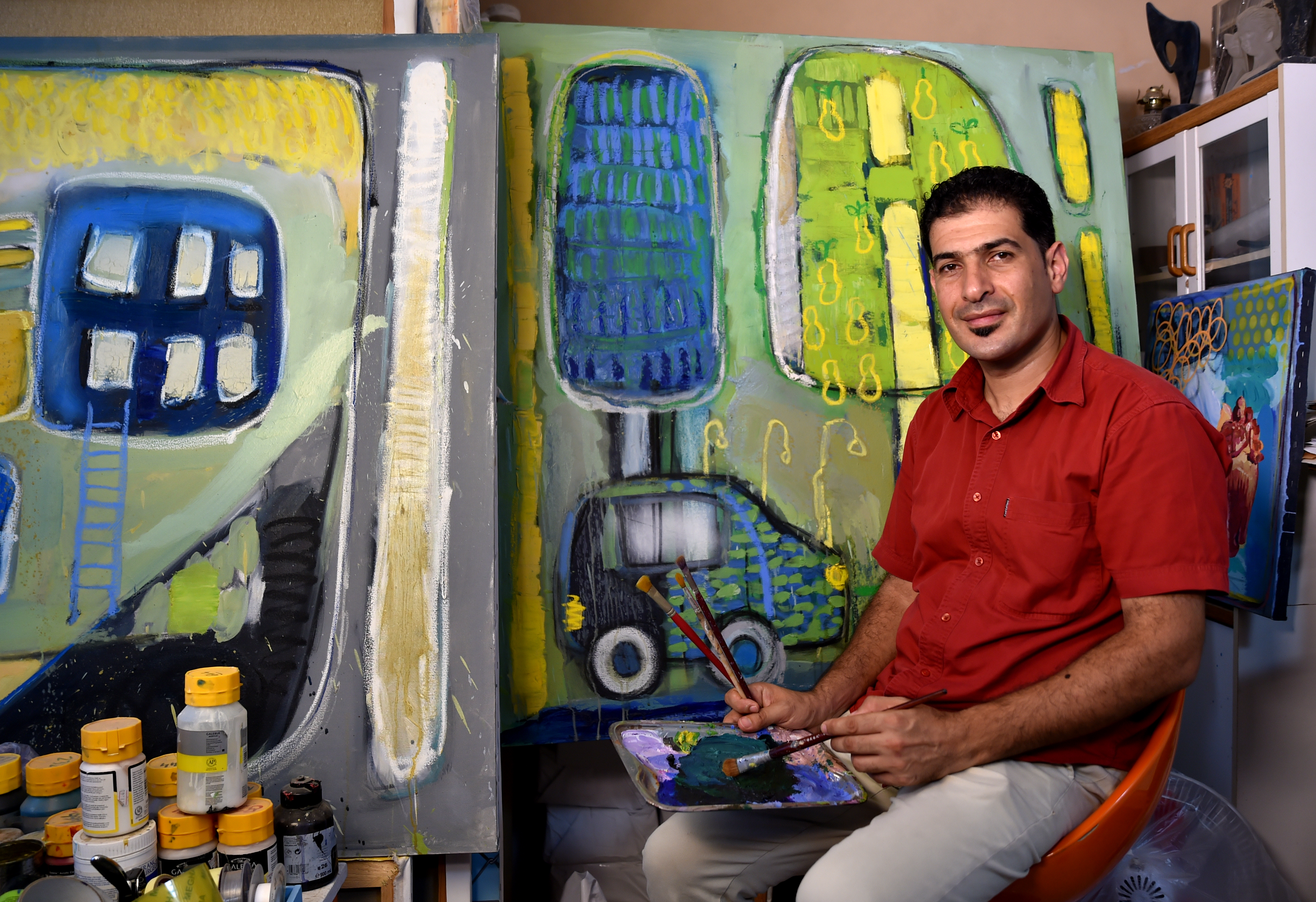
After his home and studio in Gaza were destroyed by Israeli forces, Mohamed Abusal lost trust in art – now he feels a duty to start again.
Mohamed Abusal talks to his cactus. He speaks to them all, in fact. In Gaza, he had 400 of them growing on his rooftop, but they’re gone now. Today he settles for five, all contained in small pots on the outskirts of Marseille, two thousand miles from home.
He’s protective of them, and hides them away if a friend with a bad aura comes to visit. In his experience, one look from someone like that can kill. “It’s energy,” he said, furrowing his brow and squinting his eyes, “once someone looks at something [like this], it becomes a bad situation,”
“Sometimes I feel this plant is not satisfied being beside this plant,” he said, gesturing with his hands. “A very tall plant next to a small plant – they are not satisfied, so I make them [go up] step-by-step.”
“I don’t know, maybe I’m a crazy one,” He agreed that after 50 years on this earth, a little bit of crazy is a good thing for any artist.
Abusal was sporting thin-rimmed black glasses, a deep maroon t-shirt, and a Zappa-esque soul patch when I spoke to him.
His two young children were playing behind him, and on a few occasions, he told them to be quiet. They can be forgiven for wanting to have fun in what is still a relatively new environment for them, having only moved to France in late 2024, after being displaced from Gaza five times.
Abusal spoke fondly of his own “simple and minimalistic” childhood in Palestine. He recalls the agricultural region where he grew up near the Gaza Valley wetlands, the lemon farms and their requisite greenery, and the donkeys roaming freely around his village.
“I remember Gaza without the checkpoints,” he said, “without the war, without the army… life was very nice.”
I asked him to cast his mind back. When he thinks of his earliest years – what does he see? “The people, the faces, the life,” he said, “this was important.” He grinned then, and lit up like a schoolboy: “I cannot forget the sound of people selling handmade candy in the street.”
“[But] the farms disappeared step by step,” he said, “and then the concrete came.”
It was the third anniversary of the beginning of the genocide when we spoke.
Abusal’s parents were not originally from Gaza: they were expelled from central Palestine during the Nakba – a period of mass, violent displacement of Palestinians in the late 1940s to create an Israeli state.
They always encouraged his earliest artistic inclinations; his mother loved to draw, and made traditional Palestinian tatreez embroideries (she even made him one for his wedding day, depicting two shining birds).
When he was five years old, they moved to Saudi Arabia – a change that would come with unique challenges for the young artist: “In Saudi Arabia, we felt like foreigners – like strange people.” It took him a long time to make friends and find his place there; his small green village now traded for a sprawling, rapidly modernising, oil-booming city.
Abusal returned to Gaza at 17, and even now after resettling in France, he places huge importance on maintaining a connection to his people. He and a few other Palestinian artists have formed their own small collective in Marseille, and get together to discuss how to work as an artist outside the inner workings of the cutthroat French art world.
Abusal communicates with at least one person from back home every day – his brother, his sister, his friends – take your pick.
As part of the artist collective Eltiqa (currently showing in IMMA), he got to travel widely, and upon returning to Gaza, he would bring boxes filled with pamphlets, art materials, and publications for the younger artists.
Abusal spoke passionately about this mentor role: “Every day I’m helping [them] to build a portfolio, write a statement… we try to find opportunities for them,”
“We were messengers,” he said, “transferring voices from Gaza [to the] outside.”
To ask an artist what their favourite piece of work is, is as sacrilegious as asking a mother which child she loves most – but I did it anyway. Abusal beamed with pride as he spoke about his 2012 project Metro in Gaza, a reimagining of the tunnels under his homeland.
They were first created in a desperate attempt to break the siege, but during an artist residency in France, Abusal envisioned a world where these tunnels were a metro system. He enlisted the help of several people to make it happen, and they drove through the desert with their Parisien-style metro signs, planting them at 150 stops, and handing out maps of the concept to the public.
It was difficult for them to take photos of the project, as the Israeli army were suspicious of the group planting large metal poles in the sand across Gaza and the West Bank.
They even captured a photo close to the Salah al-Din Axis, the southwestern stretch of land between Gaza and Egypt.
I spoke to Palestinian curator Yazan Khalili before I sat down with Abusal. “I met [Abusal] for the first time in Kassel,” he said, “sadly, we lived 90 kilometres away from each other, but we could not meet because access between the West Bank and Gaza is closed,”
Khalili told me how Abusal’s cactus series was especially meaningful to him. “His work touches me a lot because it’s a documentation of a life,” he said.
Abusal’s cactus garden went much deeper than a mere love for botany. For him, and several other Palestinian artists, the cactus has come to symbolise their people – grounded, resilient, and prickly, firmly rooted in the land.
“I feel the plants,” he said, “it is a passion.” You can feel this passion when you admire his paintings. You can feel the Palestinian plight if you open yourself up to it.
“When I lost my home, it was a big shock,” he said, “I lost my hope, I asked myself, ‘why am I an artist?’ – I didn’t trust art, because art didn’t protect me.”
A cactus won’t save you from a bomb, but for Abusal it offers something enduring – proof that what is gone can always come back. “When the cactus is destroyed, it grows again because its roots are very strong,” he said, “it is the soul of the land.”
You must be logged in to post a comment.