Author:

  • Is a university degree worth more than an IT degree?

    Is a university degree worth more than an IT degree?


    At the recent Global Irish Economic Forum, Glen Dimplex CEO Sean O’Driscoll stated that Ireland has “too many universities”.

    The University College Cork graduate believes that “We need to redefine the role of ITs. They should not be quasi-universities. ITs should be about apprenticeships and internships.”

    With the impending amalgamation of Dublin Institute of Technology, IT Blanchardstown and IT Tallaght to form Dublin Technological University on the city’s northside, the question arises; “Are degrees from universities more valuable than those earned through an institute of technology?”

    “In practical application, no, I don’t think there is a difference in the value of a degree, but in terms of actually getting a job, maybe.  Maybe nowadays employers look more positively on names such as Trinity and UCD than those ending with IT”- Philip Greene, Economics and Politics, Trinity College.

    “I’m sure law courses in other schools cover the same ground as we do, but I do think firms look for students from the likes of Trinity, mainly because they more than likely achieved better academically to get into their respective colleges.  As well as that, there is a lot to be said for the esteem in which employers hold colleges and universities such as Trinity and UCD.”- Ellen Gaffney, Law, Trinity College.

    Dr. Paul Horan, the head of Campus Planning at Dublin Institute of Technology believes the move to Grangegorman will be a massive benefit to the college. “For DIT the project delivers a range of wins; improved facilities, potential to respond to changing pedagogy, potential to deliver facilities we currently don’t have e.g. student accommodation, synergies and savings in more efficient operation, and a strengthened sense of identity.”

    “I’d have the same skill set as a graduate from a similar degree in UCD or Trinity i.e I don’t think there would be much difference in the content.  I’m not sure though about getting a job.  I’d imagine employers would have a preference for universities.” Daniel Condon, Economics and Finance, D.I.T.

    “I think in practice, A degree from an I.T is every bit as valuable and useful as one from a university but in reality, a university degree would give an individual more opportunities as far as employment is concerned.” Daniel Murphy, Media, BCFE.

    “I think degrees from an IT carry the exact same value as ones from a university.  My course is a four year degree course; just because it’s in an IT and not a university does that make it less of a degree? ITs are improving year on year and are quickly catching up to the level of universities.” Neal Harrison, Exercise and Health Studies, W.I.T.

    From talking to these students, it is clear that the general consensus is that a University degree carries with it a higher value to employers, but those who do IT degrees feel they are catching up.


  • Reviving the spirit of 1913

    Reviving the spirit of 1913

    This slideshow requires JavaScript.

    As many of you will know, this year marks the hundredth anniversary of one of the seminal events in this country’s history- the 1913 Lockout.

    Centred around a dispute between employers and workers about the abhorrent living and working condition that affected one third of the city’s population 100 years ago, the lockout became the largest labour dispute Ireland had ever seen with over 20,000 employees ‘locked out’ of their occupations due to alleged membership of James Larkin’s ITGWU union.

    Although defeated after a five-month stand-off, those initial strikers set in motion a gradual change in attitudes amongst employers which would eventually put an end to Dublin’s infamous tenement slums and the squalid conditions which they perpetuated.

    With centennial celebrations higher in profile than many expected, artistic and literary tributes have come pouring in over recent months to commemorate the brave stance taken by the Irish labour cause’s trailblazing pioneers.

    Prominent among these tributes is the 30-panel 1913 Lockout Tapestry currently on display at the National Museum in Collins Barracks. Devised by artists Robert Ballagh and Cathy Henderson and put together by various community groups ranging from schoolchildren to prison inmates, the tapestry vividly narrates the struggles which strikers went through between August 1913 and January 1914.

    A passionate believer in the ideals of the working class, Ballagh, who also happens to be one of the capital’s most revered painters, is delighted to see the revival in attitudes towards the nation’s cultural and historical heritage.

    “I found it really encouraging, not just that the tapestry got a good response but there’s been a tremendous reawakening of interest in that period which has always been a period of great interest to me personally,” says Ballagh.

    “I’m just one participant in this whole project. It’s an impressive list of volunteers involved in the project, from the Embroidery Guild and Patchwork Society of Ireland to people who’ve never stitched a stitch in their lives before like recovering heroin addicts and prisoners in Mountjoy and Limerick.

    “A kind of camaraderie even grew up amongst people who’ve never met and found themselves working together on this project. It reflects the communal struggle in 1913 for justice and for better working and living conditions.”

    Hisotrian Padraig Yeates describes the last sequence in the tapestry as “a candle to be passed on to future generations”, and Ballagh is hopeful that this is just how current and future generations will view the exhibition, and indeed the very event which inspired it.

    “I hope that our efforts do inspire people to realise that the only way to get what you deserve in life is not working as an individual but to work in a cooperative and communal way to make your demands, and I would sincerely hope that that would become more evident as we move forward in these very difficult times.”

    Robert Ballagh and Cathy Henderson’s 1913 Lockout Tapestry will be on display at the National Museum of Decorative Arts and History, Collins Barracks, until November 14th.

    Both artists will be joined by historian Padraig Yeates in a seminar at the museum entitled ‘Dublin Lockout- Impact and Objects’ on Saturday, October 26th. A full itinerary of events for the day can be viewed HERE.

  • Is Christmas hitting the shops too early?

    Is Christmas hitting the shops too early?

    By Jonathan Crean and Claire Mc Quaid

  • Golden Discs Opens Its Doors Again

    Golden Discs Opens Its Doors Again

    by Mike Coleman &Greg Synnott

    Irish music store Golden Discs has re-opened today in St Stephen’s Green Shopping Centre.

    They have re-opened their doors to the public again thanks to a successful year of expansion.

    This year they have opened stores in Cork, Blanchardstown, Swords and Newbridge. The company currently employ over 120 people across the country.

    The new store will employ 12 people with a possibility of seasonal part-time jobs over the coming Christmas period.

    Store manager Michaela Duggan says that today’s re-opening has been a fantastic success. “Today has been great, we’ve had a few in already and it’s only lunch time”.

    Last year the company celebrated 50 years in business and with Tower Records moving from their Grafton Street location and HMV closing down last January, now is a great time for the music retailers to open up a store in the area.

    Ms Duggan was optimistic about the store’s future saying, “the other shops that opened up this year have done well, so hopefully we’ll do well coming up to Christmas”.

    The company are aware of the popularity of downloading music, and they stated that they intend to “upgrade its on-line download store” and will offer physical CD and DVD sales through its website by the end of 2013.

    Reporter and Photography – Mike Coleman

    Camera man  – Greg Synott

  • Gesaffelstein the Great

    Gesaffelstein the Great

    Gesaffelstein is a 28 year old Dark Techno DJ who, despite having a name more German-sounding than two Bratwursts in a pair of lederhosen, hails from Lyon in France.

    Well known to aficionados of Techno, Gesaffelstein is not quite yet a household name, but having already collaborated with big names such as Daft Punk, Brodinski and Kanye West, I suspect it won’t be long before his name is on everyone’s lips (despite the fact that it really is quite difficult to pronounce).

    This is the first time the Techno artiste has graced Ireland with his presence, and so there was a significant amount of buzz surrounding this gig. To be honest when I heard that it was the Button Factory he was to play, I was just a little bit sceptical. This is a big venue, and if enough people fail to turn up for a show, it can leave the room looking a little sad and empty. Like the inside of Paris Hilton’s head.

    However I needn’t have worried. Loyal fans showed up in their droves and packed out the standing room area to create an electric atmosphere that was buzzing with anticipation and sticky with the sweat of close to a thousand teenaged techno lovers.

    The sizeable crowd at the Button factory
    The sizeable crowd at the Button factory

    The Japanese Popstars supported, and while I also had my doubts of this choice of opening act, I was once again proved wrong, as the Northern Irish three-piece managed to hold the attention of the crowd quite well, though it was obvious the vast majority of revellers had come there to hear one thing and one thing only: Techno, and lots of it.

    When Gesaffelstein finally took to the stage the feeling of excitement in the room had reached fever pitch. As the he began to play, the relentless, thumping, baseline appeared to transform the crowd into one single, bouncing, bumping entity, loosely tethered together by the beat, and, of course, more sweat.

    Gesaffelstein played an amazing set, a combination of originals and remixes, dark and light. To say his first Irish gig was a success would be a gross understatement, and I can only hope he’ll be back to us again soon. Judging by the reaction he drew from the audience, I’m not alone in this feeling.

  • International Rules at the crossroads

    International Rules at the crossroads

    With the latest set of International Rules tests between Ireland and Australia now in full swing, many people are wondering whether or not the compromise rules concept has a viable future.

    Given its former reputation of being a hard-hitting and fiercely-contested battle between two proud sporting cultures, the appetite for future installments of the hybrid game between Gaelic and Australian rules football appears to be waning.

    Growing Apathy

    Although Ireland’s 57-35 victory over the Australian select was regarded as an enthralling spectacle by some, there appears to be a growing apathy amongst the sporting public in both countries which is beginning to be reflected in the attitude of the associations involved.

    By and large the mass brawls of earlier years have been confined to the history books (Photo credit Jimmy Harris on Flickr)
    By and large the mass brawls of earlier years have been confined to the history books (Photo credit Jimmy Harris on Flickr)

    Australia caused controversy this year with the announcement of an all-indigenous selection for the first time in series history. Labelled by some as ‘reverse racism’, the Australian Football League wanted to honour the contribution of Aboriginal players to the country’s national sport, and picked what they believed to be a more agile and skilful selection in the process.

    However, despite the best intentions in the world, the fact remains that not one member of Australia’s 33-man panel was part of this year’s All-Australian team lineup. Ireland, in stark contrast, had five members of last year’s equivalent All-Star side included in the home squad, with many more set to be named in the 2013 selection later this month.

    Declining player standards on one side at least has led to a predictable fall-off in support.

    From capacity crowds in both countries during the series’ reinstatement during the late ’90s and early 2000s, the average attendance figure of just 17’000 recorded during the 2011 test series in Australia was compounded by the sight of a half-full Breffni Park for Ireland’s victory at the weekend.

    Attendances for the rules matches have been dwindling Down Under (Photo credit Michael Spencer on Flickr)
    Attendances for the rules matches have been dwindling Down Under (Photo credit Michael Spencer on Flickr)

    Indicative of this decline was the Australian media’s complete lack of interest in the event. With not one major national broadcaster providing coverage of this latest series, the press Down Under generally seems to have gotten fed up with the sanitised version of what was once regarded as all-out warfare with a ball (merely incidental, of course) involved.

    Hope Remains

    However far it’s fallen from grace, the International Rules series does still retain some of its merits.

    From what started as a tenuous association during the two sports at the time of the series’ inauguration in 1984, relations have blossomed between the AFL and GAA in recent times, with intercounty luminaries such as Jim Stynes, Tadhg Kennelly and Marty Clarke swapping the round ball for an oval version in their quest to make it big in the Aussies’ premier indigenous sport.

    With many school and college teams from both codes now traipsing around the planet to test their skills against their compromise rules counterparts, it’s also initiated a valuable cultural exchange between the young peoples of two countries with a lot in common.

    But the fact remains that at its highest level, the series is plagued by a diverse set of problems. Speaking in Melbourne in 2011, GAA Árd Stiúrthór Páraic Duffy stated that unless series interest and attendances picked up in Australia, the Irish audience wouldn’t maintain a reciprocal interest.

    It appears that, following a sad and gradual decline, we’ve finally reached that crossroads. It’s now down to the GAA and AFL to pull their formerly proud combined sporting tradition back from the brink, or risk losing it forever.

    (Featured image credit Michael Spencer on Flickr)

    SOCIAL MEDIA NOTE

    @officialgaa

    @irfsofficial

    @gaaclub

  • The city in Autumn

    The city in Autumn

    From the leaf filled paths of St Stephen’s Green to the hazy streets of the inner city – here is a collection of photographs showcasing Dublin in Autumn.

  • Roma continue fiery start to the Serie A with 100% record

    Roma continue fiery start to the Serie A with 100% record

    A.S. Roma have erupted from the traps of the new Serie A campaign and maintained an incredible 100% start to the season, notching up an astounding nine wins from nine games under the careful guidance of new manager Rudi Garcia.

    The Rome club are the only team left out of Europe’s major football leagues, who have managed to take full points in all of their domestic games.

    With Osvaldo, the club’s top scorer for the previous two seasons having made a summer switch to Pochettino’s in-form Southampton side, supporters were looking for a replacement striker just as prolific as his predecessor to be brought in, and the arrival of Adem Ljajic did not exactly ignite the imaginations of the Giallorossi fans.

    With a solid and experienced centre-back partnership in Leandro and Benatia delivering some admirable performances at the back, and Maicon proving he can still compete competently at the top level in the game after his poor spell at Manchester City, Garcia has certainly built a strong foundation from which his side can push on and focus more attention on threatening at the other end.

    Beloved Roma captain, talisman and rare “one-club” player, Francesco Totti has defied recent pundit criticisms of his age and illustrated his ongoing significance and indispensable ability in his twenty-one year tenure at the club by playing a part in eight of the nine league fixtures, generating six assists and netting three goals, two of which he had the pleasure of scoring against bitter rivals Internazionale.

    A beloved figure within the Italian media, Il Gladiatore (The Gladiator) has been named Italian Footballer of the Year a record five times
    A beloved figure within the Italian media, Il Gladiatore (The Gladiator) has been named Italian Footballer of the Year a record five times

    Francesco Totti certainly deserves his nickname of Il Re di Roma (The King of Rome) and it will be an emotional day for the club and indeed the city when the Serie A’s top active goalscorer eventually decides it’s time to hang up his boots.

    However it is not just the impressive feat of maintaining a 100% record to a tough start to the season, rather the style and newfound confidence, approach and concrete defensive philosophy that Roma seem to be enjoying under the Frenchman’s reign as boss.

    Garcia’s team have conceded just one goal in all nine fixtures and scored twenty-three.

    Not to overstep the mark and predict an Arsenal-like “Invincibles” season for the Italian outfit, but Garcia has instilled a successful balance between defence and attack similar to that of the Gunners historic season. In actual fact, I do not believe the club has enough quality or depth in their squad, particularly in the attacking arena, to mount a significant assault on the title and pry it from Juventus’ firm grasp, but their flying start to the season has to be respected and admired by fans and rivals alike.

    Garcia’s team have conceded just one goal in all nine fixtures and scored twenty-three. A record eight clean sheets is more than the majority of the bottom clubs in the division will achieve throughout the entire season. Roma fans will be chomping at the bit considering their side’s tremendous defensive record thus far.

    Rudi Garcia has already won the hearts of the Giallorossi with one vitally important 2-0 derby victory against Lazio, a 3-0 smashing of Internazionale in the San Siro and their recent 2-0 victory over second place Napoli.

    A Serie A title may not be on the cards this season, but a push for the top three and a significant Coppa Italia challenge looks more than promising for Roma, who will be craving some silverware, especially after being narrowly defeated in last year’s final by local neighbours and fierce rivals Lazio.

  • King bows out after controversial spell as interim boss

    King bows out after controversial spell as interim boss

    Noel King’s time as interim manager after Giovanni Trapattoni’s swift departure as Ireland’s head coach was originally seen as a breath of fresh air by the majority of Irish fans.

    The 57-year-old Dubliner is no stranger to the beautiful game, having played for more than two decades in the League of Ireland, managing in it for twelve, and even had a spell at French second division club Valenciennes.

    Having managed the Irish women’s international team from 2000-2010 and the Irish U-21s for the last three years, King has more than enough experience to work with the senior players of the national team, having coached a handful of his squad at the U-21 level.

    Trapattoni's spell in charge took a drastic turn after the miserable performance in Euro 2012. Photo courtesy of Davit Hakobyan on flickr
    Trapattoni’s spell in charge took a drastic turn after the miserable performance in Euro 2012. Photo courtesy of Davit Hakobyan on flickr

    His decision to invite a couple of the Airtricity League’s top players to train with the national team before the Germany game was revitalising and invigorating to see, compared to Trapattoni who continually denied the fact that there is a competitive football league in Ireland.

    The easy approach for King to adapt in the last two qualifying fixtures of the campaign was to deploy an attractive, attacking philosophy of play with a ‘nothing to lose’ mentality, which has been called for on numerous occasions by the Irish supporters and also by some sections of the media.

    In doing so, King may have won some fans and finish his interim spell earning some plaudits for giving it a go against Germany and Kazakhstan.

    However, this was indeed the easy choice and King opted to take the harder and more courageous route by stamping his own authority on the squad for those two games and no Irish supporter can complain about the two results recorded, regardless of the performance against Kazakhstan in the Aviva.

    King’s defiant and belligerent reaction to RTE’s Tony O’Donoghue in the final post-match press interview was met with great interest. Asked about his team selection after the game, he jumped into a histrionic defence of his choices and berated the journalist after walking out of the interview.

    His short spell in charge has been a drastic contrast to his Italian predecessor and his outburst illustrated his passion, emotion and patriotism for the country’s football, unfortunately this also showed a certain naïveté about the demands on those involved at the top level of management on the world stage.

    Former Sunderland boss Martin O'Neill is the bookmakers' favourite for the Ireland job. Photo: dalli58 on flickr
    Former Sunderland boss Martin O’Neill is the bookmakers’ favourite for the Ireland job. Photo: dalli58 on flickr

    Noel King has been and will continue to be an influential character on the Irish football circuit, but he was never going to be chosen to fill the void as the national coach.

    John Delaney and the FAI have a tremendously important decision to ponder regarding the appointment of the future manager of Ireland, with Mick McCarthy, Martin O’Neill and Roy Keane all being deemed early frontrunners for the post.

  • All to play for in second International Rules test

    All to play for in second International Rules test

    A massive third quarter from Australia kept the series alive on Saturday, scores from Jake Neade and Lance ‘Buddy’ Franklin preventing a run-away Ireland victory.

    Michael Murphy opened the scoring for the home side, the Donegal and Ireland captain not letting thoughts of Glenswilly’s Donegal county final distract him as he put in a typically superlative performance.

    He was best assisted on the night by Laois trio Ross Munnelly, Colm Begley and Zach Touhy. Munnelly top-scored for Ireland, while Begley’s influence and experience from the interchange was vital as Ireland took an early lead.

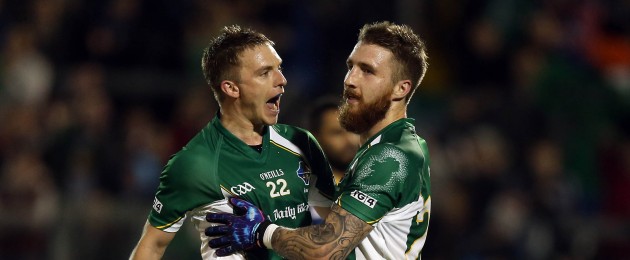
    Munnelly and Touhy celebrate during the first test last week [credit: news.msn.ie]
    Munnelly and Touhy celebrate during the first test last week [credit: news.msn.ie]
    It was Touhy that really shone though, scoring Ireland’s first goal with a magnificent run through the centre of the Australia defence, less than 24-hours before he would appear for Portlaoise as they recorded their seventh Laois county championship in a row.

    Despite some impressive Franklin scores and a third quarter that saw them outscore Ireland 18-11, the visitors couldn’t manage to close the gap, Kevin McLoughlin with Ireland’s second goal to really put the gloss on the performance.

    The indigenous Australia side’s improvement as the game wore on showed they are capable of adapting to the new game however, and the series is far from over going into the second test next week.

    Ireland: P O’Rourke; N McGee, F Hanley, C McKaigue; L Keegan, Z Tuohy (1-0-0), J McCaffrey (0-0-1); A Walsh, S Cavanagh (0-1-0); P Flynn (0-1-0), C Byrne (0-1-1), C Sheehan (0-1-1); P McBrearty, M Murphy (0-2-1), R Munnelly (0-2-3).

    Interchange:  C Boyle (0-1-0), P Conroy, C Kilkenny, K McLoughlin (1-0-0),  C McManus (0-1-2), A O’Shea (0-1-0), C Begley (0-1-0), M Shields.

    Australia: A McGrath; J Harbrow, C Yarran, T Armstrong; C Ellis-Yolmen, N Lovett-Murray, A Davey; L Franklin(0-1-3), D Wells (0-0-1); S Motlop (0-2-2), L Thomas, Leyroy Jetta; E Betts, M Stokes (0-1-0), J Hill.

    Interchange: Lewis Jetta (0-2-0), Alywn Davey (0-1-0), Aaron Davey (0-0-1), M Stokes, D Barry (0-0-1), S Edwards, S Wellingham, J Neade (1-0-0).