By Greg Synnott, Michael Coleman and Saoirse Ivory
A series of tax adjustments and cuts were announced by Minister Michael Noonan in yesterday’s budget. The City were outside government buildings when the announcement was made.
The €2.5 billion plan included €900 million in additional revenue and €1.6 billion in cuts.
Members of the Independent Workers Union protesting
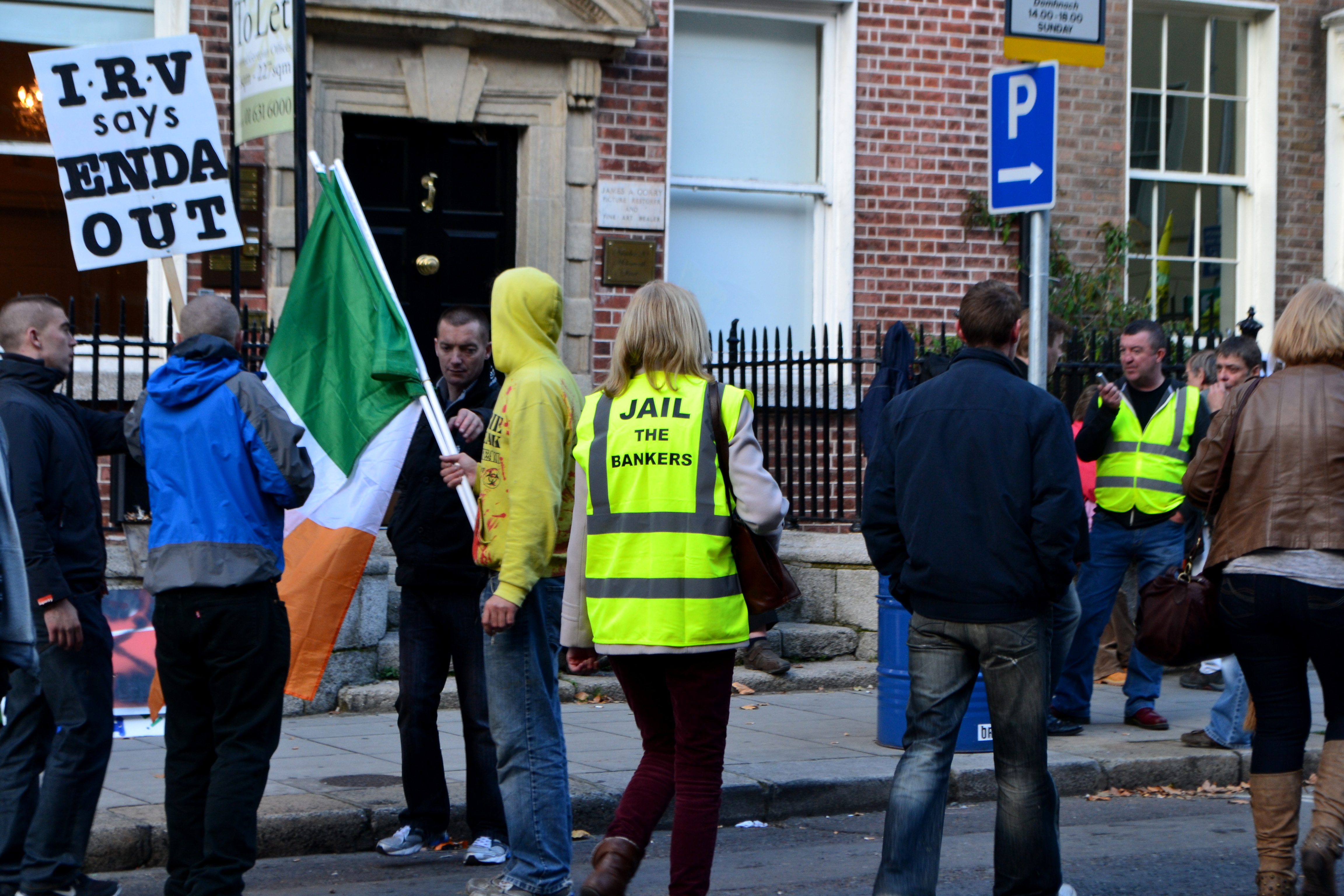
IRV protesters outside the Dáil
Some of the measures announced by Minister Noonan and Minister Brendan Howlin include:
A reduction in jobseekers allowance to €100 per week for under 25s
An increase to the price of beers, spirits and cigarettes of 10 cent, and an increase to the price of wine of 50 cent
Funding to third level institutions will be cut by €25 million
The abolishment of the phone allowance for pensioners
The banking sector will now pay €150 million to the exchequer annually
Free GP care will be provided for all children under five
Additional jobs will be added in hospitals, schools and An Garda Síochána starting next year, but overall pay will be reduced by €500 million
Prescription charges on individual items is to increase to €2.50
Tax relief for single parents (who could previously both claim the credit) will be changed to a Single Person Child Carer credit, which only the primary carer will claim
A new unified DIRT rate of 42% was introduced
Tax relief for medical insurance will be capped at €500 for children and €1000 for adults
Minister Noonan concluded his speech by saying that Ireland is still facing some tough times, but is on the road to recovery.
Meanwhile, outside the Dáil, a surprisingly small number of protesters turned out despite an enormous Garda presence.
Many protesters, who felt the government were targeting the weakest in society, were disappointed by the turnout.
Protester Pamela Hackett gives her view on the Budget
“I’m very disappointed,” said Pamela Hackett, “I thought there’d be a load of people out here.”
There has been much talk in recent weeks and months to suggest that Ireland may finally be on the up and up, after many years of foundering in the mires of economic recession.
As part of the latest quarterly KCB Bank Ireland/Chartered accountants of Ireland business sentiment survey 47% of respondents reported an increase in business activity, the highest number of positive responses since 2007.
The people of Ireland protest against austerity in 2009 Photo: SebastianDooris on flickr
As well as this, Minister for Social Protection Joan Bruton has said she expects live register numbers to fall below 400,000 in the next month or so, the lowest they will have been since 2009, although the drop in this number will in part be due to emigration.
Another good sign for the economy is the relatively easy-going budget for 2014 announced yesterday by the government. Although there will still be many cuts; senior citizens have been hit especially hard, it is being billed as “the last austerity budget” and Enda Kenny has said he expects it to provide the state with a primary surplus in 2014, which will allow Ireland to begin to decrease national debt.
Ireland is also poised to exit the bailout next year, and Olli Rehn has expressed confidence in the country’s ability to survive in the Eurozone unaided by a precautionary credit line. However Mario Dreghi declined to comment on whether Ireland would require a precautionary credit line as it was still being “discussed by the relevant authorities”.
With a prevailing feeling of cautious optimism now surrounding the fate of the Ireland and its chances in the future, The City took to the streets to find out whether or not the nation has confidence in the Irish economy.
On October 4th we as a nation passed the 33rd Amendment of the Constitution in the Court of Appeal referendum.
The yes vote consented to the establishment of a new fifth layer to Ireland’s judicial system, a new Court of Appeal which will operate as Ireland’s second highest level of judiciary in between the already existing High and Supreme Courts.
However, a lack of informed discussion on the courts referendum, largely due to the greater importance apportioned to the Seanad referendum by the media, means that a lot of people are now wondering what effect it will actually have on our courts system.
Function
The Court of Appeal will hear appeals from the High Court, thereby lessening the burden of the Supreme Court which currently has a four-year backlog of appeals to be heard [that includes over 500 appeals awaiting resolution].
The new court will be able to refer cases to the Supreme Court, which will only preside over disputes that “involve a matter of general public importance”, according to Minister for Justice Alan Shatter.
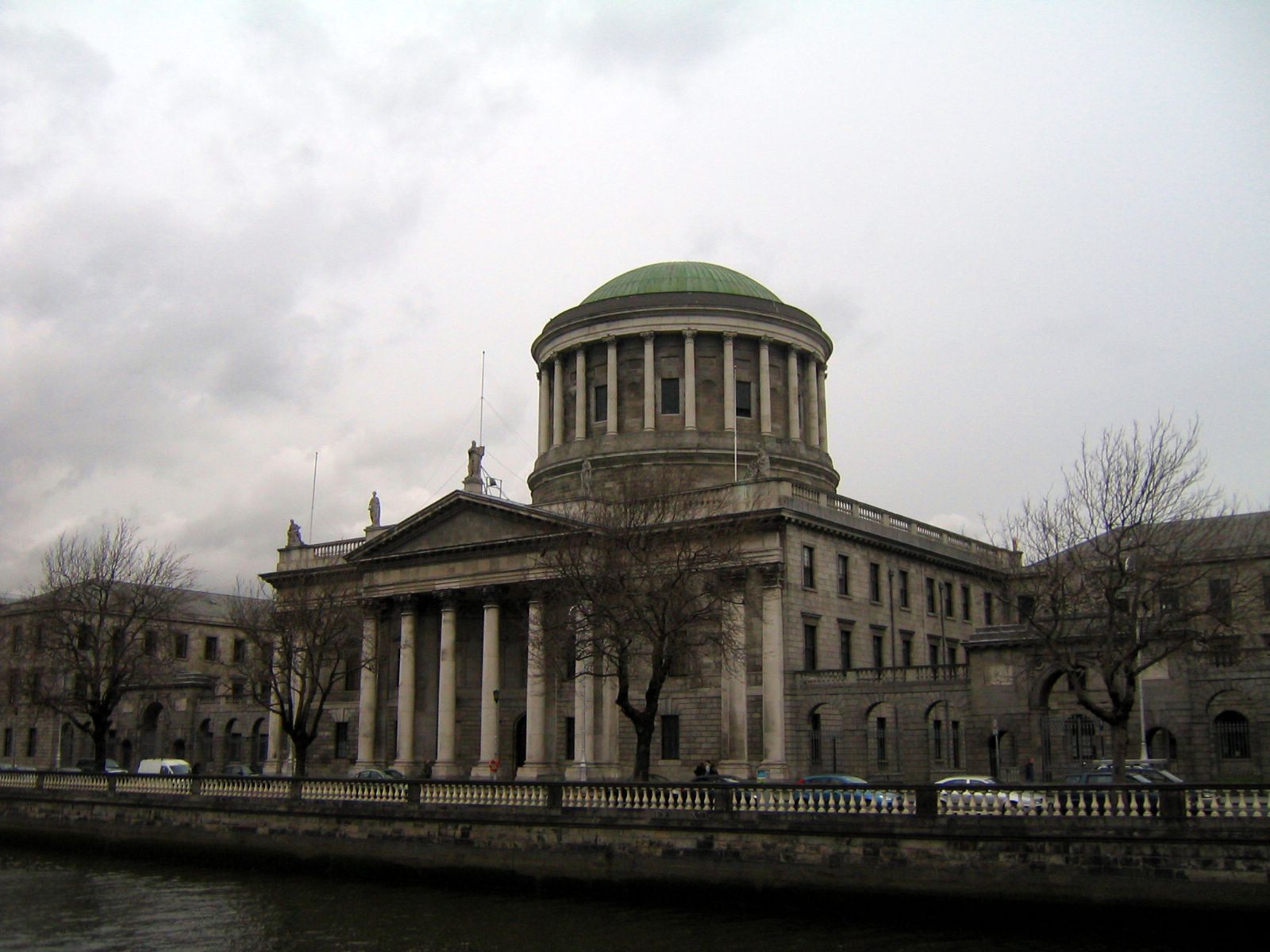
The Four Courts in Dublin, where the country’s High and Supreme Courts reside. Credit: Richard Watts on Flickr
The Court of Appeal will also lead to the scrapping of the Court of Criminal Appeal, which formerly comprised of a mix of High and Supreme Court judges, and was frequently derided for its inactivity.
How much will it cost, when will it start and how many new judges will there be?
According to the Government, the Court of Appeal will cost between €2.5-€3m per year to operate with the main expenses accruing from judges fees, support staff and overhead costs.
All going well it should be up and running by Autumn 2014, and will necessitate the appointment of around 10 new judges (dependent on how many will be needed to get through the Supreme Court’s backlog at the time of establishment).
How comprehensively was it passed?
As opposed to the Seanad referendum which was defeated, all 43 electoral constituencies voted in favour of the formation of the Court of Appeal, and the yes vote accounted for 65% of turnout.
Former solicitor and current Justice Minister Alan Shatter has endured a tempestuous relationship with lawmakers since coming to office. Credit: European External Action Service on Flickr
Again, much criticism was aimed at political parties and the media for prioritising one referendum over another and glossing over many of the substantive issues, however the general political consensus on the yes side effectively put paid to any meaningful public discourse on the issue.
Any criticisms?
The main point of contention around the new court’s function is the amount of judges Ireland will have in the upper echelons of the judicial system.
Added to the 36 High and 10 Supreme Court judges, the 10 new appointees to the Court of Appeal will mean that we’ll have around 56 judges. That’s a third of the amount of judges that England has for 1/15th the size of population, and some sceptics have labelled this excessive.
As such, those opposed to the constitutional change have lobbied to increase the workload of judges currently in operation, and have suggested reducing their nine-week holiday period in order to work through the massive backlog more effectively.
A class of Hungarian undergraduate art students and their professor have stripped down to their underwear in protest against new university dress code rules.
The president of Kaposvar University, Ferenc Szavai, issued a letter to students featuring strict new uniform rules to be enforced on every student of the university.
Female students have been forbidden from “blatant use” of accessories, excessive make up, over powering perfume, and short skirts.
Instead, they are to opt for a blouse and jacket, with a long skirt or trousers.
Male students are encouraged to dress in a dark suit, and to avoid dressing in shorts or flip-flops.
Unkempt hair and fingernails are banned for both sexes.
The students first voiced their dismay on October 1st, but students have been donning beach towels and flip-flops to class as recently as this week.
Two female students during their protest against harsh uniform rules. Image via YouTube
The students have documented their process in YouTube videos and posting images to social media.
Despite the students’ protests, many other universities from around the globe have long established, and strict, dress codes for their students.
These protests come at a time when Hungary is battling the authoritarian style rule of its current Prime Minister, Viktor Orbán, a figure who has been likened to Venezuela’s Hugo Chavez and Russia’s Vladimir Putin.
Hungarian Prime Minister Viktor Orbán
Since his election, Orbán has dominated every aspect of public and private life.
Orbán has made several controversial decisions throughout his time in office; he has ended press freedom, outlawed homelessness, and abolished an independent fiscal council whose purpose was to scrutinise budgets.
Last month, protests against the Prime Minister power reached a new extreme when a group of individuals staged a hunger strike outside Orbán’s residence.
On another occasion, a riot culminated in the toppling of a statue depicting his likeness.
St. Patrick’s Athletic manager Liam Buckley cemented his second spell in charge with another league title.
Buckley was the last supremo to have taken the Inchicore side to glory fourteen years ago, giving the supporters every reason to ‘Party Like it’s 1999’.
President Michael D. Higgins and former St. Pat’s and Ireland manager Brian Kerr, were special guests at the game and were given fond receptions by fans on the pitch once the final whistle blew.
St. Pat’s will officially lift the league trophy this Friday against Derry City, but thoughts will soon turn to next season, which will include Champions League qualifying fixtures.
Title defences are never easy, but St. Pat’s know they have the ideal person in command.
In all walks of life there are divides, tensions, battles, opposition, and rivalries. Sport is no exception, all of the world’s biggest sports have intense derbies and rivalries.
In Gymnastics, it’s the USA and China, in baseball, it’s the Yankees and the Red Sox, in Rugby Union, it’s Australia and New Zealand, but in football there is only one rivalry that everyone talks about.
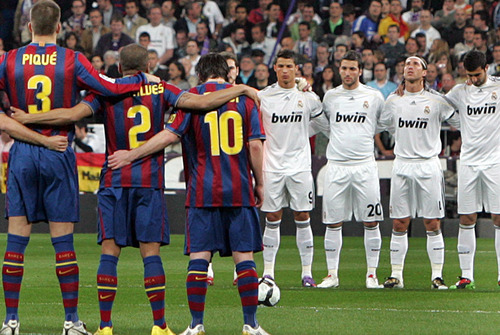
‘El Clasico’ as it’s known, is the biggest rivalry in world football. It is contested between Real Madrid and Barcelona, the two most successful teams in the history of Spanish football.
‘El Clasico’ or the Classic, was first played in 1902 between these two giants of the European game.
All rivalries must start somewhere and more often than not it is an off field dispute that starts these tensions between clubs, causing these fierce rivalries.
The rivalry between Barcelona and Real Madrid starts from the rivalry between the two cities they respectively hail from. Madrid is the capital of Spain and is very closely linked to the monarchy whilst Barcelona is the capital of Catalonia which wants independence from Spain. Real in Spanish means Royal and Real are the Royal club.
‘’Growing up in Cataluña, we were told of all the things that Franco and the Spanish did to us, how they took our money and our freedom, through football we have a non violent way of beating them’’ said 20 year old college student Aleix Hernandez. Although Franco supported Athletico, Real became the symbol of all things Spanish and although they had nothing to do with what Franco was doing they became extremely unpopular.
Ronaldo was one of seven players to play for both clubs. Image by Peter Grimes
As time progressed and politics in Spain became more influential in football, so too did the hatred between the two Clubs, Cities and Peoples. Politics became more influential as the different regions sided with different clubs. The Basque area with Athletic Bilbao, Catalonia with Barcelona, and Spanish nationalists with Real Madrid. As this evolved, so too did the hatred between the two Clubs, Cities and Peoples. When Franco was in power in Spain, from 1939 until his death in 1975, one of the orders that he gave to his troops was to kill Josep Sunyol, leader of left wing politics in Catalonia and President of Barcelona football club.
Franco also abolished the fiscal privileges enjoyed by Catalonia, refused to recognise it as a separate region from Spain and also forbid any other language being taught in schools, except Spanish. When Franco insisted that these means were necessary and would be permanent, he angered and dismissed the people of Catalonia and everything they stood for and believed in, except of course for his supporters.
By doing this, the people of Barcelona rebelled and got behind the local football club, which they saw as an identity and expression for Catalonia and the Catalan people, which they used to vent their hatred for Franco and Spain, they also set up a group called the ‘Boixos nois’ which were a left wing hooligan group used to attack Real fans and vandalise property in Madrid at away games.
‘’In Madrid we are similar to Belfast we love the monarchy and we love Spain, people in Cataluña seem annoyed by this but it is our Country and they live in it,” said Alfredo Juan Fran, a local waiter from Madrid.
The term ‘Mes Que Un Club’ or more than a club, became Barcelona’s motto in the succeeding years and remains right up to the present day. In recent times, the fiscal rivalry has increased as Real’s players don’t pay near as much tax on their wages as their Barcelona counterparts who must pay a 50% tax, once again outraging Catalonians.
This issue has been raised several times in the Spanish parliament but to no avail, Real are known as the Kings club and receive many privileges because of this.
Phil Ball, the author of Marbo ‘the history of Spanish football’, 1977, said that ‘’El Clasico was not just a rivalry but in fact a re-enactment of the Spanish civil war.’’
In the Spanish civil war, the republicans, whom Catalonia supported, fought the nationalists, whom the people of Madrid supported.
The on-field rivalry has been driven by both off field events as well as the successes of both clubs on the field. Between the two clubs they have 53 out of 73 leagues and have 44 Spanish cups.
‘’When they win it is not good it is very sad, they are not nice people, they cause much trouble. We have a history here in Madrid, we have a stadium, trophies and the best players in the world they try to copy us and yet they still want freedom’’ said Alfredo Juan Fran.
Politics has always played a major role in the Spanish Cataluña rivalry. Alfredo Juan Fran, a waiter in Madrid said ‘’you always know when Barcelona are in town, they bring much hatred with them and the atmosphere becomes very uneasy and you see a lot of police around the city, it is not nice when they are here’’.
In 1997, the rivalry reached new heights when then vice-captain Luis Figo traded the Nou Camp for the Santiago Bernabeu, Figo’s transfer from Barca to Real sparked outcry in Spain and much rioting and vandalism occurred before, during, and after ‘El Clasico’. It was revealed in later years that money from the government helped to bring the Portuguese superstar to Madrid. The reason behind this is that if Real keep winning, more people will watch and go to Real games and so Madrid and the government get a dividend.
On Figo’s return to Barcelona in 1998, during a Copa Del Rey match, a pig’s head was thrown at him by members of ‘Boixos nois’. The group cause a lot of trouble when they go to the capital, especially when they play Real. They have been known to start fires, damage and vandalise property, and cause general mayhem, both inside and outside of the Santiago Bernabeu.
‘’When I was a kid, my dad brought me to games every week and we would talk about the great football we would watch, but he would never take me to a Real game. He said it was too dangerous. Now I see for myself why it is too dangerous. I understand why Boxis Nois do what they do, they are like me, a Catalan, and we don’t like Spain or Real for what they have done to us,’’ said Barcelona native Aleix Hernandez.
In 2009, Cristiano Ronaldo’s world record transfer to Real from Manchester United sparked more controversy as it was the Spanish government who forked out some of the €93.9m paid for the Portuguese Captain, as again they felt that having Ronaldo in the capital would indeed help attract people to Real matches giving them a dividend. This transfer showed how the Spanish authorities twice in twelve years publicly backed Real against all the other La Liga teams but particularly to halt Barcelona’s progress.
‘’Real bought Ronaldo because we have Messi, Kaka, because we have Xavi, and Alonso because we have Inesta. They want to be like us, but they can’t because ‘our players’ want to play for us, while their players just want money,” said Hernandez.
‘El Clasico’ has always boasted some of the biggest names in world football, with one club battling against the other to get the world’s best players. The likes of Maradona, Rivaldo, Ronaldinho, and Messi have all played for the Catalan giants with Di Stefano, Zidane, Raul, and Cristiano Ronaldo playing for los Blancos.
The Real-Barca rivalry is the biggest watched club football match in the world with over 600 million people tuning in to watch ‘El Clasico’.
‘’I go to many Real games and I watch many Athletico (Madrid’s city rivals) games but never Barcelona’s. They annoy me and are always flying flags about Cataluña and freedom. Bilbao, a team from the Basque region of Northern Spain and Southern France) fly similar flags, but they never say sorry for all their bombs, ETA, and attacks that have killed so many innocent people,” said Alfredo Juan Fran.
Since their first meeting in 1902, The Clubs have met on 433 occasions. Barca hold the upper hand with 205 victories, with Madrid on 186, and they’ve played out 42 draws.
Although the Catalan giants have enjoyed 19 more victories than Real, it is the latter who have all the bragging rights, having won 11 more leagues than Barca, and also holding the record number of European cups, nine, with Barca back in joint fourth, and Bayern Munich with four.
Real can also boast more Club world cups than their fiercest rivals winning that battle three to two, The Kings club have far greater fan numbers in both Asia and South America although Barcelona have much larger followers in Europe and indeed in Spain.
Barca’s motto may be ‘Mes Que Un Club’ but this unique fixture in world football should acquire the motto ‘Mes Que Un Derby’.
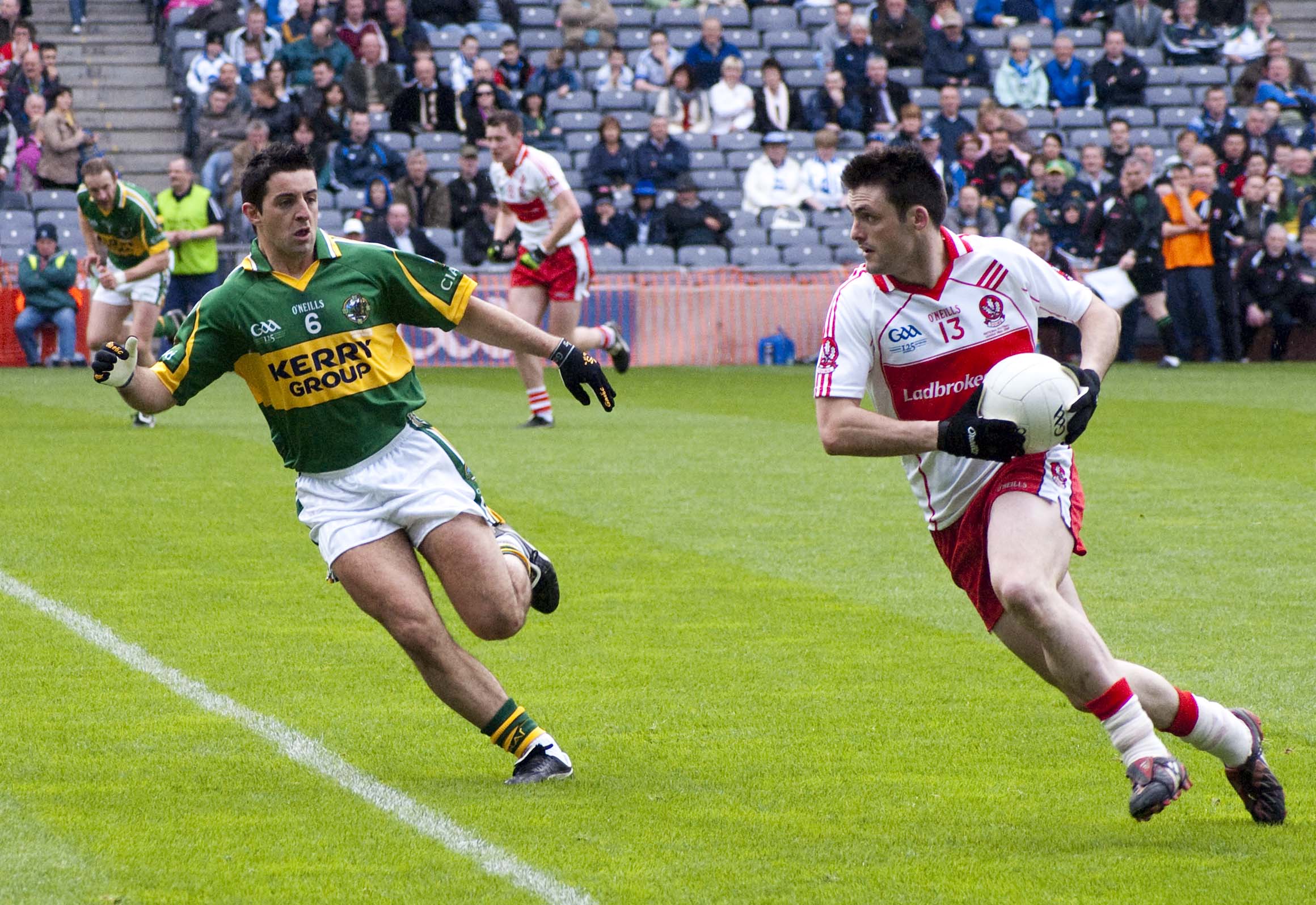
Founded in 1884, the Gaelic Athletic Association (GAA) has grown into the biggest sporting organisation in Ireland, and has also spread to various nations around the world.
The All-Ireland senior football championship is the most eagerly awaited contest of the summer. In total, 34 teams compete to be crowned champions of All-Ireland on the last Sunday in September.
Over the years, the football championship has given us some wonderful excitement and moments that will live long in the memory.
However, off-the-field issues are threatening to bring the game, and the association into financial jeopardy.
Although the GAA and the championship give us great joy, and a great sense of being Irish, there are deeper, underlying issues that must be addressed.
The political circus that the GAA has created is a disgrace and a farce.
In the recent Ulster championship campaign, Monaghan traveled to Belfast to play Antrim whilst Armagh played away to Cavan. To stand on the terrace for both of these games was €15 each and to sit in the stand, it was €22.
Between these two games, only 11,000 people attended, one fifth of the capacity of Casement Park and Breffni Park combined.
Local Postman Paddy McPhillips, originally from Cavan but working in Monaghan, is annoyed at the GAA. ‘’It doesn’t make sense to play them in separate venues, I would’ve went to the double header had there been one and so would others,” he said.
Politics are very ripe in the GAA. If we look at Dublin, we can see this quite clearly. Dublin has played only one championship game outside of Croke Park in nearly two decades.
The GAA refuse to allow Dublin to leave Croke Park so that they have more revenue, but as a result are actually losing money on the Jones’ Road venue.
On average, before the All-Ireland series, Dublin attracts crowds of 40,000. Croke Park requires at least 47,000 people to break even.
The policy of keeping the Dubs in Dublin is in the hope that they will fill Croke Park’s 83,000 capacity every week.
‘’Look at Dublin in Croke Park every other week, whereas the Cavan and Monaghan fans have to travel all over Ulster and Ireland just to watch their team, it’s not fair,” said Mc Phillips.
‘’I spent over €400 going to watch Cavan in this year’s championship, between fuel, tickets, and food, Dublin fans don’t pay near that much,” added the local postman.
Darren O Sullivan and Barry Cahill in the 2006 semi final as Tom O Shea looks on. Image by Sean Nolan
Seanie Johnson sought a move from Cavan to Kildare to play senior inter-county football in 2012. His transfer saga went on for three months and dominated the news, yet when Johnny Hanratty sought a move from Armagh to Louth, he was granted it in a matter of days! Likewise, when Billy Joe Padden moved from Mayo to Armagh in 2010, it was also granted in a number of days!
Surely there were underlying politics in the decisions – how can one man’s case be different to anothers?
If we look at the hierarchy of the GAA , we will notice that their officers are on exorbitant amounts of money. Pauric Duffy earns over €120,000 per annum and GAA president Liam O Neill earns nearer to €140,000.
‘’Pauric Duffy gets massive money down in Dublin and yet doesn’t know what’s going on in his home county,” said Clontibret secretary Colm Gormley.
‘’I don’t know why the money is not spread out among the players and clubs, after all we are all amateurs,” said the Clontibret man.
Referee’s get €35 a game plus expenses , with linesmen and fourth officials only receiving €10. Surely that doesn’t make sense, how can people that are officiating be given so little, and how can four umpires be asked to give up their day for nothing?
Donegal had over 210 training sessions in 2012. Many of their players had to travel from Dublin and Galway to Letterkenny, three to four times a week. These players’ received nothing in terms of payments or support for taking time off work, all they received was 30 cent a mile for fuel.
Peter O’Boyle was sub goalkeeper for both DIT and Donegal in 2011, and knows exactly the financial constraints that senior inter county football can have. ‘’I travelled to Letterkenny three times a week from January to May for training. I wasn’t doing well in college and I was out of lots of money, I got very little assistance from Donegal, they barely gave me the price of my bus ticket.’’
‘’I didn’t go back to the senior set up in 2012 as I had dropped out of college and was totally broke due to football,’’ said O’Boyle.
The U21 championships are big business. Image by Tom Hayes
Michael Henry is chairman of county Monaghan referees, ‘’it’s a joke, the abuse referees take for the money they are given, it’s just not on.’’
‘’I can’t believe that the senior Inter county players and managers don’t get paid considering what they put in. As for referees, their treatment is shocking.’’
Politics are ripe in the GAA, and it’s an issue that needs to be addressed greatly. How an amateur organisation can be so professional, and yet so unprofessional and underhanded, is astonishing.
There is no doubt that Budget 2014 will have implications for every person living in Ireland. However, students and jobseekers are bearing the brunt of these cuts. Dole payments for under-25s, hiked student fees, prescription charges and a 10 cent hike on cigarettes and alcohol are just some of the cutbacks facing young people.
As computers get smarter, faster and more compact we often find ourselves wondering: how much further can we push this technology?
The singularity is a theoretical instance during which artificial intelligence will surpasses human intelligence and bring about radical change in human nature. While this notion seems closer to science fiction than science fact, recent breakthroughs in computer processing show computers that can mimic the human brain.
In a statement last week, technology specialists Qualcomm announced they were making headway in relation to their “biologically-inspired” processor that is modelled on real-life neurons.
“Instead of preprograming behaviours and outcomes with a lot of code, we’ve developed a suite of software tools that enable devices to learn as they go and get feedback from their environment,” states Samir Kumar, director of business development at Qualcomm.
The tech giant has recently set up operations in Cork creating 100 digital IT security positions and has expressed interest in setting up a research and development wing, which could lead to up to 150 more jobs.
Qualcomm have already built a robot which uses this ground-breaking technology. The machine learns by means of a reward system. If the machine preforms a task correctly a “good robot” message is sent.
The companies “neuro-inspired” chips will find their way into robots, vision systems, brain implants and smartphones. They are designed to be massively parallel, reprogrammable, and capable of cognitive tasks such as classification and prediction.
The ultimate aim is for users to be able to train their devices. The use of this technology in cell phones opens up the possibility for a customised user experience for each individual.
The enabling of devices to see and perceive the world as humans do is a goal that Qualcomm feels is realistically within reach. “A major pillar of Zeroth processor function is striving to replicate the efficiency with which our senses and our brain communicate information,” said Kumar.
Other companies such as IBM and Google are also investing millions into the field of cognitive computing. Last year Google unveiled a “neural network” that taught itself how to identify cats after being exposed to YouTube videos.
Earlier this month IBM announced a collaborative research initiative with four leading universities. The study seeks to develop a system which can learn, reason and help human experts make complex decisions.
“I believe that cognitive systems technologies will make it possible to connect people and computers in new ways so that–collectively–they can act more intelligently than any person, group, or computer has ever done before,” said Thomas Malone, Director of the MIT Centre for Collective Intelligence, in a press release.
What will come of this research and how will it affect the average user’s virtual experience? Only time will tell. In the mean time we will have to make do with our not-so-brainy smart phones.
The concept was created by the UK company Hilco, which recently took over Xtra-vision and HMV. The vending machines will function very much like the company “Redbox” in the United States and Canada.
The kiosks offer over 300 rentals, with new releases added every friday. Users do not require an xtra-vision card as the machines run using debit or credit cards. Prior to the rental a debit or credit card is read, upon returning the rental the card is swiped again and the payment is charged based on number of rentals and duration.
Rentals cost €2.99. An additional fee of €1.50 is charged per day the rental is not returned. However if the rental is not returned within 10 days the charges halt and the rental is considered purchased.
One of the first kiosks in Dublin has popped up in Spar on Ranelagh Road, Ranelagh village.
Ranelagh resident Thereseanne McCormack said, “I think it’s a good idea, but a novelty idea.
“Currently it only has one screen to work from, I think it would be better if more than one person could use it at a time.
“Although considering the Baggot Street and Rathmines xtra-vision shops have recently closed it is good to have the option available again,” Thereseanne concluded.
Other Spar and Eurospar outlets supplying the new vending-machines include; Sandymount, North Circular Road, Inchicore, Kilmainham, Ellis Quay, Monkstown.
“It’s a great idea”, said movie and video-game buff Daniel O’Reilly, “it is quick and easy, which is always a great selling point.”
The Sallynoggin resident continued, “it’s sad to see that this has been a result of people losing their jobs and if these type of outlets are successful it could lead to the company removing all employees and stores and turning completely to these types of vending machines.”
The kiosk is the first initiative introduced by Hilco to boost sale revenues since they bought the chain earlier this year. Another initiative is integrated Xtra-vision and HMV stores which have opened in Artane and Ashleaf.














You must be logged in to post a comment.