In recent years, Ireland has made huge progress in equality and representation for queer communities, with our country even being the first in the world to legalise gay marriage by popular vote in 2015.
Yet, for many young people, questions around identity, belonging, and visibility are still deeply relevant.
On university campuses, societies play a vital role in creating spaces where everyone feels safe and supported, especially today, as Ireland has seen a growing wave of conservative and far-right narratives, the work of these groups feels more important than ever.
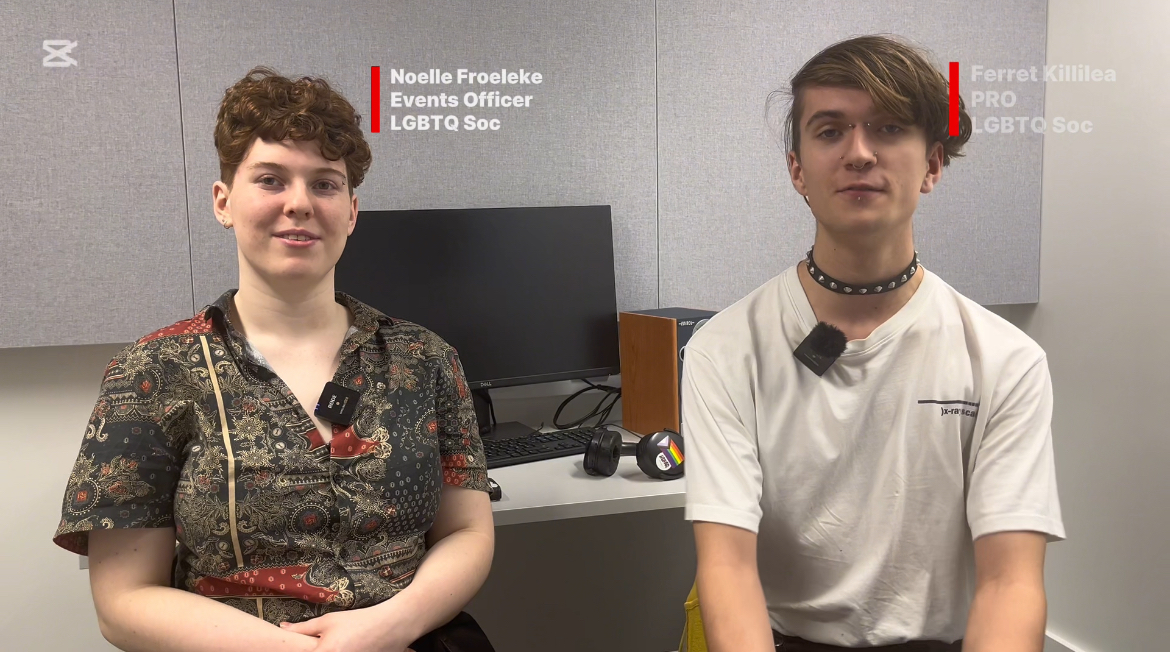
At TU Dublin, the LGBTQ society has become one of the most welcoming and active groups on campus, first established over 30 ago.
We talked to them to see what happens behind the scenes, what the society means to them, and why diversity and inclusion matter.
Many rock bands take much consideration when coming up with the name of their group. Eddie Vedder and Jeff Ament reportedly spent over three months arguing about what they would name their grunge-rock startup before settling on the name Pearl Jam.
Precinct, however, took a slightly different approach.
“We had two names. One, I can’t even remember, it was that forgettable. The other one was Precinct, and we asked a waitress at the bar ‘which do you prefer?’,” guitarist Barry Fenton said.
“I can’t even remember the first one, I only remember precinct,” the waitress replied.
And so, they went with Precinct.
The group was formed in 2017 during a Junior Certificate music project by Fenton, fellow guitarist Oliver Grennan and drummer Simon McVeigh, before they were later joined by bassist Zap Dickinson.
They discovered their current lead singer, Andrew O’Donovan, at a ‘battle of the bands’ style event in University College Dublin shortly after Dickinson joined the band in 2022.
“We did our set with a different singer at the time, and then Andrew came on after on his own with just a guitar and f—ing blasted the place away,” Fenton said.
Soon after, Precinct parted ways with their original lead singer due to problems with punctuality and differing musical styles, though the group insists that the breakup was “nothing dramatic”.
The first choice for their new frontman was O’Donovan, whom they contacted through a mutual friend and asked to come and do an audition.
According to Fenton, there was an instant connection between the band and their new lead singer, and the moment Andrew left, the rest of the members knew that they had “hit the jackpot”.
“It’s almost like a relationship; you just hit it off.” Fenton said.
The first song the band wrote together was “We’ll Be Fine”, though the band decided not to release the track.
“If we’re going to record a song we all have to be fairly enthusiastic about that song. If there’s much questioning about it, we probably wouldn’t do it,” Fenton said.
But it didn’t take long for the fivesome to put together their first single-worthy track, “Marlay Park”.
The song originated from a chord progression written by Grennan just moments before a rehearsal began and turning it into a full composition took a collaborative effort from each member of the group.
“There wasn’t much buzz around [the song] at first, but I think once we got the full band on it and we got some lyrics, and Barry wrote a really nice riff, like you hear in the song. I think in that moment it all just clicked,” Grennan said.
This spontaneous collaboration is indicative of the groups writing style and Fenton says that there is no methodology behind their making of music. If it doesn’t come naturally, he says, then the entire process becomes an “uphill battle”.
Precinct then moved from their rehearsal studio in McVeigh’s house to Paradise Studio Dublin. They worked with producer Cian Tisdall, hoping that his expertise would add a level of professionalism to the record that they couldn’t get at home.
“I remember the first time we tried to record something, we just got out a laptop and tried to do it ourselves, and it went terribly. So, we learned that lesson,” Fenton said.
The song, like the band’s music in general, fuses jazz, rock and R&B to create a unique, fast-paced indie-rock sound that could be likened to The Strokes or fellow Irish band Two Door Cinema Club.
This style blends the musical interests of the three founding members, though the addition of O’Donovan, according to McVeigh, added “a little bit of sauce” to their music.
Although Precinct are yet to earn royalties from their music, they have begun to get paid to play at small venues and functions, which helps to fund their studio time.
The band’s first paid gig wasn’t exactly the rock’n’roll birthing you might expect, as they mainly performed cover songs in the Talbot Hotel to a group of pharmaceutical toxicology students at a ‘master’s ball’.
Precinct perform at a ‘battle of the bands’ event. Photo: Andrew O’Donovan
“I would 100% prefer to do our originals over covers. When we’re doing covers, they’re not judging us, they’re judging how the original band sound, and then our sound,” O’Donovan said.
“It was just an insane night. We were so underprepared,” Fenton added.
O’Donovan was no stranger to live performing prior to joining Precinct, having spent much of secondary school doing solo shows in front of classmates with his only backing being an acoustic guitar.
He still struggled in their first live shows, though, feeling naked without his guitar and unsure what to do with his hands. But as the band played more and more shows, O’Donovan has found his footing.
“I think we’re all still kind of finding out what our performances are like on stage, what kind of people we are as performers. I tend to run off the stage for Marley Park and then just literally run around everything. It feels great to interact that way on stage,” O’Donovan said.
Fenton also admits that the group struggles most with finding the balance between being musically accurate on stage, whilst still displaying the dynamism and showmanship that defines all great live performers.
Precinct’s two newest singles, “Take Me Home” and “Light Up The Ceiling”, are available to stream on Spotify and you can click here to follow them on Instagram.
A study conducted by the Higher Education Authority (HEA) in 2024, found that 92% of college applicants who entered during the 2022/23 academic year progress into the third year of their course, and subsequently their final year as well.
The study indicates that gender also plays a part in the statistics on who is more likely to remain in college throughout their programme.
Those who identified as female aged 25-34, and those aged 35-44 years were the age ranges of students who maintained the highest college completion rates at 68% and 66%.
Those who identified as male, however, had a lower percentage than their female counterparts. Male students aged 25-34 had a college completion rate of 60%, while the age group of 35-45 had one of 55%.
The gap between gender in third-level education does play a role, whether we acknowledge it or not. This is especially prevalent in the older aged groups, with their rates of completing college being 5-10% lower than their younger counterparts.
Age and gender do play a factor in college dropout rates, but so does those who aren’t as financially well off. The HEA did a study on the progression rates of students who receive the SUSI (Student Universal Support Ireland) Grant from 2012-2022.
But what happens to the remaining 8% of students that either drop out of their chosen course, or change their course entirely?
Scott McDonald was a third-year mechanical engineering student in TU Dublin before deciding to change from his heavily maths-based course to a new option, culinary arts. He became a first year again this September.
“I realised I didn’t enjoy my degree anymore when I was struggling to get up in the morning for lectures and spending extra hours doing studying for topics I no longer understood,” said McDonald.
“I was becoming a lot more unhappy and miserable in my course. I’m pretty sure you could see it in the way I did my assignments too. The biggest for me was I began to dread what my future might be someday, working in an industry I clearly didn’t enjoy anymore. I just didn’t want to continue being unhappy to force myself to finish a degree I began to hate.”
According to the HEA report, degrees with the highest dropout rateswere in the services degrees, which include social care, at a high of 28%.
This is followed by any engineering, manufacturing or construction degrees at a dropout rate of 20%.
Scott continued: “When I switched to culinary arts, it was a completely different ball game. When I was in engineering, everything had to be so exact, to the T. But with my new course, I can be more creative and have more sense of freedom to explore things how I want in the kitchen. All my friends and family can see how much happier I am. I’m really glad I got over my fear and switched,” he said.
Photo courtesy of Scott McDonald
Students often feel pressure to continue with courses they decided to do when they’re 18 or 19, with parents often adding to the stress of students continuing courses they aren’t happy in.
“My advice for others going through a similar thought process is that you’ll be much happier once you take that leap of faith. You’ll see how much happier you can be when you start focusing on yourself, and what you really want to do now. You have the time,” Scott said.
Stories like Scott’s serve as a reminder to everyone pursuing degrees that no matter the year or age, that you aren’t limited on what you can do. But the most important being, there isn’t any shame on starting again.
In recent months the violence in Dublin City Centre has been top of the news agenda and it seems that violence has reached the university TU Dublin’s campus.
TU Dublin president, Professor David Fitzpatrick, wrote directly to the minister for justice Helen McEntee, appealing for more security around the campus for the safety of all students and staff.
In the letter earlier this year to then minister for justice Simon Harris, Fitzpatrick wrote to report about the anti-social behaviour and the lack of safety for students, “we have received reports that the response is slow and are also constrained by the fact that the University’s Estates and Security team cannot respond to off-campus incidents.”
The incidents have not been one-off attacks but have been regularly happening at the Broadstone Luas stop just outside campus.
Luas tram in Dublin City Centre. Image: Louis Hansel/Unsplash.com
“The Union has received increasing reports of anti-social behaviour in the Broadstone Plaza, right beside the Broadstone Luas stop, as well as the ‘main entrance’ to our Grangegorman Campus. Students do not feel safe entering and leaving the campus, particularly in the evening time,” said Brian Jordan, president of TU Dublin Students’ Union.
The attacks have also appeared to not be random students from the college as there has been a racial element. While it appears that ‘nobody is safe’, there appears to be a distinct racial element to many of the incidents. It’s also very possible from what I’ve heard and seen that these students are targeted specifically because of their race and/or ethnicity. Several victims of attacks here have reported that racial slurs were thrown at them during the incidents for example,” Jordan added.
With this still going on and no sign of any measures being taken by the college itself, the TU Dublin Students’ Union took matters into their own hands and held a demonstration at the Luas stop.
TU Dublin Student Union members held a demonstration to send a message to the Government. Source: @tudublinsu
The union said the reason they held the demonstration was to ‘show solidarity with the students who consistently feel let down by the government’ and the second reason was to apply more pressure on the government and McEntee to coordinate a far better response between the Gardaí, Transport for Ireland (TFI), and TU Dublin.’
“There were several speakers, including myself on behalf of the SU, Nekesa who is our VP for Welfare & Equality, who also happened to be a mature and international student in TU Dublin, several local ‘opposition’ politicians, as well as current students within the University who felt more needs to be done.
We received very little communication from the University about steps being taken (an unfortunately common trend). However, after a particularly ‘viral’ incident last semester, media reported that the President of TU Dublin wrote to the then-Justice Minister requesting more policing in the area,” said Jordan.
The previous attacks saw some students getting pelted with eggs and racially abused and another getting her hair pulled. This all happened at busy times in the evening when students were waiting at the Luas stop. Witnesses described the offenders as all boys aged around 15 years.
When asked what the desired outcome Jordan said, “We want Justice Minister McEntee to provide adequate governmental support to improve the safety of the Broadstone Plaza. This means improving resourcing to policing in that area like more of a garda presence, as well as a collective response from TFI and TU Dublin. It should not be the role of the Union to constantly try to coordinate these stakeholders when we have an incredibly well-paid Government whose role that is.”
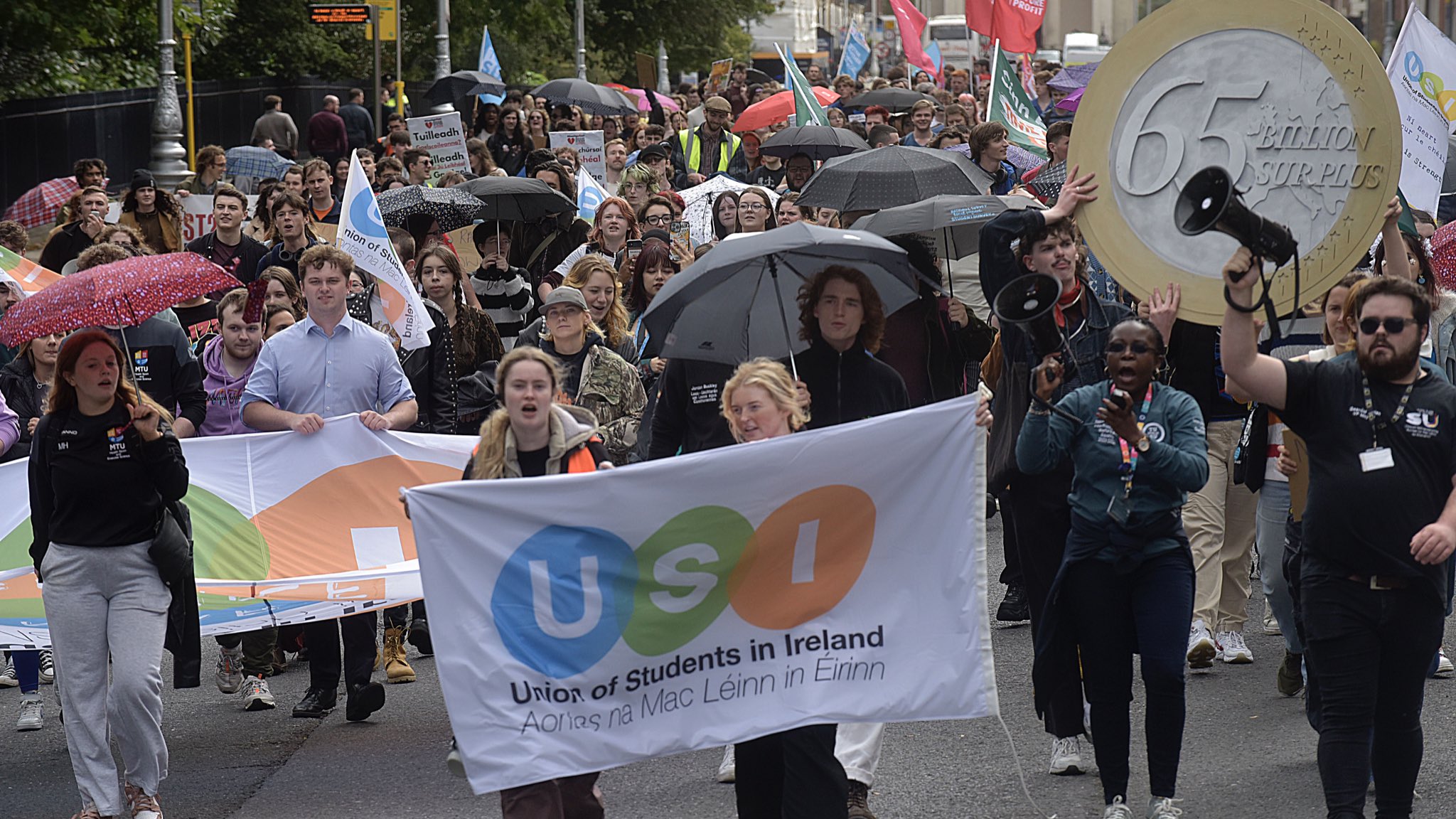
University students took part in a national demonstration, organised by the Union of Students in Ireland (USI) last Wednesday, where they protested the €65 billion budget surplus the Government is said to accumulate over the next three years. Students nationwide were outraged to hear the surplus would be used for a ‘rainy-day’ fund instead of the cost-of-living crisis.
The protest began at the Garden of Remembrance and made its way down to the Dáil with students chanting and singing about the issues they face while studying in higher education.
The student-led demonstration was organised to highlight the issues surrounding third-level education and to offer the Government solutions to fix these problems.
Brian Jordan, president of the Technological University Dublin’s Student Union said, “This is a national demonstration organised by USI […] The reason we’re protesting is because we’ve seen a lack of student accommodation. The Government has failed to give [students] capital investments, even though that is a clear solution.”
“We have a huge amount of private rented accommodation all over Grangegorman. Students are paying up to €1,100 [monthly], and that’s because the university hasn’t built their own accommodation,” he added.
Brian Jordan and the TU Dublin SU at the Garden of Remembrance. Image: @theusi/X
Environmental science student, Megan Tynan described how stressful it was to find accommodation closer to college.
“For my second year, I was commuting an hour and a half from college. By the time you get home, you’re wrecked,” she said.
“I was staying at a hostel for a few days during exams because my landlord decided to sell [the accommodation].”
“I was staying in a room with nine people, who were all strangers. It affected me negatively because it’s embarrassing to admit that you are struggling to find a place,” she added.
“It didn’t just fall out of the sky; it did not just happen. It was caused by Government policy.”
Dr Rory Hearne, Assistant Professor of Social Policy at Maynooth
According to the Pre-Budget Submission for the Budget 2024, submitted by USI, 33% of the total student population says they are experiencing serious financial issues. In 2019, that percentage sat at 26%.
President of Maynooth University Student Union, Alex Balfe said that “hundreds of students”, many of whom come from Donegal and Cork, are struggling to find accommodation on campus which is not “sustainable” for students.
“Students are waking up at five o’clock in the morning for their commute and they’re not getting home until very late in the evening,” Balfe said.
“There’s absolutely no accommodation in Maynooth, considering we’re a university town with more students than residents at the moment,” she added.
Third-level students march to the Dáil in protest of the accommodation crisis. Image: @rosspjboyd/X
The latest figures on Funding the Future — a document released by the Government in August 2023, mentioned that full-time student numbers are increasing and are expected to “peak” at 233,000 in 2030. It is also mentioned that there are currently 29,773 “oversubscribed” students who will not get accommodation in the 2023/2024 academic year.
The document mentioned that Minister Simon Harris confirmed “Government approval” for a new policy to be introduced that will provide “state assistance” to the “development of new and additional student accommodation for higher education institutions”.
The Government also “approved €62 million in additional funding” for 1,072 additional beds in universities like the University of Limerick (UL), Maynooth University (MU), University of Galway (UG), and Dublin City University (DCU). Assessment is still ongoing for all five Technological Universities (TUs).
Dr Rory Hearne, an assistant social policy professor at Maynooth said, “The housing crisis is forcing students to drop out of college, forcing them to pay unaffordable rents and to live in hidden homelessness. College days are supposed to be the best days of your life, but now, it’s a nightmare for many students.”
“It didn’t just fall out of the sky; it did not just happen. It was caused by Government policy.”
“Rents have increased by 100% since 2011, and 60% since 2020. Here’s a radical idea, in Berlin, in 2020, they reduced rents and put a five-year rent freeze in place. Why doesn’t the Government reduce all rents by 20%, back to the level they were in 2020?” Hearne said.
In 2021, Berlin’s Mietendeckle — a rent control law in Berlin, was declared ‘unconstitutional’ and was replaced with Mietpreisbremse — a new rent control law that limits how much rent the landlord can ask for. It is also possible to claim money that was overpaid for rent.
President of USI, Chris Clifford said, “How far away from reality is our Taoiseach when students and graduates are leaving the country by the plane load, when students have to decide between food and printing, and when a student’s room is the front seat of their car? That is the reality that this country has created for students.”
“We’re looking for the Government to fund the future of this country […] There’s a ‘rainy day’ fund of €65 billion and we’re asking for five percent of that. That five percent reduces waiting lists in hospitals, that five percent means that there’s enough childcare practitioners in this country, and it also means that there are enough civil engineers out there to get these houses, that not only students, but the public are crying out for.”
“Five percent for the future of Ireland,” Clifford added.
Another year of online studies, a handful of in-person classes and the college “social life” still different from how it used to be.
Students around the country have been affected immensely due to their studies being taught online, taking away the constant in-classroom learning and the classes that are in person are now only permitted to 45-minute learning time, due to government regulations. So, how are students finding college this semester?
An Instagram survey was set out to investigate whether students prefer college online or in-person and how the pandemic has affected their studies. One student from Technology University Dublin, who wishes to remain anonymous stated, “I used to be a very good student until online college and covid shattered my mental health,” they then went on to say that they were not receiving their money’s worth within their education. “My course needs a lot of communication from lecturers and that collapsed this year.”
When asked on an Instagram poll conducted by a student from TUD whether or not students preferred online college or in person, 25% of students who took part in the poll voted for online and 75% voted for in person. This poll consisted of 99 students, and it is evident that the majority voted in favour of in person college. Following this question, students were asked if they believed that students should still pay full tuition fees although classes are still online, 96% of students voted “no”, and 4% voted “yes”. With “no” being the majority vote, it is clear that students feel they should not have to pay full tuition fees when their course is being held online. 110 students participated in this poll.
Visual Merchandising and Display student from Technology University Dublin explained how the pandemic has affected her studies. “My first year of college was online, we were lucky enough to have one day on campus as it is a very hands-on practical course, but I feel like the online aspect made me somewhat lazy and less interested in my course.” When asked how she felt about this semester of college she explained that they have online and in-person classes, but the online classes are not for her. “I would much rather college to be completely in-person, I understand the severity of the pandemic, but I feel my course is at a loss as it is very practical and being in person is beneficial for our projects and hand-on learning.”
Many students agreed that they shouldn’t have to pay full tuition fees due to college being partly online and not completely in person. Psychology student from IADT stated, “no we shouldn’t have to pay full fees, I’m only in person two days a week, with a class being cancelled nearly every week.” Other students explained how lecturers aren’t as attentive as they should be and that facilities being closed within colleges does affect their studies. From shorter opening library times, too little to no hands-on use of college equipment, students aren’t getting the full college experience. DCU Students Union Officer Ross Boyd stated, “students shouldn’t have to pay full fees full stop and should be purely government funded.”
The Instagram survey concluded that students are not happy with how the pandemic has affected their studies, most students with the same response, that full fees should not have to be paid and the “college experience” not living up to expectation. Numerous students explained how their mental health has also been affected by this, and that they are less motivated to pursue their studies when classes are online.
On Thursday, 26th of November, Minister for Further and Higher Education Simon Harris announced that surveys will be carried out to research harassment, sexual harassment and bullying of both students and staff in Third Level colleges and universities. Erin Killoran explores why there’s a need for these surveys.
Minister for Further and Higher Education Simon Harris recently announced that surveys will be carried out to research harassment, sexual harassment and bullying of both students and staff in Third Level colleges and universities. These are being carried out in order to tackle the ongoing harassment issue in higher education institutions. During an Irish University Association event, Harris said: “ These action plans will involve, the implementation of systems that record the number of incidents of bullying, intimidation or harassment including sexual harassment.”
This announcement follows a letter written by Harris to the presidents of these colleges outlining plans to implement zero tolerance for bullying and sexual harassment in all of these institutions throughout the country.
The survey is due to begin next year, where the Higher Education Authority will be closely linked to Third Level institutions.
Speaking to TheCity.ie, former counsellor Siobhan Carroll said: “I think it’s very important that this survey is conducted, therefore if an issue arises, it can be dealt with accordingly.”
According to a study carried out by National Bullying For Educational Statistics, 20.2% of higher education students report experiencing bullying. Carroll said: “Being bullied in college or in your workplace can have long lasting effects into later life, which can in some cases, have detrimental effects on these victims.
“People assume that bullying is just a childhood experience. In order to fully address this problem, we need to destigmatize bullying in adulthood.”
Former student Shannon Jordan said: “I was bullied throughout the entirety of my two year course, which made me dread going in each day. However, this wasn’t from one of my peers, it was a tutor of mine.”
Describing her experience, she said: “I tried to ignore it in the beginning, but there was a point when I accepted it and realised that I was constantly being picked on by this person. To this day I regret never reporting this behaviour, because they made me miserable every day for two full years.”
If you are experiencing harassment or sexual harassment, ensure to report this to your college, or alternatively there are plenty of helplines available to listen to regarding your experience and any concerns that you may have.
Jordan spoke about her hope for this survey: “If these figures are documented and reported, I’d like to see if colleges and universities will implement ways to stop this kind of behaviour from occurring and it could also encourage others to come forward and report what they are going through.”
The overall impact and result of this survey will not be determined until next year, but hopefully there will be a positive impact and it will bring us one step closer to a zero tolerance attitude for bullying and harassment in Third Level institutions.
With restrictions now in place once again across the country, many third level students are struggling with the effects of working from home. According to research by the Commission for Communications Regulation, 3 in 5 people are seeing an increase in their home broadband use since March 1st, showing that internet connections and computer software are some of the issues facing students this semester, not to mention the social side of starting college. Amber Baxter spoke to a number of students about their challenges.
Photo taken by Bonjkarn Thanyakij. Sourced from Pexels.
Emily Ní Aogáin, a first year NCAD student, spoke about her bad connection and how it is affecting her. “Personally, I have found my internet connection has not been the best recently, typically, as soon as I need it most.
“Sometimes on Zoom call lectures it might buffer briefly, but I will have missed out on something the lecturer may have said that could have been important. I feel like we’re all at a disadvantage working from home and online rather than physically on campus. It’s very different and not as beneficial especially for practical courses because you can’t do your work as well at home as you would on campus.”
Ní Aogáin also mentioned how the Level 5 restrictions will further this: “Level 5 restrictions are going to affect my college experience quite drastically as I’ve only started in first year at NCAD, in a practical course.
“It’s been hard settling in and trying to make friends while socially distanced with masks on, because you can’t see their faces and the conversation is so muffled. I feel like we’re missing out on so many opportunities that come up in the first year of college – it’s not the same and it’s understandable but it still sucks.”
Isobel Lord, a final year Technological University Dublin student said: “In regard to Wi-Fi connection, my one has held up so far. I haven’t actually had any issues with it surprisingly. There was a girl in my course last year who did not have a computer so she literally couldn’t do online college.
“There are some people in my course and my friends who share bedrooms with people, and both of them could be doing college work at the same time, which can be very stressful. Then there are people who have family members who are working from home as well so when they’re all on the same Wi-Fi box at the same time they’re going to be running slow.”
Lord also mentioned how online work is affecting her studies on a practical course. “I’m doing an arts degree which is 99% practical work,” she explained. “We did hands on stuff in class such as how to manipulate fabric and stuff like that which is not really something you can teach through a computer screen.
“I also had to complete window displays which usually would be all practical, but we had to move online to Sketch Up, which is a graphic design program and became a huge part of our course working from home. I cannot even tell you how difficult, stressful and pressurizing that was. My grades went down so much [working from home] because I’m someone who is terrible with computers and tech.”
“My grades went down so much because I’m someone who is terrible with computers and tech.”
Teresa Walsh, a third-year student, spoke about how her mandatory attendance is being affected as a result of working from home. “I’d say overall my internet connection is fairly average but because I live slightly out of the town it’s not always the best,” she said. “If there are many people at home working from home or doing schoolwork, I find then the internet wont work. This is obviously very annoying if my class won’t load as I have mandatory attendance so at times, I feel like I’m at more of a disadvantage than my friends.”
Erica Carter investigates the financial impact online learning has had on third level students, as they express their frustration at the lack of government support for the move to online classes this year.
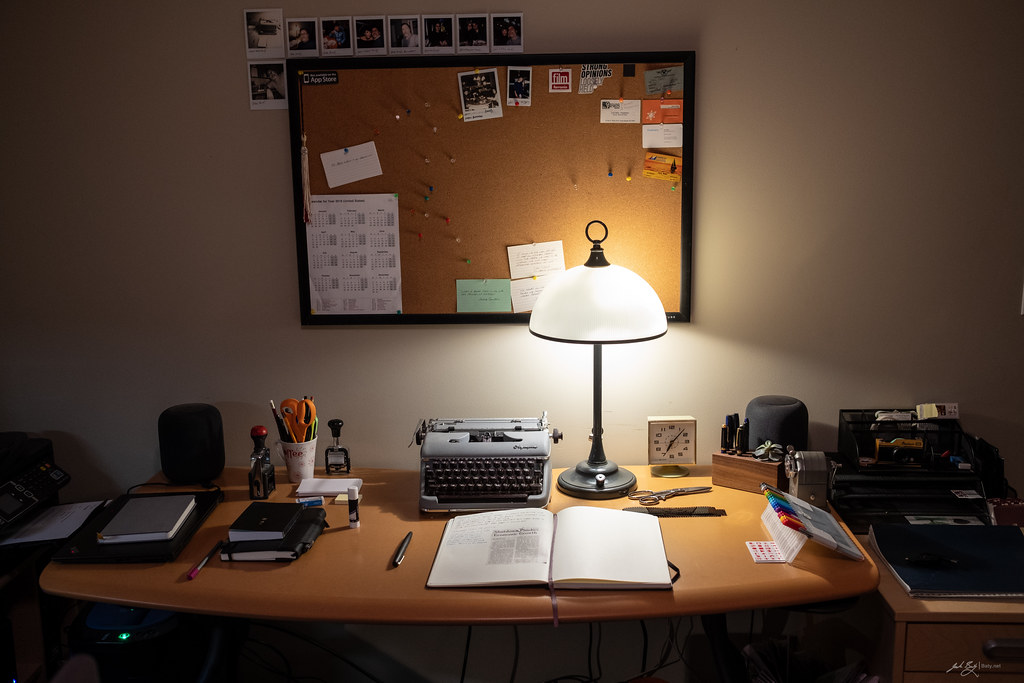
Taken by Jack Baty. Sourced from Flickr
Due to the Covid-19 pandemic, third level education has been moved primarily online, with limited access to college and university facilities. This has forced students to buy equipment, such as laptops, software and broadband, which they say is a large added cost on top of education fees in the midst of a pandemic.
Deborah Deegan, a second year TU Dublin student, was asked by her class tutor to buy a laptop that cost €1200, in order to run software they no longer had access to due to no longer being on campus – a cost on top of other expenses, such as furniture and Wifi. “In total the move to online classes cost me about €2000,” explained Deborah, “which includes the recommended laptop for my course, accessories like an external mouse and headphones, and furniture like a desk and a chair, because I previously didn’t have those in my room.
“I also had to install new WiFi and my electricity bills are higher due to attending online classes and doing my assignments from home.”
Rose Conway-Walsh, Sinn Féin TD and the party’s spokesperson on Further and Higher Education, is completely opposed to these costs. “Third-level students and their families are under unprecedented severe financial stress,” she said. “They need help to ensure they can stay on at college.”
“This practical financial support should take the form of a reduction of fees, refund of accommodation paid, wider reach of SUSI, access to the College Assistance Fund and laptops including remote connection to broadband. These supports need to be made available immediately.”
A spokesperson from the Department of Further and Higher Education, Research, Innovation and Science has detailed the additional funding provided in support of the students returning to education this semester. “This includes targeted student supports which will be of assistance to many students, particularly those with the least financial resources,” they said.
“The Department has allocated €15 million of capital funding for a once-off COVID-19 grant to support disadvantaged students in the further and higher education sectors in accessing information and communication devices,” the spokesperson continued. “The grant is being made available to further and higher education providers, which are using it to purchase devices to support disadvantaged students who are encountering challenges in accessing devices for remote learning.”
Supports such as laptop lending schemes were also only open for applications a few weeks into the college semester for some institutions, which meant students had to either buy a laptop or miss a few weeks of classes until they found out if they were eligible to be loaned one. “We were told during the summer there would be a laptop scheme for people who couldn’t afford them, but no information was provided until we had already been in classes a few weeks,” said Deborah. “Anyone that needed a laptop had already had to go out and get one because it was that or fall behind on our work.”
Another problem that many students are facing is that they do not qualify for the Department of Further and Higher Education grants. As they or their parents or guardians do not fall within the eligible income bracket.
TD Conway-Walsh is uneasy about this aspect of the grants. “I am concerned that despite Simon Harris being on public record telling me that eligibility for laptops would not be based on SUSI eligibility, I am being told by students that colleges are denying them laptops because they don’t receive SUSI,” she said. “I have written to the Minister to notify him of this.”
He now says it is up to the third level institutions. “I fundamentally disagree with this as this is public money and eligibility for SUSI is too narrow to accurately reflect the financial status of many households.”
When asked if any supports or funding were considered for students that weren’t deemed “disadvantaged”, the Department of Further and Higher Education, Research, Innovation and Science did not respond.
“I don’t think it’s acceptable to ask students to pay this amount of money on top of their college fees, in the middle of a pandemic and a recession where many are now losing their jobs,” asserted Deborah. “We as students have invested our money into these institutions to give us an education but they won’t invest in us in order to provide us with that education.”
The number of students suffering from anxiety has doubled since 2012, according to a National Study of Youth Mental Health in Ireland. The findings show that in comparison to the previous study conducted in 2012, the amount of teenagers aged 12 to 19 suffering from severe anxiety has doubled from 11% to 22%. Levels of severe anxiety in young adults aged 18 to 25 have also seen an increase from 15% in 2012, to 26% in this year’s survey.
The
report also showed that females in particular have declining levels of
self-esteem compared to males of the same age. There is also an increased level
of depression among young people.
The Union of Students in Ireland (USI) launched their
national report on student mental health at the beginning of this academic year.
Taking into account the experiences of over 3,300 students in Ireland, the
report shined a light on the varying mental health attitudes of students and
their experiences in accessing help and treatment.
“32% of students have been formally diagnosed as having a mental health difficulty”
Among the findings in the report were
that 38% of students said they experienced “extremely severe” levels of
anxiety; 30% of students said they experienced severe levels of depression, and
17% felt severe levels of stress at some point.
32% of students have been formally
diagnosed as having a mental health difficulty, while one fifth of students
said they did not have someone to talk to about their personal and emotional
difficulties.
“Third
Level education is a key life transition and can be an extremely stressful time
for students. We already know that levels of mental illness, mental distress
and low wellbeing among students in higher education is increasing” according
to a statement from the USI.
Commenting
on the results of the report, the USI said: “Students in third level education
are exposed to many stresses, which trigger or exacerbate mental health
difficulties.
“These
include living away from family and friends for the first time, coming directly
from a structures learning setting, as well as many students taking on
additional work commitments to support themselves financially.”
“In terms of of waiting periods, many students agreed that waiting periods were too long”
“Over
half of respondents strongly agreed that a free face-to-face service is
important on campus. Students were least likely to attend group therapy if
offered by the outselling services.
“Many
students said they would attend counselling, but students also said that they
did not think their problems were enough to warrant counselling. In terms of of
waiting periods, many students agreed that waiting periods were too long.”
Under
the Freedom of Information Act (FOI), TheCity.ie has obtained figures relating
to the number of counsellors employed, and the finances allocated to
counselling services in the following Irish universities: Trinity College
Dublin, Technological University of Dublin, Maynooth University, University College
Dublin and Dublin City University.
According to www.tcd.ie, there are 17,000 students currently studying in Trinity College Dublin (TCD).
Academic
Year
Expenditure
on Trinity College Dublin counselling services
Number
of counsellors allocated to the counselling services
2017/2018
€1,517,050
10
(Full Time Employee 6.59)
2018/2019
€1,674,858
10
(Full Time Employee 9.20)
2019/2020
(to date)
n/a
n/a
According
to www.dit.ie, there are 20,000 students currently
studying in TU Dublin (TUD).
Academic
Year
Expenditure
on Technological University Dublin counselling services
Number
of counsellors allocated to the counselling services
2017/2018
€466,
676 (2017)
5
2018/2019
€480,
475 (2018)
7
2019/2020
€389,
673 (2019 to date)
7
According
to www.maynoothuniversity.ie, there are 14,000 students currently
studying at Maynooth University (MU).
Academic
Year
Expenditure
on Maynooth University counselling services
Number
of counsellors allocated to the counselling services
2017/2018
€300,000
(Full
Time Employee 2.6)
2018/2019
n/a
n/a
2019/2020
n/a
n/a
An
FOI request was submitted to University College Dublin and Dublin City
University in relation to expenditure on their counselling services, and the
number of counsellors allocated, but have not responded for time of
publication.
TheCity.ie
spoke to Patricia Murphy, a counsellor at Trinity College Dublin, who said: “I
think that universities and third level colleges are all really trying to meet
the needs of a specific age group in the population of 18-24. All of them are
trying to provide the services of the mental health banner to students.
“They’re providing one-to-one student counselling, groups and workshops on psycho-education which deal with issues such as anxiety and depression. They’re trying to do lots of outreach through various social media groups, they do a lot at orientation to really try and get people in earlier so that they do not crash and burn.”
She
said that TCD uses a ‘student-to-student service’ where student volunteers, who
are well trained, can support other students in the university.
Credit: pxphere.com
“All universities and third level colleges around
the world are experiencing huge rise in demand for services. It seems to me
that the mental health of that age group, well maybe all age groups are needing
more services,” she continued.
The current Minister for Education has seen that two million euro is being given to counselling services, so there is acknowledgement that there needs to be more, which is great, but of course we need more resources in order to meet the growing demand. It’s very difficult, because colleges are hard pressed for money to devote more to this.”
Patricia said that often people assume that students use counselling services to deal with stress, but that isn’t true: “People come with a variety of issues and some tend to be quite serious in nature. Depression and anxiety are the highest issues in the population anyways, there is a rising level of anxiety in our society that’s being mirrored. Other issues are to do with relationships, bereavement, or loss.”















You must be logged in to post a comment.