Tag: dublin

  • “Looks like all our drivers are busy at the moment”- why is it becomming impossible to get a taxi in Dublin?

    “Looks like all our drivers are busy at the moment”- why is it becomming impossible to get a taxi in Dublin?

    Taxi’s warn that the shortage of drivers will only increase over the
    Christmas period.

    Taxi rank in the heart of the city.

    By Lucy Harris


    After two years of staying home, Dublin city is slowly starting to return to her old self.

    The beginning of the Christmas chapter only confirms this fact. The streets, now filled with happy shoppers and dotted with musicians give an atmosphere of a pre-pandemic Dublin. December is, without fail, one of the busiest months that Dublin experiences every year.

    But, with the average rent in Dublin City Centre sitting at just over €2000 per month, many locals face the daunting experience of trying to return home after a day in town.
    It’s no secret that Dublin’s transport system is in need of improvement. In comparison to other
    European cities, it rates pretty low.

    Berlin has the U-Bahn, which runs 24 hours, at 15 minute intervals. Paris has the Noctiliens night bus, a series of 47 lines which crisscross the city and outer suburbs of the French capital. Madrid boasts a rate of 89% of its inhabitants living 1 km or less from their nearest station.

    In Dublin, after midnight, the options become very limited. The Luas and train cease running,
    along with the majority of buses. The exception, of course, being the Nitelink, which operates on a Friday and Saturday night with 13 buses running once an hour between midnight and 4am.

    For many people, a taxi is the only course of action. The introduction of apps such as, Free Now and Bolt have streamlined the act of getting a taxi. A quick click of a button and within 3 minutes a taxi will apparate, as if from thin air.

    But it seems that the demand far outweighs the supply. Reports from individuals who have been left wandering the city centre in hopes of flagging down a taxi for hours after their night out finished, are being told on Twitter.
    One user expressed his disappointment in the situation, “I’ve been so frustrated lately living in Dublin. Everything is expensive. On top of that, we have a taxi shortage. I was out last night and although my night ended at 1am, I couldn’t find a taxi for an hour. I felt so helpless”.


    “Covid played a big part for a lot of drivers”, explained David Dunne, local taxi driver in the Dublin 7 area.

    “Before the pandemic, nobody had a second to think, for me anyway I was working over 60 hours a week but then all of a second, I had all of this time.”


    He goes on to explain how during the lockdown he switched nights for daytime work. A sentiment that was reflected in a survey released by the National Transport Authority (NTA) that stated that only 29% of registered taxi drivers in Dublin are currently working on Friday and Saturday nights.
    An element of fear regarding safety also has a part to play for the decreasing amount of taxi
    drivers left on the streets.

    “If a group of drunk people get in the car there’s a way higher risk of something going wrong”, says Dunne. “I’ve had a few cases of people running off without paying or getting sick in the car- if that happens the car is off the road for the night and I’ve lost my income for the week”.


    Dunne also goes on to explain how argumentative people can get late at night, saying how a lot of drivers “just don’t want the hassle of it anymore”.

    Other contributing factors include the rise in the fees that apps like Free Now take from each journey. Free Now increased the fees that they charge drivers to 15% per journey effective from March 2021.

    “When I started it was a 10% fee with Free Now, it keeps gradually getting higher and higher each year”. Dunne also goes on to talk about how, because of these fees, many drivers opt to switch off the app during busy periods and attempt to avail of cash payments.

    So what does the future look like? Well, according to Dunne, the announcement of a 6am closing
    time for nightclubs should ease the load.
    “At the moment everyone in Dublin is looking for a taxi at 3am because that’s when everything
    ends. I’m hoping the new rules give us a bit more of a gradual night of work” ends Dunne.
  • Vendor’s fury as Dublin County Council aim to close food and wellness space 

    Vendor’s fury as Dublin County Council aim to close food and wellness space 

    By Karl Steacy

    Chestnut Bazaar sits in the heart of the Liberties, nestled down a side alley on the busy Clanbrassil Street. 

    Walking up to its entrance, it’s striking that it lies between a block of apartments and a derelict building, perhaps symbolic of the current housing and planning issues in Dublin City. 

    As you venture down the laneway, you can hear the chatter of vendors and visitors being accompanied by a busker.

    A neglected vacant yard has been brought back to life as a food and wellness space in Dublin’s inner city. 

    Set up in October of last year by Mend, a Dublin based artistic group, the Chestnut Bazaar has become a community hub for an eclectic mix of art, food, and wellness. The vendors at the bazaar include BishBosh Kitchen, Dom Burger, The Woodfired Pizza Company, and AA’s Caribbean which offers a taste of Trinidad in Dublin.

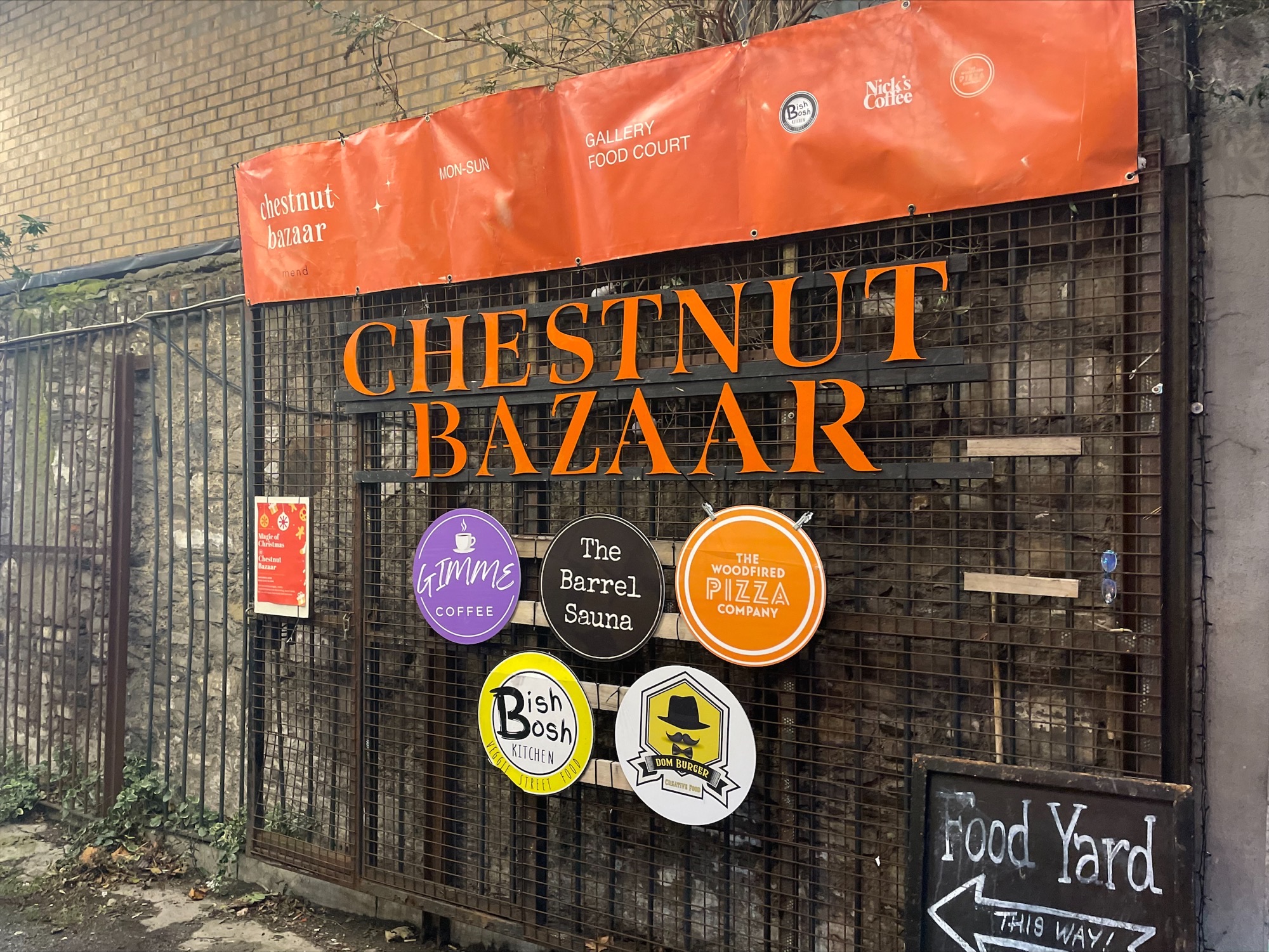
    The entrance of Chestnut Bazaar. (Image by Karl Steacy)

    The Bazaar also includes the traditional Brazilian food truck Juca BBQ, the Gimme Dublin Coffee truck, Ama Acai, the Barrel Sauna offering relaxing saunas, and Alanina Therapies which offers therapeutic massages and meditation.

    All of which is surrounded by eye-catching and thought-provoking art from the likes of Dirty Dublin, Niall O’Lochlainn, KAMBO, EOIN, PENS, and Conan Wynn.

    “The whole idea behind Chestnut Bazaar was to make a difference with a community space,” says Sean Hussey of BishBosh Kitchen who co-founded the Bazaar. 

    The bazaar on a winter’s night. (Image by Karl Steacy)

    “You shouldn’t have to spend €100 every time you leave your house to do anything in Dublin, we feel we have provided a place where you can have either a sauna, a massage, get a coffee, eat a meal or all of the above for under €50.

    “That’s not achievable anywhere in Dublin, apart from at the Chestnut Bazaar”.

    However, Dublin City Council (DCC) has deemed the bazaar as an “unauthorised development” instructing the Chestnut Bazaar team to close the space by December 31st.  

    The culture and food yard requested to extend its use of the Dublin 8 space, only for DCC to refuse. Dublin City Council has not responded to The City’s request for comment. 

    Eamon de Freitas, owner of AA’s Caribbean said he did not understand the council’s decision, arguing that the site has a history of commercial use. 

    “It was a fuel depot before it was vacant for a number of years, so historically it had been publicly accessible for the sale and goods or services.

    “Does the city council want the space to store rocks on the ground or to be a space where communities can get together and entrepreneurs can start to grow their businesses?” de Freitas asks. 

    The group has launched a petition urging the council to keep the space open while it remains vacant and awaits development.

    “We’re trying to get as many signatures as possible in the hope that it will show the appreciation for the space and the value it brings to the community,” Hussey said. 

    You can sign the petition here.

  • Duggan looks back on 2022 season following All-Star nomination

    Duggan looks back on 2022 season following All-Star nomination

    By Johnathon Pearl

    Meath Ladies GAA footballer Emma Duggan was nominated for the 2022 TG4 Player’ Player of the Year award, following a stellar season. 

    Despite her success at both club and county level, Duggan was pipped to the award by Donegal’s Niamh McLoughlin.

    Duggan – who is clubmates with previous POTY winner, and current AFL player Vicki Wall – starred as Meath completed back-to-back All-Ireland wins beating Kerry. An icon in football in Ireland, Duggan kicked 1-12 in this year’s championship.

    Reflecting on the year, Duggan expressed her delight at starring in another All-Ireland final.

    ‘’It was just great to be back on that stage competing for another All-Ireland. I would say a lot of people had sort of wondered if we could do it again after being a bit of a surprise package last year,” Duggan said.

    “We weren’t really playing as well as we could have, certainly at the start of the year, but as the year went on, we got better and better.”

    Meath’s All-Ireland bid had stuttered with a draw to Armagh, meaning they would face Galway in the quarter-final in Tullamore. With less than 10 seconds left on the clock and the game level, Duggan stepped up and scored a ‘buzzer beater’ point to win the game.

    ‘’It was a great win in Tullamore, we always knew that Galway were going to be such a tough team to play against and it went right down to the wire,” Duggan said.

    “The ball kind of just came to me and I didn’t really have a lot of time to think about what I was going to do with it, I was just delighted when I saw it went over, even though it held in the air for a long time,” she added.

    Beating Donegal in the semi final set up a clash with Kerry in the final, which Meath would later win in style. Duggan’s well rounded performance contributed to their nine-point win.

    ‘’Kind of like our year, we got better as the game went on. We obviously didn’t start well but the goals in the second half gave us a bit of a cushion,” Duggan said.

    ‘’I remember having the ball as the clock was ticking down. Honestly, it’s one of the best feelings ever to know all the hard work has paid off.”

    Following the Championship success, Duggan also won her first Senior Division One league title, beating Donegal on a scoreline of 2-8 to 1-9. It completed all the accolades she could win after winning both trophies at Junior and Intermediate levels.

    ‘’The league was a weird one because we were coming back from being All-Ireland champions. We had two great games with Dublin and then a really close battle with Donegal in the final,” Duggan said.

    After the Inter-County season, Duggan won her third Meath ladies final in a row with her local club Dunboyne, scoring 1-9 in the decider. A hectic season came to an end, finishing with her third title.

    Duggan told thecity.ie of her delight at winning yet another County title: 

    ‘’To win three-in-a-row with Dunboyne was a special feeling. We weren’t great in the final, but we got the job done against a really good Dunshaughlin team and that’s all that matters.”

  • A Year of Freedom: local Swords Karate Club reflects on changes since full reopening of society

    A Year of Freedom: local Swords Karate Club reflects on changes since full reopening of society

    One year ago, the government announced the end to most of the COVID restrictions which governed everyday life. Thecity.ie explores what’s changed and what has stayed the same since then for a Swords based karate club.

    Washido Karate, a club with roots in Chinese Boxing and Wado Ryu Karate, were one of many clubs around the country that limited or closed down their training activities after COVID, now with society wide open, how have they fared?

    “We experienced a reduction in our numbers, a few people went away. But I suppose you get that anyway during the course of training,” admitted the club’s Black Belt and instructor, Brian Ennis. 

    When the club was first allowed to train indoors again, Mr. Ennis said that due to restrictions in place at the time, the club could only have a certain number of people and training had to be done in pods.

    Sensei Brian Ennis observes a flying kick at the club’s 2022 Black Belt Grading (Image by Ervin Vucaj)

    As a result, the martial arts instructor had to choose and “gave preference to existing members” for training.

    The karate sensei also reflected on the limitations of the transitionary period, when things were half open and half closed due to uncertainty regarding Covid: 

    “There’re only certain things like Kata and floor technique that we could do, and people need a little human contact you know, it is a semi contact sport. It was great to see those restrictions lifted”.

    However, things have turned around for the club since then, as Mr. Ennis explained that there was a resurgence in the club’s numbers after the full reopening a year ago:

    “People just had an appetite for training, so I think our numbers now are stronger than they were before Covid.

    “I think people came back looking for stuff, they had an appetite for training because they’ve had maybe two years of not doing anything…”

    Beyond just a recovery to pre-covid numbers, Mr. Ennis went on to describe that the increase in members actually exceeded the club’s pre-covid numbers:

    “I can’t explain it, we haven’t done a recruitment drive or anything like that, but we’ve seen people coming through the website or looking at what’s in the centre and coming to us like that.”

    Inflation has had some impact on the club financially, Mr. Ennis revealed, with rental fees for the hall the club trains in increasing. 

    The martial arts instructor has refused to pass that cost on to club members, instead opting to use the increased revenue from new membership and the increased rent to “cancel each other out”.

    “It’s just the world we’re living in, it is inflation. But it hasn’t affected the club or its members”.

    The same could not be said for the martial arts field, as Mr. Ennis lamented that “There were some clubs I know of that didn’t survive Covid and hadn’t continued training.”

    Asked about his hopes for the club now that Covid is a distant memory, Mr. Ennis expressed hope that the local club will experience sideways growth through new black belts.

    “We have our first black belt gradings in a while, and my hope is to grow from that, to see some other senior students go further in their black belt gradings.

    “Hopefully moving forward, we go from strength to strength, but I’m not looking for world domination or anything like that,” Mr. Ennis added with a wry laugh.

  • Dublin’s bus services pay heavy fines

    Dublin’s bus services pay heavy fines

    Go-Ahead Ireland has reached their Minimum Performance Standard (MPS) regarding punctuality in just one period in the first half of this year.

    New data obtained via a Freedom of Information request shows that Go-Ahead Ireland reached their MPS of 80% in the first period of 2022, dated January 1st – January 30th

    Punctuality is a Key Performance Indicator of the performance of transport companies, as part of the terms of their Public Service Obligation (PSO) contract with the National Transport Authority. To measure punctuality and the MPS rate, Go-Ahead Ireland and Dublin Bus Routes use low-frequency routes only. 

    A low-frequency route is deemed a route “which operates less than 5 times per hour on a weekday, outside the peak periods” according to NTA reports.

    The report, made by the National Transport Authority, shows that Go-Ahead reached its target along the Outer Dublin Metropolitan Area (ODMA) corridor, while the Dublin Commuter Outer Metropolitan (DCOM) failed to reach its target once, with its highest score in the first half of this year hitting 79.5%. 

    This comes after Go-Ahead and Dublin Bus were heavily criticised by the Oireachtas Transport Committee last month. Both companies blamed staff shortages on their issues of punctuality, while the issue of ‘ghost’ buses was also discussed.

    Many bus users had reported a bus showing on Transport for Ireland’s Real-Time Passenger Information (RTPI), however, these buses never showed up. 

    The NTA, Dublin Bus and Go-Ahead chiefs blamed the ‘ghost’ buses on staffing issues, while also acknowledging technical issues as a major factor. 

    Dublin bus stated that they require an extra 150 drivers to accommodate their routes, while Go-Ahead was short by 45 drivers. 

    Speaking at the Oireachtas Transport Committee, Kildare North TD Réada Cronin said that the “job hadn’t been done” by Dublin Bus and Go-Ahead, labelling Go-Ahead’s 120 route as ‘appalling’, adding that she doesn’t think they should get the contract again.

    “It affects the economy, it affects your co-workers, it affects the service you’re delivering. It has a knock-on effect on absolutely everything, not to mention the stress it causes… You’re half an hour waiting for a bus if you’re ten minutes early. You’re standing in the rain for half an hour in Clane, or Prosperous, waiting for the bus. [If] the bus doesn’t show up, you’re another half hour waiting for the bus. You could be waiting an hour and ten minutes.”

    Go Ahead and Dublin Bus have paid heavy fines this year, with both companies paying just under €700,000 in punctuality deductions for their Dublin services. However, Dublin Bus also received over €100,000 in punctuality incentives, putting a small dent in their bill so far this year. 

    Both companies combined have paid over €2.5 million in fines, while Luas have also paid a similar amount for their cancellations and lack of punctuality. Irish Rail have paid just €15,000 in punctuality fines, while they have received €291,000 in incentive payments.

  • East Wall Protests sparks controversy online

    East Wall Protests sparks controversy online

    Many residents of East Wall took to the streets on Saturday night to protest the arrival of a busload of male asylum seekers into the old ESB building in East Wall the night before. 

    The news, which first broke via a video on Twitter, has sparked controversy both politically, and online. 

    Protesters are taking issue with the fact that no prior discussion took place and they were not made aware that they would be receiving a large number of male refugees. 

    However, many Twitter users have taken issue with the nature of these protests, condemning them as xenophobic attacks. 

    Panti Bliss, owner of thePantiBar on Capel Street and LGBTQ+ activist, said: “I live in an apartment building in ‘working class’ Dublin 1. Everyone who lives in my building is ‘unvetted’ including all the ‘single males’ and the ‘foreign’ ones. The protests in East Wall are racist.” 

    Dr Panti Bliss-Cabrera pantibliss@mastodon.ie 

    @PantiBliss 

    I live in an apartment building in “working class” Dublin 1. Everyone who lives in my building is “unvetted” including all the “single males” and the “foreign” ones. The protests in East Wall are racist.

    The protests which have now been taking place for over 5 days have been growing in size due to the volume of social media attention that they have received. 

    There have been concerns from Twitter users that certain individuals may be using these protests to further their own agenda and what may have started as a peaceful protest is now being used as a Trojan horse for certain individuals to promote racism. 

    The General 

    @Garbhannn 

    People are right to protest in East Wall at the moment. However it is being hijacked by far right grifters who have never been to the area and are not locals, only individuals that are trying to force their agenda on a working class community. 

    Many politicians and TDs have spoken out against the protests. Sinn Fein’s Eoin O’Brion spoke to RTE News in an attempt to redirect the protestors’ anger, “If you’re angry with the Government… get out and protest against Government policy, not against other vulnerable individuals”. 

    Many Twitter users seem to share this sentiment, that the issue lies with a lack of planning from the Government on immigration. 

    Twitter user @VinnyMourinho tweeted, ‘The piece you are missing here is the process. Your annoyance should be directed at the government’s lack of foresight on immigration. No plans- No

    accommodation / poor facilities flimsy vetting – no transparency. Labelling people of East Wall as Racist is inconsiderate at best.” 

    Vincent Osborne 

    @VinnyMourinho 

    The piece you are missing here is the process. Your annoyance should be directed at the government’s lack of foresight on immigration. No plans- No accommodation / poor facilities, flimsy vetting – no transparency. Labelling people of East Wall as Racist is inconsiderate at best.

  • When did pharmacy become a female-centric profession?

    When did pharmacy become a female-centric profession?

    In the last century, community pharmacy has undergone a transformation. Technology advancements and structural changes allowed pharmacy to move from an industry once dominated by independent pharmacies to larger, retail chains across the country. 

    This allowed pharmacy as a career to become more family friendly and more accessible to women. 

    Pharmacy has become a female-majority profession that is highly remunerated with a small gender earning gap and a low earnings dispersion compared to other professions. The increase in female earnings against male earnings was a major factor in the industry becoming more female-centric. 

    Women are leading when it comes to the majority of working pharmacists in the country and generally worldwide. But there is still a serious lack of women with higher positions in the industry. Men tend to be in more managerial positions and supervising pharmacist positions despite being in the gender minority. Why is this? 

    “I didn’t notice a gender difference when I was in university to be honest” says Fadia Alshareefy, a fully qualified pharmacist and PHD student. 

    “It was only when I entered the workplace I realised that there are more women”. 

    Alshareefy notes her frustration in the fact that men tend to occupy the more senior positions when the women are the majority. She explains that in the pharmacy she works for, there are six full-time pharmacists. One third of this number are men, and the rest are women. The two men currently occupy managerial positions within the pharmacy. 

    This is a real life example of the current gender statistic gathered about newly registered pharmacists since the beginning of 2020. It reflects the fact that of all pharmacists registered over the last two years one third are men while two thirds are women. 

    “Most of my male friends from college don’t even work in a patient-facing pharmacy role. The majority were headhunted into large pharmaceutical companies and some don’t use their pharmacy degree in their new roles. It’s women who tend to go straight into community pharmacy roles and stay there”. 

    If women aren’t getting senior positions as much as their peers, why has it remained a female centric profession? 

    The pharmacist profession became feminized as the “career cost” of working low hours and part-time in pharmacy decreased. The hourly earnings penalty to part-time work in pharmacy has virtually disappeared during the past four decades whereas it has remained about the same for other college graduates. There is virtually no gender pay gap in pharmacy. 

    With staff pharmacist positions readily available, women could leave the profession during their childbearing years and return to work part-time. Retail and chain pharmacies have also made working hours more accessible to women with children. 

    It is often suggested that men, being more likely to choose pharmacy for its entrepreneurial opportunities, became more reluctant to enter pharmacy as prospects for ownership declined with chain pharmacies. As men have left the patient-facing side of the profession, women have stepped in to fill the gap. 

    “Women are less often included in mentoring and networking relationships,” claims Alshareefy. “These play an important role in career advancement.”

    Women who choose to temporarily leave the profession or reduce their hours often must do so at the expense of career development. 

    Despite this, women are still the leading majority when it comes to new registrants and graduates across the world. But with the pharmacists shortage currently happening across the country will the career begin to shift to a more male-orientated career? Time will tell.

  • Illegal drug use escalating in Ireland

    Illegal drug use escalating in Ireland


    In 2021, cocaine was the second most common main problem drug. In 2021, for the first time, the National Drug Treatment Reporting System (NDTRS) recorded more cocaine than heroin cases among those treated for drugs as a main problem. Cannabis was the third most common reported drug problem.

    By Nimra Ahmed

    There has been an increase in illicit drug use in Ireland in both young people and adults. This could be due to unemployment, high population densities, poor facilities or just for recreational purposes.

    According to a Health Research Board (HRB) survey, one in four (23%) of the participants had used an illegal drug at some stage in their life. That means almost 900,000 adults of 15 years and above of the general public have used an illicit drug. Furthermore, one-in-fourteen (7%) revealed that they had used a prohibited drug in July 2021.

    The areas with the highest drug use in Ireland are: North Dublin, Southwest Dublin, Wicklow, Kildare, Southwest and East coast Regional Drug and Alcohol Task Force (RDTF) areas.

    Looking specifically at opioid use, there are an estimated 11,729 problematic opioid users in Dublin alone while the rest of Ireland has approximately 8,146 users.

    AreaKnownEstimateRate
    Co.  Dublin7,91611,72912.72
    Rest of Ireland4,3968,1463.97
    Total12,31219,8756.68
     

     Estimates of the number of problematic opioid users for Co Dublin and the rest of Ireland, and rates per 1,000 population aged 15 to 64 years (2019). Created by Nimra Ahmed using data sourced here.

    There has been an overall increase in the total number of reported cases of drug use in 2021. Statistics show that 10,769 cases were reported for treatment out of which 39.1% were new cases while previously treated cases were 56.6%. Moreover, 4.4% of the cases were of unknown status. 

    In 2020, cannabis was the substance for which treatment was most commonly received, with 1,229 cases. However, in 2021, for the first time in Ireland there were more cases of treatment for cocaine as a main problem drug. The HRB observed for 2021, 34% were treated for opioids, 30% were treated for cocaine, and 21% were treated for cannabis while 11% were treated for benzodiazepines. It was noted that 28% were females who were treated while 72% were males. 

    In 2020, cannabis was the substance for which treatment was most commonly received, with 1,229 cases. However, in 2021, for the first time in Ireland there were more cases of treatment for cocaine as a main problem drug. The HRB observed for 2021, 34% were treated for opioids, 30% were treated for cocaine, and 21% were treated for cannabis while 11% were treated for benzodiazepines. It was noted that 28% were females who were treated while 72% were males.

    Infographics for drug cases and cocaine cases in Ireland. Infographic created. by: Nimra Ahmed using data sourced here.

    At a glance, statistics show that the median age for drug use is 32 years. 13% are homeless even though 21% are employed and 21% have injected themselves at some stage. When we compare the shocking 3,248 cases of cocaine use to the overall drug use the median age is 31 years. 34% are employed and 25% of them are women.

    Infographics for drug cases and cocaine cases in Ireland. Infographic created. by: Nimra Ahmed using data sourced here.

    Since illegal drug use has increased overall, it is necessary to also observe Irish youngsters.   Another recent study on substance abuse in  Irish youngsters showed an increase in cocaine usage amongst 15 to 24-year-olds. This has led to a 170% increase in the treatment of young cocaine users. The Health Research Board’s report, revealed that  26.7% of young adults used illegal drugs in their lifetime, while 18.5% in the last year and 10.5% in the last month. 

    Created by Nimra Ahmed and data gathered here.

    Over one-half of the sample of third-level students participating in the Drug Use in Higher Education in Ireland (DUHEI) survey (N=11,592), in 2021 reported lifetime use of an illegal drug (55%) 

    Brian Pennie, author, speaker, PHD candidate, university lecturer, and life-change strategist, was a chronic heroin addict for 15 years. He believes trauma could lead to addiction. In his infancy he had a surgery without anesthesia which he thinks may be the root cause of  the uneasiness and anxiety he felt throughout his childhood and adulthood.

    These feelings of unrest, anxiety and worry led him to a dark path even though he was at school and held a job. Pennie turned his life around by replacing his addiction of drugs with the addiction of  learning.

    “I used to think I knew a lot. I didn’t. I believed my own lies, weaving an imaginary world full of delusion, denial, and deceit. Combined with chronic anxiety and an overactive mind, this warped view of reality steered me towards a life of addiction,” said Brian Pennie, author, speaker, PHD candidate, university lecturer, and life-change strategist.  

    A person smiling for the camera

Description automatically generated with medium confidence

    Brian Pennie- Photo Credit: Finne

    Philip Byrnes, 44, a General Practitioner (GP), voices his concerns, “substance use is a very real part of Irish society. Youngsters especially females are now using more than ever. 24% of females are lifetime users while males are 29% so, females are not so far behind statistically.”  

    “Nobody seems to know exactly why substance abuse is on the rise. Drug use affects people’s lives, their health both mental and physical, as well as impacting relationships with family and friends”, he added.  

    “One solution that Germany contemplates is to legalize the buying and owning of cannabis (up to 30g) for recreational use. The reason for this is to better protect young people who are already using black market cannabis. If this law passes, it could be a model for other European countries. The solution for the Irish nation is still unknown but we need to act fast if we want to save our society.”  

    Illegal drug use in Ireland had plateaued in 2014/2015 and further decreased in 2016 and 2017. However, since 2018 it has steadily been on an upward trend again. Today in Ireland, cannabis use has stabilised but there is an increase in cocaine use, and the prevalence of polydrug use. 

    Ecstasy and cocaine usage in Ireland is the second highest in the whole of Europe. It represents a huge challenge for policy makers, social workers and addiction counsellors fighting the issues day in, day out.

  • Dublin referees cancel planned strike

    Dublin referees cancel planned strike

    By David Seagrave

    The Dublin branch of the Irish Soccer Referee Society (ISRS) have cancelled a formerly planned two week strike.  

    The planned strike followed incidents of assault and attempted assault on referees in Dublin. Referee assaults can carry a minimum ban of one year, however both instances resulted in suspensions of less than seven games. 

    ISRS’s Dublin branch had previously said that they would ‘withdraw their services’  at all levels of the game from 18th November – 2nd December, however they reversed the decision following talks with the Football Association of Ireland.

    (Image source- Irish Soccer Referees Society)

    Last month it emerged that 234 reports of assault had been submitted to the ISRS, spanning across 18 of their 27 branches. Of those 234 reports, eight were physical assaults. 

    The FAI released a statement following the news of the planned strike, with CEO Jonathan Hill saying, “the FAI will do whatever we have to do”. 

    “Our disciplinary regulations carry clear and serious sanctions to be enforced on anyone who abuses a match official, and we are calling on all leagues to enforce those sanctions. We cannot, and will not tolerate any abuse aimed at a referee at any level of the game,” the statement added 

    David Bergin, Vice Chairman of St Francis FC says that more needs to be done to address assaults against referees. 

    “For the referees, it’s a hard job, it’s a thankless job. Nobody ever says ‘thanks for a great performance, they always have one comment or two comments. We have tried to instill that in our club, and we feel that we’ve made real progress. But that’s not the case everywhere.

    “I believe that every club is working towards an environment that’s safe for players, coaches and especially referees. For the refs, it’s frustrating that it isn’t translating onto the pitch all the time.”

     “The FAI have done some great video work on how to treat referees on the side-line… it’s a lot more prevalent this year, I don’t know what it is. There must be a reason for people being more vocal, but nobody benefits from it,” Bergin added.

    When asked about the lack of lengthy bans for offenders, Bergin replied “I don’t think anyone, in any club, would question a lengthy ban.”

    “They get a few bob to cover their transport costs, but it’s not phenomenal money, you know? It’s a great service, the kids need to be playing and they need referees. You don’t learn [the rules] without referees.”

     Despite criticism of the bans, Bergin also noted that the leagues were run on a voluntary basis – and that clubs also have to take responsibility. 

    “We understand how difficult it is for leagues to administrate and come up with the right size ban for everyone. Everyone appeals everything. The leagues have a thankless job as well, a bit of cop on is needed from everyone; the clubs, the coaches and the players, to make sure that we aren’t forcing volunteers to have to conduct these types of meetings and to go through the processes they have in place. 

    “We should be able to talk about the football, and the performances, and how we can improve going into the next week. We shouldn’t have to talk about referees,” Bergin added.

  • Irish Sewage Plants Behind EU Standards

    Irish Sewage Plants Behind EU Standards

    By David Little

    According to a report released by the Environmental Protection Agency (EPA), half of Ireland’s wastewater is not being treated to EU standards.

    Source- Environmental Protection Agency.

    The report states that EU countries have an average sewage treatment compliance rate of 90%.

    Areas in Dublin such as Malahide and Ringsend have not reached all treatment standards set by the EU’s ‘Urban Wastewater Treatment Directive’ in 2021. The Ringsend plant has previously pumped untreated sewage into Dublin Bay during heavy rainfall, when the sewage treatment plant is overloaded.

    Meanwhile the report stated Howth pumps raw sewage directly into rivers, due to the area’s public sewer system not being connected to treatment plants.

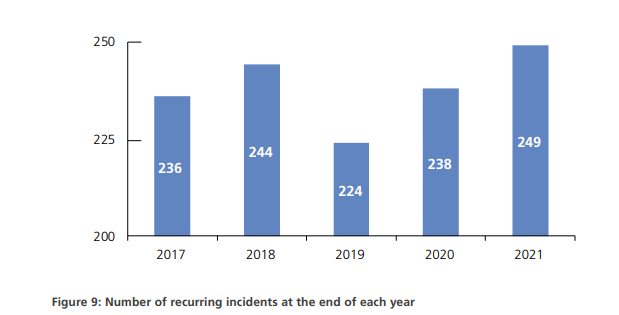
    Number of incidents leading to environmental damage across Ireland. Source: EPA Urban Wastewater Report

    The EPA has stated in the report that a “multibillion-euro investment” by Irish Water is necessary to bring the plants up to EU standards, which have not been met since 2005. 

    Speaking on the matter, Green Party MEP Grace O’Sullivan challenged Irish Water work quickly to meet EU standards. “While Irish Water have said they are playing catch-up  since their setting up in 2014, I don’t believe it is acceptable that we are missing targets from 2005.

    “Work on adamant treatment of our urban wastewater must be fast tracked as soon as possible”.

    Irish Water has previously rejected calls to treat sewage with UV light all year round, citing the lack of “any material improvement” when applied. See the tweet here.