
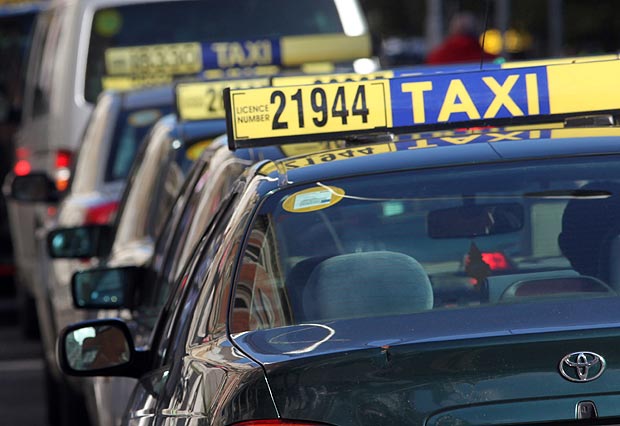
Taxi’s warn that the shortage of drivers will only increase over the
Christmas period.

By Lucy Harris
After two years of staying home, Dublin city is slowly starting to return to her old self.
The beginning of the Christmas chapter only confirms this fact. The streets, now filled with happy shoppers and dotted with musicians give an atmosphere of a pre-pandemic Dublin. December is, without fail, one of the busiest months that Dublin experiences every year.
But, with the average rent in Dublin City Centre sitting at just over €2000 per month, many locals face the daunting experience of trying to return home after a day in town.
It’s no secret that Dublin’s transport system is in need of improvement. In comparison to other
European cities, it rates pretty low.
Berlin has the U-Bahn, which runs 24 hours, at 15 minute intervals. Paris has the Noctiliens night bus, a series of 47 lines which crisscross the city and outer suburbs of the French capital. Madrid boasts a rate of 89% of its inhabitants living 1 km or less from their nearest station.
In Dublin, after midnight, the options become very limited. The Luas and train cease running,
along with the majority of buses. The exception, of course, being the Nitelink, which operates on a Friday and Saturday night with 13 buses running once an hour between midnight and 4am.
For many people, a taxi is the only course of action. The introduction of apps such as, Free Now and Bolt have streamlined the act of getting a taxi. A quick click of a button and within 3 minutes a taxi will apparate, as if from thin air.
But it seems that the demand far outweighs the supply. Reports from individuals who have been left wandering the city centre in hopes of flagging down a taxi for hours after their night out finished, are being told on Twitter.
One user expressed his disappointment in the situation, “I’ve been so frustrated lately living in Dublin. Everything is expensive. On top of that, we have a taxi shortage. I was out last night and although my night ended at 1am, I couldn’t find a taxi for an hour. I felt so helpless”.

“Covid played a big part for a lot of drivers”, explained David Dunne, local taxi driver in the Dublin 7 area.
“Before the pandemic, nobody had a second to think, for me anyway I was working over 60 hours a week but then all of a second, I had all of this time.”
He goes on to explain how during the lockdown he switched nights for daytime work. A sentiment that was reflected in a survey released by the National Transport Authority (NTA) that stated that only 29% of registered taxi drivers in Dublin are currently working on Friday and Saturday nights.
An element of fear regarding safety also has a part to play for the decreasing amount of taxi
drivers left on the streets.
“If a group of drunk people get in the car there’s a way higher risk of something going wrong”, says Dunne. “I’ve had a few cases of people running off without paying or getting sick in the car- if that happens the car is off the road for the night and I’ve lost my income for the week”.
Dunne also goes on to explain how argumentative people can get late at night, saying how a lot of drivers “just don’t want the hassle of it anymore”.
Other contributing factors include the rise in the fees that apps like Free Now take from each journey. Free Now increased the fees that they charge drivers to 15% per journey effective from March 2021.
“When I started it was a 10% fee with Free Now, it keeps gradually getting higher and higher each year”. Dunne also goes on to talk about how, because of these fees, many drivers opt to switch off the app during busy periods and attempt to avail of cash payments.
So what does the future look like? Well, according to Dunne, the announcement of a 6am closing
time for nightclubs should ease the load.
“At the moment everyone in Dublin is looking for a taxi at 3am because that’s when everything
ends. I’m hoping the new rules give us a bit more of a gradual night of work” ends Dunne.
You must be logged in to post a comment.