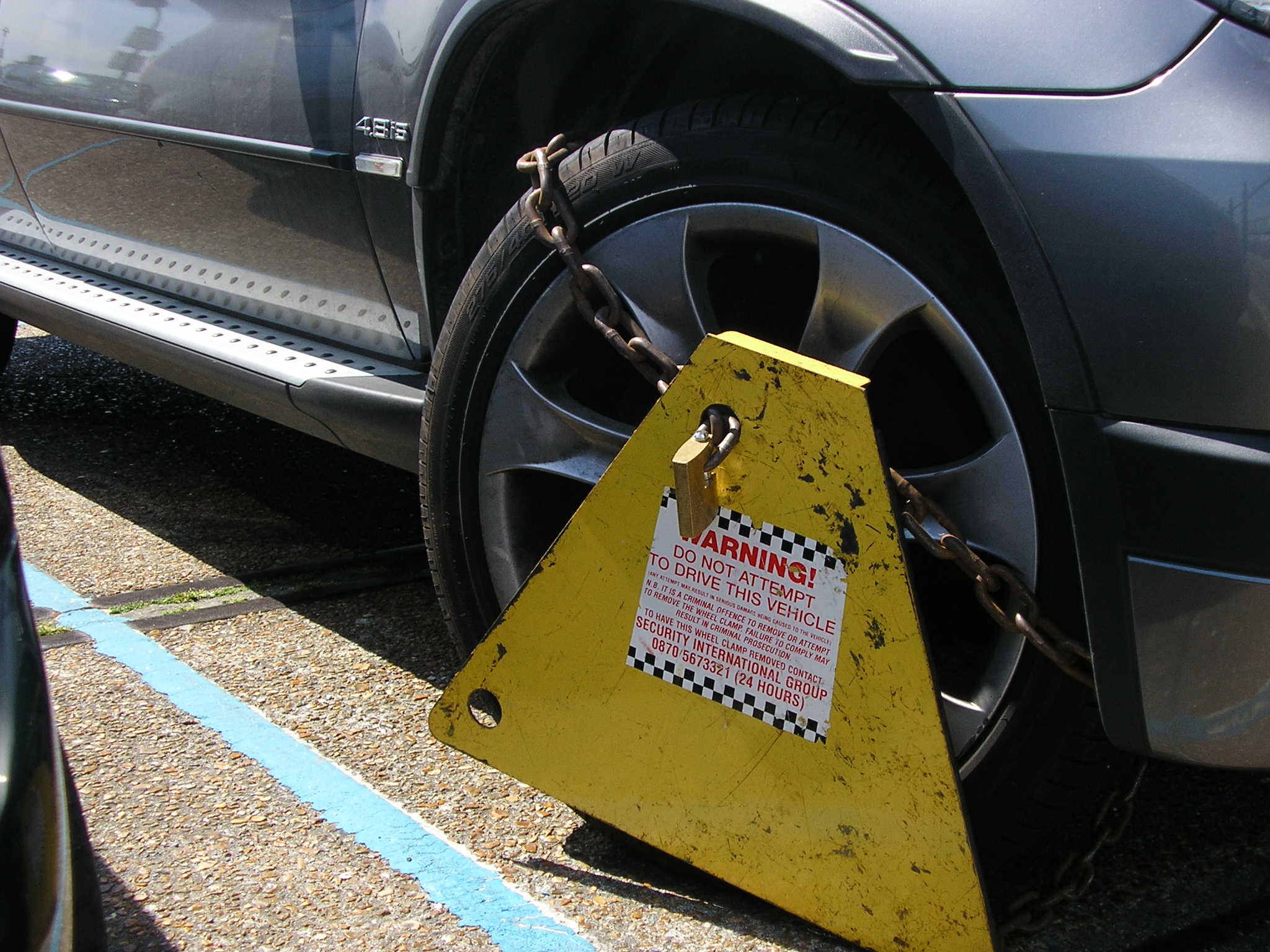
The total number of vehicle enforcements carried out by clamping company Dublin Street Parking Services (DSPS), decreased steadily in the last five years, despite a target of 60,000 being set by Dublin City Council (DCC) in 2014.
The number of vehicles clamped, relocated or towed last year fell to 54,715, a significant decrease from 58,575 in 2011, according to figures released to TheCity.ie under the Freedom of Information Act.
Last year’s decrease in enforcement followed a two-year period where the numbers averaged 56,443.
(Source: Alastair Magee and Liam McInerney)
Currently, it costs €80 to have your car de-clamped by Dublin Street Parking Services (DSPS), the company that runs Dublin City Council’s parking services contract.
In his annual report for 2015, the city’s parking appeals officer, Bill Keilthy, proposed that this figure should be increased to deter consistent illegal parkers.
He argued that they should pay more than double the current standard clamp-release charge.
The number of vehicles removed to pounds in Dublin witnessed a steady increase from 344 in 2011 to 494 in 2015.
(Source: Alastair Magee and Liam McInerney)
Vehicles can be towed away for several reasons. These include:
If your vehicle causes a hazard or obstruction, e.g. on a clearway.
If your vehicle is illegally parked, e.g. on a double yellow line.
If the time allowed on a Pay-and-Display ticket (max. 3 hours) has expired.
Dublin City Council planned to enforce stricter measures to combat the number of illegal parkers in the city this year and the annual report will show if any of these were successful.
This final article in the series on the Pulse of the Nation by Sinead Farrelly will examine the effect that political events, both foreign and domestic, have had on Irish people’s feelings towards the economic situation.
Despite everything, it was interesting to see that generally people always felt happier, than they did stressed, over the entire period, except for at the end of 2010 when the International Monetary Fund (IMF) came into Ireland.
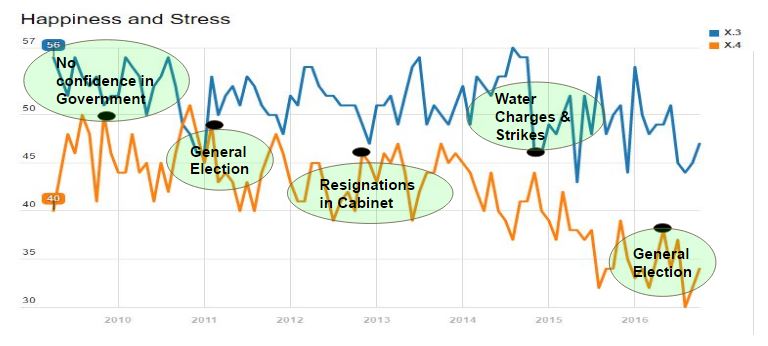
Unlike the overall Economic Recovery Index (ERI), which was not hugely affected by political events, the impact on people’s emotions was much clearer. When the statistics were examined, it appeared as though when there was a time period of political instability with resignations or elections, then people appeared to be more stressed as there was an uncertainty as to who was leading the country in a time of economic strain.
Source: Sinead Farrelly
In this first graph, happiness is indicated by the blue line, and stress is indicated by the yellow line. The major spikes in stress and dips in happiness came at times when the government was unsettled.
The year of 2010 saw a flurry of resignations from ministers across the board as there was a general unease in the government at the time. While at the same time, votes of no confidence were put in against then Taoiseach Brian Cowen and also leader of Fine Gael Enda Kenny. Both motions lost and they each retained their positions. In 2012, there was also a vote of no confidence against Minister for Health James Reilly and this led to the resignation of Minister for Primary Care Roisin Shortall.
The year 2011 began with the Green party withdrawing from government and automatically paving the way for a general election. Taoiseach Brian Cowen also resigned from his position at this time.
In 2014, there were no major changes to the government or to the cabinet but people still were unhappy with the government as water charges were formally introduced at €60 per one adult household and €160 thereafter. Some 350,000 second level students were also forced out of school as teachers took industrial action over changes to the Junior Certificate.
Each of these times saw the Irish people becoming more stressed and less happy, according to the Amárach research.
This year’s general election saw Ireland without a government for a three month period as the Dáil voted four times to elect a Taoiseach. The Amárach results show that during those times that Ireland had an unstable government, the Irish people once more felt more stressed and less happy.
As well as domestic political affairs, the Amárach research also questioned people on their feelings towards foreign political events. From October 2010 until December 2013, every month they posed the question: “The News From Other Countries Makes Me Confident The Recession Will End Soon.”
Source: Sinead Farrelly
An interesting result which can be seen in the graph is that Irish people felt most confident about the recession ending soon when other countries required a bailout from Europe.
The three major peaks in confidence in this graph appear in the summer of 2010, May 2011 and May 2012 when Greece, Portugal, Spain and Italy each received their bailouts. Famously (with Ireland included) these countries who received bailouts became collectively known as the PIIGS.
The major dips in the graph came in November 2010, when the IMF came into Ireland and the country was at its worst point, and in July 2011 and June 2012. The two latter dips both correlate to events seen in Greece, firstly when they voted in a fresh round of austerity measures and received a second bailout, and secondly when the pro-austerity party won a landslide victory in the country’s elections.
Both these events saw austerity measures becoming a mainstay in the Greek political landscape and both of these might have caused an upset in the Irish confidence as it proved that austerity measures were going to stay.
The Amárach Research polls stopped asking a specific question about foreign affairs at the end of 2013. However, they did bring the topic back up again in June of this year in the wake of Brexit.
On June 24th, the day after the Brexit referendum, there was a special Amárach poll carried out on the topic. It found that 37% of Irish people were going to become more cautious about their spending and saving following the shock result in the UK.
This poll aligned with the July 2016 standard monthly results which showed 6% less people feeling financially comfortable and 5% less people feeling optimistic, while enjoyment and happiness both dropped by 3% and 6% respectively, with stress and anxiety both rising by 3%.
Some 163 people have been killed on Irish roads so far in 2016, compared to 131 people at this time last year. Specific figures will not be released until early next year, but trends that were looking optimistic after last year aren’t holding up.
Source: Wikipedia
Looking at the figures and statistics on road deaths last year and over the last 10 years can help discover what kind of trends are occurring and who is most at risk.
Road deaths were the second lowest in Ireland in over half a century in 2015. Mayo had the highest number of fatalities per 100,000 people (10), while Dublin had very few, with just 1.3 per 100,000.
Dublin (17) and Cork (16) had the highest number of road fatalities in Ireland (because of their high populations) while Roscommon and Waterford both had no road deaths. Cathal Lynch from the RSA said that even though the two counties had no road fatalities last year, “It’s impossible to infer a trend from just one year of data,” so this does not necessarily mean they will continue on this course.
Some 29% of people who died in 2015 were not wearing seat belts, which could have been the deciding factor in their death. Almost one in three collisions were alcohol related with even a small amount of alcohol increasing the risk of being involved in a fatal crash. A shocking one in ten drivers (284,000) admitted to drinking before driving in the 12 months prior to November 2015, with 2 out of 5 of these drinking two or more drinks.
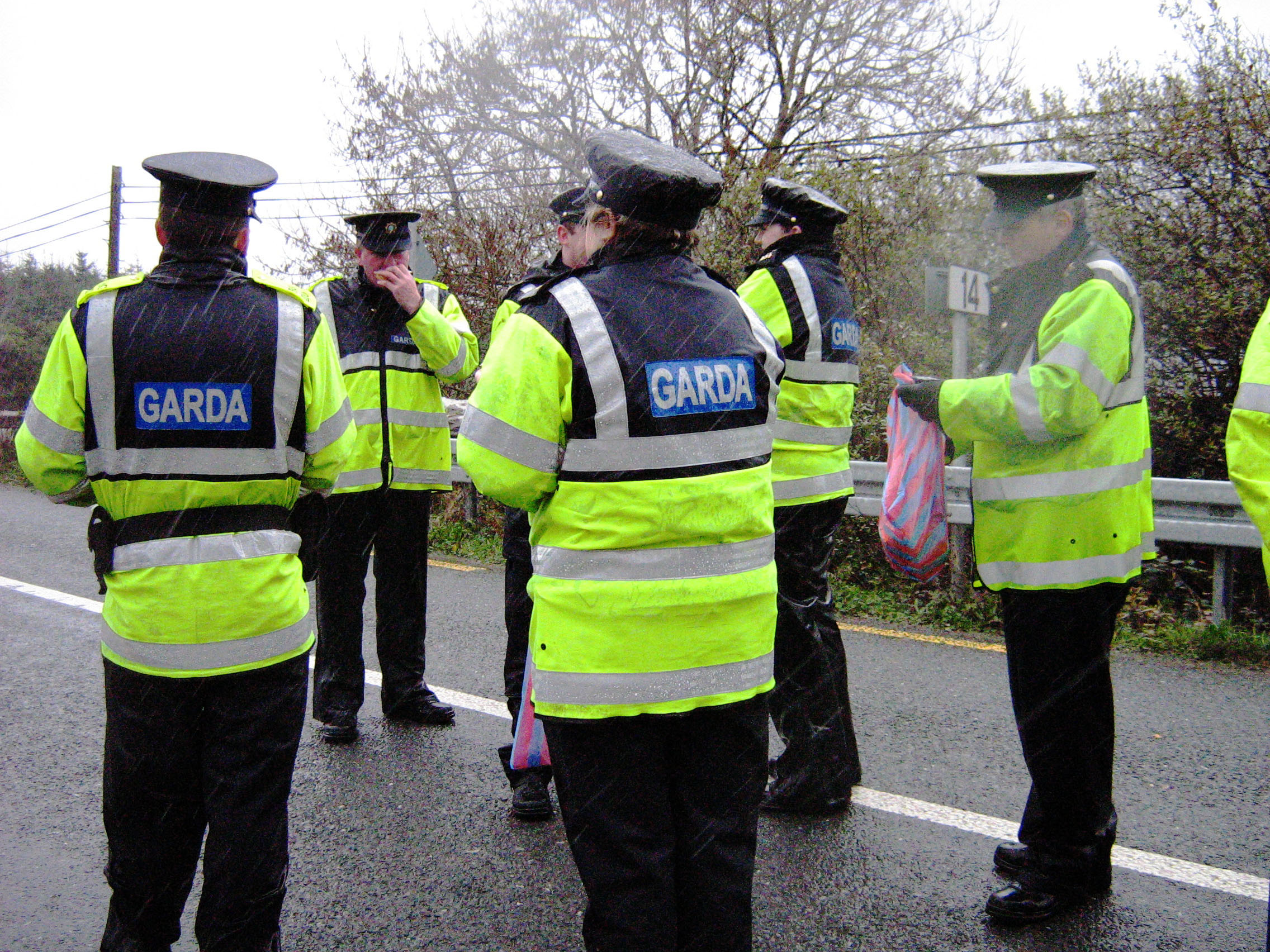
Garda Grace Byrne of Blackrock Garda station said, “People might see the stereotypical drink driver as a man having a few pints after work and then driving home. But I have noticed in recent times that there is an increase in young females being arrested for drink driving.” She has also noticed that there are more people being arrested the morning after, “they’ve been out drinking the night before and are still over the limit the next day, without even realising.”
Donegal has had the highest number of fatalities for its population continuously in the past decade, with 18.3 per 100,000 in 2005, but is making improvements, going down to almost a third of that in 2015 with 6.8 deaths per 100,000. In the last five years Roscommon has gone from 14 in 2010 (per 100,000 people) to 0 in 2015. Dublin and Cork are steadily getting lower and Galway had a huge drop from 2005 (9.1) to 2010 (2.4) but rose again in 2015 (4.8).
Created by: Kieva McLaughlin
In 2015, the most vulnerable age group was 16- 25 year olds with 27% of all road fatalities. The elderly had the second highest number of road deaths with 19% and the 26-35 year age group closely followed with 17% of all the road fatalities.
Created by: Kieva McLaughlin
The highest number of road deaths are drivers, totaling 46% of road fatalities in 2015. Vulnerable road users (pedestrian, motorcyclist and pedal cyclist) accounted for 38% of road deaths with the highest number being pedestrians. This was only down 2% in 5 years from 21% in 2010 to 19% in 2015.
Created by: Kieva McLaughlin
A total of 76 drivers were killed in 2015, this is the same number as 2014 and down from 91 drivers in 2010.
Younger drivers were most susceptible, accounting for 25% of all drivers killed (16-25 years). The majority of driver fatalities occurred on country roads, and in particular on roads with a higher speed limit (shown below). Garda Grace Byrne thinks the main reason for accidents in Ireland is speed, “Speed is a killer, the faster you are driving and collide with a vehicle the less likely your chances are [of surviving].” As shown below, males accounted for 76% of driver fatalities.
Created by: Kieva McLaughlin
Speed Limit
No. of Deaths
30 km/h
1
50 km/h
6
60 km/h
6
80 km/h
31
100 km/h
29
120 km/h
3
Total
76
Table 1 (Created by Kieva McLaughlin, Figures Source: RSA)
In 2014, almost 25,700 people died in European Union countries. Over 200,000 people suffered serious, life changing injuries. However, in 2000 very few EU member states had a fatality rate lower than 8 deaths per 100,000 inhabitants but in 2014 there were only 5 EU countries with a fatality rate higher than that. There were a total of 5,700 less deaths from 2010 – 2014.
Malta, the Netherlands, the United Kingdom, and Sweden had the lowest number of fatalities, all below 3 deaths per 100,000. Lithuania, Bulgaria, Romania and Latvia had the highest number of road deaths all having 9 or more per 100,000. Latvia had the highest with 10.5 road fatalities per 100,000 people living there.
The road fatality rate of nearly every country lowered from 2010 to 2014 except Latvia which rose from 10.3 to 10.5 (per 100,000). Sweden and Lithuania both increased by 0.1 each and Estonia stayed constant at 5.9 deaths (per 100,000).
The EU average in 2010 was 6.3 and lowered to 5.1 in 2014. Ireland was below the EU average both years going from 4.7 to 4.3. An EU road safety plan wants to reduce the road deaths by half from 2010 to 2020. Although the rate has lowered by around 19% since 2010 it has only lowered 1% from 2013 to 2014. This means the rate is slowing down rather than speeding up, which, if continued at this rate, will not reach the EU’s goal.
Pedestrian fatalities are not decreasing as much as the overall rate, with 22% of all killed on the roads in 2013 being pedestrians. Pedestrians are at a higher risk in urban areas and the elderly are particularly vulnerable. Ireland was below the EU average at 18%. The Netherlands, Finland, Belgium and France were all below 15% and in Poland, Latvia, Lithuania and Romania over a third of people killed were pedestrians.
The EU has the lowest fatality rate of any region in the world, with the USA having double its rate at 10.2 (per 100,000) in 2014.
Created by: Kieva McLaughlin
Footnote:
Country Abbreviations: AT Austria, BE Belgium, BG Bulgaria, CY Cyprus, CZ Czech Republic, DE Germany, DK Denmark, EE Estonia, EL Greece, ES Spain, FI Finland, FR France, HR Croatia, HU Hungary, IE Ireland, IT Italy, LT Lithuania, LU Luxembourg, LV Latvia, MT Malta, NL Netherlands, PL Poland, PT Portugal, RO Romania, SI Slovenia, SK Slovakia, SE Sweden, UK United Kingdom.
On the afternoon of November 24th, 2013, the Irish rugby team seemed for one brief moment of time as if they were on top of the world.
At the Aviva Stadium that winter afternoon, Ireland had breezed into a 19-0 lead against New Zealand inside 20 minutes of action. It was incredible stuff, being in such a commanding position against the most feared and dominant rugby nation on the planet.
However, New Zealand demonstrated why they are the world’s best by overhauling Ireland’s lead with a late try and conversion to snatch victory by two points.
Source: Wikimedia
The manner in which New Zealand actually came out victorious was one of the hardest things for Joe Schmidt’s weary charges to take.
The Television Match Official (TMO) had to be called in to confirm that Dane Coles’ pass to substitute Ryan Crotty was not forward. That decision tied the teams up but there would be more drama to follow.
Aaron Cruden’s conversion attempt went wide of the posts but Welsh referee Nigel Owens ordered it to be retaken as he deemed Ireland to have charged out from their goal too early.
Cruden found the target at the second attempt which left the home side stunned and still without a test victory over New Zealand. At that stage three years ago, we wondered what it would take for us to ever beat the world’s best team.
Two weeks ago, we discovered just that … the best way to beat New Zealand is to take the game to them and put them on the back foot. And that’s exactly what Schmidt’s determined band of warriors did at Soldier Field, Chicago in front of 62,300 spectators.
They stood up to the task even before kick-off. As the All Blacks performed their customary Haka war dance, the entire Irish match-day squad stood in a figure of eight in memory of the late Anthony Foley, the Munster and Irish stalwart who passed away in October.
Ireland were mentally and physically ready for the big occasion against a side that had eight survivors from their World Cup final triumph over Australia a year previously.
Tries from back row forwards Jordi Murphy and CJ Stander in addition to Conor Murray crossing the line meant that Ireland held a 25-8 lead at half-time. Winger Simon Zebo stretched Ireland’s lead with another try after the break before the inevitable New Zealand onslaught began.
The world champions displayed their strength in depth as tries from TJ Perenara, Scott Barrett and Ben Smith began to test the mental resolve of this Irish side.
Schmidt’s men regrouped and sealed the historic triumph in the ‘Windy City’ with a late try from Henshaw and a successful conversion from Joey Carbery.
The result ended New Zealand’s 18 game winning streak. It was also Ireland’s highest ever points total against the All Blacks. New Zealand don’t get beaten too often so when they do, it comes as a bitter pill to swallow.
Ireland will definitely be without the services of flanker Jordi Murphy when they renew acquaintances with the All Blacks this Saturday evening. The Leinster player suffered an injury to his left knee in the first half of the historic win in Chicago and it was later confirmed that he had suffered anterior cruciate ligament (ACL) damage, which will rule him out of action for between six and nine months.
Luckily enough, Ireland have two able replacements in Munster’s Peter O’Mahony and Leinster star Sean O’Brien, who both got game time in the facile 31 point victory over Canada last Saturday.
New Zealand were given a boost ahead of the trip to Dublin with Brodie Retallick’s second half appearance in the 68-10 rout of Italy last weekend leaving him poised for a return to the starting line-up.
Retallick could be joined in the second row by Sam Whitelock. The pair are well accustomed to each other as they were second row partners when New Zealand defeated Australia to reclaim the World Cup in October 2015.
If Ireland are to come out on top again against Steve Hansen’s world champions, they’ll need to stop winger Julian Savea. Savea scored 45 tries for New Zealand in the space of four years and the winger will aim to use his powerful presence to break down the Ireland defence.
It’s unlikely that this game will resemble the Chicago fixture in terms of such high-scoring and free-flowing rugby. New Zealand will want to reaffirm their status as the best international rugby team by whatever means necessary.
This is bound to be another physically demanding clash and it just appears that New Zealand have the greater strength in depth to emerge on top after a gruelling 80 minutes of action.
Guinness Series Ireland v New Zealand Aviva Stadium Saturday, 19th November
The world’s leading mixed martial arts (MMA) promotion returns to Ireland on November 19th with ‘UFC Fight Night: Belfast’ which will be headlined by a middleweight bout between Gegard Mousasi (40-6-2) and Uriah Hall (13-7-0).
(Source: UFC)
The only Irish representatives included are Artem Lobov , newcomer Charlie Ward and UFC veteran Neil “2 Tap” Seery who will face Ian ‘Uncle Creepy’ McCall in what is going to be his final fight.
It’s a surprise that he’s not been included on the main card for his last bout and fans have been vocal about the issue in recent weeks. Fans on this side of the Atlantic have also voiced their disapproval concerning the lack of Irish fighters featured on the show.
Despite this, UFC Belfast should draw a large crowd to the SSE Arena and TheCity.ie takes a closer look at the stand out bouts on the card.
Middleweight – #5 Gegard Mousasi (40-6-2) v #10 Uriah “Prime Time” Hall (13-7-0)
Number five ranked middleweight, Mousasi, will seek revenge against Hall, the last man to beat him in the UFC, in the shows main event.
Hall shocked fans worldwide when he stopped Mousasi by second-round TKO, thanks to a sublime spinning back-kick in Saitame, Japan, in September 2015.
The rematch pits two of the division’s best strikers against each other once more but Mousasi will be brimming with confidence as he’s been in superb form of late.
He comes into the fight on the back off a hat-trick of wins against Thales Leites, Thiago Santos and most recently Vitor Belfort at UFC 204.
Uriah Hall is desperate for a win and will be hoping for a repeat of his TKO victory when they meet having suffered back-to-back losses against Robert Whittaker and Derek Brunson.
It promises to be an intriguing battle and acts as a great replacement for the original main event, a welterweight clash between Gunnar Nelson and Dong Hyun Kim, which was scrapped after Nelson suffered an injury.
(Source: UFC)
Lightweight – Ross “The Real Deal” Pearson (21-11-0) v Stevie “Braveheart” Ray (19-7-0)
In the co-main event we will be treated to an England vs Scotland lightweight showdown.
Pearson is one of the most experienced fighters in the UFC and is a popular choice among fans while Ray has gone (3-1) in the UFC since being signed.
Both men lost their previous fights and will be anxious to win at the SSE Arena.
Pearson lost three of his previous four, most recently, when he suffered a unanimous decision to Jorge Masvidal at UFC 201 after taking just 22 days between fights and temporarily moving up to welterweight.
Ray suffered his first UFC loss last time out, dropping a unanimous decision to Alan Patrick at UFC Fight Night 95 although he had been on a three win streak beforehand.
They are both well-rounded fighters who possess knock-out power but it will be interesting to see how Ray deals with the high-intensity set by the experienced Pearson.
Featherweight – Artem “The Russian Hammer” Lobov (13-12-1) v Teruto “Yashabo” Ishihara (10-2-2)
SBG Ireland’s Artem Lobov stopped his two fight losing streak with a unanimous decision victory over Chris Avila at UFC 202 in his last fight.
This result likely saved his UFC career for now but he will be hoping to produce another victory when he faces KO specialist Ishihara.
The Japanese fighter was a featherweight finalist on “Road to UFC: Japan” but lost out via split decision in the final.
Since then he defeated Julian Erosa via second-round knockout at UFC 196 and beat Horacio Gutierrez with a bonus-winning first-round knockout at UFC Fight Night 92 to establish himself in the featherweight division.
With eight knockouts on his CV he will be no easy opponent for Lobov but this should create an intriguing stand-up war for fans. Lobov knows that a victory here will speak volumes for his future UFC career.
(S0urce: UFC)
Flyweight – #5 Ian “Uncle Creey” McCall (13-5-1) v Neil “2 Tap” Seery (16-12-0)
Team Ryano’s Neil Seery will hang up his gloves following his fight with McCall and it should be a fitting send-off for one of the pioneers of Irish MMA.
McCall witnessed two of his opponents in a row pull-out due to injury and offered to fight Seery in Belfast to put on a show for the fans.
Seery accepted and we are left with a very promising bout between to vastly experienced and popular flyweights.
The Dubliner has a (3-3) record in the UFC and returns to action following a unanimous decision defeat to Kyoji Horiguchi back in May.
This will be McCall’s first fight since his loss to John Linekar in January 2015. The American has seen his last three fights fall through and is desperate to get back in the octagon.
It will be an emotional occasion for Seery and his fans and the fight should be explosive throughout.
The number of people who are claiming jobseeker’s benefits is decreasing, after September 2016 saw the lowest numbers for over forty years.
In 2009, the number of people claiming jobseeker’s benefits rose significantly due to the economic crash.
However, since then the numbers have been on a steady decrease, with 2016 posting the lowest numbers since the surge in 2009.
According to official statistics from the CSO, September of this year recorded the lowest amount of people who are receiving weekly pay on the Jobseeker’s Benefit Scheme.
In September, it was recorded that 37,097 people had claimed from one of the three categories. This is the lowest amount for a single month since October 1974, which recorded 33,954 claims.
Source: Colly Phelan
The three categories refer to the amount of pay received per week, with a maximum of€188.00 a week allocated for those fully qualified. The qualified adult rate is €124.80, with the child rate standing at €29.80 as of July 2015.
Jobseeker’s benefits are a social insurance scheme, set up to help those who are unemployed and provide them with a means of income.
A person who is unemployed has the right to claim jobseeker’s allowance providing they are capable of work and are both available to work and genuinely seeking work.
The jobseeker’s scheme also allows those who do find part time work to claim pay for the days which they are not working.
However, the amount of applications for jobseeker’s benefits is still rather high. In fact,according to statistics on the CSO website, 2016 has a similar amount of applications as previous years, even surpassing 2009 (per month) which had the highest number of people getting their applications accepted.
Source: Colly Phelan (Per month)
Although the 2016 figures feature only nine months as opposed to twelve, recent years show that application figures throughout the year remain fairly consistent.
The largest increase in applications came in 2009, where the numbers jumped from 150,856 in January, to 239,079 applications in December of the same year.
The year of 2015 showed a decrease in applications from January to September, from 243,877 to 218,941 respectively.
Recent information about wait times in relation to claiming social benefits revealed that jobseeker’s claims have the quickest response time of two weeks. Child benefit claims have been recorded to take up to twenty-eight weeks.
Justin Bieber brought his Purpose World Tour to the 3 Arena on the 1st and 2nd of November. It was his first time touring since 2012-2013 with his Believe Tour. Both dates sold out within minutes with overwhelming demand from fans across Ireland.
Source – Wikimedia
The tour has previously made headlines when the ‘What Do You Mean’ singer was perceived as being bratty and stroppy. During his Manchester gig he stormed off stage after his fans wouldn’t stop screaming while he was talking.
Justin began his Dublin concert while donning an Irish flag on the front of his t-shirt, with ‘Dublin’ written on the back. He appeared in a glass box with a very energetic, heavily choreographed ‘Where Are U Now’.
Over the course of the concert Justin began to lose some energy, which can be forgiven because of his elaborate dances that would be sure to take it out of anyone. Justin’s back up dancers were superb and gave it their all throughout the whole show. Lasers, lights, and pyrotechnics accompanied almost every song.
Justin showcased his natural ability to sing when he took to stage, with just himself a couch and a guitar. He sat down with the effects stripped back and played ‘Cold Water’ and ‘Love Yourself’. The 22- year old singer was apparently eager to show off his instrumental skills, and later in the show he played a surprisingly good solo on the drums.
Source – Wikipedia
Justin began most of his songs with a quick-witted intro. For his song ‘Company’, the singer began by telling his fans, “Imagine being on the road for a year, away from friends, away from family.” He then thanked his fans for being there to keep him company through it all, during this, a platform trampoline came out of nowhere and hung from the ceiling. Justin and his dancers ran up the stairs to it to start the song.
A standout song on the night was ‘Children.’ A competition had previously been run to find skilled Irish child dancers to take part. They absolutely nailed it and after the song they were all smitten, as Justin addressed them all individually.
Justin closed his show with the highlight of the night, “Sorry.” A long black blow up was put on stage and the Canadian singer and his dancers performed while rain lashed down on them. Everybody left the concert feeling elated and wanting more.
In 2001, 13.5 out of every 100,000 people in Ireland died by suicide, a rate of death that has never been exceeded since. The lowest rate of suicide over the last fourteen years was in 2015, with 9.7 out of every 100,000 people taking their own life.
The numbers of suicides have generally been steadily decreasing since 2001. However, this stopped between 2008 and 2012, and the rate of suicide fluctuated between 11.1 and 12.4 per 100,0000 people during the recession. The numbers then returned to the 2007 rate of 10.6 in 2013 and have continued to decrease since then.
The increase in suicides between 2008 and 2012 can at least partly be attributed to the recession. Increased unemployment combined with depression and substance abuse was found to be some of the main factors in people taking their life during this time, according to a report by the Suicide Research Foundation.
During the recession, many people lost their jobs and had no means to support their families and in a lot of cases lost their homes. Psychotherapist Olivia Fox talks about how challenging being unemployed can be for people.
She said: “It can lead to depression and a feeling of worthlessness. In general, we could see an increase of hopelessness as people who had worked hard to get a job and a roof over their head saw their life work wiped out overnight.
“Even in this modern world of gender equality, men often psychologically feel the burden of being the ‘provider’ and when they can no longer do so, the resulting depression, pressure and hopelessness can have devastating consequences on the mental health of some.”
The suicide rates during the recession were not in fact higher than some of the early Celtic Tiger years but rather returned to higher figures after a decreasing trend in the previous few years.
(Source: Kieva McLaughin)
Gender
In 2015, nearly five times as many males died by suicide (375) in Ireland as females (76) and again it’s important to point out that last year’s figures are provisional. We do however, have one of the highest rates of male suicide in the world with nearly eight males taking their lives every week.
Only 25% of males who take their own lives have a history of self-harm in comparison to 50% of females. Under 40% of males are diagnosed with a psychiatric disorder before taking their life while 70% of females are. More women contemplate and attempt suicide than men so where does the big gap come from?
Olivia Fox attributes it to the fact women are less likely to follow through when they think about the consequences.
“Men are more likely to act impulsively there and then without giving consideration to the outcome. Also the method people use to take their own life causes a disparity in the sexes. Women tend to overdose whereas men tend to use more violent methods, such as hanging or shooting which are more likely to result in death.”
Another reason she explains is that, “Men are less likely to talk about their feelings or express emotion. This can result in them isolating themselves from any personal or social supports and in them drinking more. Alcohol involvement in death by suicide seems to be higher in men than women.”
(Source: Kieva McLaughlin)
Area
The area with the most suicides in 2015 was Carlow, with 21.2 suicides per 100,000 people, more than the double the national average.
The figures show a large disparity from cities and their surrounding rural areas. Waterford City reported no suicides in 2015 but the rate more than doubled in the county area from 8.8 in 2014. Galway City had a small increase from 11.1 per 100,00 in 2014 to 12.7 in 2015, but the surrounding county area’s figure rose more dramatically from 10.2 to 17.4.
It is estimated that some 3,780 women and girls, aged between 15 and 44, in Ireland have been subject to female genital mutilation (FGM).
FGM involves the full or partial removal of a woman’s outer genital organs. There are both short and long term health consequences for women who have endured the procedure.
A recent study from the European Institute for Gender Equality estimates that between up to 11% of the almost 14,600 girls aged under eighteen in Ireland whose parents originate from FGM-practicing countries could be at risk of the procedure
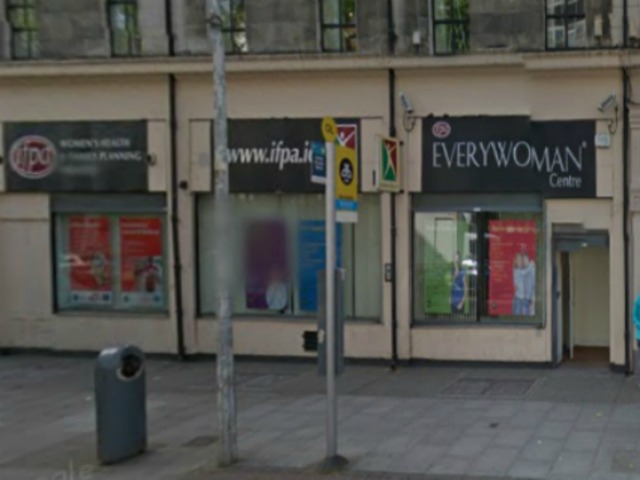
Ireland outlawed FGM in 2012 and although there are no known prosecutions under the law, Aine Travers of the Irish Family Planning Association (IFPA) said that it sends a strong signal.
“The legislation sends a very powerful message, that FGM is a serious crime with serious sanctions, but it’s also a support to parents who may feel under pressure to have the procedure done to their girls,” she said.
“All women who access our specialised service have been aware of the legislation. They’ve all known that it is a serious crime in Ireland.”
According to the latest statistics in the IFPA’s annual report, ten women accessed the FGM treatment service last year, since it first opened in May 2014.
The free service provides medical treatment for affected women, psychological support and it also offers sexual health and reproductive services.
There are both long and short-term risks associated with FGM. Infection, haemorrhage and HIV are among the problems associated with the procedure – which can often be carried out by someone who has no medical training.
Long term, women who have the procedure can be faced with painful periods, infertility, potential trauma during childbirth and psychological trauma.
“Part of our plan is sustained outreach, we’re constantly trying to spread awareness about the clinic to women in communities who are possibly affected by the procedure,” Ms Travers explained.
“They don’t have to be referred through a doctor, they can self-refer. We want to facilitate as many women as possible to access it in a way that is most comfortable for them,” she added.
Meanwhile at a policy level there has been something of a shift recently.
The Government signed the Istanbul Convention on Friday November 5, following extensive lobbying from advocacy groups, including Amnesty International.
The Council of Europe Convention on Preventing and Combating Violence against Women and Domestic Violence (Istanbul Convention) marks the first time that Ireland has agreed to a legally binding instrument in the area of preventing violence against women.
Signing it has now put an onus on the government to ensure that legislation is effective and also that the prevention of violence against women is seriously pursued.
Ireland was, in the words of Amnesty Ireland’s director Colm O’Gorman, “late to the table” in ratifying the convention.
In the intervening months, Mr O’Gorman had called on the government to sign up to the convention to strengthen their position when it came to stamping out FGM in Ireland.
“While we welcome Ireland’s enacting legislation in 2012 to criminalise FGM, legislation alone is not enough. Ireland needs to adopt a domestic FGM action plan. Ratifying the Istanbul Convention would aid Ireland in sharing best practice in effectively preventing FGM,” he said at the time.
Now that it has been signed, Ms Travers points out that only time will tell of its effectiveness.
“While it’s a very positive signal that the government have signed the Istanbul Convention, it’s really too early to say what impact it will have,” she said.
“It does highlight the importance of the area of prevention and protection, as well as prosecution, very clearly and so that would tie in with what we would like to see coming out of our advocacy work.
“For the second National Action Plan we are looking at more systematic training among the relevant professionals (medical staff, teachers, social workers), more awareness raising and education initiatives in communities where FGM is prevalent,” she explained.
“Our colleagues in Akidwa have produced a guide for education professionals looking at how to identify risk of FGM and how to deal with it in a sensitive way,” she added.
The second National Action Plan for tacking FGM is due to be published in 2016.
More information about the free FGM treatment service can be found here.


















You must be logged in to post a comment.