Irish dancing is an underrated sport in Ireland that has multiple aspects to it including pressure for success, emotional strain, sense of community, politics and beauty expectations.
Aoibhinn Gannon from Sligo a former Irish dancer from the ages of three to seventeen spoke on the interlinked nostalgia and unspoken realities of the Irish Dancing world.
Today’s episode dives into a topic that is relevant to many people, but often goes under the radar—taking the Leaving Certificate outside of the traditional school setting.
Did you know that every year, around 5 to 10% of the 60,000 students sitting the Leaving Cert in Ireland are adult learners or external candidates? That means approximately 3,000 to 6,000 people are taking these important exams after leaving the conventional school system. Many do it through alternative pathways, like the Back to Education Initiative or Vocational Training Opportunities Scheme, but some, like our guest today, are navigating this journey independently.
Joining me is Séamus O’ Riordan, a 19-year-old who has decided to take on the Leaving Cert outside of school. We’ll be hearing about his motivations, the challenges he’s faced, and his unique perspective on preparing for such a significant exam without the traditional classroom structure.
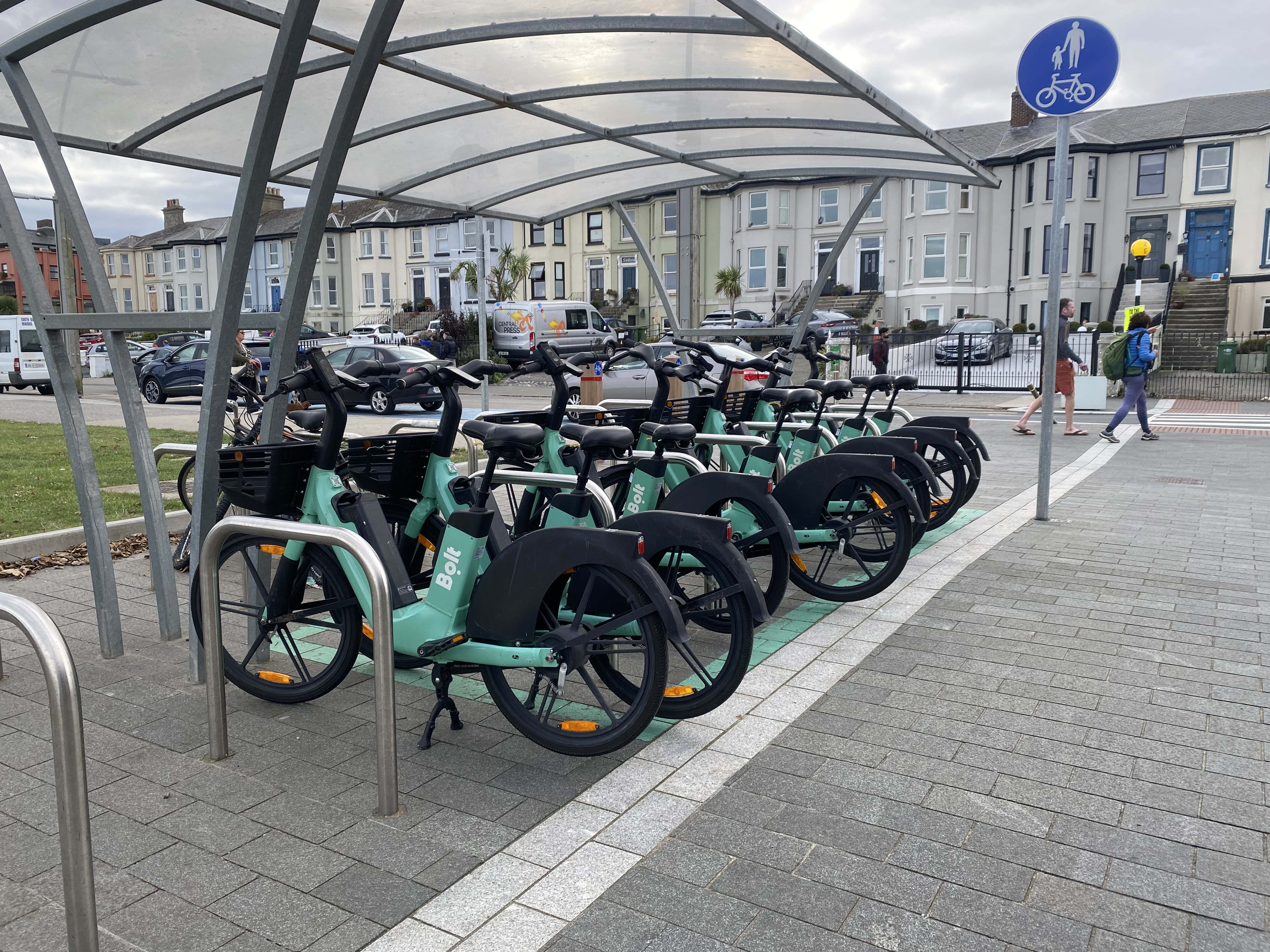
Since June of last year, popular taxi app ‘Bolt’ has extended their services to provide the people of Bray Co. Wicklow with electric bicycles.
These bikes have been a massive success across the town among people of all ages due to their cheap costs and easy accessibility.
Green Party Councillor for Bray East, Erika Doyle, was one of those involved in getting the scheme up and running in the town.
“With the introduction of the bikes, there has definitely been a modal shift, which is great because in a town like Bray we have a congestion problem. It’s very hilly as well, so with the pedal assist it has become much more accessible for people that otherwise maybe wouldn’t have used a push bike,” Doyle explained.
“It’s been a really positive thing for the town, and data from Bolt shows that these are being used even during winter months, because originally, there was a suspicion that they might only be used during the summer, but people are clearly just dressing for the weather and using them regardless which is great.”
The success of this scheme is partly due to just how easy the bikes are for people to use. Users simply download the Bolt app, scan the barcode on the bike, and they will then be charged 18 cent per minute.
Once the user completes their journey, they park the bike in one of the ‘park zones’ that can be found on the app or can be identified by a green square on the ground and bike racks.
Along with a pay as you use option, there are also a variety of subscription passes available to users too, such as a day pass, weekly passes, monthly passes and ‘unlimited unlocks for 30 days’.
The bikes go up to 25 kilometres per hour, but can be capped at 15 kilometres per hours if users wish.
Bolt Bikes at Little Bray ’Parking Bay’ – Photo Credit: Jamie Ryan
Sinn Féin Councillor for Bray West, Dermot O’Brien, speaks highly of the impact that the bikes have had in Bray.
“I would say overall there has been a very positive impact from the introduction of Bolt bikes in Bray. The user numbers are a good reflection of this, and the feedback from local people who see them as an alternative to the car, or as an easy option for getting around the town,” he said.
“I particularly notice the variety of local users, young and old, as well as tourists and exchange students who benefit from an easy and accessible option to move around the area.”
“On a personal level, I would use Bolt bikes very often, and they are a wonderful asset to someone who lives on the edge of being on time for meetings, as I bounce from one venue to another around the town.”
The bikes are easily maintainable due to there being no shock absorbers in their frames, and the tyres not containing air.
However, although there has been a plethora of extremely positive experiences from Bolt bike users, there have been issues with bikes being damaged, defaced or suffering from wear and tear.
Councillor O’Brien himself has fallen victim to this, he explained.
“In recent weeks, I changed my bike four times because of malfunctioning and ultimately, I just walked home which was frustrating,” he said.
Adam Byrne, 20, regularly uses Bolt bikes to get around the town.
“The bikes have made such a difference for me. Getting to and from work has become so much handier and it only costs me maximum €3 per journey which is much better than spending it on petrol – not to mention not having to sit in traffic the whole time,” Byrne said.
Bolt Bike at Bray Harbour with graffiti at the rear mud guard – Photo Credit: Jamie Ryan
“Of course, like anyone else who uses them regularly I’ve had one or two issues, but nothing crazy, more so just maybe a lack of maintenance with the brakes and minor damage to the pedals, but overall, I really can’t say any bad about them. I hope they stay around for a long time.”
The contract between Bolt and Bray Municipal Council has recently been extended for a further year, for locals to enjoy and utilise.
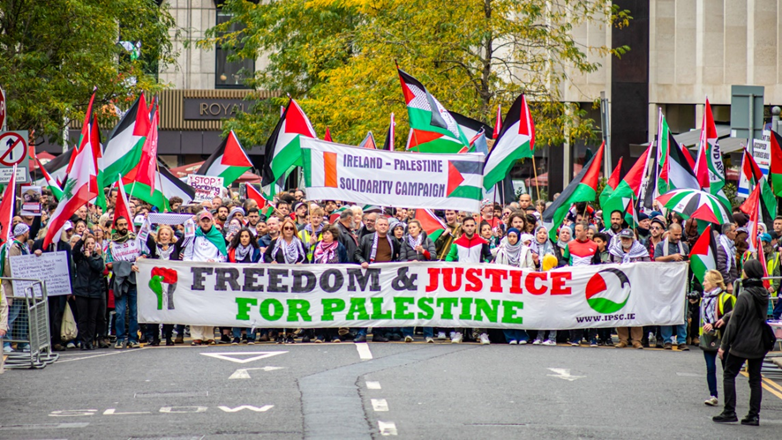
On Saturday, October 5, thousands of people took to the streets of Dublin to mark one year of Israeli escalation in Gaza.
The march, the biggest of its kind to date in Ireland, called for an end to Israel’s occupation, an end to the use of Irish airspace for transporting weapons, and for the Irish Government to act in holding Israel accountable.
Several chants were also heard supporting Lebanon, following recent attacks there, also by Israel.
The national march, titled ‘GAZA: One Year of Israel’s Genocide’, began at the Garden of Remembrance and made its way to Molesworth Street, where a stage had been set up.
Speakers on the stage included Oscar-nominated and BAFTA-winning Palestinian filmmaker Farah Nabulsi, Palestinian photojournalist Eman Mohammed, Zak Hania, who recently returned home from Gaza after seven months, and Ireland Palestine Solidarity Campaign’s chairperson Zoë Lawlor.
Music on the day came from renowned Irish singer-songwriter John Spillane, Palestinian-Irish singer Roisin El Cherif, and Palestinian rapper Talha Alali.
All photos taken by Liam Murphy
Protestors gather at Dublin’s Garden of Remembrance with signs and banners. A group gathers with signs; Some with donation QR codes, others with song lyrics, others with art – Each with meaning. Supporters gather around a 30ft Palestinian flag, as the crowd prepares to march. A young girl wearing a keffiyeh poses as the march makes its way down O’Connell Street. ‘From the River to the Sea, Palestine will be free’ – chants are heard across the capital city. Protestors feel the heat as one bloc light up flares as the march moves down O’Connell Street A masked up keffiyeh-wearing group stand roadside on O’Connell Bridge holding a red Hezbollah flag. A woman holds up a scarf, branded with the Keffiyeh pattern and the Palestinian flag and Irish tricolour flag. ‘You’d care if it was Cork!’ – A protestor holds up a sign on Molesworth Street, calling out the Irish Government The march makes its way around the corner from Dawson Street, now heading up towards Leinster House. Cork singer songwriter John Spillane tuning up before taking to the stage to perform his song ‘Palestinian Sunbird’ Zak Hania smiles as crowds applaud his entrance. Hania spent seven months in Gaza unable to return home. Palestinian rapper Talha AlAli (known as Wise Wolf) performs his newest single ‘Inshallah’ with Irish artist Blue Niall
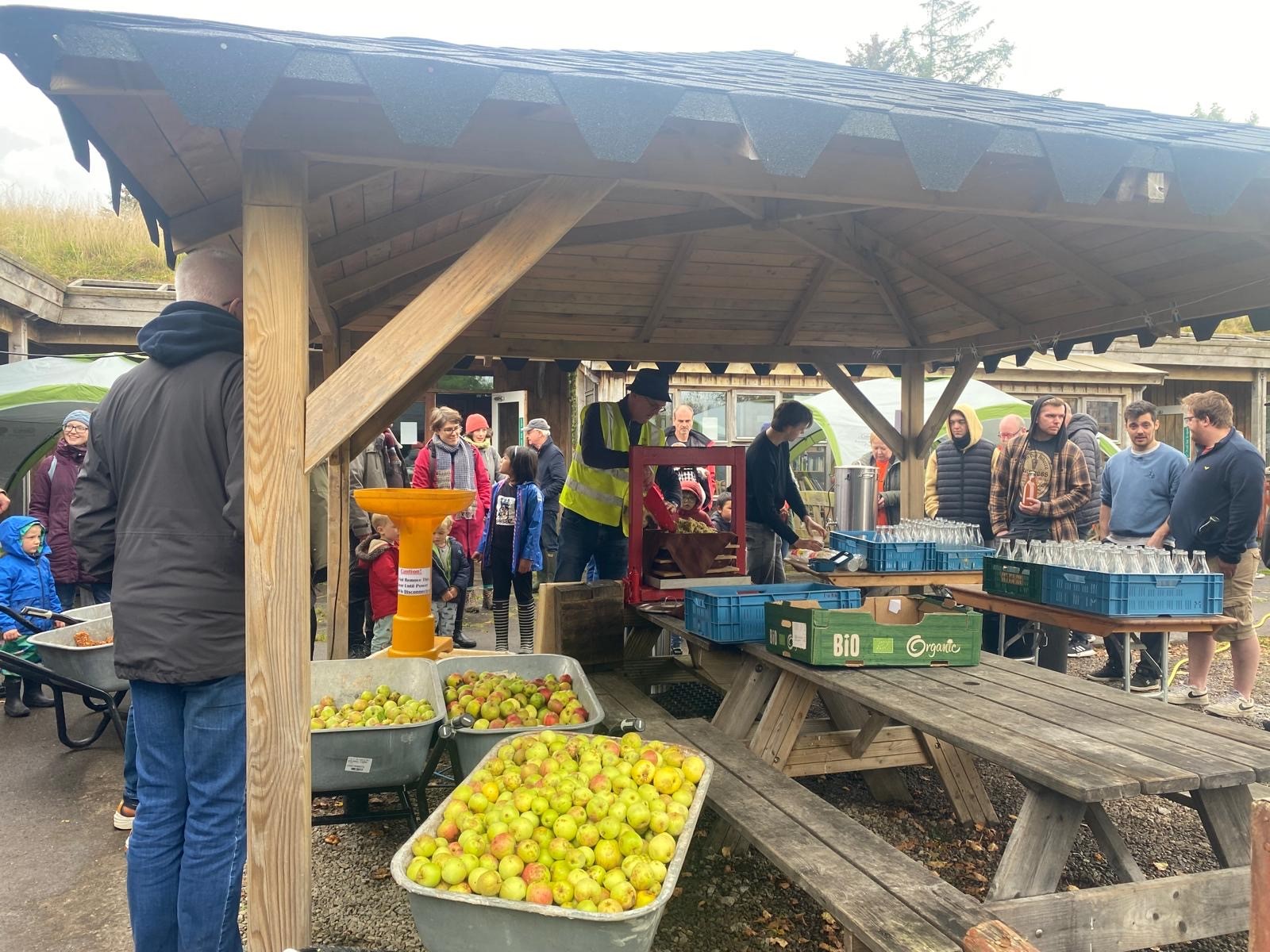
The Organic Centre in Rossinver Co. Leitrim hosted its Apple Day-Harvest Festival on 29 September and The City went to check it out.
The festival had a great turnout with lots of activities and stalls for the visitors. The highlight of the day was the apple pressing, where festival goers were shown how apple juice was made and could sample the finished product.
The stalls were full of sustainable crafts both inside and outside the building. There were craft demos, stone carving, weaving and wool spinning to keep the crowds entertained.
Talks and tours were on throughout the day by experts including The Organic Centre’s resident apple expert Phil Wheal and Botanist Maria Cullen. The Grass Roof Cafe provided all diverse kinds of apple tastes for the people to enjoy.
All photos by Luke Hurson
The crowds were shown apple pressing techniquesThe grass-roofed Organic CentreThe Apple Day Harvest festival drew good numbersThe greenhouses were full of organically-grown fruit and vegetablesThe inside of one of the greenhousesThe craft tent was a popular attractionThe Grass Roots Cafe kept the visitors going throughout the dayA different angle of the apple pressing where pressure is put on the apples to squeeze the juice out of themSome beautiful wildlife paintings were on displayOne of the many craft stalls with handcrafted goods
‘Don’t be rude, have a drink with me’, ‘You deserve a drink, after the week you’ve had’, ‘It’s tradition, you have to’ – these are just a few phrases you may hear around the table while having a few drinks.
Drinking as a social activity is quite common between friends and family across Ireland.
Stereotypes surrounding Irish people and drinking are deeply ingrained in popular culture, often exaggerating or misrepresenting the role of drinking in Irish society – whether that be heavy drinking or holding our liquor well.
But how much truth is behind them? If you read between the lines, you could argue that Ireland may have a few underlying issues with drinking that may have been swept under the rug.
As figures rise, an increasing worry is brewing regarding the effects of drinking, shifting how Irish people view their drinking habits.
But how much do we really drink in Ireland?
When experts talk about the dire health implications linked to excessive alcohol use, people tend to assume that it’s directed at individuals who have an alcohol use disorder – but health risks from drinking can come from moderate consumption as well.
In 2023, alcohol consumption was 9.9 liters of pure alcohol per capita over the age of 15 years. This shows a fall of 10% since the passage of the Public Health (Alcohol) Act in 2018.
Alcohol consumption per capita has reduced in recent years from its historically high point, in the early 2000s. We are now drinking at a level of just under 10 liters per capita.
According to |Alcohol Action Ireland per capita consumption in Ireland in 2023 equated to 284 cans of beer, 12 bottles of spirits, 43 bottles of wine, and 35 cans of cider.
“If the whole of the country was drinking within the HSE lower risk drinking guidelines, we would be consuming about 40% less,” said Dr. Sheila Gilheany, CEO of Alcohol Action Ireland.
“We have very high levels of ‘binge drinking’. Ireland is the 8th highest within OECD countries,” she added.
About 70% of the population consume alcohol. Over half of all drinkers do so in a manner that is considered hazardous. About 20% of the drinking population have an alcohol use disorder.
Consumption and affordability
“Consumption patterns are driven by price, marketing and availability. You can see the changes in consumption in the graph above. In recent years, drops in consumption are usually linked to changes in alcohol taxation. Alcohol remains very affordable, despite industry protests,” said Dr Sheila Gilheany.
The price of alcohol in shops today is essentially the same as it was 20 years ago.
The Organization for Economic Co-operation and Development (OECD) found that Ireland has the second most affordable alcohol across OECD countries.
The Irish alcohol business spends a minimum of €115 million a year promoting its goods. This excludes sponsorship agreements like those for Guinness Six Nations.
Ireland ranks the 3rd highest in the world for the number of pubs per head, and three-in-four people live within walking distance of a premises licensed to sell alcohol.
“The term ‘responsible drinking’ is very much an industry term which has no public health meaning – i.e. it is not defined,” said Dr. Sheila Gilheany.
The HSE has guidelines on lower risk drinking, although, as these are now in the process of being revised, it likely will decrease in common with other jurisdictions which have examined this recently in Canada.
Finance and office manager Jennifer Bergin at Drinkaware said, “Anybody wanting to change up their drinking habits and are looking for information can access our 2023 barometer research paper and consumption page available on our website.”
It’s likely that the majority of people have encountered someone who has struggled with their alcohol intake. Excessive drinking is a widespread problem in Ireland that affects not only the individual, but also those around them. Alcoholism can affect a drinker’s emotional, financial, and physical well-being, which can be harmful to those around them as well.
According to Alcohol Action Ireland, Ireland’s drinking culture is evolving towards more mindful consumption, with health becoming a priority.
The impact of these changes on the country’s drinking culture remains uncertain.
Planet Earth could be in serious danger of losing its main oxygen source.
With the Amazon rainforest continually being felled for its timber and cattle grazing at an alarming rate (since 1988, humans have destroyed an area of the rainforest roughly the size of the American State of Texas), what can Ireland do to try to offset and remedy this huge loss of oxygen-producing plants?
To say it is important for people to support the growth of trees, which support pollinating insects in Ireland and elsewhere, may seem like an understatement. Pollination, and having the right native trees and plants, which contribute to the ecosystem being in balance – is a vital part of nature.
If tree planting is knocked out of balance by human activity, it could have a devastating effect, resulting in the extinction of bats, bees, and other pollinating insects, and hence the plants that rely on them. Also, certainly, birds may be affected. This could have a domino effect, which could eventually lead to the extinction of the animal kingdom, which of course includes our own species, human beings.
It has been reported in the Irish Times by Ella McSweeney, that a third of all bee species in Ireland will be extinct by 2030.
Hanna Backmo, a beekeeper in Ireland, recently told Louise Walsh in the Irish Times, “It’s been a bad year for honey, but the native honeybees are real survivors. Two years ago, because of lack of rain, we had the worst summer in 30 years for honey production. Last year was excellent but, unfortunately, this year doesn’t look too good,” she said.
Orla Farrell is the project leader for the Easy Treesie organisation, whose objective is to plant and grow a million trees in Ireland by 2030. The City asked Orla her opinion on some important environmental issues currently happening in Ireland.
Orla Farrell, the Project Leader for the Easy Treesie. (courtesy of https://easytreesie.com)
Do you think that Irish County Councils giving away thousands of Hawthorn, Mountain Ash and other trees natural to Ireland ahead of National Tree Week every year is a good idea?
Orla: “A super idea. Easy Treesie and Crann do this regularly. The members of the public are thrilled to get such a donation. We ask them only to take them if they have space and if they are going to plant them immediately. The Easy Treesie project is all about planting trees wherever we can find a corner or little spot, to put them. It is vital as a Climate Action.”
Do you think the public are made aware enough about the possible extinction of bees and other insect pollinators in the Irish media?
Orla: “Everyone my age remembers insects at the windows and on car windscreens in profusion in our youth. I was doing a tree-athalon in Sligo on Monday, discussing Yeats’ poem where ‘Moths like stars were flickering out’. Does that happen now? I don’t think so. On the day that Michael D. Higgins called for action on the extinction event that was happening during his address at the Biodiversity Conference in Dublin Castle, the report was only on page 6. The front page had the usual stories.”
I see you have a campaign to plant one million trees by 2030. I see this as a great objective, and I hope it is achieved. You are now halfway to that target. Do you think you will get that number planted by 2030?
Orla: “Yes. All we need is public land. This has been the only slow part of the project. Councils are not yet familiar with our project, so we are really happy Derek, that you are writing about our initiative. Once word gets out about how we are experiencing such success (500, 011 trees at present), we think they will find us space local to the children. We are also open to planting on a really mass scale where children have to travel to the site, though local is our preferred option where the children can easily watch the trees grow.”
At the end of the day, it may be preferable in the long run, for people around the world to choose to get active, and instead of preaching to the Brazilian and South American governments, plant their own trees, woods and forests, which would make a solid positive difference, to ensure planet Earth will continue to produce plenty of oxygen for many more years to come.
Yugo Student Accommodation – Photo Credit: Jamie Ryan
The student accommodation crisis in Ireland has been an on-going issue for the past few years.
Every year, a new batch of students from across Ireland are accepted into universities, in which it is not an option for them to commute – along with returning students who are also actively seeking out accommodation for their upcoming academic year.
Kerry Ann-Darcy, 22, a recent graduate of Maynooth University, but originally from Dundalk in Louth, struggled each year during her time in university to seek accommodation.
“It’s not easy to find student accommodation in general, especially when there is a ‘first come, first serve’ general booking forum for on-campus accommodation,” Darcy explained.
“The university was not helpful and suggested that alternative accommodation could be found on a website called ‘Student Pad’ but that was it. But on Student Pad, the landlords are extremely picky with terms such as gender specific, academic year specific, course specific, degree specific and so on.
“Even once I did get accommodation, there were issues with it. My landlord had a table and chair for us in the dining room at the house viewing but had it removed for when I moved in and he told me that I ‘was imagining that there had been one there’.
Yugo Student Accommodation – Photo Credit: Jamie Ryan
“He complained and gave out to me because we had access to a bedroom, bathroom and kitchen – although that’s what I was paying him for but that’s the bare minimum. In third year, my landlady said that I had to be finished in the kitchen before 6pm but some of my classes only finished at that time,” Darcy added.
Back in 2022, the Minister for Further and Higher Education at the time, Simon Harris, made calls to homeowners living nearby to universities to rent out any spare rooms that they may have in their house to students – as a result of the severe lack of student accommodation to supply the high demands.
This alternative, however, does not necessarily end up costing students less as research carried out by the USI (Union of Students in Ireland) in February found that students are paying an average of €660 across the country to live in digs, with just 43% of those students given full access to the room, seven days per week.
This same study also found that of those surveyed, 59% said that they chose to live in digs as a result of being unable to find an alternative.
Antrim native Caitlin Procter, 19, was unable to attend university this year due to the lack of student accommodation available.
“After being accepted into multiple courses, I wasn’t even able to accept any of them because I couldn’t find anywhere to live,” she explained.
“I was really annoyed and frustrated about it so I sought elsewhere for digs but was still unsuccessful and unfortunately I can’t afford to commute two and a half or three hours per day to and from Belfast and Sligo,” she said.
This is a situation that unfortunately, too many students and university hopefuls find themselves in each year and it appears to be getting worse and worse.
Ardcairn House Student Accommodation – Photo Credit: Jamie Ryan
Dylan Downes, 22, a former student at the University of Limerick, originally from Wicklow, was living in digs for his first year in third level education as the commute between Wicklow and Limerick twice each week was unfeasible.
“I felt that living in digs was my only choice to be honest. I got an apartment with some of my friends for the following year, but I really felt that I probably lost out on the social aspect of college in first year,” Downes explained.
“My commute to and from college each day was around forty-five minutes, which is obviously better than three hours but even still, when you’re paying €700 per month for a room, it is disheartening, and I sometimes felt pretty isolated.
“Thankfully, my accommodation search in second year was far less stressful because one of my friends had already reserved an apartment for the following year and offered me the other room with him, in many cases looking for accommodation is more about who you know than anything else in my experience,” he said.
The student accommodation crisis is a direct result of the greater housing crisis that Ireland has been dealing with for the last decade.
Dublin Councillor Nial Ring has welcomed An Bord Pleanála’s decision to approve Hammerson’s controversial redevelopment plan, calling Moore Street’s current state a disgrace.
This comes days after An Bord Pleanála’s approval of a highly debated plan that will see a €500 million redevelopment undertaken between Moore Street and O’Connell Street.
The UK property group first made applications for this redevelopment in summer 2021, with approval following just seven months later in January.
However, appeals were made to the board and Dublin City Council by a number of Moore Street preservationists, campaign groups, and businesses, which caused for more than two and a half years’ worth of delays.
“I see huge benefits of this project for the local area,” said Councillor Ring, who, along with being a member on the Moore Street Advisory Group, represents the North Inner City electoral area.
“Not only in preserving the history and heritage of the street, but also in bringing Moore Street back to life. It is a disgrace at present.”
The plans, made up of three applications, include the demolition of several buildings, the construction of a nine-storey hotel, the development of a public gallery and café, and the development of a public square – plans which are allowing Hammerson up to 12 years construction on site.
A generated image of Moore Street post-Hammerson development – Photo: Dublin Central / Hammerson
The An Bord Pleanála decision and announcement coincides with the 10-year anniversary of campaign group ‘Save Moore Street from Demolition’, who have gone on to receive over 380,000 signatures opposing Hammerson’s plans.
The group started in September 2014, when members Bróna Uí Loing, Vivenne Kelly, Diarmuid Breatnach and Mel Mac Giobúin met to begin a weekly presence on the street with a campaign table, leaflets, and petition sheets.
“Moore Street is of huge importance, not just to Dublin, or Ireland, but to the world,” Breathnach told The City. “We have been here over 500 Saturdays. We talk to people, we take photographs, we hear stories – sometimes stories from people coming up with their parents when they were children, others tell us of them coming up to Croke Park for matches and coming home with bangers.
“People have different views as to what we can do with the street,” he said. “Some of us think there should be small shops and stalls here, no chain stores. Any restoration work done should be done piece by piece so that there’s not a huge disruption to the street”.
“The Hammerson plan envisages destruction of some buildings, a high-end shopping area, a street cut through the terrace and up to 12 years of building,” Breatnach said. “That would just kill any street market here.”
Diarmuid Breatnach, co-founder of the ‘Save Moore Street from Demolition’ campaign group – Photo: Liam Murphy
The National Monument buildings of 14-17 Moore Street are currently earmarked for a 1916 Rising Commemorative Centre with an estimated cost of €16.25 million.
The building was originally due to open in 2016 to mark the centenary, before being pushed back to 2023.
Work, however, has not yet started.
“The National Monument site has approval for funding, and it is imperative that this be worked on immediately,” Councillor Ring said. “Now that this [An Bord Pleanála’s] decision is out, I think it will give everyone time to reflect and, in memory of the men of women of 1916, make sure that the work starts immediately.”
“I have an interest in the project, not only as a local councillor, but my grandfather and his four brothers were in the GPO garrison,” Ring said. “It really distresses and depresses me to walk down the street and look at the national monument site, in particular, knowing that some people with their own agenda have managed to delay work on that site for many years.”
One of the many stalls on Moore Street – a street currently under threat of demolition – Photo: Liam Murphy
Hammerson’s plan outlines potential for up to 2,500 jobs after the development, but those currently trading on the street aren’t as optimistic.
“The plan means losing my job,” Andrea, a jeweler who has been trading on the street for two years said. “While there may be jobs after the building, it will destroy our jobs during that time. I’m only new here, but there are people here whose family have traded for 100 years. No one will want to come to a market if there’s construction being done nearby.”
“Other than what it means to me losing my job, my trade, and my community, it’s also what it means for the people of Dublin,” she said. “Those people care about this street. This street’s history is retail.”
“I lived in Spain for quite a while and saw a lot of markets,” she said. “But I have never seen something like Moore Street. Here we have a street full of its background, culture, and history, but also a marketplace. There’s a lot of potential in this street and I don’t think it’s being used.”
“In what world does someone think it’s a good idea to erase all this history to put more shopping centres and hotels.”
In the digital age, politicians and the public have never been more accessible to one another. While social media can make it easier for politicians to reach potential voters, platforms such as ‘X’ and ‘Facebook’ have become breeding grounds for trolling and online harassment.
A report by UCD found that 73% of the Oireachtas members are experiencing abuse on social media regularly.
While politicians of every gender identity and background receive hate online, female politicians in particular are targeted the most by sexist and derogatory harassment.
It has been argued by academics such as Daphne Joanna Van der Pas and Loes Aaldering that the difference in the way male and female politicians are framed in the media is a contributing factor for the harassment women are subjected to online.
Research conducted by Utah State University found that media coverage of female politicians is primarily “focused on their background, family life and personality. Media tended to emphasise women candidates’ lack of viability, focusing more attention on the “horse race” or outcome-predicting aspects of their campaigns.”
The study also found that of the articles sampled, 13.6% of them contained reference to female candidates’ physical appearance – such as clothing, age, makeup and weight.
A 2019 study by Amanda Haraldsson and Lena Wängnerud notes that, “The media agenda follows male candidates’ political agendas more than female candidates and is more likely to question the chances women have of winning. Media frames, including trivialisation framing, and type of media attention – tabloid outlets for women and broadsheets for men – contributed to the media bias against female candidates.”
On the type of online abuse female politicians receive, Social Democrat councillor for Leixlip, Nuala Killeen said that “women are targeted about their looks and their age, it generally has nothing to do with our politics and more to do with misogyny.”
When it comes to male politicians, Councillor Killeen states that “they [men] are criticised for their politics and policies, not their appearance.”
Although she is “thick skinned” and rarely fazed by cruel comments, Killeen notes that negative media coverage as well as the personal nature of online harassment experienced by female politicians has led to women feeling discouraged about getting into politics or rerunning for election. “Women who are confident in their political experience and knowledge, who feel they can make a difference in their communities have seen the abuse other women have been subjected to and second guess if they really want to ensure the same thing.”
People Before Profit Councillor for Ballyfermot-Drimnagh, Hazel de Nortúin, has said that the rise in online misinformation and harassment will “make it very difficult for us to find female candidates willing to run in the future, particularly women of colour and from different backgrounds.”
De Nortúin added that councillors are “lacking resources when it comes to tackling online abuse” and are often subjected to “harassment about governmental issues which are out of our hand. People are angry at the government, which I understand, but we [councillors] in local politics have no say in what goes on in Leinster House… they are letting their frustration out on us.”
The type of political violence faced by Irish politicians based on gender. Source: Chr. Michelsen Institute
Research conducted by the Chr. Michelsen Institute found that female politicians are more prone to being subject to degrading talk and false rumours; in fact, they are 2.3 times more likely to experience this than men. Additionally, the false rumours that female politicians face are more likely to be of a sexual nature.
While male and female politicians across the political landscape experience trolling and abuse online, there has been a rise in incidents of verbal and physical face-to-face harassment taking place in Ireland.
Independent councillor for Fingal, Tania Doyle and her husband, were the victims of a violent attack by a member of the far right whilst out canvassing in their constituency. Doyle was punched in the head whilst trying to shield her husband, who was beaten to the ground and left bloodied and bruised after being kicked repeatedly.
Since the incident, Councillor Doyle has stated that she doesn’t know if she will stay in politics after the attack and has been questioning her decision to run.
With the increase in online and public abuse faced by politicians, a taskforce chaired by the former Garda Commissioner Nóirín O’Sullivan on safe participation in political life has been established to make recommendations about changes that can be made to ensure the safety of politicians, with a particular focus on protecting female politicians.
These recommendations include personalised security training and advice, and an opt-in social media monitoring service for political figures. Additionally, the taskforce also recommends that election candidates should not have to publish their home address due to safety concerns.
















You must be logged in to post a comment.