
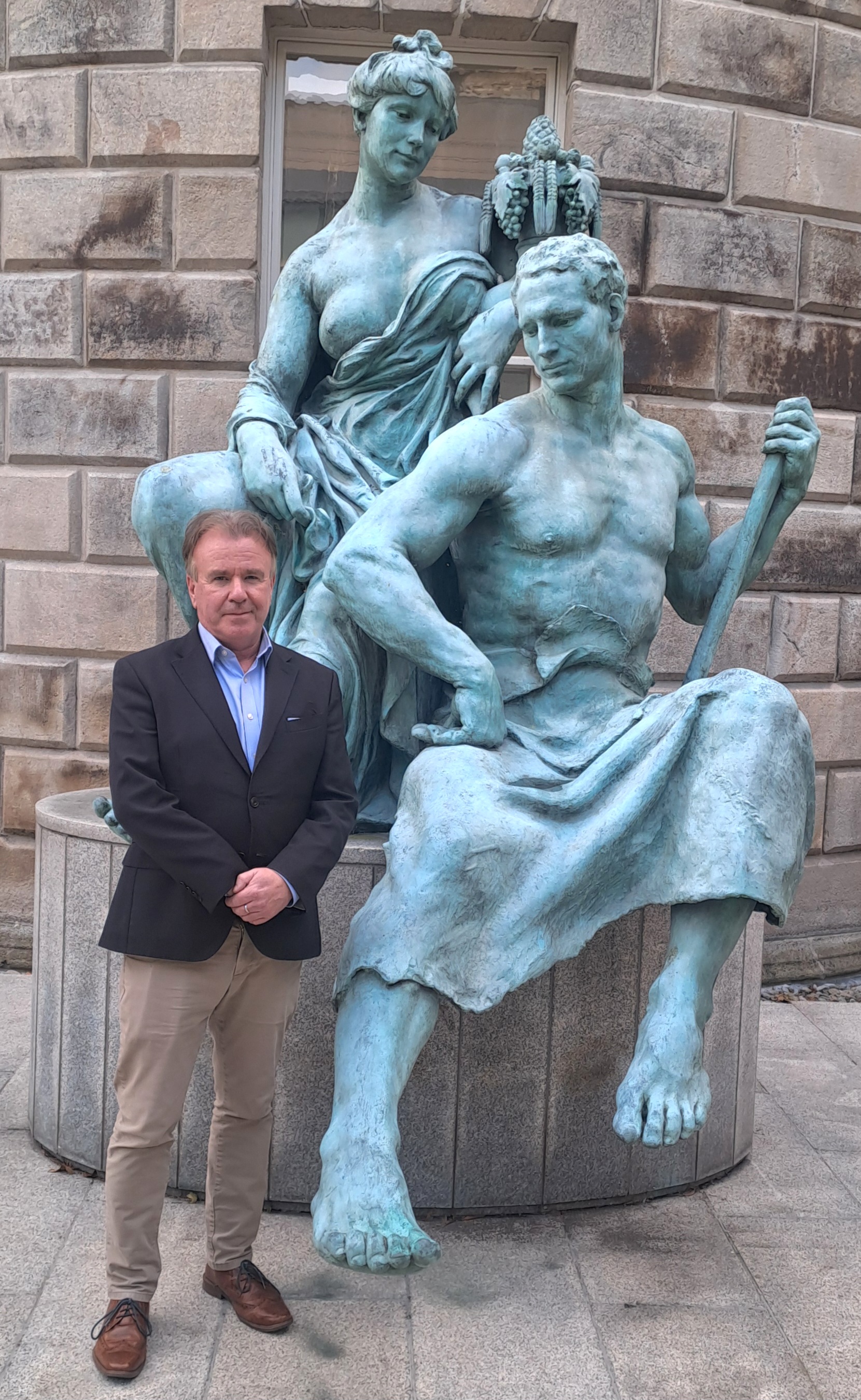
Photo: Mary Phelan
Senator Tom Clonan – retired army captain, security advisor, member of Seanad Eireann, author and carer
Tom Clonan is a busy man. He started his working life in the Army. He later became an academic, lecturing in the School of Media at TU Dublin. From 2001 to 2016 he was the Irish Times security analyst and since then has been an analyst for The Journal.ie.
He was elected 3 yrs ago as an independent senator from a constituency of over 100,000 Trinity graduates from all over the world.
The issue of disability rights is close to Clonan’s heart. He has recently drafted two important bills.
“The first is to give disabled citizens the legal right to services, supports, therapies and surgeries that are set out in their assessment of needs, said Clonan.” These socio-economic rights exist in every other jurisdiction in the European Union and in the UK.
“In many ways we are 30 to 50 years behind the rest of Europe in relation to fundamental legal rights for disabled citizens. The reasons for this are historical. When the state came into being in the 1920s the catholic church played a central role in carrying out many functions in our society, such as education and medicine, whereas issues around disabilities were often dealt with in congregated settings by the catholic church. This aspect of care was seen through the prism of charity.”
He hopes to bring this Bill to its final stage by christmas and then seek to have it introduced into the Dail.
“As a single lone independent senator and as a member of the opposition, I am very proud to bring a bill to completion. I’ve learnt a lot”.
The second bill is more complex. It is called the disability personalised budget bill of 2024. The plan is to progress this, so disabled people will have autonomy over the means of support they need to fulfil independent fulfilled lives. “Due to cultural and historical reasons, we are outliers and behind Europe in this regard”.
Even though today the religious orders no longer have the same level of control in society, the idea of charity compliance and conformity troubles Clonan. They have now been replaced by ‘for profit’ corporate care providers, which Clonan says is “an appalling vista” as they are still seen through the prism of charity, as the family, not the constitution, is considered the primary carer. We have chosen a very poor model due to our post-colonial catholic past.
“The Government is not listening to us. They listen to the financial sector, construction, big pharma and hospitality, but don’t listen to us because their views are framed by charity. They seem rather surprised when disabled citizens and carers like myself speak out because we are supposed to be happy with what we are given”.
Many of the disabled have major obstacles to overcome. They are living in enduring poverty or are enduring homelessness or suffering from sub-optimal care from not getting spinal surgery, occupational therapy, and speech and sports therapy.
There are a number of disabled persons organisations run by disabled persons. However, they are not Government funded, so the government is reluctant to deal with them. “They prefer to deal with more established corporate care providers, which is wholly inadequate”.
“It’s a bit like the Government dealing exclusively with IBEC and refusing to deal with trade unions. It is hostile to the idea of socio-economic rights for the disabled. They don’t believe they are worth it and see it as a matter for charity.”
Besides his interest in disability rights, he has a firm commitment to Ireland’s neutral status and is lobbying very hard to maintain the “triple lock” which the Government is trying to get rid of.
“It is intimately linked to our neutral status, and this is a very dangerous situation for Ireland. The Government is not modifying or amending it but removing it completely, and once it is gone the government can send any number of troops to any part of the world by a simple majority.”
“In the absence of the triple lock, we should have an explicit constitution on neutrality like in Switzerland and Austria, so decisions to send our troops anywhere would be tempered by what’s set out in our constitution”..
Whereas I trust the democratic process, I don’t necessarily trust the decision makers.
“Governments make mistakes, the current debacle concerning the Presidential election is one example”, said Clonan. Ireland is completely defenceless in air, ground, maritime and cyber domains. We need to invest in our own defence”. “If the government insists on removing the triple lock, I will table amendments to propose alternative safeguards to protect Irish citizens, particularly Gen Z and Gen Alpha, who have already been very badly treated in terms of their right to housing and homes”.
As far as he is concerned, the concept of future peacekeeping is gone. “It is now peace enforcement”.
“We are coming under pressure from our European partners”. The government believes this view would be good for research and development and financially attractive in terms of foreign direct investment. They have agreed to sign up to a package of weapons investment of nearly one trillion dollars over the next 5 to 10 years”.
He is adamant that more money needs to be spent on houses and the fundamental rights of disabled citizens, as very little has been done to address these issues in the budget.
In 1996 he did a PhD on how women were treated in the army. It looked at the discrimination and systematic sexual violence against female personnel. Military authorities alleged that he falsified the findings.
He was subjected to whistleblower reprisal, isolation and character assassination. He is the only person to have been sanctioned for his enquiry findings. In 2021 The Women of Honour from the army came forward and made fresh disclosures of sexual violence against them while serving in the Defence Forces.
Finally, Micheál Martin set up an independent group enquiry, which vindicated his findings in 2023.
His hopes for the future? That more money is spent on health, climate change measures and housing.
Does he have any down time?
.
“Apart from work and raising a family, I’m a full-time career. I have no hobbies or interests. It is simply not possible. This is the case for most carers”.
You must be logged in to post a comment.