
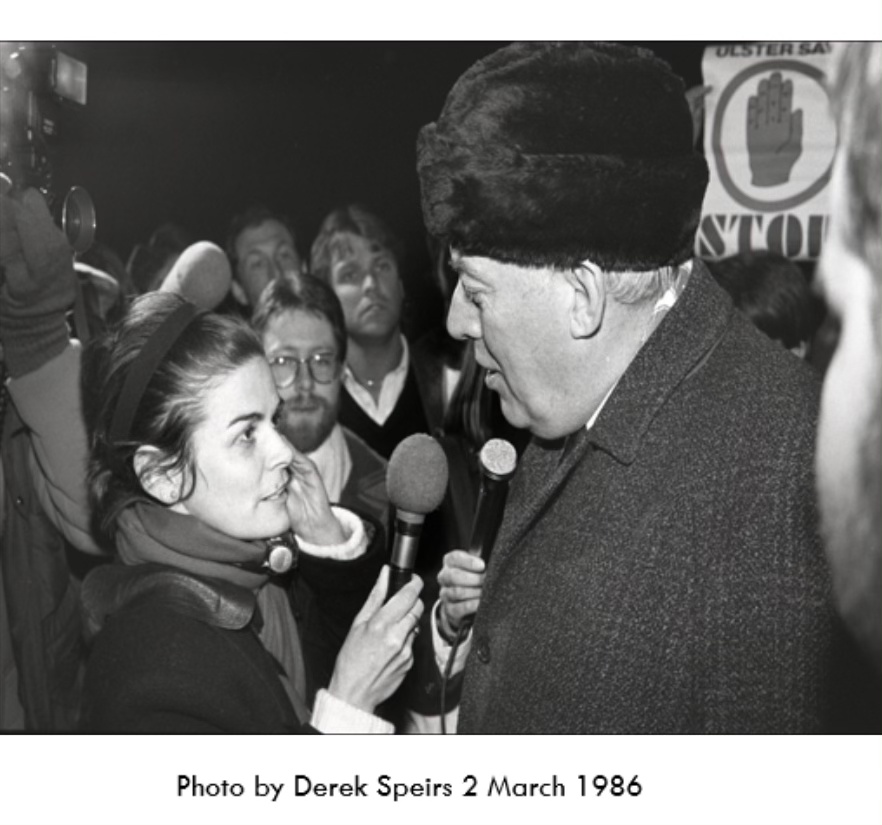
A deep look at a woman whose journalism, feminism, and anti-colonial solidarity shaped both her career and the students she inspired along the way.
“It’s my DNA… I have to do it.”
These words are spoken with absolute certainty by a journalist who has spent decades challenging power structures. Roisin Boyd’s journalistic journey and ethical and moral compass is shown through her courageous storytelling.
Boyd’s path to journalism began in the politically charged atmosphere of 1980s Ireland, a place held in a political chokehold by profound social constraints. “I was interested in becoming a journalist from the age of 14,” she recalls. “My family was quite political, and my mom was a feminist. There were meetings in our house, feminist women’s liberation meetings.”
These weren’t just your average family gatherings; they were revolutionary assemblies. In an Ireland where contraception was restricted, divorce was forbidden, and women’s voices were systematically marginalized, these meetings were acts of radical resistance.

A common misconception when talking about the issues above, and many others, is that nothing was being done about the unjustness of it all, but many voices like Boyd’s spoke out against them even when that was maybe not the norm.
“We were not all lying down, taking it,” Boyd said. “There was resistance, and people were protesting.”
From the get-go Boyd stood up and wrote about what she believed in. Her early journalistic experiences were rooted in feminist publications. At a time when many young women were confined to traditional roles, Boyd was writing for Wicca, a feminist magazine that challenged societal norms. Later, at Trinity College, she worked on Bell Jar, named after Sylvia Plath – another important symbol of women breaking through systemic silences.
A defining moment of her early career came with Spare Rib, a radical London-based feminist magazine. Boyd became the first ever Irish woman on its collective, a position that would reshape her understanding of journalism and activism.
“When I was in London, it was really tense,” she explains. The time that Boyd made this move was during the height of the Troubles in Northern Ireland, a period of intense political conflict. Being Irish in England meant navigating difficult political landscapes. For Boyd, this meant that every story was potentially considered controversial.
One of Boyd’s most difficult and controversial articles, “Why You Can’t Be a Zionist and a Feminist,” shows her fearless approach to journalism. She interviewed an Israeli Jewish woman, a Lebanese woman, and a Palestinian woman in the aftermath of the Sabra and Shatila massacres. This was one of the most harrowing massacres committed in the Lebanese civil war, a conflict known for its violence.
“All hell broke loose,” she remembers. Shops in New York refused to sell Spare Rib, and she faced accusations of anti-Semitism. “It was so painful and so difficult to be accused of being anti-Semitic when I was trying to amplify voices of resistance and solidarity. And to highlight the horror of what had happened in the camps.”
Looking back, what Boyd did is somehow even more impressive today. Decades before it became more “acceptable” to speak openly about these topics, she was amplifying the voices that were ignored, showing how journalism really can challenge silence. Now, with more people speaking out, even the younger generation, it’s clear how necessary that courage was.
Boyd says that “the slur of anti-semitism is frequently weaponised to silence critics of Zionism and the Israeli state’s aggression against Palestinians.”

Returning to Ireland, Boyd joined RTÉ, where she encountered another form of censorship through Section 31, a law restricting media coverage of the Northern Ireland conflict. “This had a disastrous effect on RTÉ’s coverage of the north and human rights issues,” she explains.
Yet Boyd was not easily silenced. She found innovative ways to tell important stories, working alongside colleagues who shared her commitment to truth. Her reporting spanned international landscapes from conflicts in Somalia to highlighting the struggles of cleaners at University College Dublin, all with the same goal: to have voices heard and make a difference.
“Even with censorship, there were always ways, if you’re a good journalist and you’ve got supportive colleagues, to do the story,” she said. “But you have to work a lot harder to make sure your story gets out.”
Boyd has always balanced journalism and activism and never backed down from what she believes in. She was Head of Communications for the Irish Refugee Council from 2007 to 2010 and, when working with refugees in Ireland, she used and shared her skills by training refugee women so that their voices could be heard.
Her involvement with the Ireland Palestine Solidarity Campaign also demonstrates her belief in using your voice for the right reasons, whether that is in your career or day to day life.
Boyd’s dedication to speaking out is not just in a journalistic sense but in everything she does.
“Journalism always will matter,” she said, “the truth obviously really matters, and finding the truth often takes a lot of time and energy.”
Her approach to journalism is very layered. “I would have aligned a lot with women from the Global South,” Boyd said. “I interviewed Nawal el Saadawi, a very well-known Egyptian feminist who had been campaigning against FGM in the 80s.”
Her work never just skimmed the surface or the news agenda: Boyd dug deep, connecting human’s personal experiences to broader social and political struggles and issues.
In recent years, Boyd has been increasingly vocal about emerging challenges in Irish media and society. The rise of far-right narratives, the treatment of immigrants, and the systematic marginalization of people of colour are not just news stories for her, they are urgent calls to action.
“I think there’s an amazing opportunity for good journalism today in Ireland,” she said. “How do we communicate with each other on these topics? Because a lot of it’s just shouting. There’s no real communication.”
Her advice to young journalists is both valuable and inspirational. “If you’re going to be a journalist, you need to be engaged. You can’t just switch off from the realities happening around you.”
Boyd retired from her role as a lecturer in TU Dublin last year, but in her time there she inspired and taught a generation of journalists by showing them that their work is not just a profession, but a responsibility.
Boyd’s students had firsthand accounts in something invaluable, especially because it was reporting at times that some were not around for.
“I always like to say to people who weren’t around then, to remember that there was huge resistance in Ireland at that time.”
Boyd highlights this important fact because the students were the next generation at the sidelines of history unfolding.
Her motivation remains unchanged, even after retirement, as Boyd still speaks out in what she believes in, “It’s my DNA… I have to do it.”
In a world where the tensions rise higher every day Róisín Boyd continues to use her voice.
Her legacy is not just in the stories she’s told, but in the countless journalists she has inspired to see their work as a form of resistance.
In the words of Boyd, “Journalism is about finding the truth, no matter how difficult the journey.”
You must be logged in to post a comment.