Tag: dublin

  • A tight squeeze: Public transport in Dublin severely congested at peak times and on popular routes 

    A tight squeeze: Public transport in Dublin severely congested at peak times and on popular routes 

    By Gary Petrov

    A display of photos from the point of view of a commuter using public transport in Dublin. Examples of overcrowding can be seen here on Dublin Bus, Luas and Irish Rail services in densely populated or heavily visited areas in Ireland’s capital – in which the photos below were taken during peak times of travel, on-board and at stops and stations. 

    Nevertheless, the photos pose the question: Do Dublin commuters need more frequent services of existing public transport, or do they need more modes of public transport? Or both

    Whether the answer is a swift underground metro system, or more frequency on existing services – or both, the population is growing and commuting access in and around Dublin is becoming more of an issue and needs urgent attention. 

    All photos present the same problem – Dublin’s public transport system is overwhelmed. 

    The photos also present how this overcrowding issue can prove difficult for accessibility on public transport for wheelchair users, mobility aid users and parents with children. Even in busy times, not everyone can just squeeze on and stand. People are inevitably being left behind – hoping that the next bus, train or tram will have room. 

    Commuters joining a lengthy queue for Blanchardstown Shopping Centre’s busiest bus route to Dublin City Centre, the 39a – hoping to get on as it fills very fast. 
    The standard sight at this shopping centre bus stop at peak morning and evening times, as commuters fight for a spot on the 39a service. 
    The 39a route journeys down the Navan Road, in which sections of the journey lack bus corridors in both directions, leaving passengers stuck in traffic at peak times. 
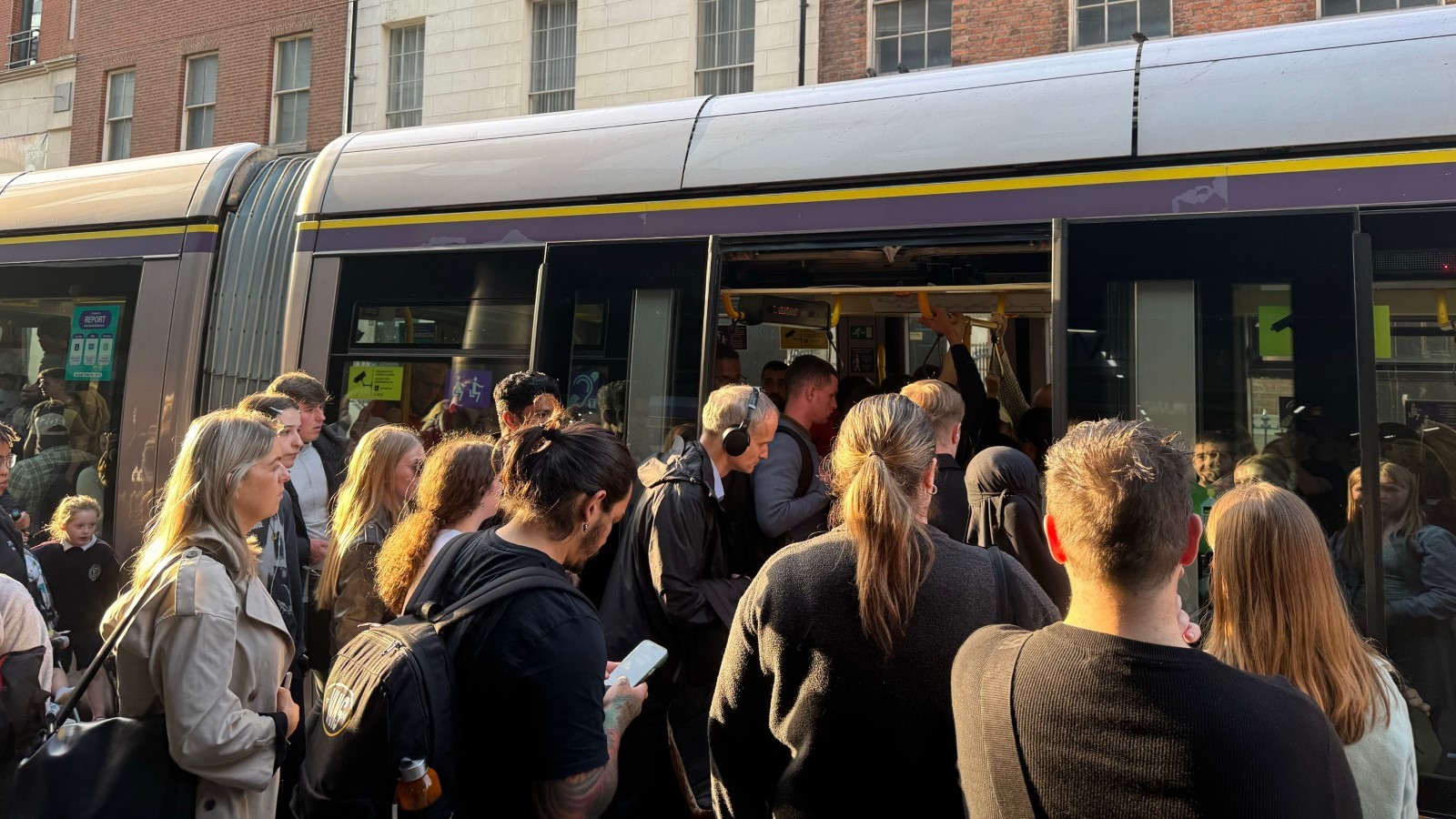
    Meanwhile at the Jervis Luas stop in Dublin City Centre, peak times result in commuters pushing themselves on-board to very packed carriages, with just about enough room to stand, for the few at the busy stop that manage to squeeze on. 
    Finished work and want to hop on the Luas Red Line home? You’re not the only one – and that’s not even including commuters already on-board. 
    A Luas has arrived, and the carriages are evidently full. With some commuters possibly disembarking, maybe there will be room for some intending to board. 
    “Oh my God, let us get off first,” said a young woman as commuters tried to get off while commuters on the platform scurry towards the doors for a spot on the mostly full Luas carriages. 
    “Oh, there’s another one coming in three minutes, maybe we’ll get on that one,” said one woman as disgruntled commuters accepted not being able to get on-board – but hopeful they remained, as another Luas was due in a few short minutes. 
    The next Luas has arrived at the Jervis Luas stop and like the previous one, it’s almost full and the next round of commuters on the platform attempt to get a spot on-board.  
    Three Luas trams later and the platform begins to clear as the Luas carriages begin to have more space than the previous trams – but was there space for commuters who have accessibility issues? How many trams must pass for there to be room for a person in a wheelchair or with a mobility aid, or a person with a baby pram to board comfortably and safely? 

    Getting on a train at peak times is no different. Commuters at Broombridge Station queue at every door, wondering if they will fit on-board as the train arrives full from the city centre – in which it will remain like that until it reaches the outskirts of Dublin. 

    If a commuter manages to squeeze on-board, there is only room to stand, and it gets quite uncomfortable. Like the Luas, accessibility issues are present here. 
    Dublin’s only service that has flow is Irish Rail, due to no road traffic, but commuters experience peak times with traffic by foot – if you stay on-board until disembarking in a Dublin suburb. 
    Traffic standstill mayhem: The need for more efficient modes of public transport is hiding in plain sight here. Modes of transport that aren’t subjected to peak time road traffic. Commuters using an underground metro system around Dublin would go from A to B in an instant, in comparison to this.
    A bus stop and rain: Commuters already report it to be a struggle to get on-board popular routes, but adding bad weather to the equation does not make for a comfortable experience – when all a person wants to do is start their day commuting with ease or commute home swiftly, after a long day. 

    _____________________________________________________

    Everyone understands that peak times will always be busy for public transport users, that’s why it’s referred to as ‘peak times’ – but that doesn’t mean it’s acceptable for Ireland’s capital city and its surrounding areas’ public transport network to be severely overwhelmed, at a constant. 

    In a day and age where people are being encouraged to use public transport instead of private transport, as a means of reducing carbon emissions through minimising their individual carbon footprint – it’s worth noting that the correct infrastructure is vital for that to be sustainable, otherwise, people who can won’t use public transport, if it becomes more and more overcrowded, uncomfortable and unreliable. 

    A popular route having frequency in its service isn’t good enough, as it can be seen in the photos above that the demand is too high at peak times for ‘frequency’ to be enough. Ireland’s capital needs an expansion of public transport services across the board, not statements to brush the issues under the mat. 

    Dublin’s public transport congestion is clearly failing people with accessibility issues, despite the designated accessible areas on-board services – as abled people are filling up the designated areas at peak times. 

    Dublin needs more efficient public transport that facilitates everyone, and these photos are prime examples why improvement is needed – the only question now is, when will anything be done? 
  • Bolt powering Bray’s E-bicycle Movement 

    Bolt powering Bray’s E-bicycle Movement 

    By Jamie Ryan  

    Since June of last year, popular taxi app ‘Bolt’ has extended their services to provide the people of Bray Co. Wicklow with electric bicycles.  

    These bikes have been a massive success across the town among people of all ages due to their cheap costs and easy accessibility.  

    Green Party Councillor for Bray East, Erika Doyle, was one of those involved in getting the scheme up and running in the town.  

    “With the introduction of the bikes, there has definitely been a modal shift, which is great because in a town like Bray we have a congestion problem. It’s very hilly as well, so with the pedal assist it has become much more accessible for people that otherwise maybe wouldn’t have used a push bike,” Doyle explained.  

    “It’s been a really positive thing for the town, and data from Bolt shows that these are being used even during winter months, because originally, there was a suspicion that they might only be used during the summer, but people are clearly just dressing for the weather and using them regardless which is great.”  

    The success of this scheme is partly due to just how easy the bikes are for people to use. Users simply download the Bolt app, scan the barcode on the bike, and they will then be charged 18 cent per minute.  

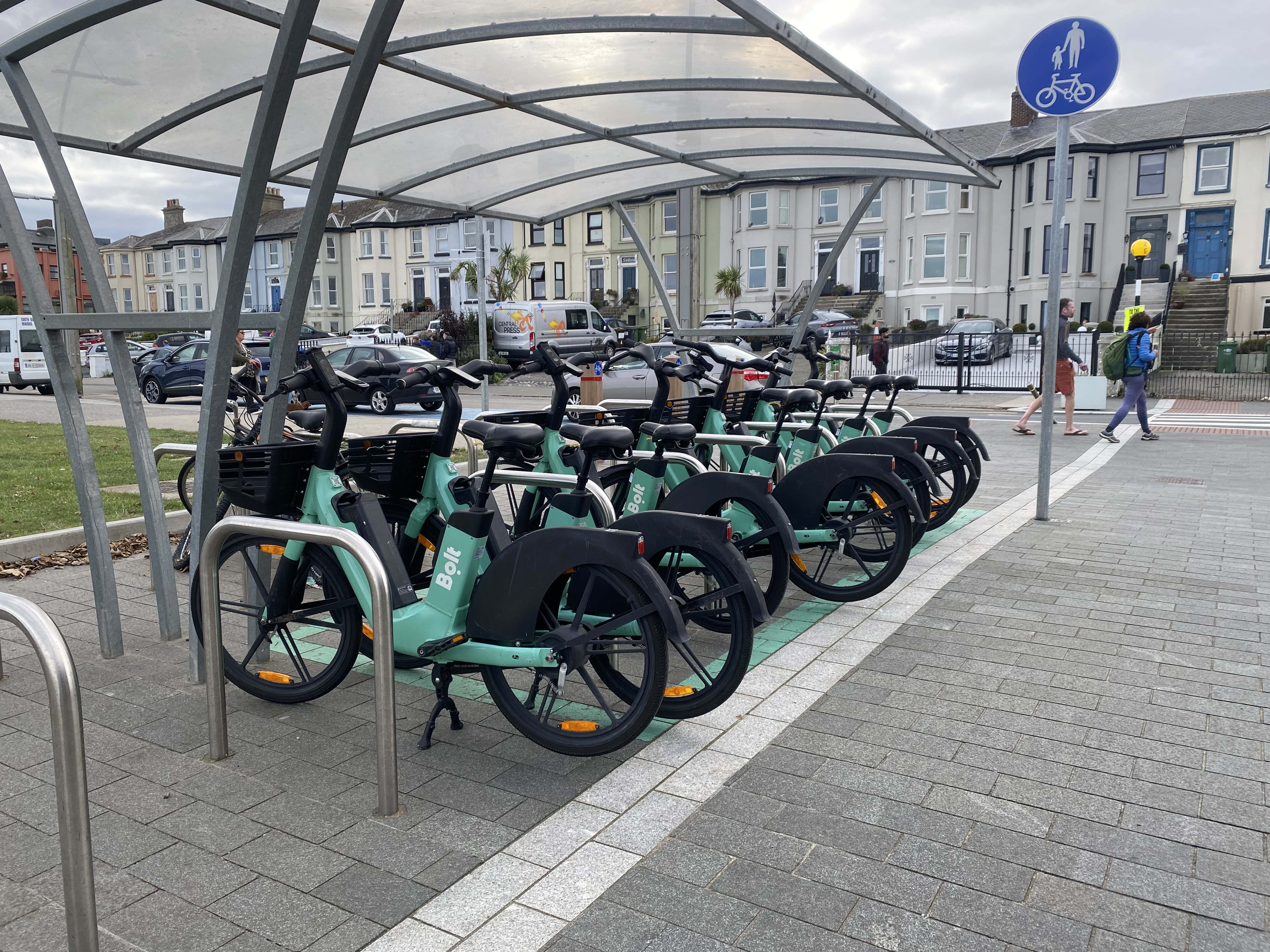
    Once the user completes their journey, they park the bike in one of the ‘park zones’ that can be found on the app or can be identified by a green square on the ground and bike racks.  

    Along with a pay as you use option, there are also a variety of subscription passes available to users too, such as a day pass, weekly passes, monthly passes and ‘unlimited unlocks for 30 days’. 

    The bikes go up to 25 kilometres per hour, but can be capped at 15 kilometres per hours if users wish.

    Bolt Bikes at Little Bray ’Parking Bay’ – Photo Credit: Jamie Ryan 

    Sinn Féin Councillor for Bray West, Dermot O’Brien, speaks highly of the impact that the bikes have had in Bray.  

    “I would say overall there has been a very positive impact from the introduction of Bolt bikes in Bray. The user numbers are a good reflection of this, and the feedback from local people who see them as an alternative to the car, or as an easy option for getting around the town,” he said.  

    “I particularly notice the variety of local users, young and old, as well as tourists and exchange students who benefit from an easy and accessible option to move around the area.” 

    “On a personal level, I would use Bolt bikes very often, and they are a wonderful asset to someone who lives on the edge of being on time for meetings, as I bounce from one venue to another around the town.” 

    The bikes are easily maintainable due to there being no shock absorbers in their frames, and the tyres not containing air.  

    However, although there has been a plethora of extremely positive experiences from Bolt bike users, there have been issues with bikes being damaged, defaced or suffering from wear and tear.  

    Councillor O’Brien himself has fallen victim to this, he explained. 

    “In recent weeks, I changed my bike four times because of malfunctioning and ultimately, I just walked home which was frustrating,” he said. 

    Adam Byrne, 20, regularly uses Bolt bikes to get around the town.  

    “The bikes have made such a difference for me. Getting to and from work has become so much handier and it only costs me maximum €3 per journey which is much better than spending it on petrol – not to mention not having to sit in traffic the whole time,” Byrne said.

    Bolt Bike at Bray Harbour with graffiti at the rear mud guard – Photo Credit: Jamie Ryan 

    “Of course, like anyone else who uses them regularly I’ve had one or two issues, but nothing crazy, more so just maybe a lack of maintenance with the brakes and minor damage to the pedals, but overall, I really can’t say any bad about them. I hope they stay around for a long time.”  

    The contract between Bolt and Bray Municipal Council has recently been extended for a further year, for locals to enjoy and utilise.  

  • In Photos: Thousands take to the streets for Dublin’s largest Palestine protest to date 

    In Photos: Thousands take to the streets for Dublin’s largest Palestine protest to date 

    By Liam Murphy

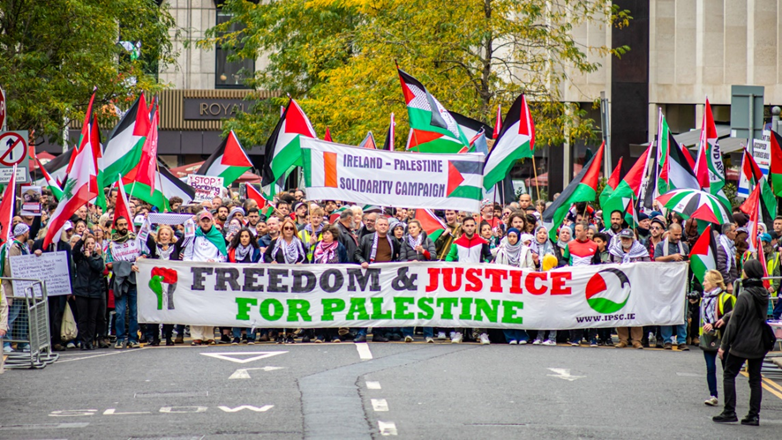
    On Saturday, October 5, thousands of people took to the streets of Dublin to mark one year of Israeli escalation in Gaza. 

    The march, the biggest of its kind to date in Ireland, called for an end to Israel’s occupation, an end to the use of Irish airspace for transporting weapons, and for the Irish Government to act in holding Israel accountable.  

    Several chants were also heard supporting Lebanon, following recent attacks there, also by Israel. 

    The national march, titled ‘GAZA: One Year of Israel’s Genocide’, began at the Garden of Remembrance and made its way to Molesworth Street, where a stage had been set up. 

    Speakers on the stage included Oscar-nominated and BAFTA-winning Palestinian filmmaker Farah Nabulsi, Palestinian photojournalist Eman Mohammed, Zak Hania, who recently returned home from Gaza after seven months, and Ireland Palestine Solidarity Campaign’s chairperson Zoë Lawlor. 

    Music on the day came from renowned Irish singer-songwriter John Spillane, Palestinian-Irish singer Roisin El Cherif, and Palestinian rapper Talha Alali.   

    All photos taken by Liam Murphy

    Protestors gather at Dublin’s Garden of Remembrance with signs and banners. 
    A group gathers with signs; Some with donation QR codes, others with song lyrics, others with art – Each with meaning. 
    Supporters gather around a 30ft Palestinian flag, as the crowd prepares to march. 
    A young girl wearing a keffiyeh poses as the march makes its way down O’Connell Street. 
    ‘From the River to the Sea, Palestine will be free’ – chants are heard across the capital city. 
    Protestors feel the heat as one bloc light up flares as the march moves down O’Connell Street 
    A masked up keffiyeh-wearing group stand roadside on O’Connell Bridge holding a red Hezbollah flag. 
    A woman holds up a scarf, branded with the Keffiyeh pattern and the Palestinian flag and Irish tricolour flag. 
    ‘You’d care if it was Cork!’ – A protestor holds up a sign on Molesworth Street, calling out the Irish Government 
    The march makes its way around the corner from Dawson Street, now heading up towards Leinster House. 
    Cork singer songwriter John Spillane tuning up before taking to the stage to perform his song ‘Palestinian Sunbird’ 
    Zak Hania smiles as crowds applaud his entrance. Hania spent seven months in Gaza unable to return home. 
    Palestinian rapper Talha AlAli (known as Wise Wolf) performs his newest single ‘Inshallah’ with Irish artist Blue Niall 

  • Dublin City Council Clamping Down on Parking 

    Dublin City Council Clamping Down on Parking 

    by Molly O’Reilly

    Credit Molly O’Reilly 

    In Ireland’s busiest city, full of life,  

    As the epidemic of clamping down on cars becomes rampant around the Capital, there are three things guaranteed in life in Dublin; death, taxes and clamping.  

    It is no secret that the housing crisis has seeped into student life in Dublin, resulting in many in neighbouring counties commuting to college or having to find accommodation for the academic year. 

    Despite the argument there are plenty of transport to use or places to “pull in,” many Irish students have been left lost and have had no choice but to fork out a sum to release their car from the shackles of the clamper. 

    The fee for clamping is a release fee of one hundred and twenty-five euro, which is operated by Dublin Street Parking (DSPS). 

    However, if the release fee is not paid within the 24 hours of being initially clamped, not only will your car be towed away to the city car pound, but there is also a fee of 250 euro and an additional 35 euro per day according to the DSPS website.  

    Dublin City council has released the statistics for clamping of cars around the city from 2022 with a total number of clamps of 40,732 excluding invalids (disabled parking badges out of date is an example of an invalid) 

    Credit Millie Storey 

    Although the reasonings behind the clamping may seem obvious, there can be virtually nowhere for people to park even when paying elevated levels of rent for accommodation. 

    For instance, in private accommodations and estates it is not an unusual sight to see a car with a registered parking ticket clamped. 

    Dublin City Council provide an appeals process that must be submitted within 60 days from the original day the car was clamped. 

    One Dublin driver, who did not wish to be named, had their car clamped last year whilst it was parked on a private estate in Dublin. Not only was their car the only one clamped on the street, but without their knowledge it was moved from Cabra to Stoneybatter.  

    Is this Dublin’s latest trend amongst students? 

    Marese Masterson, originally from Leitrim, who studies in Maynooth said her car is a necessity during her time in Dublin for her work as an intern. Masterson drives to work five days a week and says the lack of parking is taking a toll on her finances. 

    “They even clamp in Supervalu in Ranelagh, there is barely any street parking just loading bays and clearways. I have gotten clamped twice, said loading bay and once got clamped at 7 in the evening,” she said. 

    “The parking price per hour is extortionate for students- example twenty euro a day, very unfair as this leads to students unable to pay the ticket, which in hand leads to clamping.” 

    Masterson is not the only student feeling the pinch. Elli Duggan from Kilkenny recently studied social care in TU Dublin Grange Gorman and lived in student accommodation in Phibsborough. Her car was a necessity for her work placement as well as getting to and from her job in Kilkenny.  

    “In my student accommodation of 400 students there were only 8 parking spaces available, which were 50 euro a month, I would have to park on the North Circular Road.” 

    According to DSPS website, clamping can occur when a park has expired by as little as ten minutes.  

    The City.ie asked the DSPS to comment on allegations that   clamping was excessive around Dublin. They declined to comment but said further contact can be made with those in higher management or an FOI (freedom of information) application can be made. 

  • District X – Index, Dublin’s Popular Nightclub Takes on the Festival Scene 

    District X – Index, Dublin’s Popular Nightclub Takes on the Festival Scene 

    By Amy Murphy

    A brand new one day festival, District X came to Palmerstown House, Co Kildare. It was a techno and house music fans dream.  

    The festival saw Irish artists like blk. and Kettama perform throughout the day. Other international artists that performed were Chris Stussy, Hannah Laing and Pawsa.  

    The event was an enormous success, a sold-out event with people searching for tickets right up to outside the venue just before it started.  


    The event had high security, medical tents, and transportation organized for people arriving and leaving the festival. However, there was no service which made ordering a taxi a little difficult if people wanted to leave earlier than planned.  

    There were after parties scattered across Dublin city center after the festival, with some of the Dj’s playing in different nightclubs.  

    The City sent some of our photographers into the festival to capture the energy throughout the day. 


    Tents were placed close together, enabling festival goers to move with ease from one place to another. This allowed people to see multiple acts and as many as possible, as there were crossovers with some artists’ set times.   

    There were carnival rides, which cost around 10 euro per person. Despite the price there were people queuing up throughout the day.  

    Kerri Chandler drew an enormous crowd at the District X stage. Many people were pushing to the front for one of his most popular songs ‘You are in my system.’  

    Elena Gatica, 22, an attendee who has traveled to popular rave destinations like Ibiza and Berlin. She was most excited to see Dj Heartstring.  

    People were feeling the love during Skepta’s set. The backstage section was packed with people.  

    As it got darker the lights placed around the venue started to light the way for the crowd trying to find their next stage.  

    “I am most excited to see BLK, I met him once and it makes me proud that he’s from Ireland.” Orla Shortt, 21, from Meath.  

    Despite the fun being had, it was a long day for some. Rodney Jones, 22, from Dublin, had been there since 1:00pm and his bus home was not scheduled till 11:30pm that night.  

    Some visuals during Chris Stussy’s set who later guest appeared during Ketama’s set.  

    As the event ended the lights from the rides and ‘X’ statue became more vibrant and led to the long walk back to the car park.  

    All photo credits: Amy Murphy  

  • ‘It’s a disgrace at present’ – Dublin Councillor Welcomes Controversial Redevelopment Plan 

    ‘It’s a disgrace at present’ – Dublin Councillor Welcomes Controversial Redevelopment Plan 

    By Liam Murphy 

    Dublin Councillor Nial Ring has welcomed An Bord Pleanála’s decision to approve Hammerson’s controversial redevelopment plan, calling Moore Street’s current state a disgrace.

    This comes days after An Bord Pleanála’s approval of a highly debated plan that will see a €500 million redevelopment undertaken between Moore Street and O’Connell Street. 

    The UK property group first made applications for this redevelopment in summer 2021, with approval following just seven months later in January.

    However, appeals were made to the board and Dublin City Council by a number of Moore Street preservationists, campaign groups, and businesses, which caused for more than two and a half years’ worth of delays.

    “I see huge benefits of this project for the local area,” said Councillor Ring, who, along with being a member on the Moore Street Advisory Group, represents the North Inner City electoral area.

    “Not only in preserving the history and heritage of the street, but also in bringing Moore Street back to life. It is a disgrace at present.”

    The plans, made up of three applications, include the demolition of several buildings, the construction of a nine-storey hotel, the development of a public gallery and café, and the development of a public square – plans which are allowing Hammerson up to 12 years construction on site. 

    A generated image of Moore Street post-Hammerson development – Photo: Dublin Central / Hammerson 

    The An Bord Pleanála decision and announcement coincides with the 10-year anniversary of campaign group ‘Save Moore Street from Demolition’, who have gone on to receive over 380,000 signatures opposing Hammerson’s plans.

    The group started in September 2014, when members Bróna Uí Loing, Vivenne Kelly, Diarmuid Breatnach and Mel Mac Giobúin met to begin a weekly presence on the street with a campaign table, leaflets, and petition sheets.

    “Moore Street is of huge importance, not just to Dublin, or Ireland, but to the world,” Breathnach told The City. “We have been here over 500 Saturdays. We talk to people, we take photographs, we hear stories – sometimes stories from people coming up with their parents when they were children, others tell us of them coming up to Croke Park for matches and coming home with bangers.

    “People have different views as to what we can do with the street,” he said. “Some of us think there should be small shops and stalls here, no chain stores. Any restoration work done should be done piece by piece so that there’s not a huge disruption to the street”.

    “The Hammerson plan envisages destruction of some buildings, a high-end shopping area, a street cut through the terrace and up to 12 years of building,” Breatnach said. “That would just kill any street market here.” 

    Diarmuid Breatnach, co-founder of the ‘Save Moore Street from Demolition’ campaign group – Photo: Liam Murphy 

    The National Monument buildings of 14-17 Moore Street are currently earmarked for a 1916 Rising Commemorative Centre with an estimated cost of €16.25 million.

    The building was originally due to open in 2016 to mark the centenary, before being pushed back to 2023.

    Work, however, has not yet started.

    “The National Monument site has approval for funding, and it is imperative that this be worked on immediately,” Councillor Ring said. “Now that this [An Bord Pleanála’s] decision is out, I think it will give everyone time to reflect and, in memory of the men of women of 1916, make sure that the work starts immediately.”

    “I have an interest in the project, not only as a local councillor, but my grandfather and his four brothers were in the GPO garrison,” Ring said. “It really distresses and depresses me to walk down the street and look at the national monument site, in particular, knowing that some people with their own agenda have managed to delay work on that site for many years.” 

    One of the many stalls on Moore Street – a street currently under threat of demolition – Photo: Liam Murphy

    Hammerson’s plan outlines potential for up to 2,500 jobs after the development, but those currently trading on the street aren’t as optimistic. 

    “The plan means losing my job,” Andrea, a jeweler who has been trading on the street for two years said. “While there may be jobs after the building, it will destroy our jobs during that time. I’m only new here, but there are people here whose family have traded for 100 years. No one will want to come to a market if there’s construction being done nearby.” 

    “Other than what it means to me losing my job, my trade, and my community, it’s also what it means for the people of Dublin,” she said. “Those people care about this street. This street’s history is retail.” 

    “I lived in Spain for quite a while and saw a lot of markets,” she said. “But I have never seen something like Moore Street. Here we have a street full of its background, culture, and history, but also a marketplace. There’s a lot of potential in this street and I don’t think it’s being used.” 

    “In what world does someone think it’s a good idea to erase all this history to put more shopping centres and hotels.” 

  • Comedian Vittorio   Angelone kicks off   Irish leg of extended tour with Vicar Street gig 

    Comedian Vittorio Angelone kicks off Irish leg of extended tour with Vicar Street gig 

    By Gary Petrov

    Stand-up comedian Vittorio Angelone is kicking off the Irish leg of his extended sell-out tour with a gig in Dublin’s Vicar Street on November 3.

    Vittorio Angelone during one of his stand-up shows. Photo: @vittorioangelone and @nicomedyofficial 

    The sell-out ‘Who Do You Think You Are? I am!’ tour saw the Irish-Italian comedian bring his humour to UK and Irish cities with 68 gigs between January and May 2024. 

    Angelone announced on Instagram earlier this year that he was extending his tour into the Autumn with “loads of new places” and “loads of old favourites” across the UK and Ireland. 

    His upcoming Irish leg of the extended tour commencing in Dublin on November 3 will mark his second solo gig this year in the Irish capital’s Thomas Street comedy house – as he hosted one of his tour’s original 68 gigs here on March 22, this year. 

    Angelone also hosted a fundraiser show ‘Gig For Palestine’ in Vicar Street with fellow comedian Mike Rice on September 1, this year, for NGO Medical Aid for Palestinians

    The Dublin stop is one of 13 in Ireland for his extended tour’s dates. 

    The City reached out to Vittorio Angelone for a comment regarding the 13 Irish dates for his extended tour in which he said, “Ireland isn’t full but my tour shows will be. Get your tickets now!” 

    November stops on the tour in Ireland after his Dublin gig include – Cork on November 4 (The Everyman), Ballymena on November 8 (The Braid), Coleraine on November 9 (Riverside Theatre), Belfast on November 11 (Ulster Hall), Derry on November 12 (Millennium Forum), Bangor on November 15 (Court House), Killarney on November 16 (INEC Club), and Sligo on November 17 (Hawk’s Well). 

    Running into December, his Irish stops conclude with Westport on December 7 (Town Hall), Galway on December 8 (Kings Head), Dundalk on December 12 (Spirit Store) and Kilkenny on December 14 (Watergate Theatre). 

    The City spoke to avid fan of Angelone, Terri-Ann McNally, who said, “I used to see clips of him on social media all the time, so I ended up going to see him earlier this year, which he was truly unreal!”

    “I’m going to one of his shows again now in November. I mean, he’s just gas with what he comes out with. It’s going to be a great laugh,” she said. 

    Growing up in Belfast, the comedian, both of Irish and Italian heritage moved to London to train as a classical musician before diverting towards a career as a funny man. 

    Angelone has made several TV appearances since his career in stand-up began and has also supported several huge names including Russell Howard, Jason Manford, Adam Rowe, Shane Todd, and Dan Nightingale. 

    In 2022, his debut run at the Edinburgh Fringe Festival was a sell-out and earned him the award for Best Newcomer at the Dave’s Edinburgh Comedy Awards. 

    Vittorio Angelone at the Dave’s Edinburgh Comedy Awards in 2022. Photo: @vittorioangelone 

    In 2023, Angelone toured his solo-show ‘Translations’ after his 2022 debut during the Edinburgh Fringe Festival and released the full special on YouTube in September of the same year. 

    English stand-up comedian Adam Rowe, who Angelone has been a supporting act for, called Angelone “so much better than he has any right to be at this stage of his career.” 

    “If you’ve already seen Translations don’t worry, I’m touring a brand new hour of great and funny stuff very soon,” Angelone said on his website of his debut tour and what’s to come. 

    Angelone is one half of the podcast ‘Mike and Vittorio’s Guide to Parenting’ with regular collaborator and comedian Mike Rice – and their podcast is available to listen to on YouTube and streaming platforms. 

    You can keep up with everything Vittorio Angelone by visiting his website, here

    Tickets prices for ‘Who Do You Think You Are? I Am!’ range from €20-€30 depending on the venue and additional ticket vendor booking fees apply. 

  • Sickle Cell Disease – Q&A with Lora Ruth Wogu, CEO of Sickle Cell and Thalassaemia Ireland (SCTI) 

    Sickle Cell Disease – Q&A with Lora Ruth Wogu, CEO of Sickle Cell and Thalassaemia Ireland (SCTI) 

    By Elio Bonelli

     
    Image sourced from Facebook with the permission of Lora Ruth Wogu 

    It’s wintertime and many conditions can be exacerbated by the cold and chilling drop in temperatures. One of those conditions is Sickle Cell Disease and thecity.ie had a chat with the founder and CEO of Sickle Cell and Thalassaemia Ireland (SCTI) Lora Ruth Wogu to find out more about the disease.

    SCTI is managed by families impacted by Sickle Cell and Thalassaemia, along with dedicated volunteers. Their mission is to promote awareness and offer support to individuals facing Sickle Cell and Thalassaemia challenges, as well as their loved ones, within Ireland. 

    What is Sickle Cell Disease? 

    “Sickle Cell Disease is a genetic condition that affects red blood cells. It is a condition caused by a mutation in the HBB gene, which provides instructions for making hemoglobin—a protein responsible for carrying oxygen in red blood cells. The mutated gene leads to the production of abnormal hemoglobin known as hemoglobin S (HbS). 

    The presence of such a gene leads to the red blood cells becoming solid and rigid which leads to clogging. The cells end up resembling a C shape or sickle, which is where the name sickle cell comes from.” 

    What are the symptoms of Sickle Cell Disease? 

    “The main symptoms of the condition are pain crises which are periods of intense pain, weakness and fatigue, mental delays, strokes and infections. The weakness and fatigue are caused by anemia which is when the number of red blood cells or levels of hemoglobin within them are much lower than usual. We would also see weakness of the elbow and joints due to the small areas in which the blood vessels are in.” 

    Does Sickle Cell Disease affect certain populations? 

    “Anyone can get it, not just certain demographics. The condition is more predominant amongst patients with African or Carribean backgrounds, but the disease is not exclusive to just that group.” 

    How is Sickle Cell Disease inherited? 

    “The disease can only be inherited if both parents have the genetic mutation. If only one parent has the gene, then the child will not get the disease.” 

    How many people are affected by Sickle Cell Disease in Ireland? 

    “Around 800 people in Ireland are affected by the condition and the vast majority of the patients are based in Dublin.” 

    What are the mortality rates of this condition? 

    “The mortality rates of Sickle Cell in high-income countries are significantly lower than those in lower-income countries. 

    For example, the rate is usually five years in Africa but in the likes of Ireland or the UK, the rate would be 45 – 55 years. I have seen people survive for nearly sixty years with the condition.” 

    How is Sickle Cell Disease treated? 

    “It is usually treated firstly with folic acid and penicillin, but we mostly treat the disease with blood transfusions and blood exchange. There is a big difference between blood transfusions and blood exchange.  

    Blood transfusions involves giving a patient blood to essentially “top up” the patient with good blood cells.  

    A blood exchange involves removing some of the patients’ blood and replacing it with a substitute.  

    Patients are also treated with Hydroxyurea which is a medication that helps to increase the production of fetal hemoglobin, which can reduce the frequency of pain crises and other complications. It is classified as a chemotherapy drug but is dosed differently to what you would see in a cancer patient.” 

    Are there any issues that Sickle Cell Ireland have faced? 

    “Yes. We have faced issues with trying to get supplies of blood. There is currently a shortage of blood for our patients and there is not enough pace in securing the supplies that are badly needed.  

    There are some children with SCD in Crumlin Children’s hospital who have to stay there beyond the age limit of sixteen for treatment. Otherwise, there are not many treatment options available after they leave the hospital.” 

    What about the future? 

    “We hope to have our own designated centre as we have had none since we started in 2015. We would also love to see the introduction of gene therapy which was very recently approved in the UK. Gene therapy involves replacing a faulty HBB gene with a normal, functioning one.  

    The more treatment options that can become available means that there can be less of a strain on supplies of other treatments like blood transfusions.”  

  • Macnas Parade – Photo Collage

    By Elio Bonelli

    The Macnas Parade: Cnámha La Loba took place on the streets of Dublin for the first time since 2019 as part of this year’s Bram Stoker festival. 

    The festival, which is now in its tenth year, celebrates the life and work one of Ireland’s most beloved and iconic writers. 

    This festival was produced by Schweppe Curtis Nunn and brought to life by Dublin City Council. 

    One of the highlights of this festival was the Macnas Parade which drew in thousands of spectators despite the rainy weather. 

    The parade, which was directed by James Riordan, tells the story of La Loba, a wild wolf-woman, who wanders the world collecting bones and preserving that which is in danger of being lost to the world. 

    It is said that, as darkness falls, she prowls the streets along Lough Corrib, singing the bones – or “cnámha” in Irish – back to life by the light of the moon. 

    The parade started at 7pm in Moore Street, turned onto Henry Street and travelled up to Mary Street, then turned right onto Capel Street, then left onto Little Britain Street and left again to finish on Halston Street. The parade lasted just over an hour. 

  • Worry spreads among Irish XL bulldog owners – will the UK’s ban on the breed cross overseas? 

    By Taylor Mooney 

    Irish XL bully dog owners express concern over the UK’s ban on the breed following Rishi Sunak’s announcement that the dogs are “a danger to the community.” 

    Image: Megan Pryor

    Concern is growing across Ireland and the UK as the Prime Minister calls for the breed to be banned.  

    The Southeast Inner-City Councillor Mannix Flynn expressed his concerns to the Chief Executive at a Dublin Council meeting earlier this week.  

    He asked the Chief Executive to initiate a review of how many XL Bully dogs are now in the Dublin City Council-administrated areas.  

    “Having clear tabs on the number of XL Bully dogs and owners in an area is one way to manage the breed if people are worried about the threat they pose to a community,” said XL Bully dog owner Megan Pryor.  

    Since Sunak’s announcement, Pryor has taken to the social media platform TikTok to showcase her loving “best friend,” Torvi, a 9-month-old XL Bully, who she fears she might lose in future, as no clear information has been given to XL Bully owners since the ban was first announced.  

    “We haven’t got any information from the government about their plans and what is going to happen to us families with XL Bully dogs.  

    “Hopefully, it will be a case that clear regulations will be put into place – including a registry on who owns these dogs so that the government and our communities can know these breeds are owned and existing.” she said.  

    Chief Executive of Dublin City Council spoke for Dublin saying; “There is currently no database in Dublin to provide figures in any given Local Authority Area other than the register of dogs held at the municipal shelters. Microchips are held by 4 separate organisations making it very difficult to get an overall picture of breeds in any particular area.”  

    Pryor explained how the temperament of these dogs is something every owner should get used to, and that owners should be held responsible for their dogs. 

    “It is the owner’s responsibility to know their dogs and how to properly train them. I’m starting to muzzle-train Torvi and I’ll have her wear a muzzle on walks outside. It would be irresponsible of me if I didn’t.”  

    At the Council Meeting, Councillor Mannix Flynn also called for the Chief Executive to outline the potentially dangerous threats of this breed on a community. 

    “The XL Bully is an extremely powerful dog with a perceived tendency towards aggression and for that reason is defined as a Ban Dog under the S.I. No. 123/1991 – Control of Dogs Regulations.” answered the Chief Executive.  

    Image: Megan Pryor

    The UK’s ban on the breed came after several vicious attacks, including one incident where a man was mauled to death in Walsall last month. Sunak said he “shared the nations horror” and that he was working with experts to define the breed.  

    “My son is 8 months old, and Torvi is 9 months old, and they’re besotted by each other,” said Pryor.  

    “[Torvi] is great with my son and will always cuddle up to him when he’s crying or try to get into his bouncer with him, they’re great,” she added.  

    The ban will be implemented in the UK at the end of the year and will see all domestic and criminal gang-related American XL bully dog owners affected.