Tag: dublin

  • A sort of homecoming: Morrissey plays Dublin

    A sort of homecoming: Morrissey plays Dublin

    morrissey-live
    Picture via Wikimedia/Wiki Commons

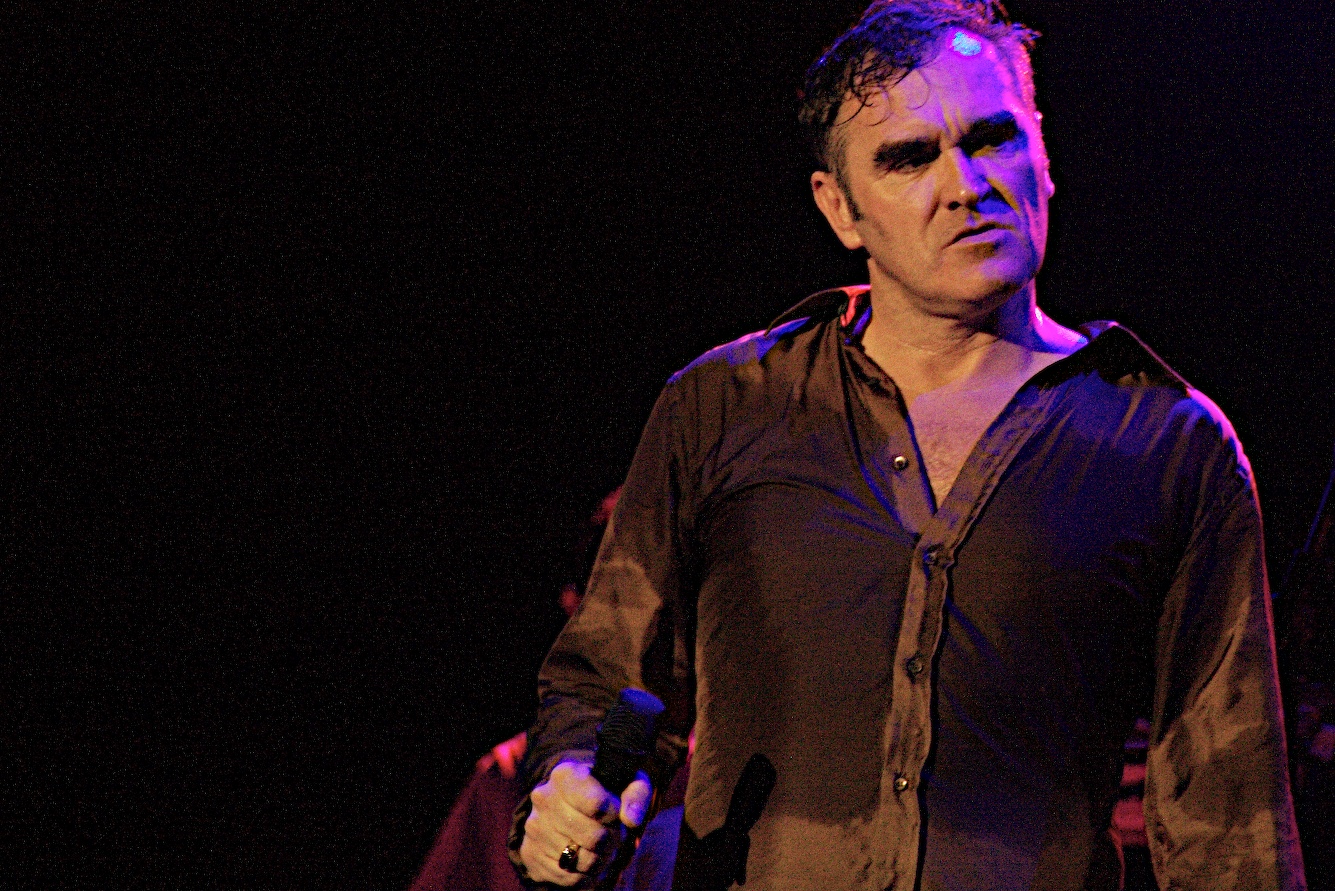
    Former Smiths frontman Morrissey plays the 3Arena on Monday (December 1). The City spoke to UL sociology lecturer Eoin Devereux about the significance of the gig for Moz’s Irish fans.

    As much as I hate to admit it, I can hardly count myself as a real Mozaphile. Yes, I can recite the words to ‘Alma Matters’, and a host of other gems no bother, but I just don’t have the vast wealth of knowledge a true Mozhead has.

    Put it this way: I’m more of a lowly private than a medalled general in the #MozArmy. I’ll work myself up the ranks someday, but for now I’ll just keep studying the back catalogue.

    The clue is in the quiff. You can always tell Morrissey’s most devoted fans by their great sweeping fringes, and most are infantile compared to Dr Eoin Devereux’s.

    Picture by Liam Burke/Press 22 courtesy of Eoin Devereux
    Picture by Liam Burke/Press 22 courtesy of Eoin Devereux

    Dr Devereux (pictured) is Senior Lecturer in Sociology at UL and co-director of the Popular Music and Popular Culture Research Cluster. He is Ireland’s Morrissey expert.

    He has a host of Mozzer gigs under his belt after first seeing The Smiths in Galway in 1984 and has “never looked back since”.

    Writing in an email, he explains what first attracted him to Morrissey: “[His] status as the Outsider’s Outsider is at the core of his appeal for me.  He sings about the lonely, the sad, the disenfranchised. That has been the constant thread for me. He is a raconteur of the marginalised and is wonderfully anti establishment.”

    It’s common for people who get Morrissey to describe how he gets them. His music changed their lives, which is common rhetoric for music fans, but there’s something different about Morrissey fans. He’s more than just a pop hero.

    Dr Devereux explains: “While fandom in general is a continuum and levels of fandom vary, Morrissey fans are passionate, sensitive and devoted.  I don’t mean devoted in a slavish way. I mean they display huge dedication to knowing and understanding as much as is possible about the object of their fandom and the things that influence him. It’s striking how many of them talk of how their Morrissey fandom has led them to reading Oscar Wilde.”

    Perhaps more obscurely, Mozafiles also celebrate the work of Manchester dramatist Shelagh Delaney because of her influence on Morrissey’s songwriting (The first Shelagh Delaney Day took place last Tuesday).

    My inaugural Moz gig was three years ago at Vicar Street. I was amazed by the great urgency for the audience to propel themselves at their hero. Some punters defied security and flung themselves on stage just so they could touch His Mozness. This is a common occurrence at his concerts. (Take a look at the pandemonium at a recent gig in Berlin).

    “There is almost a sacred dimension in evidence at Morrissey gigs in terms of the need of fans to touch the hand of their often reluctant icon,” Dr Devereux says. “This is particularly intense where his Chicano/Latino fans are concerned.”

    If you don’t already know, Morrissey has a very strong Latino following, which might be a bit surprising. But think about it, Latinos are marginalised in the States. Morrissey is marginalised everywhere (at least in his own eyes), so it makes sense.

    He gets most stick in the British red tops, often for saying something unflattering about the Queen or the meat industry. After all, he is a sexually ambiguous, reclusive, celibate, vegetarian pop star who doesn’t take drugs, so the tabs can’t really make any sense of him unless they can squeeze him under a headline like Heaven Knows He’s Miserable Now or Bigmouth Strikes Again.

    Much like my other hero, Leonard Cohen, Morrissey is often misunderstood as a depressing whinge (The Pope of Mope, they call him). Yes, he does sing about loneliness, but he does so in a very empowering way. And he’s actually very funny. He writes witty, kitchen sink lyrics Jarvis Cocker can only dream of. Listen to ‘Girlfriend in a Coma’ or ‘You’re the one for me, Fatty’ and you’ll see.

    Born to Irish-emigrant parents in 1950s Manchester, Morrissey considers himself “ten parts Crumlin, ten parts Old Trafford” and is clearly proud of his Irish blood and English heart.

    But is there anything unique about his fans in Ireland? Do we have a stronger connection with him since he is “one of us”?

    “Fans around the world have different kinds of connections with Morrissey,” Dr Devereux says. “Where Ireland is concerned I think that apart from his Irish roots (and influences) his anti establishment position on a range of issues makes a firm favourite here.  His Second Generation Irish and Catholic upbringing are still strongly in evidence in his creative output.”

    So if we were to draw a tour map of Morrissey’s Dublin, where would we go? First stop Crumlin, where next?

    “The National Stadium where The Smiths and Morrissey have played; the site of the old SFX; the Point Depot (3Arena) where he talked in 2004 of being ’10 parts Crumlin, 10 parts Old Trafford’, Swords and anywhere associated with his beloved Oscar Wilde.”

    So he has made his mark on this city and its people. And if he hasn’t made his mark on you, where should you start?

    Viva Hate would be the one [Morrissey’s debut solo album],” Dr Devereux says. “It’s still a great record and bridges the world of The Smiths and Morrissey’s solo career.  For ‘Late Night, Maudlin Street’ or ‘Margaret on the Guillotine’ alone it’s a great album.”

    I wonder if Dr Devereux has ever met Morrissey, surely the most sacred experience for any Mozaphile:

    “I haven’t met Morrissey,” he says. “I don’t think I would like to, really. Never meet your anti-heroes!”

    Morrissey plays the 3Arena tonight.

  • Caught out by ‘Catfishing’

    Caught out by ‘Catfishing’

    FACEBOOK

    Numerous cases of ‘catfishing’ have come to light in recent times, illustrating just how dangerous the web can be and highlighting a grave concern over just how safe an individual’s images and personal details are on the world wide web.

    A ‘catfish’ is an individual who pretends to be someone they’re not using a social media account for the purpose of creating a false identity.

    ‘Catfishing’ is a startling reality in today’s era of digital communication and can have serious repercussions for those affected.

    Many of the ‘do-no-gooders’ hide behind a computer/iPod/tablet screen as they scam their way into building a romantic relationship with unsuspecting victims.

    Not only do those responsible for catfishing steal the identity of other individuals, but they post false information alongside the image they have stolen of an individual they may or may not know.

    Aida Skirmantaite, a fourth year journalism student in DIT, spoke about her experience of being catfished and the terror associated with realising that someone somewhere is pretending to be you.

    Aida couldn’t understand why she had fallen victim to catfishing and what had attracted the perpetrator to her page. “I asked myself why would they choose me,” she said.

    For Aida the whole experience of being catfished started when the fake page was suggested to a fellow Facebook friend.

    That friend happened to run the page by Aida, as he knew the profile picture was of Aida but the name underneath was far from hers and instead supposedly was that of an Irish woman.

    Aida’s boyfriend added the fake page in order to discover who the personal identity thief was but to no avail. Aida then immediately reported the site to Facebook who took action by removing the page.

    Since the experience Aida has tightened the security surrounding her online social media profiles and is more aware of what can happen in a realm of virtual communication. She now searches for any associations with images on her social media account through an application called ‘Tineye.com’, a “reverse image search engine” that has the ability to find out where an image online came from, how it is being used online, and if any modified images exists.

    Another social media account holder Jennifer McDonald commented, “I’ve never been catfished but I get loads of friend requests and messages from profiles that are clearly fake and are people catfishing. I usually go onto the page and block them and I usually don’t write back to them but I did once and it was a weird experience so I just block them all now.”

    Essentially catfishing is pretending be someone you’re not on popular social media accounts as seen in the case of 21-year-old journalist Emma Nolan whose images were uploaded to a Tinder account and used for online dating purposes.

    A 2010 movie entitled Catfish brought to light this shocking scenario by telling the tale of a 28-year-old man named Nev Schulman who fell head over heels in love with a stranger’s Facebook profile picture only for her picture to be remarkably different to what she looked like in reality. The movie was a success and furthermore went on to inspire a series of documentaries on the issue.

  • New proposed by-laws no longer bad news for street performers

    New proposed by-laws no longer bad news for street performers

    104

    The proposed by-laws that would see buskers banned from the heart of the city centre and tourist hotspot Temple Bar, and only permit them to perform on Grafton Street under strict guidelines, have been overruled by Dublin City Council. 

    According to Dublin City Council (DCC), busking provides a “public amenity that enhances the character of the city and adds to its attractiveness.”

    The DCC were forced to re-consider the rules and regulations governing street performers and their activities after numerous complaints were made in recent times to DCC, An Garda Síochána and other representative bodies.

    Concerned individuals have brought forward complaints relating to loud noise, the obstruction of premises, late night busking disrupting residents and the pressure placed on some individuals to make some sort of donation.

    Bearing this in mind, a revised version of the Draft Street Performance By-Laws was put together and presented by the Arts Strategic Policy Committee on October 13 for consideration by DCC.

    The by-laws set out strict protocol including the banning of knives, flames, swords and axes in any performance.

    They also stated that a permit must be obtained by the DCC for an individual to perform in a public place, with prohibited sites including anywhere outside the GPO on O’Connell Street and the entire radius of Temple Bar.

    If the by-laws came into effect, an individual had to apply for a permit, and if granted, pay the fee and provide identification and photographic evidence of oneself.

    The permit would be granted for one year and included a fee of €30.00 per annum and €60.00 per annum for those with amplification.

    Under the proposed by-laws the performer had to display the permit throughout his/her entire performance and could only perform for a maximum of two hours.

    A busker could not perform twice within the space of 24 hours in the same area and had to relocate to a location not within 250 metres of his/her previous performance.

    With busking in Temple Bar prohibited, Grafton Street would prove to be the spot, however, time restrictions would be implemented with a curfew for performers.

    Buskers would not be allowed to perform before 9am or after 11pm with the exceptions of Saturday and Sunday mornings.

    The City spoke to Irish musician and Carlow man Shane Hennessy, who commented:

    “As soon as you kill off the music on the street, you kill off what is really unique about Dublin.

    “Every single day tourists and visitors say to me “Wow, there is a huge amount of music in Ireland, it’s great to see so much music on the streets”, and it is true. Many of Ireland’s best started out singing on side streets and alleys. Imagine the case for musicians down on their luck or looking to make some money, who have to pay to play on the street?

    “These proposed regulations might eliminate the problem of chancer buskers, but it absolutely destroys the situation for every good busker out there. How many times have you seen huge crowds on Grafton Street or in Temple Bar genuinely loving what they’re watching?

    “I really hope these measures don’t go through. I wouldn’t have thought so before but knowing what the City Council has been like the last few months, it wouldn’t surprise me,” he said.

    In early November DCC voted in favour of removing the proposal after large protests by musicians and individuals which has allowed for no changes to be made.

  • Up to 5,000 seats added to DUB-LCY route


    LCY runway at dusk
    LCY runway. Credit: London City Airport

    From today (October 27), London City Airport (LCY) will receive up to 5,000 more seats a week from Dublin when British Airways and FlyBe join Cityjet on the Dublin to London route.

    British Airways commenced a five-a-day service from Dublin to London City Airport yesterday using a mix of Embraer 170 and 190 jets.

    Willie Walsh at launch of BA's DUB-LCY route
    Credit: Eoghan Corry/Travel Extra

    Willie Walsh (pictured), the Dublin-born chief executive of International Airlines Group, the parent company of British Airways, said: “[The DUB-LCY route] complements our existing London Heathrow service and the excellent schedule means customers will have plenty of choice whether flying for business or leisure.”

    The airline hopes to attract business travellers with an early morning departure from Dublin (07:00).

    Regional airline FlyBe’s new service launches today.  The airline is also targeting business travellers with four daily flights starting at 07:00 as well.

    Dublin’s US immigration pre-clearance facilities are an attractive feature for westbound travellers in Britain.  FlyBe recently signed an interline deal with Aer Lingus that allows travellers from Britain to connect on the Irish carrier’s transatlantic services using the same ticket.

    However, FlyBe chief executive Saad Hammad has suggested the airline will not immediately target this niche.

    Another Dublin native, Declan Collier, CEO of LCY, naturally welcomed the two new routes.

    “Our vision to position LCY as the airport of choice for both business and leisure passengers has received a huge boost as a result of this news,” he said.  “We believe that the increased capacity on the route is good news for passengers, offering more choice of when and how to travel.  And I can’t deny that I privately welcome the news as it greatly enhances my own options for flying back home to Ireland.”

    The route will now be serviced by 15 daily flights from three three airlines.

  • BLOOD AT THE SCIENCE GALLERY


    "Blood Vessels" by Charlie Murphy, made of borosilicate glass filled with red and blue toluene that's used in thermometers.
    “Blood Vessels” by Charlie Murphy, made of borosilicate glass filled with red and blue toluene that’s used in thermometers.

    As soon as you walk in through the glass door of the Science Gallery, you are greeted by the large sign that says “Blood: Not for the faint-hearted”. It really isn’t.

    If you’re prone to getting squeamish at the sight of the tiniest trickle of blood, you might want to miss this one. However, if you’re fascinated by the crimson red liquid that runs through your veins and want to learn more about it, you need to see this exhibition.

    25 different installations and artworks in the Science Gallery incorporate the main theme of blood, exploring its nature, its scientific use and its perceptions in our society.

    The whole atmosphere in the gallery space is eerie in the evening, with dimmed lights illuminating the intriguing installations: a baby sculpture made out of freeze-dried animal blood; a vampire killing kit with four different sizes of wooden stakes; various one-man cinema quarters with videos of stem-cell extractions and blood transfusions; a machine that lets you feel the blood pressure through the aorta by holding the aortic arch simulator; and many more.

    If you have some time to kill, you can even stand in the pitch dark corner to watch as luminol drops down onto a sculpture made of blood and resin, slowly revealing the structure made by Beatrice Haines. Luminol is the substance that’s used in TV criminal dramas like CSI, where the cops are looking for evidence of blood residue in crime scenes.

    You see, blood on its own doesn’t really show up under fluorescent light. First, forensic scientists would pour luminol over the area and then illuminate it with the bluish-green light. When luminol comes into contact with the haemoglobin in the blood, it glows under the light.

    This is one of the more fascinating installations, however it does take time to truly see the structure in its full form. Apparently, it’s approximately 20 minutes, though it does take a lot of patience to stand still in pitch dark while concentrating on one spot.

    Another interesting installation is the work of an electronic artist, Rafael Lozano-Hemmer. It’s called “Pulse Index”, and it is an interactive installation where you can scan your finger on a sensor located in a small tube-shaped digital reader. The scanned image instantly pops up on the screen and keeps moving sideways.

    All of the participants’ fingerprint scans are accumulated into a digital gallery and displayed onto a huge monitor, divided into hundreds of smaller screens – each person’s finger scan travels along the screens and gets smaller and smaller until it reaches the end of the installation. Finally, the picture completely disappears into the maize of finger scans. The scanner is so precise that it even picks up the tiniest sweat droplets off your finger.

    This slideshow requires JavaScript.

    Sequence 01_2


    “Blood Jukebox” is yet another interactive installation that catches people’s attention. There was even a queue to this intriguing device. This machine, made by the art collective, Robot Versus Future, reads your pulse and tries to estimate your age, generating tracks from your teenage years.

    Additionally, it reads the tempo of your pulse and picks a song that matches the beat – the faster your pulse, the more upbeat song the machine generates.

    The exhibition at the Science Gallery runs until 25 January and is open to the general public, though it is recommended for over 15s due to its gory and bloody nature. (No sign prohibiting vampires from entering, though. Mind you, that would get quite messy, what with the free buffet of blood installations and curious mortals lurking in the dark corners of the Science Gallery.)

    Photography by Aida Skirmantaite.

  • Storymap – An Interactive App that Helps You Explore Dublin City

    Screen shot 2014-11-04 at 19.51.03
    Image courtesy of Storymap

    Storymap is an app unique to Dublin, which allows you to explore the city as you walk through it, or from the comfort of your own home. The app and website contain a compilation of endearing, informative and amusing stories told by Dubliners themselves. The stories are told and filmed where they took place, and you don’t have to walk far in the city centre to be at the scene of a Storymap tale. Its two creators, Tom Rowley and Andy Flaherty, are both Dubliners who studied Film Studies and English in Trinity College.

    On the Storymap website Tom describes the app,

    “…like one big pub where everyone shares their stories, creating a sense of what the city means to Dubliners. It’s a simple idea, but with complex possibilities, and we’re only just at the beginning of it.”

    Because Dublin currently has Storymap all to itself, I caught up with it’s other creator, Andy, to find out more.

    landing_logo
    Image courtesy of Storymap

    What gave you the idea of starting Storymap?

    Myself and Tom were just back in the country, We returned at the height of the recession, we were unemployed, in between film projects and we were getting really annoyed with all the negative press the city was receiving. The bleak tales of recession, the gloomy accounts of unemployment and the notion that Ireland’s best and brightest had emigrated. This wasn’t the Dublin we were experiencing. We were excited to be home and even though we were broke, we were really enjoying the flourishing art scene that had been somewhat pushed aside during the boom. 

    We wanted to do something to get people as excited about the city as we were. While loads of great people have left the country, you only have to walk into any gallery, gig or any of the fantastic spoken word or comedy nights to see that Dublin is a ridiculously fun and vibrant city with wonderful characters and an amazing art scene. We wanted to bring that charm and character to a wider audience and figured a really nice and easy way to do it was through stories. So we came up with the idea for Storymap, and it’s been ridiculously fun ever since. I’ve heard so many stories about Dublin, learnt so much about my city and met so many wonderful people. It’s really been an amazing project to work on. 

    How do you source your stories and the people who tell them? 

    Sourcing stories is the best part about working on Storymap. It’s not as hard as people think either, we have a couple of different ways we source stories, we do a bit of research on stuff that interests the two of us, utilising blogs like Come Here to Me Now! and History Ireland. We attend loads of different cultural events and see if any of the performers interest us.

    What are some of your favourite stories from around Dublin?

    There’s so many amazing stories, but my favourite stories are always the personal ones, people like Maureen Grant, Gerry Cowen, Tom Matthews, The Brothers O’Neill, Filippo Fusco or Bernie O’Shea – they always make me laugh. I also really like the story Shane Langan gave us about Lawrence Downey, ‘The Holy Hijacker’, who hi-jacked an Aer Lingus flight to London to try and get the Pope to make public The Third Secret of Fatima… and Conor O’Toole’s bizarre true story of how Dublin was saved from the brink of starvation by the most unlikely of foodstuffs. 

    What has the reaction to Storymap been like?

    People seem to really like the app, we’ve got loads of really nice emails and comments from Dubliners and tourists who’ve been using the app to explore the city. When we started Storymap we always thought it would make a good app, a really fun way to learn about the city, so it’s always really nice to hear that people are using and enjoying it.

    How many people have downloaded the app?

    Just under 10,000 which is really amazing when I think about it.

    Are you looking to expand further?

    We’ve built the Storymap platform so it can be moved to any city in the world without any hassle, so if anyone would like to set one up in their city they can have the app and website for free, they just need to contact us and then go out and find some stories.We’d love to see people set up their own Storymaps around the world, and have it as a tool to explore different cities. We also have a few more ideas we’d like to do in the future. But for now we’re focusing on a few different projects away from Storymap. So unfortunately we haven’t been able to focus as much time on Storymap as we used to but we still have loads of really good stories to release and a few nice surprises in store so watch this space.

    Anything about the app or Dublin itself you’d like to add? 

    Yeah, go out and support local artists – Dublin is amazing at the minute. There is so many fantastic nights on in town, from spoken word to comedy to live music. Nights such as The Brown Bread Mix Tape, NightHawks, The Weekly General Meeting, The Monday Echo, The Firehouse Film contest and loads more. Go check them out and see for yourself just how good the art scene in Dublin is.  

    For more stories check out http://storymap.ie/

  • Ireland’s writers celebrate the visual arts


    IMG_0950
    Carravagio’s The Taking of the Christ. Picture: Aaron Hennessey

    The National Gallery of Ireland is currently celebrating 150 years of existence. An impressive feat, I’m sure you’ll agree. So too is the manner in which they are celebrating this milestone.

    The Gallery asked 56 of Ireland’s most celebrated writers to contribute a piece of work to a collection of theirs. This new collection is called Lines of Vision: Irish Writers on Art and contains stories, poems and essays. Each writer who contributed was asked to choose a painting from the Gallery’s collection to use as the source of inspiration for their piece.

    The works chosen hang together in a beautiful exhibition which reinvigorates works of art which may have become either over-familiar or forgotten to visitors of the gallery. Not that we’re exactly spoiled for choice in comparison to some of our other European counterparts, but there is real beauty to be found here, or the representation at least.

    Each painting is accompanied by a short bio of the writer who chose it. There is a 15 minute film at the end of the exhibition which compliments it nicely.

    Also in conjunction with the exhibition, there are numerous talks and workshops happening in the gallery, most of which are free.

    This slideshow requires JavaScript.

  • Dublin Protest Against Water Charges

    Dublin Protest Against Water Charges

    Saturday November 1 saw a nationwide day of protest against the proposed introduction of water charges.

    Marches were organised in all the major cities and towns across the country, with the largest gathering taking place in Dublin.  Smaller local marches took place throughout the greater Dublin region in the morning, with protesters then coming together in the city for the main event at 2pm.

    There were two starting points: one at Connolly Station, the other at Heuston.  The two groups marched on their respective sides of the Quays before joining and converging at the GPO in O’Connell Street.

    As with last month’s march the atmosphere was good, with no reports of arrests. At the same time, however, a palpable feeling of anger against the Government and Irish Water pervaded.  The message which the people were sending out was “enough is enough”, and that after years of austerity they were not prepared to be squeezed any more.

    Unlike many parts of the country the rain held off for most of the day, but by late afternoon the bad weather had set in and many people did not stay for the end of the speeches.  Nonetheless, the organisers once again claimed a higher turnout than expected, pointing out that the sheer volume of protesters sent a clear message to the Government.

    Speaking at the Fine Gael presidential dinner in Dublin that evening, Taoiseach Enda Kenny said that the Government would not be scrapping water charges. He admitted, however, that mistakes had been made in their introduction, and that the setting up of Irish Water had been badly handled.

    He went on to point out that the alternative to water charges would be an increase of 4% on the higher bracket of income tax, an option which he was not prepared to consider.

    Meanwhile, the latest opinion poll for the Sunday Independent shows a further slip in Government popularity.

    Dissatisfaction with the Taoiseach has grown to 67%, up 9% since September; Joan Burton’s popularity has also slipped by 8% in the same period.

    The poll also asked voters who they would vote for if a general election was called tomorrow.  Results suggest that Sinn Féin, at 26%, is now the most popular political party in the country, ahead of Fine Gael at 22% and Fianna Fail at 20%.

    Further water protests are planned for the end of this month.

  • Damnation Review

    damnation2
    Damnation will make you question every choice you are about to make

    As a huge adrenaline junkie, horror movies have always been a quick fix for me.  Nothing gets me more buzzed then that familiar feeling of listening to the blood pumping in your ears while your heart tries to burst out of your chest as you contemplate every outcome in flashes in your mind.  So when I heard that the RDS was hosting a live horror event called Damnation, I jumped at the opportunity to go.

    Unfortunately, over many years of watching horror films my sensitivity has somewhat decreased.  Stepping in to  the show, my friend and I were  definitely cynical about the experience. However, to my delight I found that Damnation is a night that will exploit your worst fears, and even better, bring new ones to light that you never knew you had.

    Damnation is based on the story of Samuel Page, a blacksmith who mysteriously disappeared around the 1800s.  Along with his wife and two daughters, Page was very well-known in the community.  However at night he apparently operated a Satanic Cult in his basement.  When his terrifying practises were found out, the community burned his house down to the ground with Page and his family inside.  Page was the only one whose body was never found.

    Damnation plays out the horrors that were suspected to have happened in that satanic house, with many surprises that will play with your mind. The actors take you through a maze of horrors that not only play on your fears in a physical and visual manner, but also aim to disorientate you to make you more vulnerable.  You start off cautiously walking through the rooms, and by the end you will be running!

    damnation
    These terrifying faces will haunt you afterwards!

    However, this attraction is not for everyone; those who have photosensitive epilepsy are advised to not enter  Damnation.  There are also “chicken out”doors for those who can’t handle the fear.  In some parts you do have to get on your hands and knees and crawl, so people who suffer claustrophobia  are allowed to skip this part and go through a door.  As my friend suffers from this we went through the door, but take heed and remember that this does not give you a free pass from getting scared half to death!  We contemplated that maybe the doorway was the worst part!

    The prices are a little steep,  €19 for a general pass, but there are discount tickets too, and the event only lasts around half an hour.  But for those looking for something very different from the usual weekend bores this is the place for you!  Even though it seems like a quick scare for a big price it is definitely an unmissable experience.  Take it from me, the person who involuntarily recoiled in fear after opening the bathroom door.

    For more information go to http://www.damnation.ie. Tickets can be purchased from http://www.ticketmaster.ie.

  • Airtricity League title evades the capital – 2014 Season Review

    As another year of Irish league football comes to an end, the time for reflection for managers, players and fans has arrived. Whether your club has won the league, embarked on a memorable cup run, exceeded expectations or spectacularly failed to live up to them, little will change the love we feel for the club we support. Here’s a round-up of all the Dublin-based Premier Division clubs for the 2014 season.

    Bohemians

    Dalymount Park will welcome back First Division football next season. Photo: Jack Pollock
    Dalymount Park will welcome back First Division football next season. Photo: Jack Pollock

    After retaining their SSE Airtricity Premier Division status in 2013 with a 10th place finish, the Gypsies pushed on in the 2014 season to surprise everyone at Dalymount Park and finish in a commendable 7th place.

    Having only secured safety in the final weeks of the 2013 season, this campaign was a far more productive effort under now departed boss, Owen Heary. The 38 year-old, who spent seven years with the Phibsborough based club as a player and manager, guided his team to the latter stages of all three domestic cups. Bohs reached the semi-final stages of the EA Sports Cup, only to lose out to Shamrock Rovers 0-2. The FAI Cup brought more heartache, as the side were narrowly defeated by St Patrick’s Athletic despite threatening a late comeback in their quarter-final tie. The lesser acclaimed Leinster Senior Cup also saw the club excel, before being convincingly beaten by rivals Shamrock Rovers once again at the quarter-final stage.

    Dinny Corcoran ended the season as the Gypsies’ top scorer, as he bagged 13 league goals to ensure relegation was never at the forefront of his teammates’ thoughts. Summer signing Jason Byrne also provided the goals for Heary’s men, but at 36 years of age, time is running out for the Dublin-born striker to break the League of Ireland’s all time scoring record of 235 goals, currently held by Brendan Bradley. Byrne still needs just over 20 goals to match Bradley’s feat.

    Shamrock Rovers

    Photo: Shamrock Rovers FC
    Shamrock Rovers narrowly missed out on European qualification for next season. Photo: Shamrock Rovers FC

    Having previously secured a domestic cup treble in the 2013 campaign, Rovers were expected to improve on their 5th place finish and to challenge for the league title. However, the Hoops were to end another season without qualifying for Europe.

    Midway through the season, manager Trevor Croly left the club by mutual consent as the club decided he was no longer the man to take the club forward. Pat Fenlon, the former Hibernian boss, took over the reins as the club desperately tried to secure European football for the first time in four years. With their league form proving indifferent, the cups took on more importance as the club searched for an alternative route into Europe.

    The Hoops surrendered their EA Sports Cup to Dundalk, who claimed a 3-2 victory in a pulsating final. The club also lost its grip on their two remaining trophies, as they exited both the Leinster Senior Cup and the Setanta Sports Cup at the semi-final stages. Most painfully, Pat Fenlon’s side saw their last opportunity to qualify for Europe pass them by, as they lost to Derry City in their FAI Cup semi-final replay. The FAI Cup was high on the list of priorities for boss Fenlon, with the club having gone 27 years without claiming the trophy.

    Gary McCabe ended the season as the club’s top scorer with seven goals, as the Tallaght-based club struggled to find a prolific scorer. Goalkeeper Barry Murphy was named as the club’s Player of the Year.

    St Patrick’s Athletic

    Richmond Park Image
    Fans of St Pat’s can look forward to some Europa League action in July 2015. Photo: Fionnsci

    In claiming the SSE Airtricity Premier Division title in 2013, St Pat’s finally shook off their tag of ‘nearly men’. However, Liam Buckley’s side failed to recapture their title-winning form in 2014, as arguably the best squad in the league vastly underperformed to seal only a 3rd place finish.

    In light of their league triumph, the Inchicore club’s struggles in the cup competitions were largely overlooked last season. This campaign, in contrast, will be remembered for their exploits in both European and the domestic cups. Having gained a remarkable 1-1 draw in their Champions League second-round qualifier first-leg against Legia Warsaw, those at Richmond Park began to dream of a fairytale meeting with Scottish giants, Celtic. Unfortunately, those visions would remain imaginary, as the Polish champions thrashed St Pat’s in the second-leg, to end their chances of progressing.

    Liam Buckley and his players did claim the Leinster Senior Cup after beating First Division side Longford Town in the final. With Europa League qualification secured through their final league position, St Pat’s head into the FAI Cup Final on November 2 with little to fear, as they go in search of more silverware.

    Christy Fagan marked a memorable personal campaign with 20 league goals; Conan Byrne and Chris Forrester also reached double figures. Keith Fahey also enjoyed a fine campaign as he made his eagerly anticipated return to the League of Ireland.

    UCD

    UCD. Photo: Ed Scannell
    UCD’s future in the Premier Division remains in their own hands. Photo: Ed Scannell

    The perennial target for the Students is to remain in the SSE Airtricity Premier Division and they still have a chance of extending their five-year stay. In 2013, UCD sealed their safety after finishing in 9th place and in doing so, avoided the uncertainty of a relegation play-off. However, Aaron Callaghan’s side were not so fortunate this time around, as they will have to wait until Halloween night before their Premier Division status is decided.

    With the club’s target of survival the only real aspiration for management and players, cup competitions always prove to be a thankless task at the UCD Bowl. The Students exited all domestic cup competitions in the early rounds, as they lived up to their low expectations. Striker Cillian Morrison left the club in July to join Cork City, in what has become a familiar scenario for UCD as they continue to lose their best players on an all-too regular basis. The likes of Michael Leahy, Craig Walsh, Dinny Corcoran and David McMillan have all left the side in the past 12 months. However, management encourage the club’s best players to move on, in order to further their careers at more ambitious sides throughout the division.

    Time will tell if UCD are to prepare for life in the Premier Division once more, or whether they will finally endure relegation to Irish football’s second-tier.