The average age of Irish brides and grooms in opposite sex marriages is the highest recorded to date, continuing a trend of people deciding to marry later in life. The average age of the groom has increased by 8.1 years since 1987 and the average age of the bride has increased by 9.3 years, according to figures from the Central Statistics Office (CSO).
Source // CSO
In the last five years, the average age of the groom has risen by 1.4 years and the average age of the bride has risen by 1.5 years, according to the CSO.
Source // CSO
The CSO figures show the average age for same sex marriages decreased from 2016 to 2017. In 2016, the average age of males in same sex marriages was 40.5 compared to 40.3 in 2017. The average age of females in same sex marriages in 2016 was 41.0 and dropped to 40.5 in 2017.
The marriage rate in Ireland is down 0.2 per 1,000 population since 2016. There were 605 less marriages in 2017 than in 2016. There were 759 same sex marriages in 2017 and 21,262 opposite sex marriages. In 2017, Just over a half of all opposite sex marriages were Roman Catholic ceremonies (52.8 percent) and July and August were the most popular months to wed.
Over the last 30 years, the average age for first time mothers has increased by 4.8 years, according to the Central Statistics Office (CSO). In 1987, the average age of first time mothers was 26.2, compared with 31.0 in 2017.
Source // CSO
The United Nations Population Fund (UNFPA) looked at reproductive trends in 200 countries for a report published last month. It found that Ireland has the fourth highest average age of childbearing in Europe, after Spain, Switzerland, Italy, and Luxembourg. Outside Europe, Ireland’s average age for childbearing is beaten only by Libya, Korea, Djibouti, Saudi Arabia, and Hong Kong.
The video game ecosystem rarely gets a look in when it comes to the Irish media apart maybe from the odd trailer around Christmas to entice the little ones or a write up about how Red Dead Redemption 2 is the best thing since sliced bread. But in reality, fans are lucky to get a consistent review section in a national newspaper. Though, when unsavoury gaming news rumblings about exploitation and underage gambling start emerging, you imagine the power elites here would act. Well … they did, then swiftly washed their hands of the subject. “Anyway, here’s another PlayStation 4 advert. Enjoy.”
Over the last few weeks, many fans – and government officials – have debated the legality of loot boxes and micro-transactions (in games purchases, represented by virtual containers, that gifts players with items, weapons, and modifications based on chance). The main issue is the way games ask players to unlock, often pay-walled, content, encouraging gambling, especially amongst the current generation of youngsters.
The Irish Government, however, have no plans in cracking down on the questionable “loot boxes,” after initially joining an international declaration condemning the “blurring of lines between gaming and gambling.” David Stanton, Department of Justice, has since clarified that the declaration “does not have legal effect.”
Since it’s release, Destiny 2 has been embroiled in controversy with its questionable microtransactions // PlayStation 4
Presently in Ireland, we don’t have a clear and concise, legislative stance when it comes to online gambling – this concerns video games also. A number of European countries have called for an EU-wide ban on the loot box algorithms, following an investigation into four high-profile games by the Belgian Gaming Commission.
As far as Ireland is concerned, however, Mr Stanton says: “It should be understood, that if a game offers in-game purchases – be they loot boxes, skins, etc. – which are promoted to gamers as increasing their chances of success, such purchases are essentially a commercial or e-commerce activity. This activity would fall within normal consumer law.”
In short, this doesn’t concern the Department of Justice, unless a game offers the possibility of placing a bet or the risk for financial reward within the game, then it must be licensed as a gambling product.
But that covers the situation from a government standpoint, what do the game developers have to say about it? These are the people who dedicate months, even years to expertly craft a playable experience worthy of purchase. So, surely, they have their opinions on such an important issue concerning their industry.
“As I gamer I enjoy a micro-transaction when it’s cosmetic. Since I play mostly competitive games, if there is a micro-transaction that says ‘buy this sword or item for more damage’ it kills the game. It would be comparable to sports if they made steroids legal but too expensive for everyone to play evenly,” says Michael McNabola, Director of Operations at Hail Games.
Of course, as a fan, everyone has that purist belief that every game should serve its original purpose – escapism at its finest. But once you swap the casual gamer life for a vocation, that perspective begins to shift.
Fortnite’s style of loot boxes are far less predatory than its competitors // PlayStation 4
“I can see the necessity of micro-transactions in free to play games in order to make their income. This is their business model and it’s a requirement to make a profit as ad revenue in free to play games are not nearly as lucrative. However, there is no justification in my mind for full priced titles from large developers like EA and Ubisoft having micro-transactions in their game,” adds Stephen Farnan of SavePoint Studios.
Loot boxes don’t have to be wholly negative, though, if introduced honestly and in a way that doesn’t hinder the gameplay. Epic Games unearthed a highly-profitable gem this past year when Fortnite – specifically its Battle Royale mode – became a runaway success.
Though such innovation should be championed, seeing free-to-play games (F2P) generating such a copious amount of money has altered the large developers’ motives. Often obsessed with a game’s longevity, developers employ F2P economies into their projects, while also slapping on a hefty retail price.
“It involves locking away content that five years ago would have been freely included in the game. There is an argument from some that this is required since games are more expensive to make now, but the biggest games are making more money than ever and recent titles like the new Spiderman game released with no micro-transactions and has sold extremely well,” says Stephen.
Whether micro-transactions should be regulated or monitored is regularly debated by developers, and there isn’t a simple fix, sadly. These gaming economies affect the balance of the game.
“In order to crowbar in a system to an existing game, you may have to make normal progress slower to make micro-transactions valuable or lock away previously free content. This means the original vision of the developer becomes blurred and tainted,” says Michael.
Disappointed by Ireland’s official response to loot boxes, Stephen says: “Loot boxes are a form of gambling that is extremely predatory in practice while being aimed at children, they are in desperate need of official regulation. In some cases, the line between micro-transactions and loot boxes, and online games on sites, such as Paddy Power, are being blurred.
“In both instances, you pledge real money in order to win a game of chance. The only distinction is one potentially gives you a real-world reward, while the other does not, so you could argue that money spent in loot boxes is lost already, win or lose, and thus is potentially even worse than gambling in some ways.”
Star Wars Battlefront 2 was one of the major titles that warranted investigating by the Belgian Gaming Commission // PlayStation 4
Ireland’s lack of understanding and interest in the industry is a core component as to why the topic is continually being overlooked.
“The Irish government doesn’t have enough knowledge diversity be able to help; greedy developers and investors will just work on ways around how to take as much money from their consumers as possible regardless of any regulations. There should be a not-for profit organisation that rates and reviews the quality of games and companies’ reputations,” adds Michael.
Suffice to say, micro-transactions do not belong in retailed games. As Fortnite has shown, if a game is free-to-play (F2P) and the developer actively listens and converses with an audience, then the game is less likely to be embroiled in ignominy. But in an age where downloadable content (DLC) and season passes are a permanent bedfellow of major titles, it’s inevitable that micro-transactions will continue to grow, as all power elites, even in gaming, are driven by money. Hopefully, the gaming community will vocalise their gripes and concerns, deterring these financial predators, and prioritising legitimate projects.
Figures released by the Central Statistics Office (CSO) and sourced by the Dublin Airport Authority (DAA) have shown that Ireland has been getting a steady increase in foreign visitors for the period spanning 2010 to 2017.
The overall figure has risen from just over 6 million people in 2010 to 9.9 million in 2017, a rise of over 35%. Unsurprisingly, Great Britain sent the most visitors to Ireland over this period with more than 25.5 million people visiting our shores in the eight year period. Conversely, 20 countries from Africa produced only 348,500 people travelling to the country.
However, it’s when you look at the figures on a year by year basis that you begin to see the trend of the number of visitors rising every year bar a few exceptions. Germany, Spain, The Netherlands, The USA, Canada and Asia (includes 50 countries) all had increases every year without fail.
Figures show a steady increase of visitors to the country in the last few years // Central Statistics Office
While some countries and areas had annual decreases here and there, not a single one had lower figures for visitors in 2017 compared to 2010. Again, as you would expect, the majority of visitors were from Europe, but outside of that, the USA dominated with more visitors than Canada, Australia, New Zealand and Other Oceania (31 countries), Africa, Central and South America, Mexico and Asia combined.
Niall Gibbons, CEO of Tourism Ireland, commented on Ireland’s increased number of visitors for 2018 by saying: “Particularly welcome in today’s figures is the continued strong performance from North America, with an increase of 12.9%. A number of factors are working in our favour, including more airline seats than ever before, from more gateways across the US and Canada.
“We’ve also seen excellent results from Mainland Europe, up 10% on January-September last year, with particularly strong performances from Germany (+20.9%) and Italy (+11.8%). While we welcome the fact that arrivals from Britain are up 1.1%, it is not yet clear if this represents a turnaround in the long-term trend. The impact of Brexit on outbound travel from Britain remains a concern.”
It was a Tuesday morning, I was running late for a big day. No time for coffee.
‘I’ll grab one on the way,’ I told myself, ‘I’ll use my KeepCup.’ It was at that moment, like clockwork, that I heard it. The sound of glass shattering echoed through my kitchen. I looked on in what I can only describe as a state of frozen despair.
Not my first, but my second KeepCup, taken too soon from this cruel world. With no time to mourn I swept up the shards and rushed to catch my bus, going without coffee that day because “surely I can’t use a paper cup after all this time”. It was then that I decided to go back to the beginning, what are these reusable cups and where did they come from?
My first stop, George’s Street. On this street, the coffee shop Granthams had moved from their sit-in-cafe space to its existing space in Camden Market, opening a “Pop-Up” Coffee shop by Diarmuid Gavin near Dunnes Stores.
I wondered if, as a take-away coffee shop only, they had seen a rise in people drinking coffee from reusable cups. Upon entering I saw a sweet women behind the till. I struck up conversation and then informed her of my article on keep cups, asking if I could interview her on her experiences in the coffee shop. She looked at me in amused bewilderment, “KeepCups?’ Strike one.
From there she directed me to Austin, the head barista, who knew all too well about reusable KeepCups. He spoke about how reusable cups popped up one day and became the latest craze. “In the last year or so, people will come in with Christmas or birthday gifts that are KeepCups. People are incentivised to use KeepCups, especially with us as our other branch in Camden Market offers 20c off if you bring in one.”
“They became a craze for a while where everyone was using them, but it’s as though they became a hindrance so we wanted to see how we could improve on that and get people using them again.”
With the coffee industry continuing to grow while global warming worsens, have these changes, along with the potential discounts encouraged people to use reusable cups? I took to the streets of Dublin to find out.
As I walked down South William Street, I spotted a girl on the steps of Powerscourt, plastic KeepCup held proudly in her hand. Plastic not glass, clever. “I bought a KeepCup when I started noticing the build up of coffee cups on my desk. After a few days I would be surrounded by paper cups, and it was then that I really start noticing the waste,” said Paula O’Rourke, 24, from Dublin.
“I think the discount is a good idea to get people to use KeepCups but I don’t know if it is enough. People won’t just use them for 20c off their coffee,” she said.
As a student, I wondered if maybe the idea of KeepCups, in theory, is good, but how many people actually own them, and is there an element of guilt if you still use paper cups? Rory McGrath, 21, from Cabra had a different opinion: “I don’t own a reusable cup and I feel like paper cups aren’t that bad. For me, it’s the plastic lids that are the problem.” When I asked if he felt guilty about using paper cups instead of a KeepCup his response was very well thought out. “No, I think KeepCups are a good idea, but at the end of the day I think there is a lot more everyone could do for the environment, rather than just using a reusable cup.”
So, after an in-depth look into the reusable coffee cup scene, it seems people’s opinions are torn. Are reusable cups just the latest trend and are they a step in the right direction to a more eco-friendly world?
One thing’s for sure, I will be drinking from a plastic KeepCup from now on.
Blogger Hilda Smith spoke to thecity.ie about her fashion blogging success. Hilda created her blog, Over the Hilda, three years ago and now has over 3,000 followers on Instagram.
On her reasons for starting a fashion blog, she says: “I realised that there were no bloggers catering to women of my age. It was as if only young people were interested in fashion. Also, I was tired of being sold skin creams and makeup that were not right for an older woman’s skin.
“In a moment of madness, I said I was going to start a blog myself. I am a technophobe, who even found it difficult to get into Netflix, so my family did not hold out much hope of success.
“I had plenty of life experiences to share … menopause, my interest in staying healthy and fit into midlife and older … so having laughed in my face at first, they finally got behind me.”
Hilda’s blog details her fashion tastes as well as elements of her personal life // Instagram @overthehilda
She said she has always been an over-sharer. She writes her posts as if she is chatting to friends and telling them what she is doing. “It could be about how I am worried about my memory, how to survive 35 years of marriage and not kill him, or about the wonderful new lipstick I have found or the cream I consider is not worth the money.”
Before she got into blogging, Hilda was a secondary school English teacher at The King’s Hospital for 34 years. She has been retired for six years. She graduated from Trinity in 1974 and was involved in drama and hockey coaching.
Hilda gets her fashion inspiration from magazines, other bloggers, and her daughter Courtney, who is regarded as one of Ireland’s top fashion stylists.
She says the main aim of her blog is to start a conversation with similar like-minded women of a certain age, “to discuss issues such as being ignored by the media because we are considered irrelevant”.
She said: “I suppose I really want to showcase that when we reach 50, 60 or 70, it does not mean that we have to go and hide away. I was always interested in fashion and I still am. I will not be told how to dress.
“I feel that women over 50 have been undervalued, overlooked and ignored by brands. It is as if when we turn 50 we are expected to start wearing granny clothes or elasticated trousers. Many of us are interested in fashion and looking good and we are not invisible.
“I love seeing older women rocking their leathers and ripped jeans. And I also admire those who wear beautiful elegant dresses and timeless pieces.”
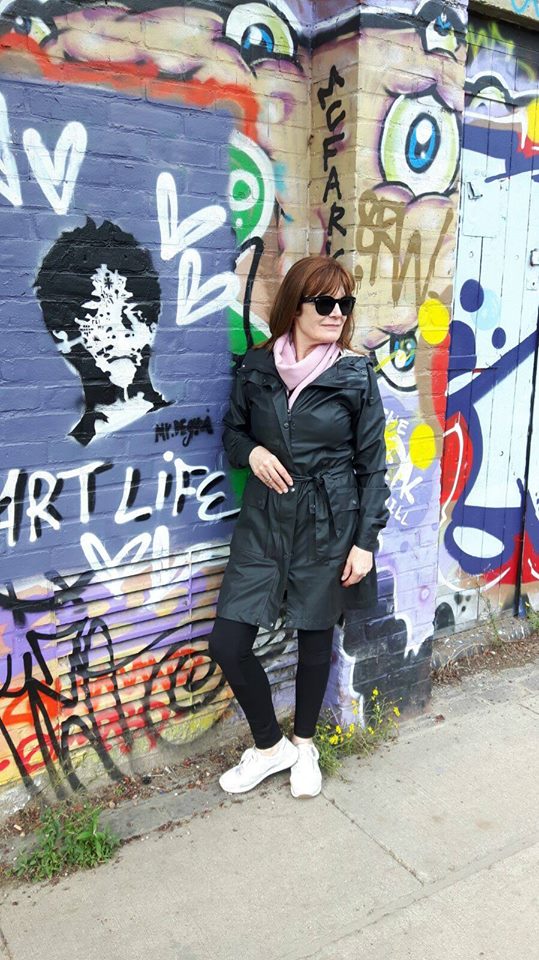
Though Hilda is not your stereotypical blogger, she believes her fashion sense is just as valuable as any 18-year-old influencer // Instagram @overthehilda
Hilda says that there have been so many articles recently stating that women should not wear jeans, bikinis or short skirts after a certain age, and they certainly should not show off their cleavage after 50. She believes women should ignore these rules about dressing for your age and just wear what they want.
Hilda says she usually shops in Zara, Warehouse and H&M and has found items in Penneys and Topshop too.
“I like LK Bennett for something special and find Arnotts wonderful if I want to spend a bit more. I will shop anywhere and love browsing in boutiques too. I have only recently bought into the online trend, generally, I prefer to feel the material, but if I know a brand suits me I can shop online.”
Speaking about her style, Hilda says: “I am classic with a twist, I guess. I love boho but it doesn’t really suit me; however, I love it on others. My style has changed and developed hugely. I am less afraid of trying something different. I have worn many of the trends before and love seeing them re-interpreted.”
Hilda says in order to create a successful fashion blog you either need lots of clothes, money or contacts in fashion or an amazing photographer who knows how to make you look good.
She says: “It takes time to build up a following and I have done really no self-promotion. But my name is getting out there now and brands are approaching me, although I want my blog to be about more than fashion.”
The price of hotel rooms and eating out are set for a major hike after the government announced that VAT rates in the hospitality sectors would increase to 13.5%.
Irish hoteliers have slammed Minister for Finance, Pascal Donohoe, who announced on Tuesday that VAT for the sector would rise from 9% to 13.5% in the 2019 Budget.
The Irish Hotels Federation (IHF) has branded the increase as ‘reckless’ and warns that Irish tourism will struggle to compete with cheaper European destinations.
Over 235,000 people are employed in the tourism sector currently and the government aims to raise over €450 million with this latest tax rise.
Michael Lennon, head of the IHF has pleaded with the finance minister to reconsider the measures until at least after the completion of Brexit.
Speaking on Tuesday, Mr Lennon said: “Ireland will now have a higher tourism VAT rate than 26 countries in Europe with which we compete.
“We are already a very high cost economy by international standards, so it is astonishing that the government is now imposing additional taxes on tourists and making our country less attractive as a destination.
“Have no doubt, this increase will hurt tourism across the country but businesses outside of Dublin will be hit the hardest.
“Regional businesses will bear the brunt, as about €300m of the €466m in additional taxes will be taken from the rural economy, which has been slower to recover from the economic crisis.”
The current VAT rate of 9% was introduced in 2011 as a temporary measure to increase productivity in the tourism and hospitality sectors and Mr Lennon claims that the industries should be rewarded for growth.
He said: “The government recognised the tourism industry’s ability to deliver on jobs across the country and we delivered, year after year, creating over 65,000 new jobs.
“We achieved this by providing a quality product, high levels of service and competing internationally for business every day.
“Today the tourism industry supports over 235,000 jobs in every county and town, over 70% of which are outside Dublin, generating over€2 billion in taxes for the exchequer each year.
“It is deeply disappointing and frustrating that despite the strong response of the tourism industry to the 9% activation measure, its economic contribution and potential is no longer of importance to government policy.”
“We understand that government needs to raise taxes to pay for many social demands on the exchequer.
“However, we have argued that the best way to generate the additional funds needed for public services is to support growth in those business sectors, such as tourism, which are contributing.
“Time and again, tourism has shown itself to be one of the most effective ways to spread economic prosperity throughout the country and its successful recovery demonstrated its potential.
While the increased VAT has aggrieved many in the tourism sector, TD Paschal Donohoe said that the initial low rate was a stop-gap measure // Cormac Byrne
“Today’s short-term budget fix will have long-term implications for an important indigenous export industry and rural Ireland in particular.”
Hotels and restaurants are not the only businesses that will fall under the new tax rate, with catering, cinemas, theatres, museums, amusement parks, hairdressers, horse racing and greyhounds all subject to the VAT rise.
Adrian Cummins, CEO of the Restaurants Association of Ireland described the government’s actions as ‘thoughtless’.
He said: “This was the incorrect decision by government and had little economic intelligence behind the decision to increase the VAT, as did the report by the department in July which didn’t take consideration of Brexit or revenue generated by overseas tourists to Ireland.
“VAT at 13.5% reduces Irish tourism’s competitiveness, resulting in less appeal to overseas visitors and, most worryingly, impacts the value for money offering which discourages people to spend their money in Ireland on Irish goods and services.
“With Brexit on the horizon and the as yet unknown implications it may have on our sector, this decision has put the Irish restaurant industry in jeopardy.
“This was an election budget paid for by the restaurant and tourism industry.”
This short video is about a museum in Dublin. EPIC The Irish Emigration Museum has been attracting large crowds since it first opened its doors in May 2016.
Founded by Neville Isdell, a successful businessman who was born in Co Down but moved to Zimbabwe at the age of 10, it is described as an ‘immersive interactive’ museum located in Dublin’ docklands. In this video we take a look at what the museum offers and talk to a number of people who work there and explain its appeal.
Recent figures released by the Central Statistics Office (CSO) in November this year show that the number of people speaking Irish is declining.
Information gathered during the 2016 census revealed that as of April 2016, 1,761,420 people (39.8% of the population), aged 3 and over, said that they could speak Irish.
Out of the total amount of Irish speakers recorded, 968,777 were female and 792,643 were men. Compared to 2011, there has been a drop of 0.7% (-13,017 people).
However, of the 39.8% of people who stated they are able to speak in Irish, one in four (23.8%) of them admitted to never using it, while a further 558,608 (31.7%) expressed that they haven’t used in daily conversation or for any other reason, since leaving school.
Of the percentages of people able to speak Irish, the highest numbers were recorded in Galway County at 49%. Clare closely followed with 45.9%, with Corky County (44.9%) and Mayo (43.9%) shortly behind.
The lowest percentages were found in Dublin City at 29.2%, followed by Louth and South Dublin, both at 34.1% and Cavan at 34.6%.
The number of those who say they speak Irish less often than weekly stood at 586,535 people (33.3%) compared to the lesser percent of people who attest to speaking the language on a weekly basis, (6.3%) or 111,473 people.
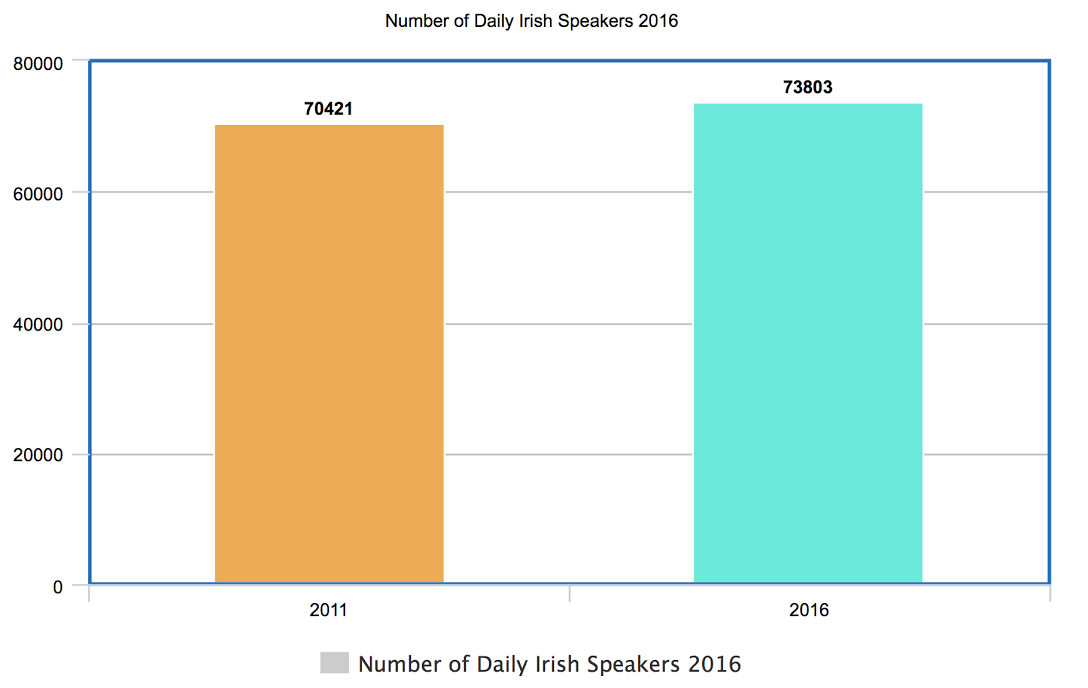
While the number of daily Irish speakers stood at 73,803, representing 1.7% of the population. This was a decline of 3,382 (4.4%) on 2011.
20.2% of the total 73,803 lived in Dublin City and suburbs. This was an increase of 674 people (4.7%) since 2011. Cork, Galway and Limerick together accounted for 6,034 daily Irish speakers (8.2%).
Outside of these cities, the largest absolute numbers of daily speakers were living in An Bun Beag-Doirí Beaga (771), followed by Letterkenny (525) and Swords (487).
Daily Irish speakers in the Gaeltacht areas of Galway County and Donegal made up almost three quarters of all daily Irish speakers in Gaeltacht areas, with 9,445 (45.9%) in Galway and 5,929 (28.8%) in Donegal.
Figures from the Irish Film Board have shown that the number of female producers involved in Irish filmmaking peaked in 2016, with 50 percent of film producing roles in 2016 undertaken by women.
This was a twenty percentage point swing from the previous year which saw just 30 percent of women involved in these production roles, while 2012 saw a mere 27 percent of films produced by females.
In the chart above we see female film producers on a par with male producers in 2016.
This increase is in line with the IFB’s Gender and Diversity Policy which intends to adopt a more inclusive breakdown of creative talent, and that ultimately a 50/50 split of gender in creative roles on and off screen is achieved.
Teresa McGrane, Deputy CEO for the Irish Film Board said, “We first noticed the divide in gender roles several years ago when we did a study regarding theatre production roles. We noticed women were few and far between in the production roles and we then carried this study over to Irish film, where we found much the same trend.
“The main problem for the first few years leading into the 2010s was that we weren’t getting applications from female producers. As a result we couldn’t make much of an impact with no applications,” Teresa said.
“So we invested in increased funding and set up a five year strategy that seeks to largely promote gender equality in film roles both on and off screen. This is largely in the form of working with production companies and funding with our public broadcast partners like RTÉ and TG4 and the BAI so that gender balance is promoted in publicly funding screen content.”
Although female film producers have greatly increased, the share of female writers and directors hasn’t changed greatly over the past few years.
Male directors and writers still greatly dominate these roles.












You must be logged in to post a comment.