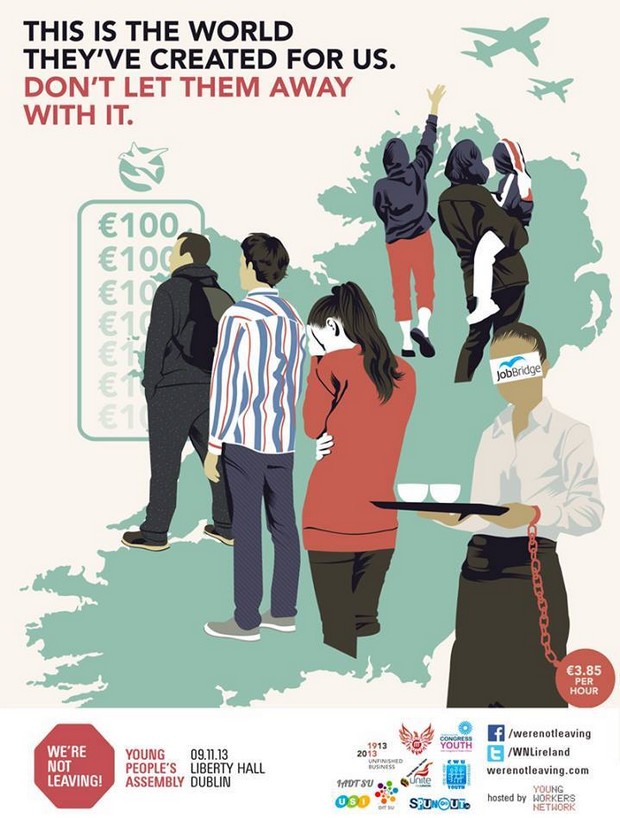
The ‘Young People’s Assembly’, organised by the We’re Not Leaving initiative and the Young Workers Network, met in Liberty Hall on Saturday to discuss the uncertain future of young people in Ireland.
The aim of the rally was to draw attention to the plight of those in this country under the age of 25, looking at the impact of fee increases and grant cuts, as well as the problems of housing, mental health and unemployment benefit.
Nearly 200 people attended the assembly, held between 11am and 5pm and accompanied by the #werenotleaving hashtag, which trended in Dublin and Ireland on Friday and Saturday as word of the event spread.
Laura McKenna of the Young Workers Network and Shane Fitzgerald from We’re Not Leaving, along with Moira Murphy, opened the debate and called for the youth of Ireland to organise and engage in an attempt to prevent what they see as a concerted attack on young people from those in power.
“Forced emigration is not a lifestyle choice, it’s a government policy” said Fitzgerald, as letters from the Department of Social Protection advising of jobs abroad were publicly destroyed.
As well as general debate, there were several helpful talks and inclusive workshops held, the pick of which concentrated on student issues and the raising of third level fees, ran by Joe O’Connor and Patrick Cole.
The topics of internships and unpaid work-experience were raised, with many of the attendees unhappy with the perceived exploitation of young workers by employers.
Stronger regulations for landlords were also a main talking point, with those present complaining of exorbitant prices and refusal of rent allowances.
It remains to be seen what impact, if any, this show of solidarity will have with those who can directly inspire the changes needed.
Every year after the dust settles and the All-Ireland has been won, the attention quickly turns to the Club game. Local pride, playing with family and friends, the parish team are all at the core of club football, but unfortunately our game’s biggest prize is flawed.
There are lots of reasons, out of the GAA’s control, that don’t allow the club model to function as well as the county one. I will look into some of the main reasons why the Andy Merrigan cup is over shadowed by Sam MaGuire.
Karl Lacey played every single game for club and county in 2012 but only played once in 2013 due to injury credit gaa.ie
1. Staggered championships
The County Championships are all staggered, depending on when your county exits the race for Sam. The Louth championship could start in early June whilst the Dublin equivalent won’t begin until late September. With no fixed start date but a fixed final date it can lead to too many games in short spaces. When Donegal won the 2012 All-Ireland their club championship was ran off in five weeks, champions St. Eunan’s played eight games in that period. ‘‘I remember going to games on Tuesday’s and Wednesday’s in the middle of November’’ said Mark Boyle of Ardra.
2. Bad Conditions
The club championships are usually played over the winter months, especially the provincial series’. By playing these games on soft pitches and in desperately cold conditions players don’t get to express themselves as they would do over the summer. Due to the conditions games are much slower and more players get injured. Leg injuries are ripe in the Provincial Club Championships.
3. External Commitments
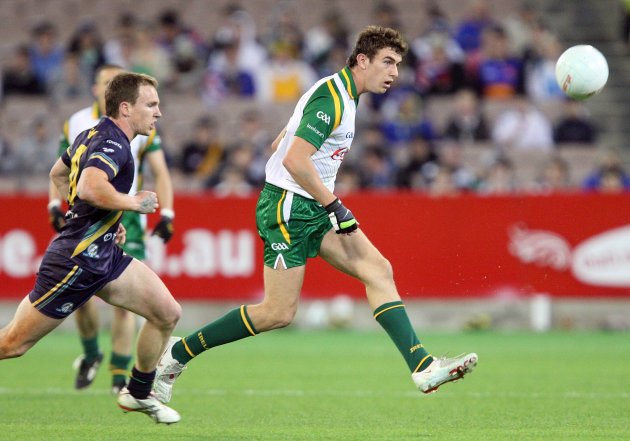
Should you be lucky enough to prevail in your county and have county players or students on your team, it is nearly a burden. County players are wrecked after a tough seven months, at least, and both the colleges and schools are just beginning their campaigns. Also, the selection to play with your province and country are problems as both the Railway cup and the Cormac McAnallen cup squads are being finalised.
The distraction of playing for your country is hurting the club game. [image: zimbio.com]4. Burnout
A professional Rugby player and/or a professional soccer player gets six weeks off at the end of a season, this time is used to recover and allow the body to relax after a tough season. The most a club player gets due to one commitment or another is, at the very most, three weeks. Training for county and clubs starts the first Tuesday in January. Harry Dawson of Skerries Harps says that he feels mentally and physically wrecked all the time ‘’I find it hard to go training and all I want to do is sleep’’.
I don’t know whether its a coincidence or a fact, but if you look at the counties and provinces winning the All-Ireland’s you’ll very quickly see that the club football in those counties is struggling and vice versa.
The All-Ireland club championship is the pinnacle of every single player’s career but due to the above reasons we are endangering of ruining our game. The GAA need to reform their fixtures and get a more coherent agenda put in place.
I have taken the first step by giving GAA president nominee Aogan Farrell a copy of this article.
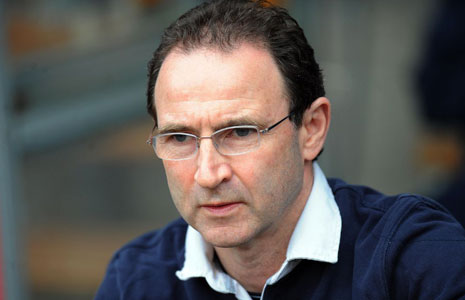
FAI chief executive John Delaney has confirmed that Martin O’Neill will be the new Republic of Ireland manager, with Roy Keane as his number two in what the Irish support hope will signal “a new era for Irish football.”
O’Neill is expected to appoint his own backroom staff with the combined package estimated to cost the FAI more than €2 million per annum.
Delaney has stated that an official press conference and unveiling will take place on Saturday 9th November.
Interestingly, it was Martin O’Neill’s decision to bring Roy Keane into the frame, with Delaney claiming that the FAI had no participation in the decision.
The new number one and two have a lot in common despite their almost 20 year age difference. Both have played for Nottingham Forest under the great Brian Clough, and both men have held the reins at Sunderland football club.
With Keane and O’Neill both having taken a brief hiatus from the game since their last jobs, the Ireland vacancy seems like a fantastic opportunity for the two Irishmen to get back into the game, albeit at an international level which neither have experience in managing.
Keane will take his first step back into the game after his spell at Ipswich Town in 2011. Credit: Figo29 on WordPress
O’Neill and Keane are a perfect balancing act – O’Neill, the affable Belfast man with his modest personality and calm temperament. Keane, with his determined and infallible attitude, renowned for his hot-headed nature and no-nonsense take on the game.
Neil Lennon stamped his approval on the appointment stating “they’re two great characters with a vast knowledge of the game, two very proud men as well. God help the players!”
On paper, this looks like a potentially successful appointment, although the danger is also there for all to see. It would have been a huge mistake to hire another foreign manager after Trapattoni’s spell, but Keane and O’Neill are widely respected and influential figures in the game. And more importantly, they’re Irish!
However, can two big characters and personalities work so closely together and generate a successful partnership to take Irish football forward, or will it be a case of one step forward and two steps back for John Delaney and the FAI?
The Irish support has already taken to social media sites such as Facebook and Twitter, in particular, to voice their opinions on the matter. The decision seems to be met with a widely mixed reaction.
Paddy Power have tweeted: “Ireland to qualify for Euro 2016 now 5/6! 3/1 to qualify for World Cup 2018. First to leave their job, 4/6 Keane v 11/10 O’Neill.”
Anne Stewart writing for thecity.ie travelled to Blarney, Co. Cork, where she met Jennifer Dowler, CEO of Irish Dogs for the Disabled.
Everyone knows dogs are man’s best friend, but some dogs are much more than that. Irish Dogs for the Disabled places trained dogs with adults and children with disabilities.
Irish Dogs for the Disabled, Blarney, Co. Cork – Image by Anne Stewart
As we pulled in, Jennifer Dowler and Fleur opened the door to us and we began to chat over tea in a large country kitchen. Fleur, an 18-month old golden retriever, is full of fun and mischievous to boot; she could easily be mistaken for a normal dog, and she is, but with special skills.
Jennifer has more than 20 years experience training dogs for the disabled. She breeds all her own bitches, stud dogs and puppies, and stresses how important it is for the dogs to be healthy and to come from a perfect blood line.
“We don’t have health problems with our dogs and we don’t touch anything unless they are in perfect health. If you have one puppy in a litter with cancer, then it will keep coming [back] in the lines. We are very strict about what we will or will not breed,” said Jennifer.
She explained it was a two-year process to make sure the dog has perfect shoulders, perfect skin, perfect temperament, everything perfect. “We spend thousands on our breeding stock and we don’t get any support from the government. We raise all the money ourselves.”
I asked Jennifer to explain how a new-born puppy becomes an assistance dog. “From 0-12 weeks is the most critical time in a pup’s life and from birth we start socialising them, de-sensitising them and handling them.
“When the pups are 8 or 9 weeks old, we place them with volunteer families for about 18 months and they rear the dog and continue with the socialisation process. The dogs then come back to Irish Dogs for the Disabled, where they are assessed on their personality type and matched up with a person on our waiting list.”
Jennifer Dowler, CEO of Irish Dogs for the Disabled with Fleur, an 18-month old golden retriever with special skills – Image by Anne Stewart
Fleur is the next dog out – she is going to Luke, an 8-year old boy with profound cerebral palsy; Fleur and Luke have already met and according to Luke’s mother, “Fleur is cheeky, playful, bright and loveable, and you could just as easily be describing Luke”.
“Fleur has been clicker-trained to engage with Luke’s physiotherapy”, said Jennifer. “We train her to touch him in different parts of his body and then he has to move that part of his body. Fleur will crawl and roll over and this will encourage Luke to imitate her and crawl alongside her.”
Fleur is into playing and she is loving and gentle. She will curl right into Luke, as he can’t curl into her or hug her. Each dog has their own strengths and weaknesses.
“The final step is to train Luke to interact with Fleur and to encourage him to practise physiotherapy himself in a practical and fun way. If you ask a child to do something, they are more likely to do it with a dog, as it is often painful, uncomfortable and stressful”, said Jennifer.
Dogs for the Disabled is accredited by Assistance Dogs International. Golden retrievers are best for children and more work-orientated dogs, such as labradors, for adults. Labradoodles are ideal for children with a tracheostomy, as they don’t shed hair.
Jennifer places 85% of her assistance dogs with children aged 6-12 years old. She trains 20 dogs every year at a cost of €15,000 per dog. There is a 5-year waiting list for these dogs.
Dogs trained for adults are taught to push alarm buttons, open doors, send for help, retrieve a phone and fetch a blanket. Physical disabilities include spina bifida, cerebral palsy, duchenne and muscular dystrophy.
Cannabis has many functional uses besides the most popular form, which is smoking. Image by: mafiosoch
American comedian and commentator, Will Rogers, once said of alcohol prohibition in the US that “prohibition is better than no alcohol at all”.
Although Rogers made his quip as a means of generating humour, he made a very valid point on the purpose of prohibition. It just doesn’t work.
Alcohol prohibition in the US did not prevent people from drinking alcohol, it just made the process more convoluted. It also made spirits – a form of alcohol that was very rarely acquired prior to prohibition – one of the highest forms of consumed alcohol due to its easy ability to hide and smuggle vast quantities.
Prior to the 20 US states and the District of Columbia passing laws allowing some degree of medical use of marijuana, and 14 states decriminalizing it to some degree, similar events surrounded the prohibition of cannabis.
It was still being used heavily throughout the US. And it was wasting precious police time, removing the man hours from being able to focus on more deadly drugs and/or crimes.
“I don’t smoke weed”, explained Kelley Duffy, a South Dublin mother, “but I know that if I wanted to get my hands on it it could in less than 30 minutes. An hour at max.”
Mark, a cannabis user, claims, “Sure it might as well be legal, because its not like people can’t get it as it is.”
He continued to explain. “People who want to smoke it are smoking it. Just because you can’t doesn’t mean it will stop people.
“Look at alcohol – people under 18 still get their hands on it and still drink. If people want to do it they will do it. Look at the massive increase in heroin use in Ireland. Surely tackling that is more important than some bits of plant.”
Forbes Magazine calculated that a 15% tax on the estimated 600,000 Coloradans cannabis smokers will generate over $130 million in revenue for the state of Colorado.
TD Luke ‘Ming’ Flanagan, who was the man who has put the decriminalization bill to the Dail, estimated that cannabis could raise €300 million in revenue for the country.
Flanagan’s estimate may be on the optimistic side of the tax scale, but even a tax figure closer to the estimate given by Forbes would be of great benefit to a struggling Irish economy.However Fanagan was correct in saying that cannabis decriminalisation would “free up” garda resources.
“Even if it is not legal to smoke it, it should be legal for medicinal use”, stated Donna, whose mother suffers from severe arthritis.
“I use it for recreational use, but my mother takes a very small amount before bed and it helps her to no end.
“It relieves her pain, allows her to get to sleep. She doesn’t need to take three of her pills, that really don’t agree with her. It works wonders for her and I think that it is a disgrace that people who need it can’t.”
The bill will be either passed or rejected by the Dail on the 6th of November. The decision of the bill will have great consequences for hundreds of thousands of Irish citizens – many would argue positive, while some will still argue negative.
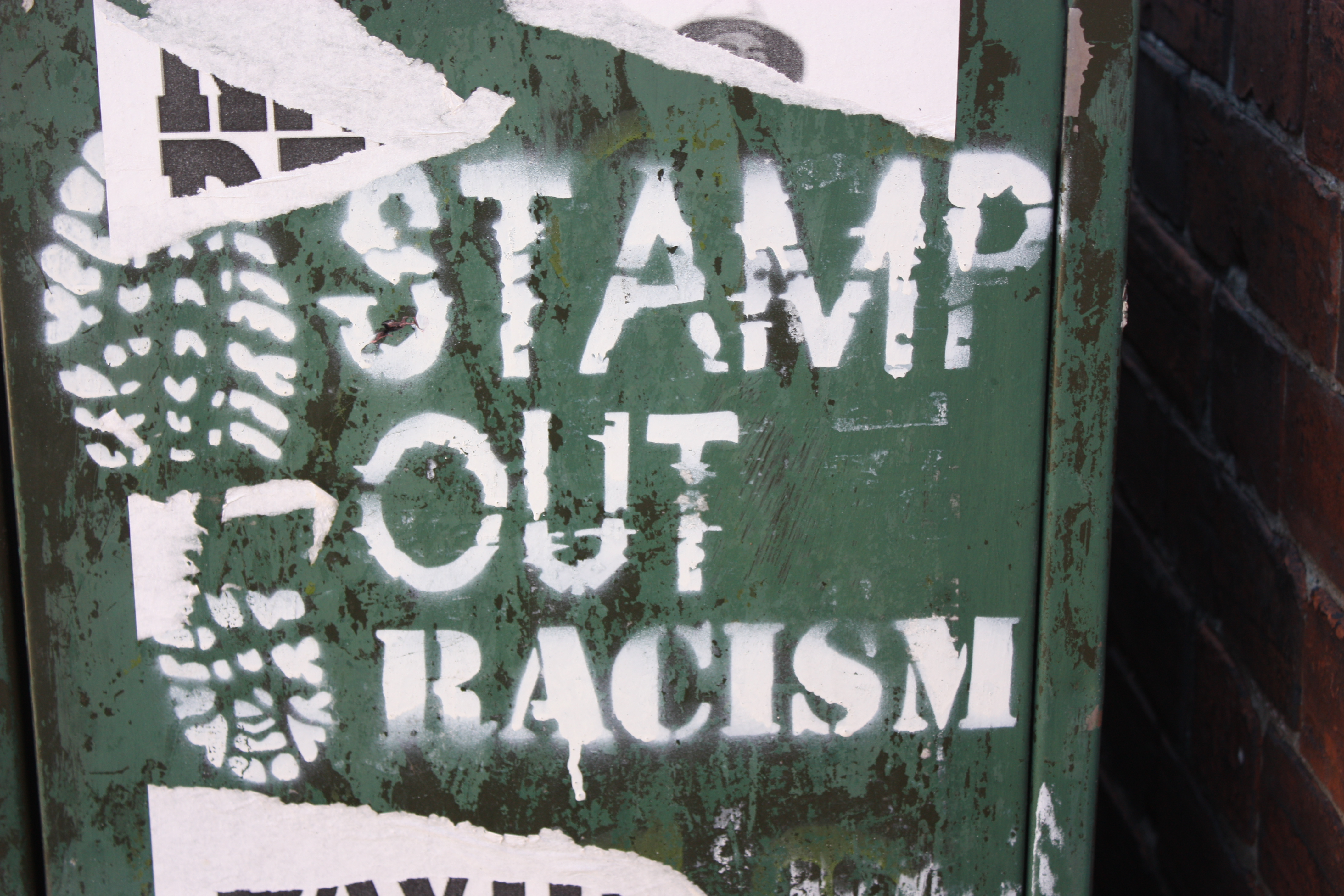
Racism seems to be an ongoing, unreported, issue due to the influx of foreign nationals over the past decade. Image by: Machine Made
According to a recent report racism is rampant in Ireland, with very few cases going reported.
The report was conducted by Dr Patricia Kennedy, of the School of Applied Social Science in UCD, and states that 60 percent of foreign people in this country have encountered racism.
An Garda Síochána Press & Public Relations Officer, Duty Sergeant Damian Hogan stressed that “All matters relating to racism should be reported to An Garda Síochána”.
He also noted that An Garda Síochána has a designated unit for dealing with racism at their Racial and Intercultural Office, which is located on Harcourt Street.
The Racial and Intercultural Office is deemed to be responsible within An Garda Síochána for the development and monitoring of the implementation of organisational policies and strategies, which deal with racial, ethnic, religious and cultural diversity.
The office received a thirty thousand Euros innovation prize by the European Commission in recognition of work already undertaken by the Garda organisation in raising awareness around racism and related issues.
“I have been abused cycling through the city centre,” said Donatas Okafor, a Nigerian national, who came to Ireland in 2006.
“I have had people drive by making monkey chants and stuff,” explained Donatas.
When asked if he any of these incidents were ever reported Donatas replied; “No. I don’t have the time to be going through the effort of dealing with reports. I just get on with life”.
Donatas did have some positive experiences to share about his time in Ireland: “I have lived in many countries over the years; England, Thailand, China, South Africa and Ireland is definitely the nicest of them to live in. There has been some isolated incidents but overall I would say Ireland is the least racist country I have lived in”.
It seems that people of colour may encounter racism more than other foreign nationals. Hungarian national Katalin Takacs said, “I have never been racially abused but I have seen Luas staff abused over the colour of their skin and being told ‘go back to your country”.
Katalin, who has lived in Ireland for the past 7 years, explained further, “I think people are angry over the economy and that state of the country and black people just seem to be an easy target for these people. It’s sad”.
Paul Zhang and Anna Slugacz, who have been in Ireland for the past eleven and 7 years respectively, have never encountered racist events.
“No one has ever been racist to me, or any of my friends thankfully,” said Anna. “I really like working in Ireland and at times you think that maybe some people think bad things about you, but no one has ever actually said anything”.
Paul found some humour in an otherwise serious issue saying, “Ireland loves Chinese food, so that might be why me and my friends haven’t been abused. Thanks to our food”.
Cannabis has many functional uses besides the most popular form, which is smoking. Image by: mafiosoch
Luke ‘Ming’ Flanagan – TD for Roscommon/South Leitrim – has put forward a private members bill in the Dáil for the decriminalisation of cannabis – similar to the line that many U.S states have taken in recent months.
I took to the streets of Dublin to find out what the general public view on the bill was, and whether they wished to see the law on cannabis amended.
Held on the 27th of October in the stunningly beautiful location of Glendalough House, County Wicklow, Samhain festival was the hot ticket of this year’s celestial season.
Aerial dancers entranced the crowds
In association with Life festival, Bodytonic and others, this was the first year the “one night fancy dress musical feast” has been staged, but if the preternaturally positive atmosphere on the night was anything to go by it won’t be the last.
There was an eclectic mix of innovative costumes
Featuring over 20 acts across four stages and set against the breath-taking backdrop of the 1,500 acre estate of Glendalough house, this festival, which also happily happened to be BYOB, was definitely a more spiritual experience than a school disco.
The night featured performances by the likes of Frank B and Marcel Dettman
Efficiently organised and smoothly ran, Samhain was nothing short of a massive success. Acts such as Todd Terje and Nina Kraviz almost managed to upstage the venue. However some of the most interesting sights to behold that night were the revelers themselves. Luckily TheCity was on hand capture images of all three.
The Web Summit officially opened today bright and early at 9am with found Paddy Cosgrave taking to the main stage.
The day was split up between numerous stages in the RDS with some of the biggest names in tech talking about the industry, innovation and moving forward.
Big names of the day included Kevin Rose of Google Ventures alongside Tony Hawk, known primarily as a professional skateboarder.
Gary Vaynerchukgave an empowered and passionate rant about the industry and how he wants change in the way business is done, citing how he works harder and smarter than most people out there.
Father of the Internet, Prof. Kleinrock gave a discussion on “A Brief History of the Internet and Its Dynamic Future”, opening the floor to questions which he answered openly and honestly when discussing controversial topics such as drones.
“Drones are a technological wonder, they’re also a nightmare… It’s in the eye of the beholder” he said, whilst pointing out that innovators were never expected to think about the implications of what they were creating.
The halls were full of companies advertising their wares, showcasing new apps and mediums of social interaction as well as bizarre utilities such as machines for collecting analytical data on bees.
Many companies brought along gimmicks to attract an audience in the form of video games, and oxygen bars, with many going the extra stretch to give out as much free merchandise as possible, all in the name of exchanging business cards.
The Web Summit is expanding into The Summit in coming years with more events going on around it consisting of the Food Summit which took place in the adjacent Herbert Park, served up by Good Food Ireland, as well as the Night Summit which is providing entertainment throughout the evening for the 10’000 attendees whilst promoting some of the best bands in Ireland.
Gary Vaynerchuk talks no bullshit policies with regards to consumers
Making Music on the Main Stage
Alphaville, the village of start up companies
The Web Summit Main Stage
Spark of Genius judges
Companies pitching their ideas to investors
Ringing the Nasdaq bell
Paddy Cosgrave at the ringing of the Nasdaq bell
Sams Barbers shaving people ahead of Movember at the Websummit
Talks started early just before 9am
Tony Hawk and Kevin Rose discuss the Hawk Foundation
“An amateur game played at a professional level” was how Colm Begley described Gaelic football this week.
“The gap has been closed” between GAA and AFL in recent seasons stated the former Brisbane Lions Rookie of the Year, speaking ahead of last weekends second International Rules test.
Echoing Ireland captain Michael Murphy’s comments last week, Begley believes that the only real difference between football and professional sport is that while GAA players are “focused on work or college, anything like that”, professionals can concentrate on rest and recovery.
The 2011 Laois senior captain also warned that if the GAA don’t address the problem of burnout in their players, the recent upward trend in physical preparation will result in long-term damage to the game.
“If they don’t look at it in the next few years, they’ll see a lot of players retiring at a younger age. Players love playing, but it’s just a massive, massive effort, and very mentally draining for those who don’t get a break”.
Begley, who in addition to Ireland and Laois will also represent DCU and Dublin club Parnells this year, pointed to a recent change in AFL preseason training where players will only be allowed train three days a week to prevent burnout as”something the GAA will maybe have to look into”.
The rise in strength and fitness levels has aided Ireland in the International Rules series however, Colm pointing to the fact that “we’re not being physically out-matched”, players endurance and speed levels on par with their professional opponents.
This increase in training has led to a more competitive domestic game as well; “In the past, the top six or seven teams in Ireland would be fitter or stronger, whereas now teams are realising if we cant match them skillfully, we’ll try and surpass them in training, in strength or endurance. We’ll outrun them, out-tackle them. If you can control a players playing ability, skills etc, you can control how fit or strong they are”.
“Whatever people say, it is professional”, continues Begley, “The game is getting faster and faster, all the small details are being looked at; Body Mass Index, GPS, stats, all the things that really, in an amateur game, you wouldn’t have to look at, but it’s not amateur anymore, it’s run in a professional way”.
While he stops short of calling for professionalism in GAA, Begley does admit he would like to see some rewards for inter-county players. “I’m not sure how they’re going to do it, even its just some form of tax benefit or even expenses being increased a little more. Players don’t want alot, just a bit of a benefit for the effort they put in during the year”.
Colm Begley ahead of Saturday’s second test match [image: INPHQ: Dan Sheridan]After being nominated for man-of-the-match in the first test match, the Laois man is convinced that the indigenous Australian side will improve in Saturday’s up-coming second round. “They learn very fast. I think they’ll carry the ball, work it into the danger zone and try work off the breaks. I also expect a bit more physicality from them as well”.
Ireland carry a 57-35 lead into the second test, to be played in Croke Park at 7PM on Saturday.


![The distraction of playing for your country is hurting the club game. [image: zimbio.com]](https://i0.wp.com/thecity.ie/wp-content/uploads/2013/10/tommywalshaustraliavirelandinternationalc4v4d7ub7ksx.jpg?ssl=1)








You must be logged in to post a comment.