Tag: Protest

  • Whatever happened to Occupy Dame Street?

    Whatever happened to Occupy Dame Street?

    This slideshow requires JavaScript.

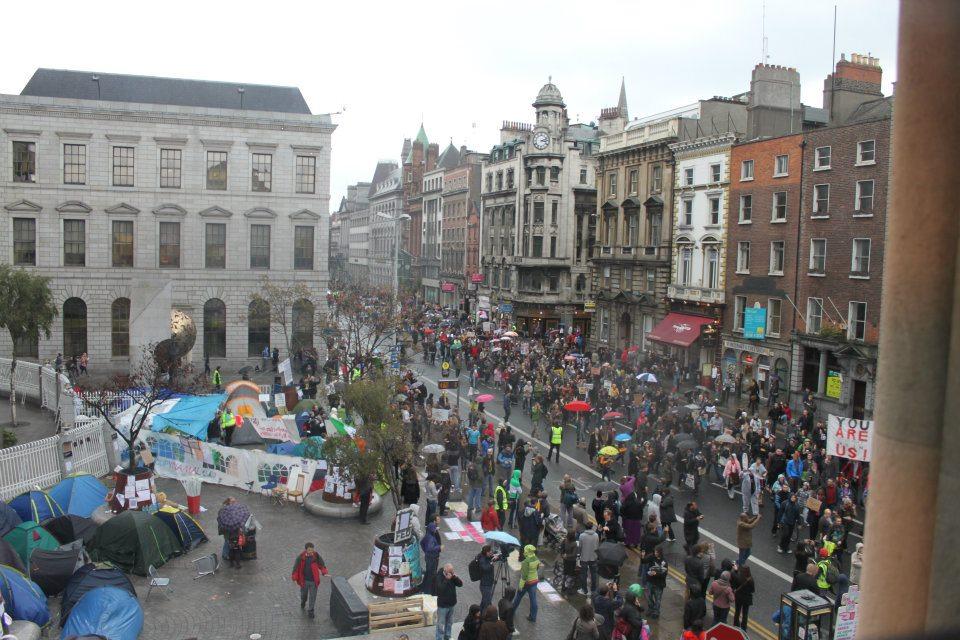
    Last Saturday saw, according to whoever’s statistics one chooses to believe, 30,000, 100,000 or even 150,000 protesters marching through Dublin.  But what became of the people we were all talking about three years ago: the Occupy Dame Street Movement?

    The short answer is that, like Monty Python’s legendary parrot, it is dead and deceased.  It is no more.  The only visible surviving remnant is the group’s original Facebook page, still active, but according to the original members, long-since hijacked by outsiders.  The vast majority people who marched on Saturday did so of their own volition; others were part of larger protest groups and organisations.

    Rob Dunlop was one of those original members of Occupy Dame Street and was one of the first to arrive at the steps of the Central Bank.  He had protested a week or so earlier outside the Dáil on the night of the now infamous signing of the bank bailout and was excited to hear of the planned Occupy protest.  “I took myself and my sleeping-bag down there straight away” he says. “I was really concerned about how the economy and society in general were going and did not want to have it on my conscience for the rest of my life that I stood idly by and did nothing.

    “At first there was a good atmosphere.  People were on our side, and that included the gardaí, who would stand around chatting to us.  Anyone was free to come along; the only rules we had were no drugs, no alcohol and no politically affiliated parties.  Unfortunately this meant that we had no way of keeping certain flaky elements out, and it was they who were mostly responsible for eventually turning public opinion against us.”

    The protest came to an end when the gardaí eventually moved in to clear the camp in February 2012, concerned as they were that conflict might arise as the forthcoming Patrick’s Day parade, with its inevitable component of alcohol, passed right by it.

    The protesters were offered the option at the time of moving out for the duration of the parade and returning after, but many were suspicious and refused, believing that once out they would be stopped from coming back.  Rob believes that they should have accepted the offer.

    Another core member at the time was Darragh Kenny.

    “When I heard I went straight down, full of enthusiasm, and ended up camping for two months” he says.  “Within a few days I had somehow become treasurer.  Someone had to do it because we were getting a lot of donations at the time.  The problem was that there was no structure for appointing the right person to the right job; people just volunteered.  I was probably the worst person to be treasurer, I knew nothing about it but did my best.  There was a lot of that sort of thing going on.”

    Would the movement have survived had its members agreed to absent themselves over Patrick’s day and return after?  Darragh thinks not: “To be honest it [the protest] was on life-support by Christmas anyway.”

    Helena Sheehan, a respected academic and a professor emerita at DCU, was instrumental in the original setting up of the protest.

    In November 2011 Occupy Wall Street was making headlines around the world and she tweeted “#OccupyIFSC. Up for it?”  The result was a flurry of communications via Facebook and Twitter and on October 8th a group of people came together on the steps of the Central Bank.

    A veteran of anti-Vietnam war protests in Washington exactly 40 years previously, Helena deemed it “inappropriate at my age” to camp out and instead slept in her own bed.  Nonetheless she says “I look back on that day with fondness, because the atmosphere was so fresh and open, because all voices were equal, because there was such hope in the air.”

    So why did the hope eventually die?

    Helena advocated political inclusion rather than exclusion right from the start, believing that the way forward was to unite and work with all parties with a similar mandate; however, the general consensus was that ‘this is our movement, it stays our movement and others can leave their own politics at the door if they wish to enter’.  Many did turn up at the door, and many were turned away. The result was much bickering and bad feeling, leading to groups which really should have been pulling together pulling in opposite directions instead.  From here the movement went into an irreversible decline.

    Helena attempted an initiative on a different front.  She set up “Occupy University”, an academic forum intended to encourage structured debate on the issues of the day.  Sadly this is now also defunct.

    Despite this she remains positive.  “The movement may have ceased to exist but nonetheless it had an effect.  It provoked debate and raised an awareness of social issues.  Its members might have all gone their separate ways, but many are still politically active in their chosen spheres and many of those cut their teeth on the Occupy movement.”

    And the current Occupy Dame Street page on Facebook?

    “They do not represent us.  They do not like us and we do not like them.  They do not believe in dialogue; they are mostly concerned with antagonism and getting themselves arrested for the publicity it brings.  If they cannot get arrested they are not happy.”

    Strong words, but words which might go some way towards explaining why no-one from that group, despite repeated requests, came forward to be interviewed for this article.

  • Thousands protest water charges

    Thousands protest water charges

    This protester had a message for Joan Brution
    This protester had a message for Joan Brution

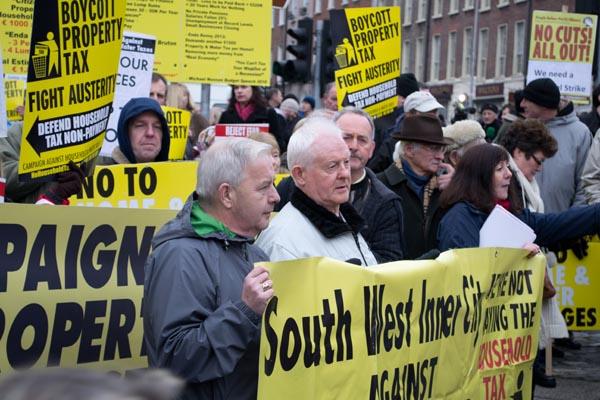
    The sheer scale of yesterday’s water protest march in Dublin yesterday appeared to take both the organisers and the Gardaí by surprise.

    The march was originally planned to start at Parnell Square at 2 pm and proceed down O’Connell Street, but by 1.30 pm the square was already full and newly arrived protesters were diverted around the Rotunda Hospital to form up. Eventually the queue stretched back as far as Dorset Street.

    From O’Connell Street the intended route was across the river and down D’Olier Street before doubling back down Westmoreland Street to assemble at the GPO. In the event the Gardaí realised that the crowd was too large and that the head of the procession would collide with the middle going in the opposite direction. Barriers were opened at College Green and the march was allowed to proceed unplanned past Leinster House and on round Stephen’s Green. From here it carried on to Aungier Street, down George’s Street, and rejoined the original route back at College Green.

    By the time the tail of the march had left Dorset Street the head was already at Leinster House.

    Water march
    Planned route in green; route on the day in red

    The result was that traffic was brought to a standstill on both sides of the city, and many drivers found themselves immobilised as the marchers swept past. Despite this the atmosphere remained good, with many of these same motorists sounding their horns in support.

    As always, it is impossible to accurately gauge the number of protesters. RTE last night quoted a Garda source at 30,000; other estimates are much higher, with many in excess of 100,000. Certainly from the ground a figure of 30,000 would appear impossibly low. Many of the protesters were critical of media coverage of the Irish Water issue, with RTE being singled out for alleged bias more than most.

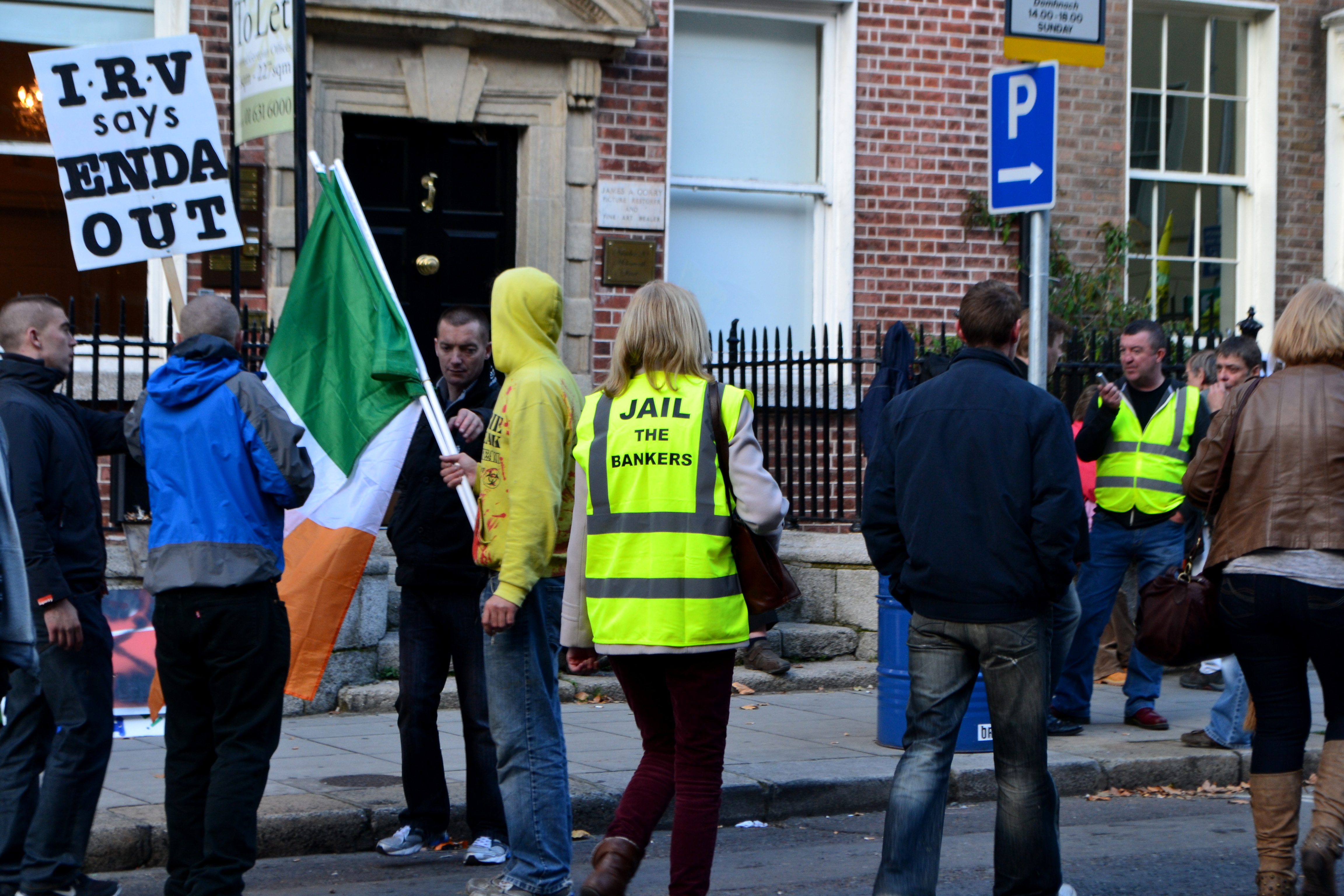
    Much was made, by both the protesters themselves and the speakers back at the GPO, of Joan Burton’s recent comment about protesters owning expensive iphones. One placard read “Who pays for your smartphone Joan? We do”, people defiantly waved their camera phones in the air at every opportunity. Richard Boyd-Barrett urged everyone to take selfies and email them to the Tánaiste.

    Audrey Clancey, of the Edenmore Says No campaign, thanked Irish Water in a backhanded way by congratulating them on doing what no-one had managed to do before: to finally unite the people of Ireland in saying that “enough is enough”. This drew a large cheer.

    Independent TD Clare Daly declared that “today is an historic day when things will finally change”, and Richard Boyd-Barrett urged everyone present to keep the momentum going by supporting the next stage of the campaign: a day of nationwide protest in all towns and villages on November 1st.

    This slideshow requires JavaScript.

  • Irish Students Unite in Pre-Budget Rally

    Irish Students Unite in Pre-Budget Rally


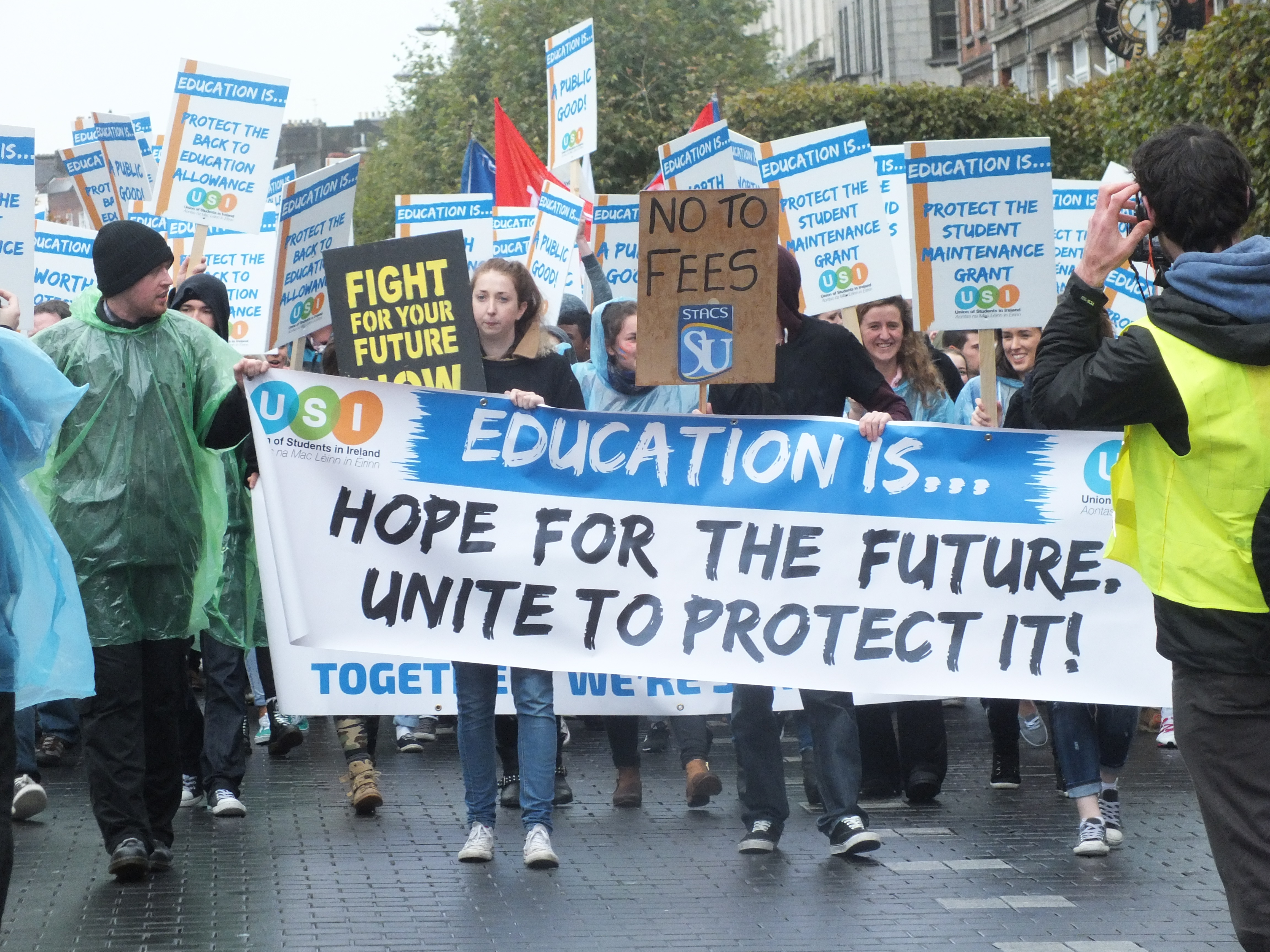
    Third level students from all over Ireland took to the streets of Dublin yesterday for the USI March for Education.

    The protest commenced at the Garden of Remembrance and the students marched to the Dáil in torrential rain, calling on the Government to protect essential student services in next month’s budget.

    Speaking at yesterday’s rally, NCI student Rebecca Caulfield (20) said, “If we didn’t protest and costs go up in the budget, it’s going to hold a lot of people back and less people are going to go on to third level education.”

    USI president Laura Harmon said that the main goal of the rally was to protect the existing State financial support services for third level students:

    “The main thing we hope to achieve is to highlight the fact that student supports need to be protected in Budget 2015.  The student maintenance grant and the Back to Education Allowance must be protected.”

    According to DIT Student Union President Fiachrá Duffy the march was the beginning of the USI’s #EducationIs campaign which aims to show the Government that education is a very positive thing for our society.

    “It is to get people behind us”, said Mr Duffy, “It isn’t just students; it is everyone coming together to say that education is positive and it should be made more accessible and more affordable for as many as possible.”

    Mr Duffy also added that around 45% of students studying in DIT are on some sort of State financial support.

    “It is essential that we call for those financial supports to be protected for our students” he said.

    Despite the weather it was estimated that 1,500 students from throughout the country took part in yesterday’s rally, and were joined by lecturers and trade unions.

    This was a low turnout compared to previous national scale protests in 2010 and 2011, in which around 40,000 students took part. However Fiachrá Duffy said that numbers weren’t an issue.

    “I think it was important that there were people there,” said the DITSU President.

    “It was to show that students from all over Ireland are united on the same issue, and I think that it is a representation that we are all calling for the same thing,” he added.

    This slideshow requires JavaScript.


  • Budget Day met with lacklustre protest

    Budget Day met with lacklustre protest

    By Greg Synnott, Michael Coleman and Saoirse Ivory

    A series of tax adjustments and cuts were announced by Minister Michael Noonan in yesterday’s budget. The City were outside government buildings when the announcement was made.

    The €2.5 billion plan included €900 million in additional revenue and €1.6 billion in cuts.

    Some of the measures announced by Minister Noonan and Minister Brendan Howlin include:

    • A reduction in jobseekers allowance to €100 per week for under 25s
    • An increase to the price of beers, spirits and cigarettes of 10 cent, and an increase to the price of wine of 50 cent
    • Funding to third level institutions will be cut by €25 million
    • The abolishment of the phone allowance for pensioners
    • The banking sector will now pay €150 million to the  exchequer annually
    • Free GP care will be provided for all children under five
    • Additional jobs will be added in hospitals, schools and An Garda Síochána starting next year, but overall pay will be reduced by €500 million
    • Prescription charges on individual items is to increase to €2.50
    • Tax relief for single parents (who could previously both claim the credit) will be changed to a Single Person Child Carer credit, which only the primary carer will claim
    • A new unified DIRT rate of 42% was introduced
    • Tax relief for medical insurance will be capped at €500 for children and €1000 for adults

    Minister Noonan concluded his speech by saying that Ireland is still facing some tough times, but is on the road to recovery.

    Meanwhile, outside the Dáil, a surprisingly small number of protesters turned out despite an enormous Garda presence.

    Many protesters, who felt the government were targeting the weakest in society, were disappointed by the turnout.

    Protester Pamela Hackett gives her view on the Budget
    Protester Pamela Hackett gives her view on the Budget

    “I’m very disappointed,” said Pamela Hackett, “I thought there’d be a load of people out here.”

    Photos: Michael Coleman

    Video and Editing: Greg Synnott

    Report: Saoirse Ivory

  • Hungarian Students Strip in Protest of New Dress Code

    Hungarian Students Strip in Protest of New Dress Code

    A class of Hungarian undergraduate art students and their professor have stripped down to their underwear in protest against new university dress code rules.

    The president of Kaposvar University, Ferenc Szavai, issued a letter to students featuring strict new uniform rules to be enforced on every student of the university.

    Female students have been forbidden from “blatant use” of accessories, excessive make up, over powering perfume, and short skirts.

    Instead, they are to opt for a blouse and jacket, with a long skirt or trousers.

    Male students are encouraged to dress in a dark suit, and to avoid dressing in shorts or flip-flops.

    Unkempt hair and fingernails are banned for both sexes.

    The students first voiced their dismay on October 1st,  but students have been donning beach towels and flip-flops to class as recently as this week.

    Two female students during their protest against harsh uniform rules
    Two female students during their protest against harsh uniform rules. Image via YouTube

    The students have documented their process in YouTube videos and posting images to social media.

    Despite the students’ protests, many other universities from around the globe have long established, and strict, dress codes for their students.

    These protests come at a time when Hungary is battling the authoritarian style rule of its current Prime Minister, Viktor Orbán, a figure who has been likened to Venezuela’s Hugo Chavez and Russia’s Vladimir Putin.

    Hungarian Prime Minister Viktor Orbán
    Hungarian Prime Minister Viktor Orbán

    Since his election, Orbán has dominated every aspect of public and private life.

    Orbán has made several controversial decisions throughout his time in office; he has ended press freedom, outlawed homelessness, and abolished an independent fiscal council whose purpose was to scrutinise budgets.

    Last month, protests against the Prime Minister power reached a new extreme when a group of individuals staged a hunger strike outside Orbán’s residence.

    On another occasion, a riot culminated in the toppling of a statue depicting his likeness.

  • ‘Some Cuts Never Heal’

    ‘Some Cuts Never Heal’

    By Gillian Stedman

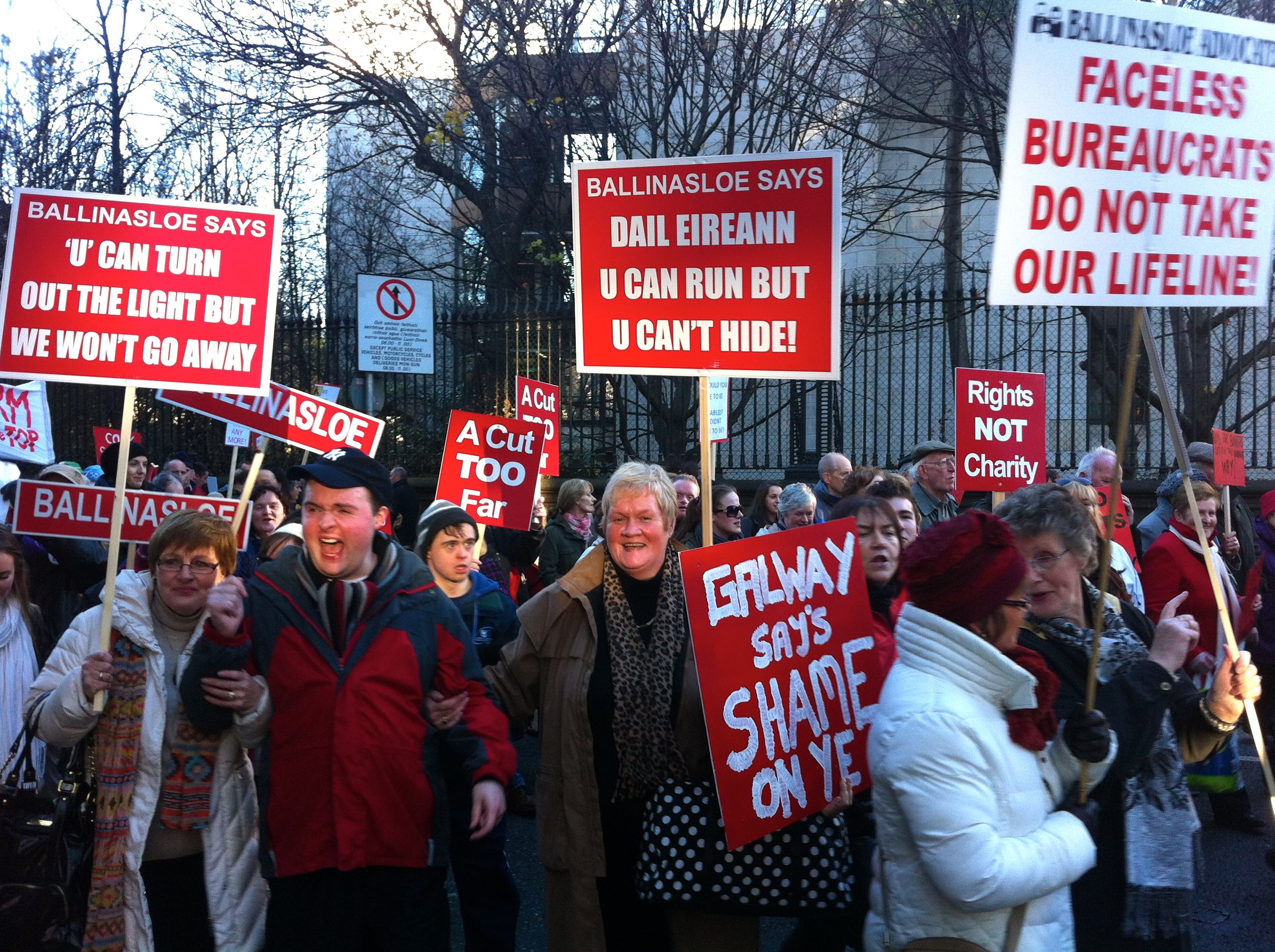
    Last Wednesday thousands took to the streets of Dublin to protest proposed cuts to disability payments. The crowds marched to Leinster House where they chanted in unison “No ifs, no buts, no disability cuts.”

    The march was held to urge the Government to fully implement the promises made in the 2011 Programme for Government. The programme published in March 2011 contained the Government’s key promises to people with disabilities including, “tackling Ireland’s economic crisis in a way that is fair, balanced, and which recognises the need for social solidarity”.

    Other promises included the maintenance of social welfare rates and the introduction of independent inspection of disability services.

    The protest was organised by the Disability Rights Coalition Ireland (DRCI).  Speaking to the crowds on Wednesday, DRCI spokeswoman Suzy Byrne said, “We should not be relying on rattling buckets to provide us with our human rights.”  Protestors who attended on the day were asked by the DRC not to bring political banners in order to make the protest as inclusive as possible.

  • Dublin’s streets packed for march against austerity

    Dublin’s streets packed for march against austerity

    This slideshow requires JavaScript.

    Saturday’s anti-austerity march brought thousands out on the streets of Dublin City.

    The march, organised by the Dublin Council of Trade Unions, saw people from all corners of the country come to capital to demonstrate against austerity measures and taxes.

    Gathering at Parnell Square, live traditional Irish music – well known songs like the ‘Rare Old Times’ and ‘Dirty Old Town’ –  kept participants entertained while waiting patiently in the cold for the demonstration to take off.

    When the time came, approximately 10,000 strong left from the Garden Remembrance, with chants and banners at the ready.

    Despite the colds, spirits were high and all aspects of society marched side by side – the young, old, students, unemployed and employed alike.
    [youtube.com=http://www.youtube.com/watch?v=akQJwaG6OLc]

    Accompanying the marchers was a wide range of lively music and dramatics – including marching bands, singers, costumed performers and creative floats.
    Led by a deathly cloaked figure on a horse – demonstrators left from Parnell Square, making their way down O’ Connell Street and across College Green, before proceeding back across the O’ Connell Street bridge for a special assembly in front of the GPO.

    So many turned out for the event that tail end of the march had barely left Parnell Square while those way ahead in the lead were almost at the end point.

    This made for a parallel meeting of marchers travelling across both directions of the O’ Connell Street bridge. Here, the sound of uilleann pipes mixed with enthusiastic shouts and a lively sing along of Bob Marley’s ‘Stand Up For Your Rights’.

    Meanwhile, unified chants of “You cut, we bleed” bellowed across the Liffey. These chants echoed the general theme and feeling of the march – many hurt and worried by budget cuts and taxes to come.

    But whether marcher’s cries were heard all the way over in the offices of Kildare Street remains to be seen.

    By Liam Keegan & Aidan Knowles

  • Student Teachers and NQT’s stage Leinster House protest

    Student Teachers and NQT’s stage Leinster House protest

    Student Teachers protest Education Cuts

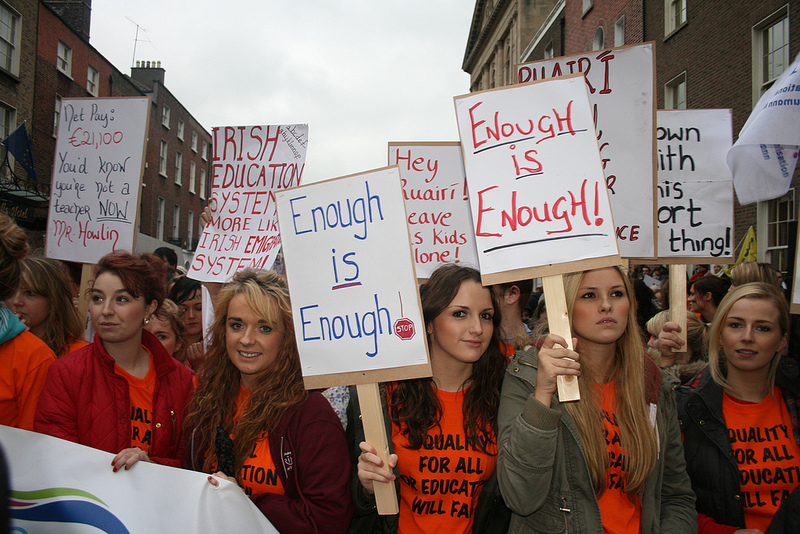
    Student Teachers want their say- equal work for equal pay” was the battle cry of an estimated 2,000 trainee teachers and Newly Qualified Teachers (NQT’s)

    Student teacher’s NQT’s and their colleagues marched in solidarity from O Connell Street to the gates of Leinster House in protest against education cuts and Separate Salary Scales for NQT’s.

    Ann Fay president of the Irish National Teachers Organisation (INTO) was MC for the event. She began the rally by urging the crowd to do what they do best and “Educate the Government-Education Cuts do not heal.”

    Several high profile speakers were in attendance including Gerry Breslin president of the Association of Secondary Teachers in Ireland (ASTI) and Gerry Craughwell president of the Teacher’s Union of Ireland (TUI). They led the crowd in heartfelt, poignant and passionate speeches praising the ongoing work of Student Teachers and NQT’s and lambasting the Irish Government for its decision to cut education budgets.

    Breslin labelled Education Minister Ruairí Quinn the “Minister for Shrinking Resources”  and warned that it will be the vulnerable children who suffer as a result of education cutbacks.

    Schools lose teachers, classes are amalgamated and classes become bigger. Schools have dropped subjects like Physics, Chemistry, Economics and Languages- Students need these subjects, they need them to compete in the foreign markets and to get a good job.

    He also made the point that permanent teaching jobs are relatively nonexistent and hundreds of young NQT’s are forced to emigrate overseas to secure a stable job position.

    TUI President Gerry Craughwell

    TUI president Gerry Craughwell began his speech by acknowledging the various placards held by the protesting students. Craughwell then wished to remind Minister Quinn that his party (Labour) was founded on the backs of Workers and Trade Unionists in this country.

    The Minister well knows that the basic principle of Trade Unionism is Equal Pay for Equal Work. This principle has been abandoned in our republic, we now have colleagues working side by side on different pay scales- the minister must stand up for the basic principles his party was founded on – Equal Pay for Equal Work.

    Each impassioned speech was met with cheers of approval from the crowd. Ann Fay of the INTO closed the rally with the words

    And finally please please do not litter the place with your posters- you’re going to need them again, bring them home. Go raibh maith agat agus Slán Abhaile.”

    A section of the estimated 2,000 strong crowd

    Click on the following link to listen to snippets of audio and speeches from the protest: protest-against-education-cuts