Tag: dublin

  • Fears for jobs in Tallaght as retail sales decline 

    Fears for jobs in Tallaght as retail sales decline 

    Cuts to staff hours and lower sales reflect the reality of the retail market in the Square Tallaght, Dublin, post-festive season. 

    By Samuel Adeleke 

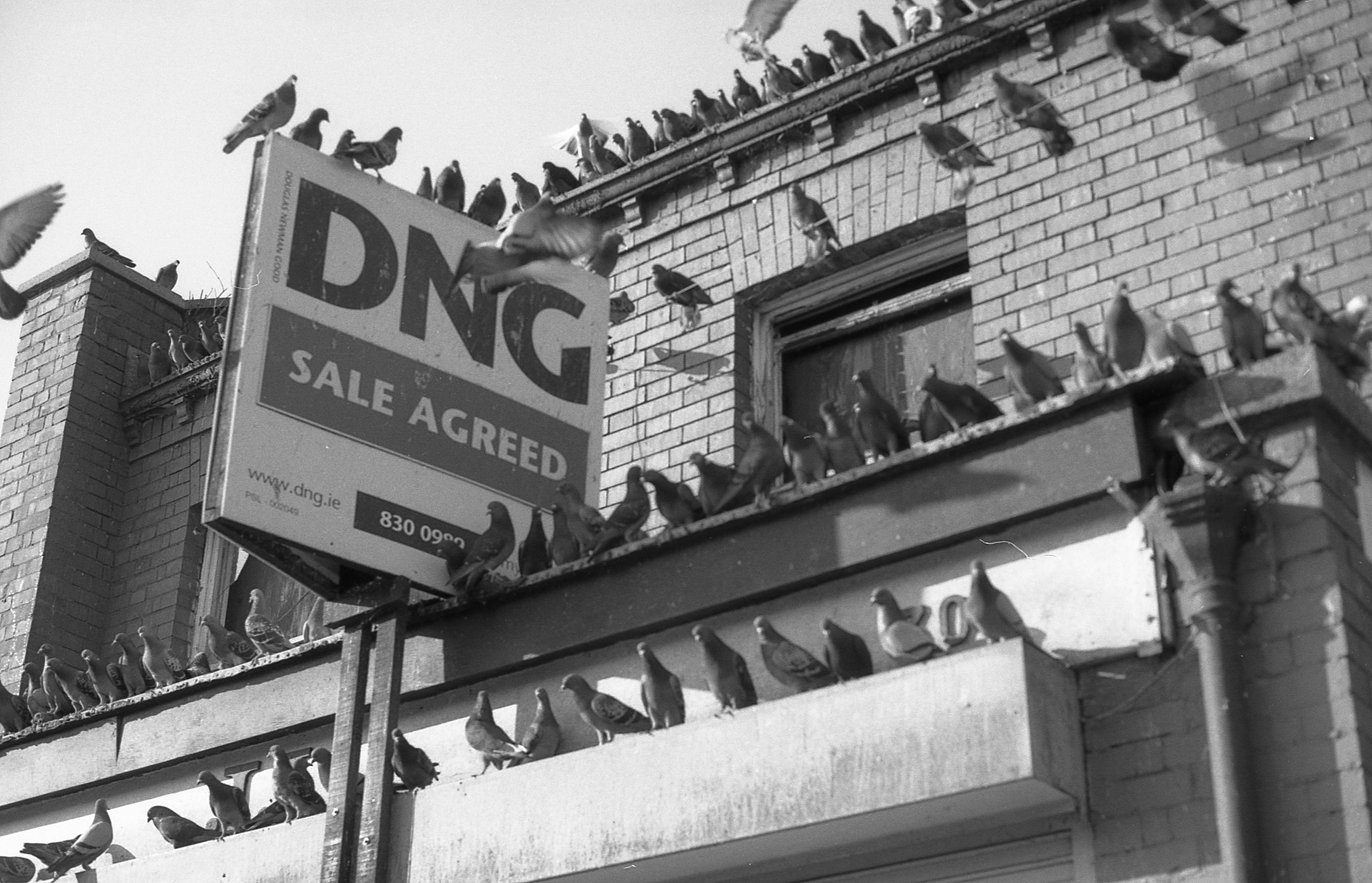
    image emphasises the quietness of shops
    As the shops become quieter, the staff find ways to stay busy. Photo credit: Samuel Adeleke

    Business owners in the retail sector in Dublin are experiencing a decline in sales after the holiday season during the January and February slump, when trading activity slows to its lowest. 

    While statistics often focus on the economic impact of this period on business owners and the economy at large, TheCity spoke to retail staff, who are often the first to feel the effects. 

    Tasha Villisca, a full-time staff member at the Vero Moda clothing brand in the Square, Tallaght, who loves working in retail, described the period as being extremely quiet and slow.  

    “When I am here now, I feel like my day gets dragged, unlike during the peak period, where there is always something to do and people to help,” she said. 

    This situation has hit Tasha’s finances, despite putting in the work. “I got my pay-slip last week, and it is literally not making up for the work I put in here,” she said.   

    “I blame it on not getting enough work hours and people shopping online,” she said.  

    Keris Fonory works as a retail staff member with Naming it (a children’s clothing brand).  “Due to the slump in business, the management had to cut down people’s hours; you can only work contracted hours,” said Fonory.  

    “I work with other girls who are in college, and they are struggling financially because they have fewer hours,” she said.  

    One worker from India, who did not wish to be named, said they were let go from their job in Pandora due to the slowdown in business. He has since managed to pick up with A&B Gadgets, “It is not only a bad time for retail businesses but also a bad time for part-time workers,” he said. “This affects me personally, as the hours I can work are reduced,” he said. From his experience, the retail market has become a “click and collect” model, where people just come in to pick up orders, thereby making the retail staff’s role obsolete. 

    Libby Deleon, a manager at Jack & Jones said, “In the next 5 years, I doubt if there will be any more jobs in retail shops because businesses have fallen into a full decline and people are buying stuff more online.” 

    Deleon also mentioned that with the slowdown in the retail business, a lot of small shops in this period lay off their staff, but at Jack and Jones, she said, “We try to make a system where we still try to make things work. Some are great, some are not.” 

    As a way to drive sales during the slowdown, some businesses resort to running sales. “We have reduction sales going on because we are looking to clear the whole winter stocks and build up for the summer stocks,” Steven Abergele, manager of Best at the Square Tallaght, said. 

    Speaking on the impact of this season on other staff, Steven said, “We only employ part-time staff, so it doesn’t affect us really much; but it does affect bigger brands.” 

    January and February mark the transition into the spring and summer season, and this can impact sales in outdoor gear. Gerald, manager at Trespass, a performance outdoor clothing brand, said that they are a weather-dependent shop. 

    Gerald mentioned that in the post-festive season, there is a slowdown in businesses because people are more careful with their money, and it affects everything, including staffing. “It’s like Irish people forget it’s going to rain and it’s going to be cold, so they come in and buy stuff,” he said. 

    There is hope that businesses will pick up in the summer period leading to the Easter season, and there will be more opportunities for staff to work more hours and earn more in the retail sector. 

  • ‘The reality is that you need money to work in this business’: an interview with actor and filmmaker Laoisa Sexton

    ‘The reality is that you need money to work in this business’: an interview with actor and filmmaker Laoisa Sexton

    The “I Can’t Go On” writer/director reveals her early inspirations and addresses the challenging realities of breaking into the film industry.

    By Oscar Meagher

    Laoisa Sexton never set out to be a filmmaker. In her own words, “I’m an actor, and then I started plays, and one thing just led to another.” 

    “I grew up in a rural area where there wasn’t much around, apart from community theatre. My mother always encouraged me to take part, especially when we moved to the city. I remember she’d always play showtune records for me and tell me about the stories behind them. Shows like West Side Story or Les Misérables.” 

    Sexton recently won the Best Director award at the Dublin International Comedy Film Festival for “I Can’t Go On,” a short film which follows a children’s entertainer trapped in a party from hell. She describes it as “an angst-ridden dark comedy panic attack”. 

    Image from “I Can’t Go On” – credit: Laoisa Sexton

    “I wanted the viewer to have a visceral experience; to be inside that costume with our lead and to feel her claustrophobia. It’s based on my own experience as a kid’s party entertainer, which can be hell on earth!”  

    The short creates such an overwhelming atmosphere of discomfort that it’s almost off-putting to the viewer. However, that seems to be the point.

    “As a filmmaker, I love to explore the tragedy of what it means to be human while making an audience laugh at the same time. Sometimes, you must go for the jugular by tapping into disturbing levels of discomfort and being unapologetic to get at the truth.” 

    “I Can’t Go On” was produced under the Screen Ireland Focus Shorts scheme and marks the first of Sexton’s films to receive industry funding. She emphasised how appreciative she is of the support, but doesn’t cower from addressing the difficulties faced elsewhere.  

    “Most people who are making films come from more privileged backgrounds than I have. I’ve had to rely on crowdfunding to raise money for much of my work. A short film can take the guts of a year to complete without proper funding. Some of my films have taken longer to create, as I’ve had to start and stop to raise more money for postproduction.”

    Her story is proof that no person can be considered entirely self-made. Both Laoisa Sexton, the person and filmmaker, were born from a passionate and supportive mother.

    “She’d plonk me down in front of the TV and make me watch these incredible films that I probably shouldn’t have been watching at that age. Films like The Red ShoesBlack NarcissusDouble IndemnityIrma La Douce, and North by Northwest. My mother knew the names of all the actors, even the producers. She was always a wealth of film knowledge, and I think that planted the seed.”

    “I Can’t Go On” ends with a dedication to her late mother.   

    The short was recently awarded Best Irish Film at the horror festival, Imblog: Women Who Terrify, held in Griffith College Dublin as a celebration of St Brigid’s Day. The event spotlighted original works by women and LGBTQA+ creatives.

    While film festivals are often the best place for blossoming filmmakers, financial matters may tarnish a promising career before it can even begin.

    “The Irish film festivals are brilliant and passionately supported by the public. They can be wonderful opportunities to get your work out there, but it costs money to submit and to go to the festivals to represent your film. Some of them are very pricey, especially internationally. You really need a budget for this because they can cost upwards of €2K. More affluent filmmakers can afford to pay short film distributors to get their films included in more festivals and promote them. If you don’t already have the financial backing, you are clearly at a disadvantage.”

    Sexton embodies the romantic ideal of a filmmaker. She is honest, uncompromising in her vision, and she fights to get her work made and shown – a task generally more challenging for a female creative.

    “Statistically, we make up less than any other group making films, I think it’s about 8% for female directors. While there are opportunities for us to make short films, when it comes to funding our features, we aren’t being given the same opportunities as our male counterparts. This isn’t just in Ireland; it’s across the board. The subject matter of what we want to make is not given the same weight either.”

    The challenges faced by Sexton are sadly universal. She articulates the limitations imposed on anyone with the desire to push beyond the comfortable and recognisable.

    “I want to make the kind of films that I want to see, but that I don’t see being made. The truth is that unless something has been done before or proven as worthy of financing, it may not happen. Cinema is not like that; you never know what an audience will respond to.” 

    A filmmaker’s personality, interests, heritage and identity will naturally inform their work. For Laoisa Sexton, the diversity of new voices is a necessity for the future of filmmaking.

    “I think when people talk about diversity, they should also include class. It’s very important to include more voices, especially when it comes to funding. Hopefully, that will lead to more types of stories being made.” 

  • ‘It felt like we were just pretty girls on wheels’: 50 First Skates reveal the challenges of being a female-focused organisation 

    ‘It felt like we were just pretty girls on wheels’: 50 First Skates reveal the challenges of being a female-focused organisation 

    Dublin-based skating group 50 First Skates rolls into the new year, bigger and better than ever. They hope to have more safe spaces for expression and creativity while confronting challenges.  

    By Alex Cloud 

    The skating group has expressed their experiences with random people showing up to skate meetings and making the members feel uncomfortable. 

    Nicole Douglas, also known as Ballsy Wallsy on Instagram, explains that her skating group 50 First Skates was born out of the need for creative and safe spaces in Dublin.  

    The group has faced adversity, leading to the implementation of strict rules to join.  

    “We have had people show up and just watch us skate or record us practising. Now, we don’t publicise where we skate anymore,” said Douglas.  

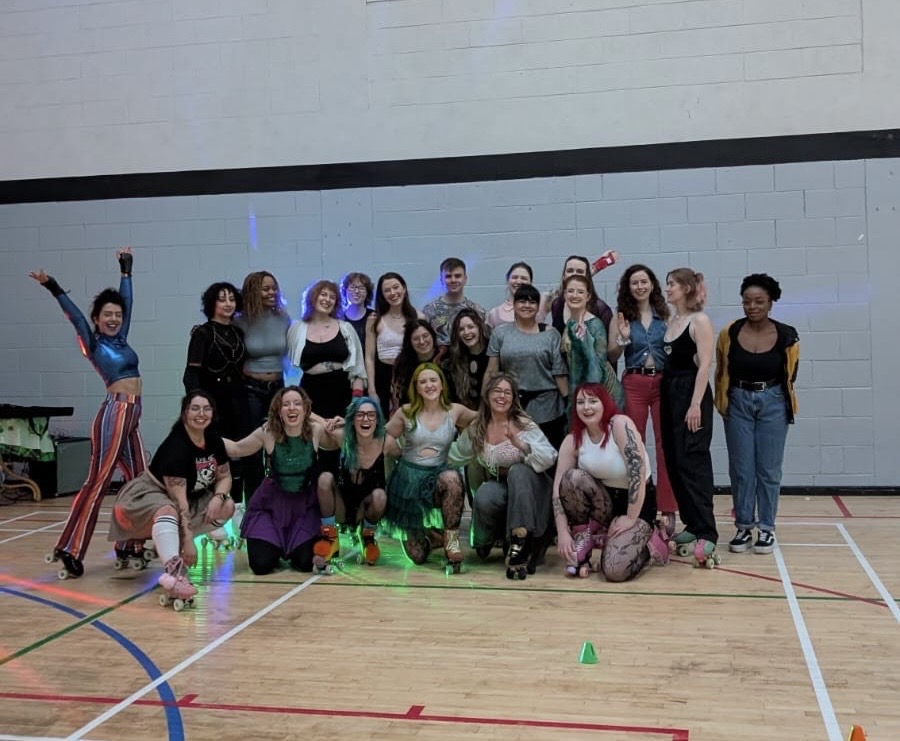
    50 First Skates members sharing a laugh during a skate meet – photo credit: Nicole Douglas

    She revealed that the group have had issues with strangers showing up to meets, leaving members feeling unsafe. They have had to implement measures to prevent any further occurrences.  

    “It needed to be organised in such a way that we could control who was coming to the meet so that nobody was uncomfortable.”  

    “We have a rule that if you bring someone with you, you need to be able to vouch for them. When you join our WhatsApp group, we ask you to send a photo of your skates so we can verify you’re here for the right reasons,” she said.  

    50 First Skates originally began as a strictly female and pro-LGBTQA+ group. However, Douglas explained that they have recently allowed men to attend the meets after they have been vouched for.  

    “If a guy asked to join beforehand, I would refer him to another skating group. But now we’ve opened it up much more,” she said.  

    The Instagram account for 50 First Skates currently boasts nearly seven thousand followers.  

    “Setting up a club had never been on my agenda; it was never something I had even thought about doing,” Douglas said. 

    “The more I skated, and the more people saw me, the more people wanted to join in. This club is for the gays, the gals and non-binary pals first and forever.”  

    50 First Skates has also been featured in Dublin Live, where Douglas explained that their meet location has been leaked before, leading to problems for the group.  

    “I know someone from another skate group that got stalked because their WhatsApp link was public and anyone could join,” she said. She’d post where their skate meet was, and people would follow her there.”  

    Outside of unsettling encounters the members have faced while skating, Douglas explained that it has been nearly impossible to find a venue willing to host them.  

    “Most venues in the City Centre have shut us down just because we have wheels on our feet. They claim it damages the wood, even though the wheel’s purpose is to be non-invasive – and they think we’re doing roller derby when that’s not it at all,” she said.  

    The group hosts a weekly skate meet in a hall located in the Dublin suburbs. The location is always confirmed through their WhatsApp channel to avoid any unexpected guests.  

    “This is adult play. Everyone works so hard, earns so little and pays so much to live – nobody has anywhere they can just go,” Douglas said. 

    Nicole Douglas, a.k.a. Ballsy Wallsy- photo credit: Nicole Douglas  

    Douglas found her passion for skating through grief.  

    “When my dogs passed, I would go to a car park and listen to downtempo music and just go for it. It is something you can connect with emotionally,” she explained.  

    “Taking what you’re dealing with, and with the music that you love while processing your emotions through motion – it’s amazing.”  

    Douglas works with an administration team of three people. They host skating workshops for all levels.  

    “Our hope for the new year is to be insured to teach under-18s. The demand is insane, they really want to come skate with us – and I really hope to teach them.” 

  • Remembering Hugh Wallace and his lasting effect on Irish creativity  

    Remembering Hugh Wallace and his lasting effect on Irish creativity  

    By Millie Reid 

    When news broke of the death of architect, presenter, and TU Dublin alumnus Hugh Wallace, tributes poured in from across Ireland’s architectural and creative communities. Known to many as a judge on RTE’s Home of the Year and host of The Great House Revival, Wallace’s impact stretched far beyond television. For current architecture students at TU Dublin, where Wallace once studied many are inspired by his work everyday.  

    Photo by Millie Reid. Bolton Street College, where Hugh Wallace was educated.

    Born in Dublin and educated at what is now TU Dublin’s School of Architecture, Wallace often spoke fondly of his formative years at Bolton Street. Those who followed his work know the hallmarks: warmth, curiosity, compassion, and a belief that design could transform not just buildings, but lives. His death at 68 leaves a void in Irish architecture, but the values he championed continue to resonate strongly with emerging designers. 

    “What struck me about Hugh was how human his architecture felt,” said one TU Dublin architecture student. “He showed Ireland that design wasn’t just for the elite, it was for everyone.” 

    For many students, Wallace’s visibility on television was their first window into what an architect could be. His feedback was always fair, and his enthusiasm was infectious. On Home of the Year, Wallace’s eye for detail and his famous love of bold colour became a national talking point, but what is remembered most was his kindness. 

    “He showed us that you can be both professional and warm,” said another student. “The way he listened to people’s stories influenced how I approach my own projects.” 

    Wallace’s career began long before his television fame. As a founding partner of Douglas Wallace Architects, his style became a niche in design, shaping spaces across Ireland and abroad. Yet he remained grounded. Even as he became one of the country’s most recognisable architectural voices, he championed accessibility in design and encouraged young architects to think beyond traditional boundaries. 

    In a way Wallace mentored young designers informally through his television work, where he broke down design decisions in a way that made architecture accessible and exciting. Although he graduated decades before the Technological University formally came into being, he often referred to Bolton Street as the place that taught him. 

    His influence has also reached students who are currently shaping their final-year portfolios, many of whom grew up watching him on RTÉ. 

    “I didn’t know any architects personally when I was a teenager,” said a third-year student. “Hugh Wallace was the first architect I ever saw talk about design with joy. That mattered.” 

    In a 2025 interview with IMAGE.ie, Wallace reflected on the role of architects in shaping the built environment, noting that the spaces we design today become legacies for the future. Through his own work, from thoughtfully restored homes to innovative public spaces, Wallace left a lasting mark on Ireland’s towns and cities, creations that will be experienced and remembered for generations. 

    At his funeral, colleagues and friends spoke of him being “honest, passionate and deeply human”. Online, viewers shared memories of how his programmes inspired them to restore old cottages, take risks with colour, or simply care more about the spaces around them. But in TU Dublin’s studios, where the next generation of architects are sketching, drafting, and arguing over floor plans, his impact is lasting. 

    Wallace never taught at the university, but to many, he was a teacher. 

    Hugh Wallace may be gone, but the spirit with which he approached design Joyful, and human continues to inspire the students walking the same corridors he once did.  

  • “The whole climate and nature crisis, to me, is the reason I’m in politics.” Senator Malcolm Noonan on his political career

    “The whole climate and nature crisis, to me, is the reason I’m in politics.” Senator Malcolm Noonan on his political career

    Malcolm Noonan is someone who is well-known around Kilkenny. He was a member of Kilkenny County Council for almost 15 years and served as Mayor of Kilkenny between 2009 and 2010.  

    He was then elected to the Dáil in 2020, and served as a minister, before becoming a Senator this year. 

    From his office in Leinster House, I sat down to speak with Malcolm about life as a public servant, his experience in the world of politics, and the challenges that politicians face. 

    Politics wasn’t always Malcolm’s calling. Enviromental activism has always been a key tenet of his life. From a young age he was engaging with his local community and the world around him. “I was just interested in nature and the environment,” he said. 

    But politics came knocking when he was approached by the Green Party to run for Kilkenny County Council in the 2004 local elections. “They said, “would you be interested in running?” and I said, “I’m not so sure.” So, I gave it a bit of thought, and then I said, “Sure, what will be the worst thing to happen?” and then the worse thing happened. I got elected.” 

    Malcolm topped the polls in that election, a feeling he describes as “amazing.” Very soon, he began to realise the possibilities of the role, beyond his ideological goals. “It’s funny, when you get elected you actually realise, I can make a difference in people’s lives. I can get a disabled persons grant, I can help someone get a house.” 

    His entry into politics was certainly accidental, least of all did he think he would still be involved in it some 20 years later. Malcolm was very aware of the precarious nature of being an elected official. He studied for a Rural Development degree so that he would have something to fall back on. “When I stood in 2009, the party was in government, and we lost most of our council seats. That made me realise how vulnerable this could be.” 

    In his time on Kilkenny County Council, he was heavily involved in many community initiatives, including forming and chairing the Heritage Forum in Kilkenny, and establishing Kilkenny’s first Integration Forum. “These are refugees brought in by the state from refugee camps in Uganda and South Sudan. They were amazing families.” 

    Integration is something that Malcolm feels is still important today, especially with all of the discussion around immigration online. 

    After 15 years on the council, Malcolm contested the 2020 general election for the Green Party and won a seat for Carlow-Kilkenny, something he didn’t expect. “We went to the count centre, and I looked like I was dead and buried, and lo and behold I got a huge dump of transfers.” 

    As was well documented, the months after the general election were chaotic. The three big parties, Fianna Fáil, Sinn Féin, and Fine Gael were neck-and-neck. And then, just a few weeks after the vote, the pandemic hit. Malcolm initially thought that he would be spending the next five years in opposition, now he felt that his party couldn’t sit on the fence. 

    “The Greens will always go into government,” he said. “We feel we have a duty; we’re a policy driven party, and we should step-up where we’re needed.” 

    Noonan describes his appointment as a Minister with great enthusiasm. 

    “He [Eamon Ryan] called me down to his office and I recall it being like Charlie and the Chocolate Factory.” He was given the portfolio ‘Heritage and Electoral Reform’ (which later became ‘Nature, Heritage and Electoral Reform’), which entailed the National Parks and Wildlife Service, National Monument Service, and all of the biodiversity policy. “My immediate reaction was I skipped up the corridor, clicking my heels. I was delighted with myself. I’ll never forget the day I was appointed.” 

    The term of a government is both very short and very busy. “My legacy from that time was giving a huge uplift to the heritage sector, [and] the biodiversity sector.” 

    But all good things must come to an end, and the 2024 election was looking gloomy for the Green Party. Having lost many of their councillors in the local elections earlier in the year, the mood closer to election day was more sombre. 

    I asked Malcolm whether he felt that his colleagues in the other coalition parties had turned on the Greens, and I was surprised by the honesty of his response. 

    “There was a narrative emerging over time. Some of it was built around Eamon Ryan. It suited some in the media to attack Eamon. It suited some in a ‘business as usual’ agenda to target us. And then, perhaps, there’s an element of our colleagues who say, “all that bad stuff, carbon tax, that’s the Greens.” 

    But he doesn’t put all the blame solely on outside actors, he admits that there were failings in how the Green Party put itself across. 

    “I do feel that we spend so much time delivering, and I don’t think we did a good job of communicating why we were doing this stuff. Behavioural change is really hard.” 

    Malcolm is proud of the things that his party achieved in government, such as cutting public transport fares, expanding the LocalLink bus network, and installing free solar panels on schools, But as someone living in rural Ireland, I could see that the Greens were failing at advertising those achievements to the public. 

    Malcolm said, “I remember a man giving out to me. I was out at an event in a rural village and he was giving out yards about Eamon Ryan, and next thing the 891 (a LocalLink bus in county Kilkenny) passed and he said, “God, isn’t that great!” and I said, “That’s Eamon Ryan for you.” 

    When election day came, and in the days afterwards, it was clear that it was not looking good for the Greens, and Malcolm was knocked out at the 8th count. “You have to dust yourself off and say, “people have voted, that’s the way it is.”” 

    But opportunity came knocking again during the Seanad Elections this year, where Noonan was elected to the Agriculture Panel. Now Malcolm is a Senator, still roaming the halls of Leinster House.  

    I touch upon a serious topic, about the increase in hostility towards politicians, both online and in-person. It is quite shocking.  

    “I’ve had death threats, both in writing and on the street.” he said. “I’ve been physically assaulted; you get verbal abuse.” He says it doesn’t happen often, but it does make him question why he does the job, and why anyone, particularly young people, would want to get involved. “No other workplace would accept the level of abuse that politicians receive,” Noonan said. 

    Away from the politics, Malcolm Noonan is an artist. He paints, he draws, and he plays in a band. Like most people, there is the family side to it all. “Dad taxi”, as he calls it, to football matches. He admits that being in government kept him away from his family, so he’s enjoying having more time with them these days. 

    To finish up, I ask Malcolm what he is most concerned about, and optimistic about, in the future. 

    What he is most concerned about is what he is also most optimistic about: the climate. 

    “The whole climate and nature crisis, to me, is the reason I’m in politics. Every year there’s a COP, and every year they walk away with some kind of agreement on something. At the root of it all is our financial and economic system. I fundamentally believe that we need to move away from our reliance on economic growth as a measure of our progress as a nation.” 

    But it is young people who make him feel optimistic about the climate. The likes of Greta Thunberg, whom he is a big fan of. In a school in Urlingford, County Kilkenny, he tells me that the pupils received a handwritten letter from Sir David Attenborough, telling them to keep going with their Green Schools initiative. 
    “If David Attenborough, the most famous naturalist broadcaster in the world, can take time to handwrite a letter and handwrite an envelope, and send it to a school in Urlingford, County Kilkenny, well, there has to be hope.” 

  • Peter Willis – a designer with flair

    Peter Willis – a designer with flair

    An independent designer with flair for colour and texture

    Peter Willis is a multi-disciplinary artist who graduated from Belfast Art College with an Honours degree in textile and fashion design, specialising in weaving.  After graduating he worked for the National Trust as a textile conservator for two years. He then received a scholarship to go to business college in Canada to learn how to run a business in textiles.    From there he went to Guatemala and worked with an artisan association in conjunction with Oxfam Trading. Guatemala inspired him to work with textiles and pottery.   When he returned to Ireland, he worked as an interior designer for twenty years and has always believed in connecting people with their places. He enjoys working with ceramics.  He also has a love of fabrics and colour and uses many different types of materials in his work. His masks are inspired from his time working with indigenous cultures. He says he has now come full circle and works as a muti disciplinary artist mainly in textiles and fashion.  Peter works from home when not at fashion shoots and exhibitions.

    For more information, contact Peter @peterw_illis

    Navaho Shawl

    This piece was inspired by the Navajo First Nations people – and the shawl was made in the shape of a dream catcher and made with alternative bands of textural yarn. One of them is a very soft chunky, fluffy yarn, and the other, a bright fluorescent pink, is more a flat yarn so each band when knitted up with different size knitting needles creates different textures.

    Alien Monkey Fantasy Head Mask

    A mask with a verdigris lustrous glaze which is quite a technical procedure. Layers of other glazes were applied, and a wax resist was finally applied. Patches of the eyes and cheeks are applied in several different layers. Then masked over which gives the textured effect. 


    Using the leftovers – Multi coloured hand knit scarves

    Give peas a chance

    A pun on “give peace a chance.”  This is a shoulder piece; part of a costume made for a green party event. There was also a bag made from a pack of frozen peas which completed the ensemble. The green balls were made from pom poms.
    The Head Piece

    Head piece modelled in a fahion shoot for Culture Night  in Gallery X, Hume Street

    Neck and shoulder piece together

    Moon in the Man

    The mask represents nature within us.  We are nature.  The moon is in us.

    Industrial Death Mask – Big mouth, no eyes

     Big mouth is a reference to big loud politicians.  An acknowledgement to indigenous cultures and how they lived a primitive life, but they were wiser in how they treated the planet. They lived in communities in relative peace without destroying the planet. Celebrating indigenous culture from all part of the world

    A hand knit gilet

    A colourful and practical garment worn over tunic with slightly heavier knit sleeves as worn by designer in first photo

  • Christmas Spending – The Value of Christmas

    Christmas Spending – The Value of Christmas

    The Central Statistics Office on November 13th released the consumer price index for this year, which shows a 2.9% increase in the inflation rate over the last 12 months, which is the fastest and highest rise of inflation since March of 2024.

    The increase will affect the prices of food items such as dairy and pastries. The price of poultry and meat increased by 6.6% which will affect the price of viands such as Chicken, beef, and turkey.

    Aside from household staples, an increase of 7.7% in health insurance, 3.7% in electricity, and 3.6% in rent was reported in the current figures.

    Going around Dublin city centre, TheCity asked a few people how much they will be spending this Christmas.

    Economist, Dr. Clare O’Mahony, will also be commenting on the hiking prices this holiday season.

  • 10 Activites you can do in Dublin this Winter

    10 Activites you can do in Dublin this Winter

    Ireland is often accused of being a boring place for young people. It’s often wet and rainy, and the outdoor activities lacklustre. Here is a list of 10 activities that might keep you occupied this Winter season.

    1. Visit the Gingerman pub. You may not think it from this stunning display, but this is actually a pub. This could be a great stop off for any 12 pub-partakers.
    • Visit the Guiness Storehouse. You’d be surprised how many Irish natives haven’t seen it yet.
    • Here’s one for the non-drinkers. Kilmainham Gaol is a great daytime activity for the history nerds.
    • Go to a sauna. They’re everywhere nowadays!
    • Find your new favourite restaurant. This is Mama Yo on Camden St.
    • Try a new bakery. There’s one on every corner, you’d be kept busy for a while.
    • Matcha is the new craze at the moment and Dublin is quite good at keeping up with the trends.
    • Find your new go-to bar. “The usual, please.’
    • George’s Arcade, Grafton St, Henry St. There’s so much fun jewellery to look at everywhere.

    10: Go to the Howth Cliff Walk. Ideally save this one for one of the less rainy days.

    All photos by Alison Gussago.

  • New government figures raise concerns for future home buyers

    New government figures raise concerns for future home buyers

    An assessment released this week by the Department of Finance shows increasing concerns for Ireland’s future economy and society, with an emphasis on the housing market.

    Minister for Finance, Paschal Donohue, launched “Future Forty: A Fiscal and Economic Outlook to 2065”, which models over 2,000 scenarios for Ireland’s future over the next forty years. The models are based on national and international trends.

    ‘Future Forty’ includes a fiscal analysis of how the age demographic will impact Ireland over the next four decades. The assessment shows that the old age dependency ratio has increased, and fertility rates have declined over the past 38 years. The assessment states, “A rising old-age dependency ratio increases pressure on public finances, by raising costs for age-related expenditure. Over the long term, a smaller workforce relative to the total population will pose fiscal challenges and potentially constrain economic growth.”

    Demographic trends show that migration will have both positive and negative impacts on the issue. Inward migration can help to alleviate the challenges of our ageing population by filling skill gaps and reducing labour shortages. However, an influx of migrants will pose challenges to the government through the increased demand for infrastructure and public services. ‘Future Forty’ states that this may cause delays in family formation which, in turn, lower birth rates.

    Source: assets.gov.ie

    The above graph shows population projections from 1996-2022 and includes estimates up to 2057. 

    The assessment includes a report on housing, which states that it is expected that demand for housing will peak in the early 2030s and will not ease until the 2040s.

    Rachel Dunne, a 32-year-old special needs assistant told The City, “I’d be more inclined to emigrate than to wait another 20 years until I can purchase my own home.” Ms. Dunne and her partner have been renting in Dublin for the past 6 years. “We’re lucky to be in the position to afford rent in Dublin, but I just want to paint my own walls without having to ask someone,” she said.

    Depending on immigration and fertility rates, it is projected that the population will reach between 5.9M and 7.9M by 2065. Notably, the report states that the current government plans to build 300,000 more houses by 2030.

    The main scenario in the ‘Future Forty’ document is referred to as the ‘Central Scenario’. The ‘Central Scenario’ is a model that anticipates a change in household size preference due to changes in demographics over the coming years. Suppliers are predicted to shift from providing family-friendly housing units to units more suitable for single occupants. 

    Source: assets.gov.ie

    The above graph is a representation of projected future housing expenditure and its relative GNI. The ‘Central Scenario’ takes social housing, HAP, and RAS into consideration.

    Housing expectations in this scenario are entirely dependent on the 2030 supply target being met.

  • A conversation with Susan Marie Martin

    A conversation with Susan Marie Martin

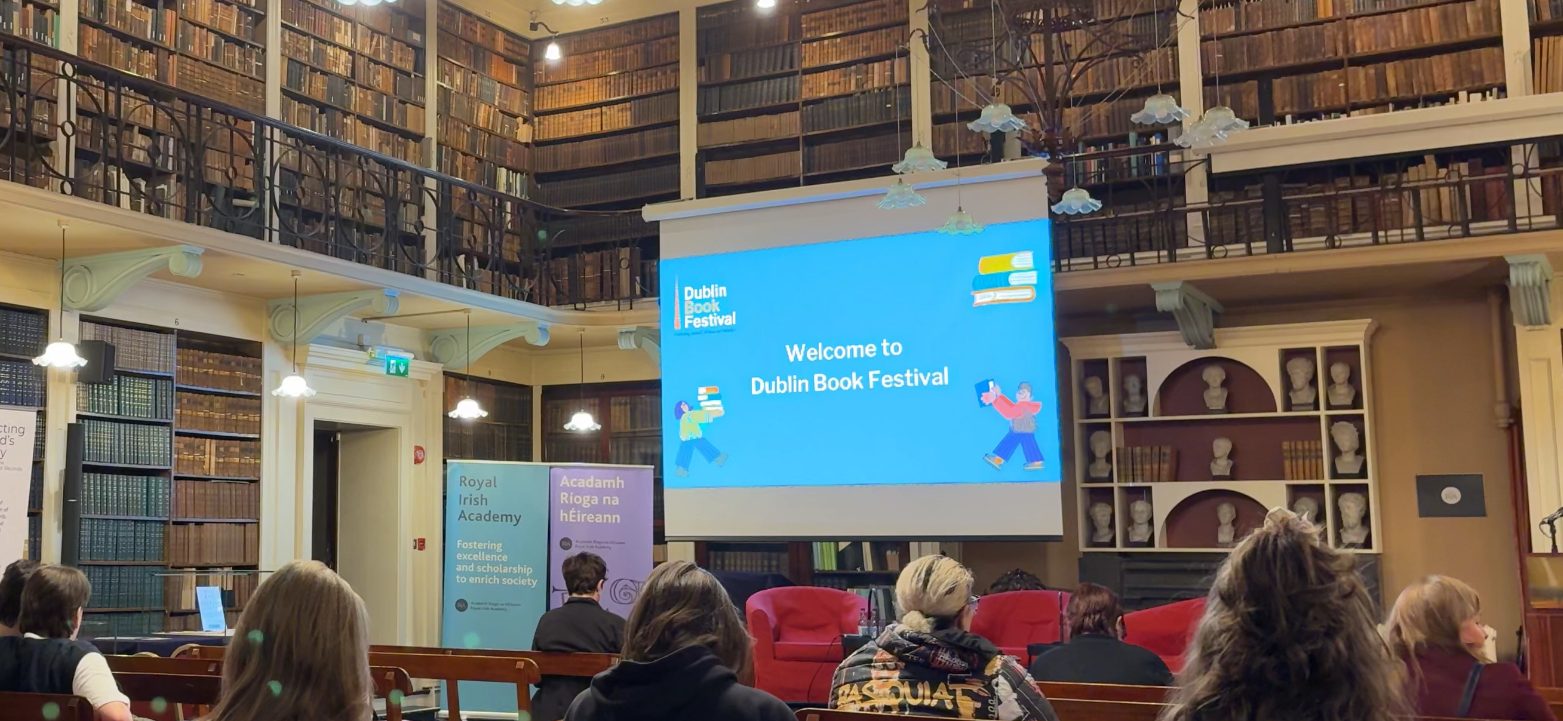
    The Dublin Book Festival takes place every November and has a wide range of events to go to. This year, the festival took place from Nov. 5th to 9th with the events spread across Dublin city.

    TheCity attended ‘Women, Struggle, and Resilience,’ a talk that was held in the Royal Irish Academy. Afterwards, TheCity had the opportunity to speak to one of the speakers on the night, Susan Marie Martin PhD. Dr Martin wrote her book on female Dublin street traders from the years 1882-1932. In the discussion Dr Martin talks about why she got interested in street traders in the first place, how she became affiliated with the Dublin Book Festival, and what the future holds for her.