Tag: ireland

  • Irish Pride is Never Far in New York City

    Irish Pride is Never Far in New York City

    Irish pride is never too far away in New York City… and neither is a drink. 

    By Katie Shadlow

    Talking about the accomplishment and reward in owning an Irish pub in the city that never sleeps with Blaggards Pub owner Liam Lynch is enough to make you realise that Irish pride is alive and well in New York, and Irish craic is only ever a block away for the homesick. 

    Originally from Celbridge, Co. Kildare, Liam Lynch moved to New York and has been running his business on 8 W 38th Street for 26 years, and though he misses home, he has no regrets. 

    While there is evidence of Irish workmanship throughout the city in forms of architecture, cultural influence and more, it seems only fitting that the Irish bring great pubs and great craic to New York City, and here’s just a few. 

    All photos taken by Katie Shadlow

    Blaggards Pub, opened on 8 W 38th Street, New York, in 1998 by Liam Lynch. Run by an Irish man, this pub really offers the piece of Ireland that the homesick are missing. 

    McGee’s Pub, located in the heart of Hell’s Kitchen, was the pub that posed as the inspiration for the iconic ‘McLaren’s Pub’ in the hit TV series ‘How I Met Your Mother’. 

    The Keg Room located on 53 W 36th Street, is an upscale Irish- American sports bar, which offers the perfect blend of cultures for those who miss home but not enough to want to feel at home. They also delightfully welcome you to their website with some comforting Irish words, ‘Céad Mile Fáilte’, meaning ‘One Hundred Thousand Welcomes’. 

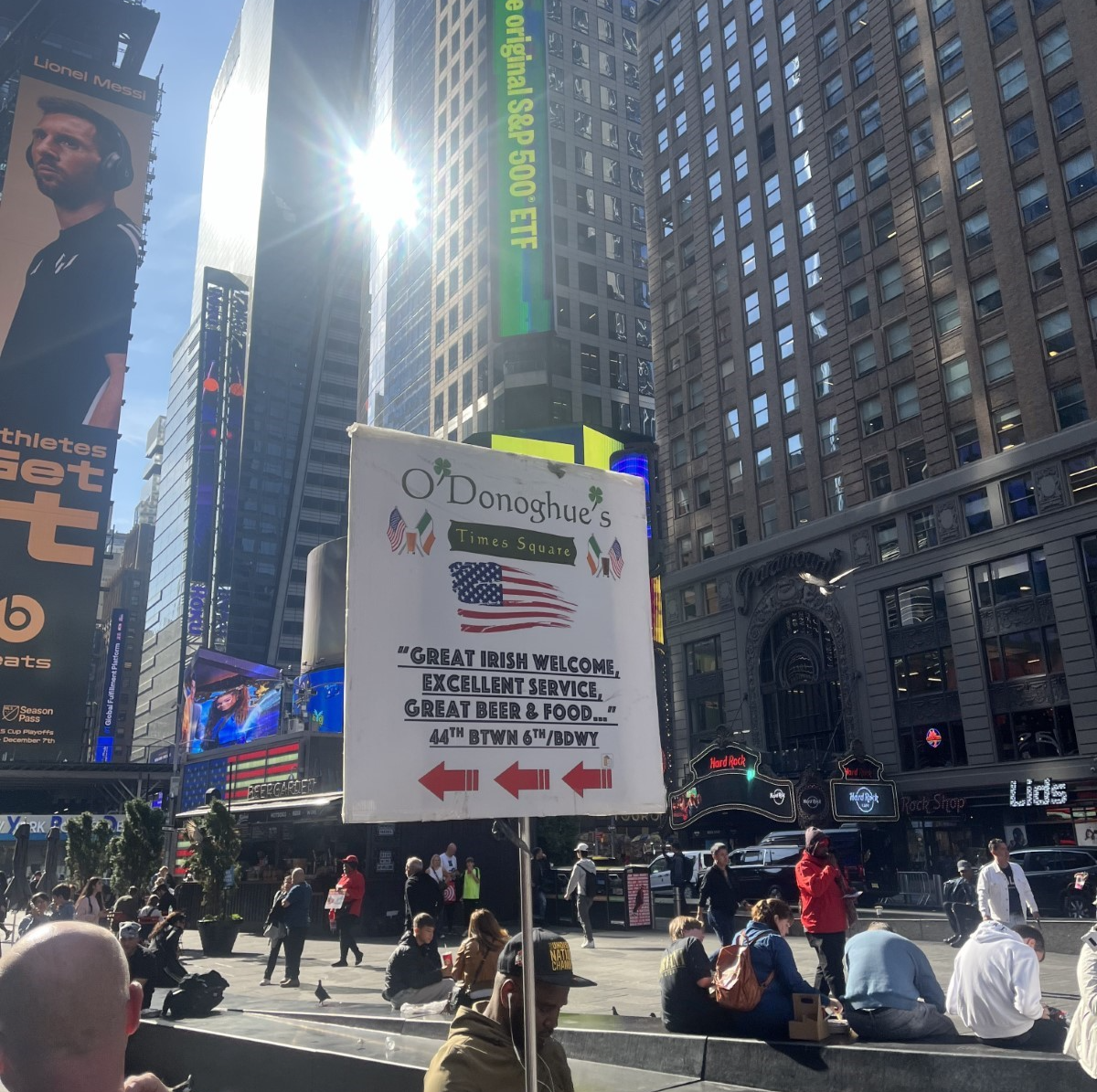
    O’Donoghue’s blends the excitement of the Big Apple with the old Irish warmth right in the heart of Times Square. 

    The Long Acre Tavern is a contemporary Irish American pub, located on 146 W 47th Street is more in tune with its traditional American roots, but makes a nod to the Irish with its flag outside and their frequent use of their Instagram page to advertise Irish sporting events that they show in their bar. 

    The Playwright Irish Pub and sportsbar, located between 5th and 6th avenue, is owned by John Doherty, and while it may not have the most authentic Irish atmosphere, many reviews raise their glass to their great pint of Guinness! 

    Nobody does advertising like O’Donoghue’s, with this nod of appreciation to both the bar and the Irish, with the words “Great Irish Welcome” waved for everyone to see in Times Square, New York City. 

  • Meet Dublin’s Newest Art Collective Celebrating Black Alternative Culture

    Meet Dublin’s Newest Art Collective Celebrating Black Alternative Culture

    By Dearbhla Kiarie 

    The AV Club is a new art collective seeking to promote Black alternative culture in Ireland, by curating events that celebrate Black individuals in subcultures, such as punk, goth, rock, metal.  

    Founders Tina Wekare and Jasmine Odabi described their creation as an aim to “return these subcultures to the control of their original creators.”   

    They have also said they are “dedicated to creating a welcoming and inclusive environment, where everyone can express themselves authentically and connect with like-minded individuals, fostering a sense of community and empowerment within the vibrant subcultures we champion.” 

    The new art collective opened their doors to the public for the first time this month with their inaugural event, ‘BLACKOUT.’ The event included a headline performance from band Cable Boy, as well as pop up stalls for various Black Irish artists. 

    Cable Boy performing at BLACKOUT event – Photo: Lucia Burke

    According to organisers Wekare and Odabi, this event was created to “foster a burgeoning Black Irish alternative scene, which is only now starting to reach mainstream. It was created in a response to the constant racism within alternative spaces, which for the longest time, has been predominantly white.” 

    However, the aim of these events is not only to benefit Black people seeking community in Dublin. A portion of the proceeds of ‘BLACKOUT’ ticket sales were donated to Friends of the Congo, a nonprofit organisation who strive to “bring about peaceful and lasting change” in the Democratic Republic of Congo (DRC).  

    Event organisers said the reason behind making the event a fundraiser was to start a conversation.  

    “We need people to join the dialogue and the fight. We want people to leave with a sense of empowerment; to feel like they too can help out – no matter how small the impact. Every little helps,” they said. 

    When asked about plans in the works for more events like this for the Black Alt community in the future, Wekare and Omondi said, “Absolutely! There is a need for more events and safe spaces for Black alternative people in Ireland. AV stands for ‘Audio Visual’. And we plan to have a lot of events that explore alternative art in all its mediums, from music to fashion to films to visual art etc.” 

    Eventgoer Ani Dhore said the event evoked “a sense of belonging” and was “inspiring” for her, which organisers said was one of their many goals. 

    DJ Booth at BLACKOUT Event – Photo: Dearbhla Kiarie

    “We want people to come out feeling like they’ve found like-minded alternative people,” they said. “And we want others to feel like they have a safe space to be loud as well. To be truly heard. To feel seen.” 

    The AV Club has plans to host a movie night as one of their next projects in December, as “Christmas time is notoriously a lonely time for the outcasts. It will hopefully be a great time, having people just hang out and get to enjoy being weird and free and together.” 

    What the event organisers want people to take away from their collective is that “Black people aren’t a monolith. We fit into a vast variety of subcultures which is why intersectionality is so important to us; and why we are dedicated to curating a safe space for people all over the diaspora.” 

  • A Way to Celebrate Black History Month in Ireland

    A Way to Celebrate Black History Month in Ireland

    By Mene Agbofodoh

    The Red Line Book Festival held a book conference for influential Black Women in Ireland to celebrate Black History Month. 

    The Red Line Book Festival is a cultural event that happens once every year. 

    It is held to appreciate and celebrate literature, storytelling, and creativity.  

    It aims to bring people together from across Dublin and Ireland, spark conversations, and inspire the next generation of writers and readers. 

    The Red Line Festival is normally held throughout an entire week with multiple events happening throughout the week. and one of the events was ‘Stories of Black Women in Ireland’. 

    Luas Red Line in Tallaght. Photo: Mene Agbofodoh 

    Dr. Ebun Joesph, a special rapporteur for racial equality and racism Ireland and founder of Anti-Ireland and Black Studies was also in attendance for the talk. 

    Melissa Bosch, (Head of Diversity, Equity, and Inclusion at where?, Eya Lawani, a Special Needs assistant who has a background in assisting charities for Black Irish children, and Carline Thompson, a nurse, researcher, entrepreneur, and activist, also attended to talk about their new book, ‘Equity in the Workplace Stories of Black Irish Women in Ireland’. 

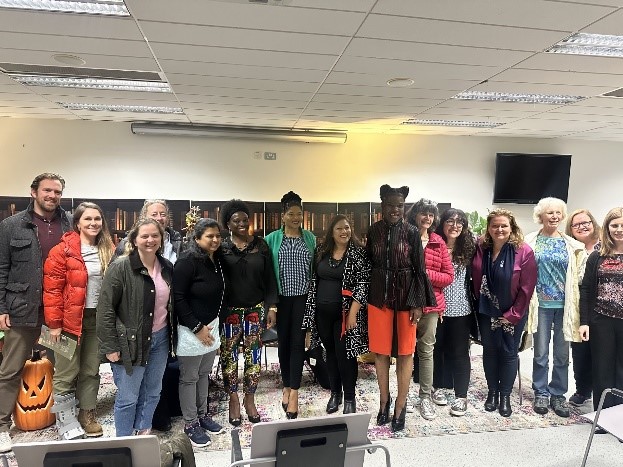
    Left to Right- Eya Lawani, Carline Thompson, Melissa Bosch, and Dr. Ebun Joesph speaking at their Red Line Book Conference.
    Photo: Mene Agbofodoh 

    The purpose of the book was to amplify the voices of black Irish women and examine their experiences within the Irish labour market.  

    It aims to uncover the challenges they face and their perceptions of achieving equity in the workplace.  

    Despite progress in gender parity, disparities still exist, with women being underrepresented in leadership roles and facing lower pay, poor working conditions, and instances of bullying and harassment. 

    Dr. Ebun Joesph spoke about the importance of women finding their voices within the workplace. 

    “I think it is important that us women find our voice especially us black women, so that our stories can be heard, to be told and not told from a perspective that doesn’t truly represent us,” she said 

    Melissa Bosch talked about understanding the power your voice has. 

    “When you see something that is wrong along the lines of racism and discrimination, your voice is so powerful and when speak out against these things, it can drive change,” she said. 

    “If we do not speak about things like this and if we don’t open our minds, our hearts to create those spaces for this kind of level of dialogue, we are not going to change anything. Ireland won’t be able to move forward”. 

    Melissa Bosch’s chapter in the book revolved around trying to help people see their place in the world and what they can do to help marginalized people. 

    “Whatever ethnic background you come from, whatever demographic background you come from, you have the power to make that change, it’s about understanding your privilege and position in this world.”. 

    Carline Thompson spoke about the challenges of writing her chapter in the book. 

    “One of the challenges I had when writing my chapter wasn’t the 2,500-word count even though I only had a week to do it, it was how do I write so much about this topic without exceeding the limit?” 

    “People think racism only happens in the workplace however, it’s everywhere around you. It’s in the supermarket where you feel you’re being watched by security whilst you’re shopping, it’s in the library, it’s in the restaurant when you’re going out to eat with family and you get stares throughout the night”. 

    Eya Lawani also spoke on her challenges when she was writing her chapter. 

    “My problem or challenge about writing my chapter was I didn’t know how I was going to convey the message that systematic racism is the problem in our society without blaming white people as a whole.” 

    “It was a very difficult topic to write because I had to relive certain moments in my life that made me feel belittled, moments when applications were rejected despite having my bachelor’s degree from Nigeria but because it wasn’t an Irish degree it wasn’t good enough”. 

    “I struggled with the fact people in society were willing to accept I could be discriminated against because I was a woman but If I said I felt discriminated against because I’m black suddenly it couldn’t possibly be because I’m black and having to convey that in my chapter was very challenging.” 

    Black History Month is observed in Ireland from the 1st of October until the 31st

  • In Photos: Oscariana Sees Oscar Wilde’s Childhood Home Open to the Public

    In Photos: Oscariana Sees Oscar Wilde’s Childhood Home Open to the Public

    By Adam Stynes

    Last month, marked the 170th birthday of Oscar Wilde. The City.ie took a visit to the famous poet’s childhood house where the event Oscariana was taking place, while also going to see key locations around Dublin associated with the poet’s life.  

    Some of the key items in Oscar’s life were on display in the home where he grew up. Many people attended the open house tour at 1 Merrion Square, which occurred over the weekend. 

    A walk on the Wilde side showed off aspects of his life, from where he was baptised to when he studied at Trinity College at the old library. Each stop showed a vital part of the poet’s life from early places to memories of his later life. 

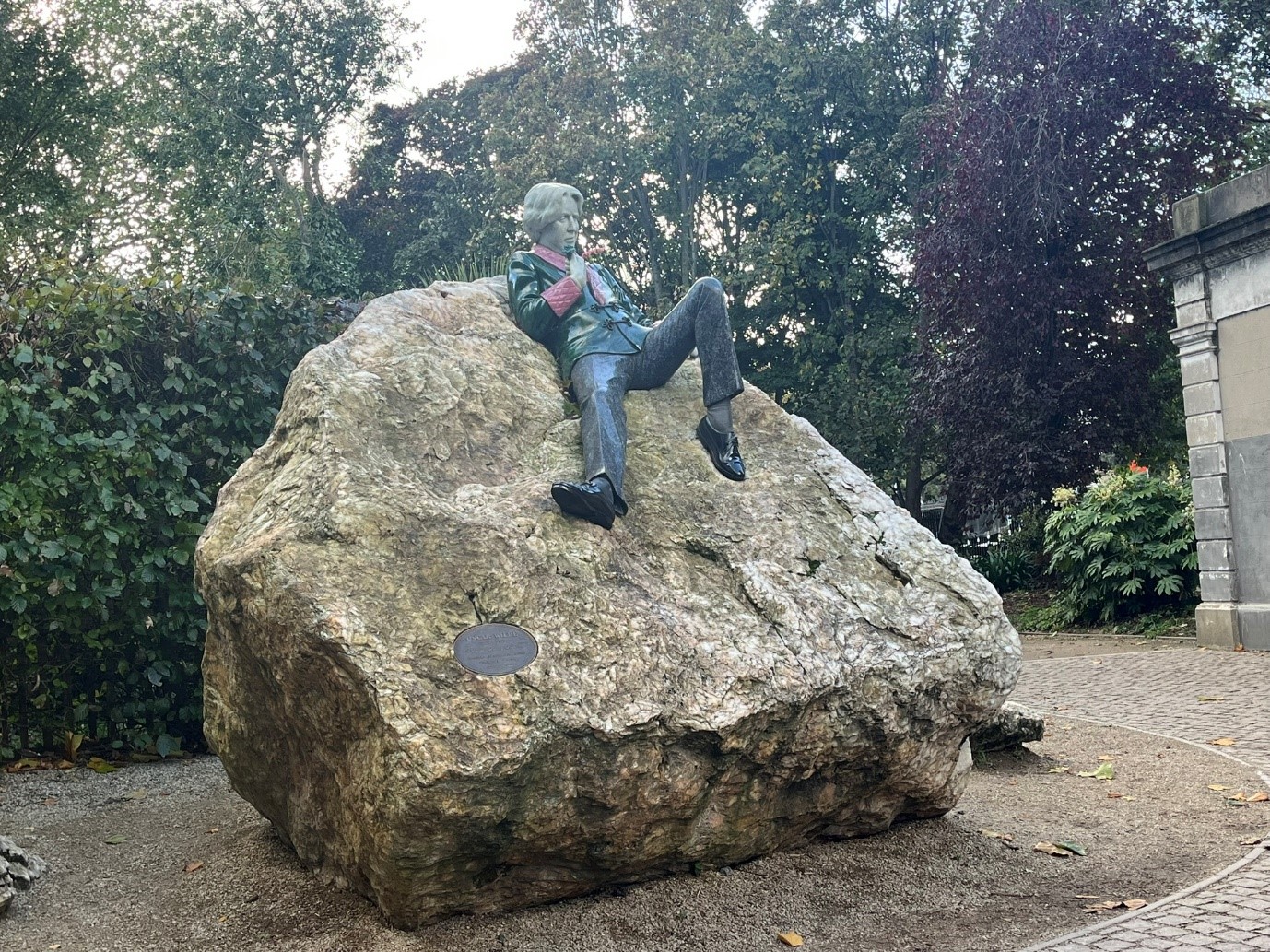
    The Oscar Wilde statue in Merrion Square opposite the Oscar Wilde house. 
    A statue of Oscar Wilde by Melaine lo Brecquy  
    The outside of Wilde’s family home from 1855 to 1879
    An image published in Harper’s Bazaar during Oscar Wilde’s tour of America.  
    A portrait of Oscar Wilde in his childhood bedroom  
     A portrait of a young Oscar Wilde in a dress hung in his childhood bedroom
    Oscar Wilde’s birth and baptism certificate and a copy of his parent’s marriage certificate.
     Some books that were written by Oscar Wilde and an Oscar Wilde action figure  
     A portrait of Oscar Wilde hanging at his house.  
    Some of Oscar Wilde’s published works
    The outside of Oscar Wilde‘s house at 1 Merrion Square 
    The outside of the Old Library at Trinity College, Dublin, where a young Oscar Wilde studied.
  • Why are electric car sales continuing to decline? 

    Why are electric car sales continuing to decline? 

    By Luke Hurson

    2024 has been a disappointing year for the electric vehicle market, so far.  

    Latest figures from The Society of the Irish Motor Industry (SIMI) revealed that in September 1010 new electric cars were registered which was a massive 30.8% lower than the 1,460 that were registered in September 2023.  

    16,133 new electric cars have been registered so far, this year, as of the end of September. This is a 25.8% decrease compared to the same period in 2023 when 21,726 electric cars were registered. 

    Brian Cooke the Director General of SIMI commented: “The new electric vehicle segment has experienced another month of decline in registrations, marking the eighth consecutive month of this trend.” 

    “It is vital that we see positive measures from the Government to support the EV project and help reverse this drop in demand for EVs. Reinstating and extending EV supports, as well as investing in a reliable charging infrastructure, can help regain lost momentum in the electric vehicle project. The industry remains committed to supporting the transition to electrification,” he said.   

    An electric car charging at a charging station. Credit: Pixabay

    So why has there been such a steep decline this year? 

    In January 2022, the Irish Government got rid of the €2,500 grant for new plug-in-hybrid-electric vehicles (PHEVs). This resulted in a reduction in PHEV sales and an increase in battery electric vehicle sales (BEVs), which was the intention.  

    In July 2023, the Government reduced the grant for new BEVs from €5,000 to €3,500. Although there wasn’t a sudden impact, there is now a slowdown in sales of BEVs, whereas PHEV sales are increasing again. 

    Many people in the EV scene find that it is harder to get the mass market to make the switch to electric compared to the early adopters.  

    The early adopters tend to be more comfortable with risks like range anxiety or queuing at charging points – whereas the mainstream adopters are less likely to be wealthy and are not as comfortable with the same risks. 

    Luke Donnellan, a mechanic for Renault spoke to The City. “A lot of the cars we sell are either hybrid electric or petrol. Not a lot of people are ready to make that change to fully electric yet. 

    “A lot of people are still very reliant on diesel and are very unsure of the range of electric cars, as well, because with a petrol or diesel cars, when they run out of fuel, it’s not a big deal, you can just fill it up and away you go but with an electric car you’re almost stranded. 

    “A lot of people do have that range anxiety and It’s also made harder when there isn’t the infrastructure there to charge all these cars. 

    “A big thing that we’re seeing as well is people trading in their brand-new electric vehicles because they buy the electrics and realise there’s nowhere to charge them and how much it is to charge them. A lot of them realise they can’t charge the cars at work, so then they’re left with these cars where they have to plan everything. You can’t just go do something; you have to plan your entire trip from start to finish and it’s a lot,” he said. 

    An electric car plugged in at an integrated charging station parking space. Credit: Unsplash

    EVs can also provide different mechanical problems to that of a petrol or diesel car.  

    “One thing that we are noticing is because all these electric cars use regenerative braking systems, where they don’t actually use their brakes and they use the slowing down of the wheels to try to charge the battery up – the brakes are getting completely rusted out,” said Donnellan.  

    “Even though they’ve only used 20% of their brake pads, their brake discs are so badly corroded, they need to change their brake pads and discs more frequently than a petrol car, so there’s more maintenance in that sense,” Donnellan added. 

    Hybrid vehicles, however, are rising in popularity. There has been a 12% increase in regular hybrid sales this year, totaling 26,079 new registrations at the end of September.  

    Similarly, there has been growth in plug-in hybrid sales, now amounting to 10% of total sales with 11,766 registrations. 

    Petrol remains the most popular choice for Irish buyers, with 36,339 registrations, followed by diesel with 26,947. 

    More support and infrastructure are needed if the Government has any hope of reaching their target of 845,000 EVs by 2030. 

  • Richmond Park: The Home of Saint Patrick’s Athletic 

    Richmond Park: The Home of Saint Patrick’s Athletic 

    By Derek Price

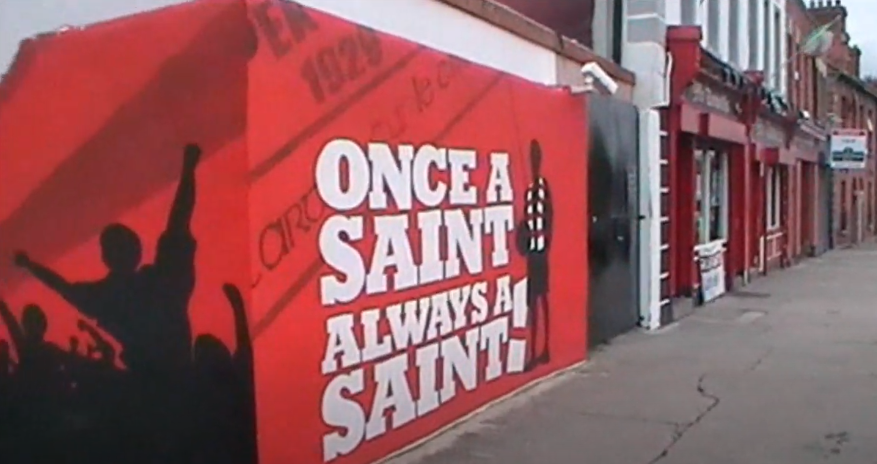
    Richmond Park is the well-known venue, pitch, and home, of St Patrick’s Athletic football team in Dublin, in the heart of Inchicore in Dublin.  

    Photo: Derek Price

    According to the team’s website, the ground was originally used as a recreational area by the British Army, from Richmond Barracks. This barracks has since been demolished many years ago. 

    The pitch was then unused for 3 years.  

    Brideville Football Club, originally based in The Liberties, Dublin. then began using the ground in 1925. 

    Although St Pats were founded in May 1929, back then they played their home matches in the Phoenix Park. 

    In 1930 Brideville F.C. moved from the Richmond Park football pitch to the Harold’s Cross Greyhound Stadium, as St Patrick’s Athletic then took it over and moved in. St. Pats used the ground until 1951, and then entered the League of Ireland, but the league declared the pitch inadequate, and for the best part of 9 years, St. Pats had to play on different pitches in Dublin, while they redeveloped Richmond Park. 

    In 1960, the team returned to the Inchicore pitch. The ground then closed for a upscaling in May 1989. Due to St Pats suffering financial difficulties, the team did not return to the site until 5 December 1993. 

    The ground is situated behind a row of terraced houses in a natural valley off Emmet Road, and is regularly used for the Republic of Ireland youth teams, and women’s soccer matches.  

    Richmond Park also is usually the venue for the non-league clubs in surrounding areas if they qualify for the FAI Cup. 

    Some music acts such as the 1970s and 80s rock band Thin Lizzy, have also used the venue to stage their concerts in the past. 

    In 2020, St Patrick’s Athletic used Richmond Park as a hub for donated items, and a food bank to provide aid to the needy during the COVID 19 pandemic, which was reported on the St Pats website, and in The Irish Times. 

    There are numerous shops, restaurants, cafes, and pubs in the area, which one could imagine, must enjoy the influx of football supporters and their families, buying lots of food and items, and increasing their business and livelihood.  

    There is also a high level of security provided by An Garda Síochána, at every match, to ensure that law and order is maintained, with several Garda squad cars, vans, and motorcycles present, to keep the fans and patrons on the straight and narrow. 

    The St Patrick’s Athletics’ fans have been very enthusiastic about their team staying in Inchicore village, but how do the locals feel about the soccer fans etc., being around the surrounding area? 

    “I’m not a Pats supporter myself, but I drink in the pubs around the area, and I’m usually there on the weekends. The atmosphere is great because of the matches, and I for one am in favour of it. It wouldn’t be the same without it,” said Johnny Byrne (48) from Inchicore. 

    Susan O’Donnell from Bluebell is a fan of soccer. 

    “I drop down to some of the home games in Richmond Park. I’ve not seen much of any serious trouble at the matches, I have to say. A bit of monkeying around at times, with some young fellas messing, shouting at, and slagging the other team’s fans, but nothing that would stop me from turning up at the matches. They’re a good bunch of lads overall, as far as I’m concerned.” Susan said. 

    Patrick Evans (55) said: “I don’t live around here these days, but my parents do. I’m not a football fan myself, but I do watch the odd match when it’s on TV. I come up on the weekends when most of the matches are on. The buzz here on match nights is great and livens up the area. The supporters seem so loyal and mad into it. I’d recommend any football fans to drop up and take in the experience, and see it for themselves, whether they’re from Dublin, Ireland, or abroad,” he said. 

    Several shop workers from the Inchicore area where also asked for comment regarding this article, but unfortunately all declined to voice their opinions, and participate on the day. 

  • “I Would Rather Die Here Peacefully, than be Killed There” – South Africans Living in Direct Provision on Hunger Strike Outside Dáil

    “I Would Rather Die Here Peacefully, than be Killed There” – South Africans Living in Direct Provision on Hunger Strike Outside Dáil

    By Jamie Ryan 

    Since Monday 21 October, these South African men and women who are living in Direct Provision have gone on a hunger strike in the hopes that the Irish Government will reconsider having South Africa listed on Ireland’s ‘Safe Countries’ list.  

    The EU and Irish Government define a ‘safe country of origin’ as a country in which: “there is generally and consistently no persecution, no torture or inhuman or degrading treatment or punishment and no threat by reason of indiscriminate violence in situations of international or internal armed conflict.” 
    Neels Heystek – a South African that are taking part in the hunger strike. Heystek told TheCity.ie his daughter is suffering from PTSD and is having regular panic attacks at school as a result of what has happened to their family in South Africa.

    “This is our last resort now.”

    Neels Heystek
    Passersby and sympathisers have donated water to the hunger strikers.
    On the otherside of Dáil Éireann’s gates, was a protest held by Irish Healthcare Workers for Palestine. Some of these protesters came over to the hunger strikers in support when a far-right agitator arrived.
    The Irish Healthcare Workers for Palestine lending their megaphone to the South African hunger strikers to drown out the far-right heckler. 
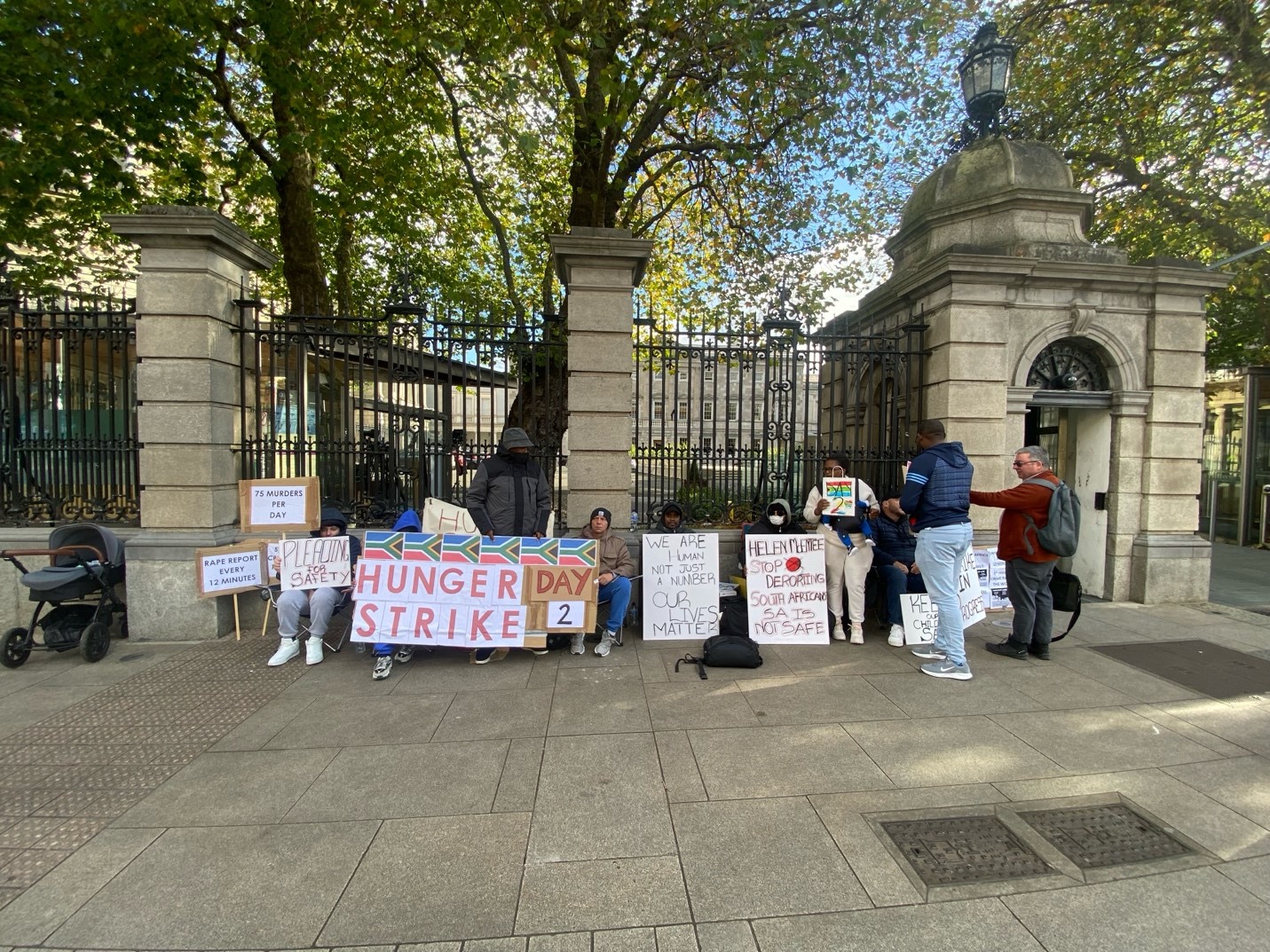
    A collection of the protester’s signs 
    • ‘Rape Report every 12 minutes’ 
    • ‘75 Murders Per Day’ 
    • ‘Pleading for Safety’ 
    Hunger strikers displaying their respective signs telling those passing by why they are on hunger strike.
    One of the protesters, down on their knees sticking together another sign for passersby and government officials coming through the gates of Dáil Éireann to see and take notice of.
    Brian Mogotsi is another of the hunger strikers.
    He is taking part in this protest in the hopes that the Government will engage in a dialogue with South Africans that are living in Direct Provision to reconsider their position on deeming South Africa as a safe country

    “I fled South Africa in need of safety.” 

    Brian Mogotsi

  • Filled to the Bram… Stoker festival 

    Filled to the Bram… Stoker festival 

    The October chill has hit which means the Bram Stoker festival has begun. It’s Dublin’s time to celebrate and honour Bram Stoker, the author of the most famous vampire around- Dracula. Events over four days and four nights lead you all around Dublin City, from the Casino of Marino to Dublin Castle, you are sure to learn all about Stoker and Dracula’s life.  

    On Friday the 25th of October a fantastic family friendly spectacle ‘Frank and McSteins Monster Laboratory- Out of the Lab and into the Fire’ took place in Dublin Castle.  

    Starting the evening early- queues had begun building up half an hour before the event started. 
    Groups of people entering the grounds at 6pm sharp- the tower highlighted red for Dracula himself 
    People were starting to warm up to the spooky ideas with interactive games and flames 
    Frank and McSteins helpers putting out the fire 
    Fire and crazy scientists meet art and street theatre for Halloween 
    Frank teaching the youth of today his evil ways
    Where there’s smoke there’s fire 
    Getting gothic at Dublin Castle
    Frank gave us a wave before the big show- little did we know what was to come
    Frank led the crowds through bringing this animatronic to life, many attempts were made, and many arguments were had with the other mad scientist McStein. Eventually, the two scientists pulled it together. 
    There he is, slowly coming to life
    And after a long day of creating life, fighting fire… and lighting fire, witches and ghouls alike skipped home ready for bed.
    These guys had seen enough madness to last them through Halloween  

  • Cuala triumph in first Dublin final since 1988 

    Cuala triumph in first Dublin final since 1988 

    By Oscar Lawlor Plazas 

    A nail-biting end to a dramatic game on a windy day in Parnell Park saw Cuala overcome local rivals Kilmacud Crokes with a last gasp hand passed point by Eoin Kennedy, after Luke Keating’s freekick fell short with seconds to go on Sunday afternoon. 

    This put a stop to Kilmacud’s hopes of winning 4-in-a-row for the first time since the 1960s and gave Cuala their first ever Dublin Senior Football Championship win, in their first finals appearance since 1988. 

    Players appeared to struggle to determine which way the wind was blowing. In the first half, it appeared to benefit Crokes, but that didn’t last long. It was evidently blowing in the main from the church- end and behind Cuala’s backs but was equally indiscriminatory and unpredictable throughout the afternoon. 

    Crokes tried to smother Cuala’s strong first half and contain the damage until they could make use of the wind in their favour, but they were guilty of a few hurried attempts at goal and, predictably, bad choices considering the difficult conditions. 

    With their ace attackers Paul Mannion and Shane Walsh each scoring one point in the first half, Crokes missed six opportunities, blowing attempts at the uprights wide or short into goalkeeper Skollard’s hands. 

    During this period, Cuala’s offensive style was much more direct and focused. They made fewer poor attempts and had some well worked teamplay as they repeatedly drove up the pitch in packs to take a healthy lead going into halftime.  

    Dublin defender Michael Fitzsimons contributed to their onslaught, by fist passing a smart point and following it up by hitting another creative score after flicking the ball over Walsh’s head and collecting it on the other side.  

    Cuala’s five-point advantage at the half was only cheapened by the fact that two goal scoring opportunities had escaped them in the first six minutes of the second half. 

    Con O’Callaghan had the first but was denied by brave defending. This was followed up by Niall O’Callaghan’s excellent strike at the top corner being elegantly tipped over the bar for a point by Devon Burns. 

    Within a frenzied few minutes though, everything looked as though it might change.  

    Cuala fans rush onto pitch after final whistle 

    The Dalkey men kept Crokes at bay with the odd score and some outstanding defending but couldn’t stop a more experienced Crokes side from cutting the margin to three points between the forty- and fifty-minute marks. This was then made worse for Cuala when after just a few minutes in play as a blood substitute, Kilmacud’s Luke Ward scored the game’s first goal to tie the score for the first time since the fourth minute, when Mannion found him with a sweeping pass across Cuala’s last line of defenders. 

    Then, during the break in play, there was drama at the opposite end of the ground when Con O’Callaghan was shown a straight red card by referee Sean McCarthey at Stillorgan sides goalmouth, for an elbow on Crokes goalkeeper Devon Burns. This made for a tense end to the finals for both sets of supporters, but the purple and gold of Kilmacud Crokes didn’t have enough in the end to halt a history making day for the red and white of Cuala. 

    The team’s victory was well-earned, handling the match and Storm Ashley with skill and caution. They now progress to the quarterfinals of the Leinster Senior Football Championship and will take on whoever comes out on top between the Wicklow and Longford Championships respectively. 

    Scorers for Cuala: L Keating (0-3, 0-2 frees); C Doran (0-3); M Fitzsimons (0-2); E Kennedy, C McMorrow, P Ó Cofaigh Byrne, P Duffy N O’Callaghan and C O’Callaghan (all 0-1). 

    Scorers for Kilmacud Crokes: P Mannion (0-4, 0-1 free and 0-1 mark); S Walsh (0-3, 0-1 free); L Ward (1-0); H Kenny, C Dias, D Mullin (all 0-1). 

    CUALA: R Scollard; D Conroy, M Fitzsimons, E O’Callaghan; E Kennedy, C McMorrow, D O’Dowd; P Ó Cofaigh Byrne, P Duffy; C Dunne, C Ó Giolláin, C Doran; L Keating, N O’Callaghan, C O’Callaghan. 

    Subs: C Groarke for Ó Giolláin (43); C Mulally for Dunne (48); L Ward for O’Brien (blood, 54) and for Murphy (56). 

    KILMACUD CROKES: D Burns; M Mullin, T Clancy, D O’Brien; M O’Leary, A McGowan, J Murphy; B Shovlin, R O’Carroll; H Kenny, C Dias, D Mullin; P Mannion, P O’Connor, S Walsh. 

    Subs: C O’Connor for O’Leary (43); T Fox for Kenny (45); M Conroy for D Conroy (56); S Cunningham for O’Connor (71). 

    Referee: Sean McCarthy (St Vincent’s). 

  • Big wigs, Fake Tan, Cakey Makeup and Bedazzled dresses.  

    Big wigs, Fake Tan, Cakey Makeup and Bedazzled dresses.  

    By Molly O’Reilly

    Irish dancing is an underrated sport in Ireland that has multiple aspects to it including pressure for success, emotional strain, sense of community, politics and beauty expectations. 

    Aoibhinn Gannon from Sligo a former Irish dancer from the ages of three to seventeen spoke on the interlinked nostalgia and unspoken realities of the Irish Dancing world.