Tag: slider

  • Combining Football and Art: An interview with Barry Masterson

    Combining Football and Art: An interview with Barry Masterson

    By Dylan Kerrigan

    Dylan Kerrigan talks with illustrator Barry Masterson about his career and work to date.

    Image Courtesy of Pixabay

    If you recently attended the Republic of Ireland’s World Cup qualifier versus Portugal, the under-21 European Championship qualifier versus Italy, the FAI Women’s Cup Final or Women’s World Cup qualifier versus Slovakia, you may have picked up a matchday programme booklet with impressive pieces of artwork on the front cover.

    This work was carried out by Barry Masterson – a freelance illustrator who runs his own print shop and produces content such as football matchday programme covers, book covers and other online content.

    Describing his early interest in art, Masterson said “I started drawing as a kid with no real plans about what to do. When it came to choosing what to do for college, that is a tough time as a kid particularly if you don’t know what to do and I certainly didn’t. I took a year out and decided to do a portfolio course because to get into art college you have to do a portfolio. I then fell into a fine art degree and that was a good experience.”

    Masterson described sport as his biggest interest growing up and tried to find a way to incorporate it with art. Following a break from the art scene due to other work commitments he said: “It took a few years to start drawing again and I began posting things online. The sports art scene wasn’t as big back then. Social media was still relatively new, but people liked my work and they shared it around. I made a lot of League of Ireland work and people were excited to see it. People engaged in that because it meant something to them.”

    To create his work Masterson uses a digital drawing tablet and photoshop, where you “basically draw directly onto the screen.”

    He said: “It is kind of the same as using paper or paint but it’s digital. It is the same process and gives you a lot of flexibility. In college there was a lot of printmaking and a lot of traditional ways of making images like carving into wood and when you leave college you don’t really have those materials anymore, so using the digital stuff made a lot more sense. I taught myself how to do that and I am still learning.”

    The last game of the Republic of Ireland’s World Cup qualifying campaign came against Portugal just two weeks ago – the first time the Aviva Stadium had been sold out since the beginning of the Covid-19 pandemic. The ‘Limited Edition Souvenir programme’ cover illustrated by Masterson featured a goal scored by Ray Houghton at the World Cup in 1994. To get to the stage where his work was on display to thousands of people on matchdays, Masterson said that “it took a few years because when you are learning from scratch it takes a while to decide what images you want to make and why. I also kept on tagging the FAI (Football Association of Ireland) in my posts, hoping they would see it. I then got an email from the Communications manager and did the artwork for a book called ‘The Greatest League in the World’ and that went down quite well, so I got to do the programmes for the Nations League in 2018.”    

    Many football matchday programme covers that have been illustrated by Masterson have a particular theme, with the programmes illustrated for the men’s 2022 World Cup Qualifying campaign aiming to capture past World Cup moments. For example, the programme illustration for the home game against Luxembourg in March featured Alan McLoughlin’s goal versus Northern Ireland in the 1994 World Cup qualifying campaign. The match against Azerbaijan featured the penalty shootout versus Romania at ‘Italia 90’ and the following illustration for the game against Serbia saw Robbie Keane’s goal and celebration at the World Cup in 2002 as the front cover. Other work for other campaigns such as the Euro 2020 qualifying game with Denmark featured “the idea of a child aspiring to play for Ireland.” 

    The League of Ireland is associated with a lot of Masterson’s work, and he is aiming to illustrate every stadium in the League. Dalymount Park, Tolka Park, The Showgrounds, Richmond Park, Finn Park and The Markets Field stadium are some examples. Masterson describes these drawings as “the ones that probably took the most work. “

    “They take a lot of time, and they can be tough on your wrist after a while. But they are spaces I love, and they have so much life and character because so much has happened there,” he said. There are features that all football fans recognise when visiting grounds like Dalymount Park, such as the floodlights and the alleyway entrance to the ground, which are both featured on Masterson’s website.

    Other work displayed on Masterson’s website include Serie A portraits of players such as Andrea Pirlo and Francesco Totti, illustrations for books like ‘Heart and Spirit: A footballing history of the Republic of Ireland’, portraits of League of Ireland players as well as other Irish sporting faces like Katie Taylor and much more.

    All of Barry’s work and shop is available by following the link: https://barrymasterson.com/.

  • F*ck The Fees student protest takes place outside Leinster House

    F*ck The Fees student protest takes place outside Leinster House

    By Shay Galon

    A group of people holding signs and flags

Description automatically generated with medium confidence

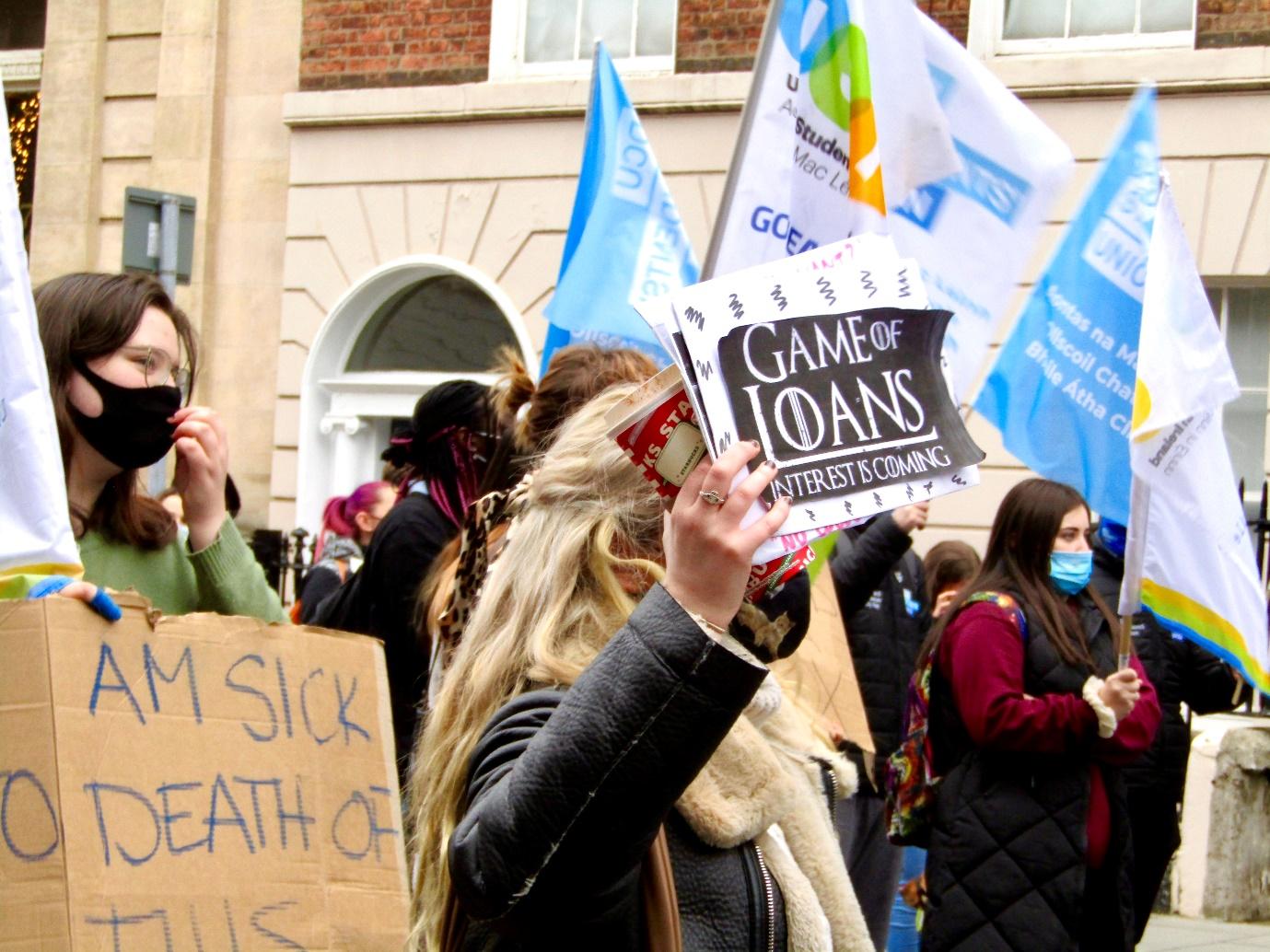
    The Union of Students (USI) organised a student protest in Dublin outside Dáil Éireann on 23 November demanding the Government puts an end to the country having the highest contribution charges for first time undergraduates in the EU. Student Unions (SU) in Galway and Cork have also organised protests in their own cities.

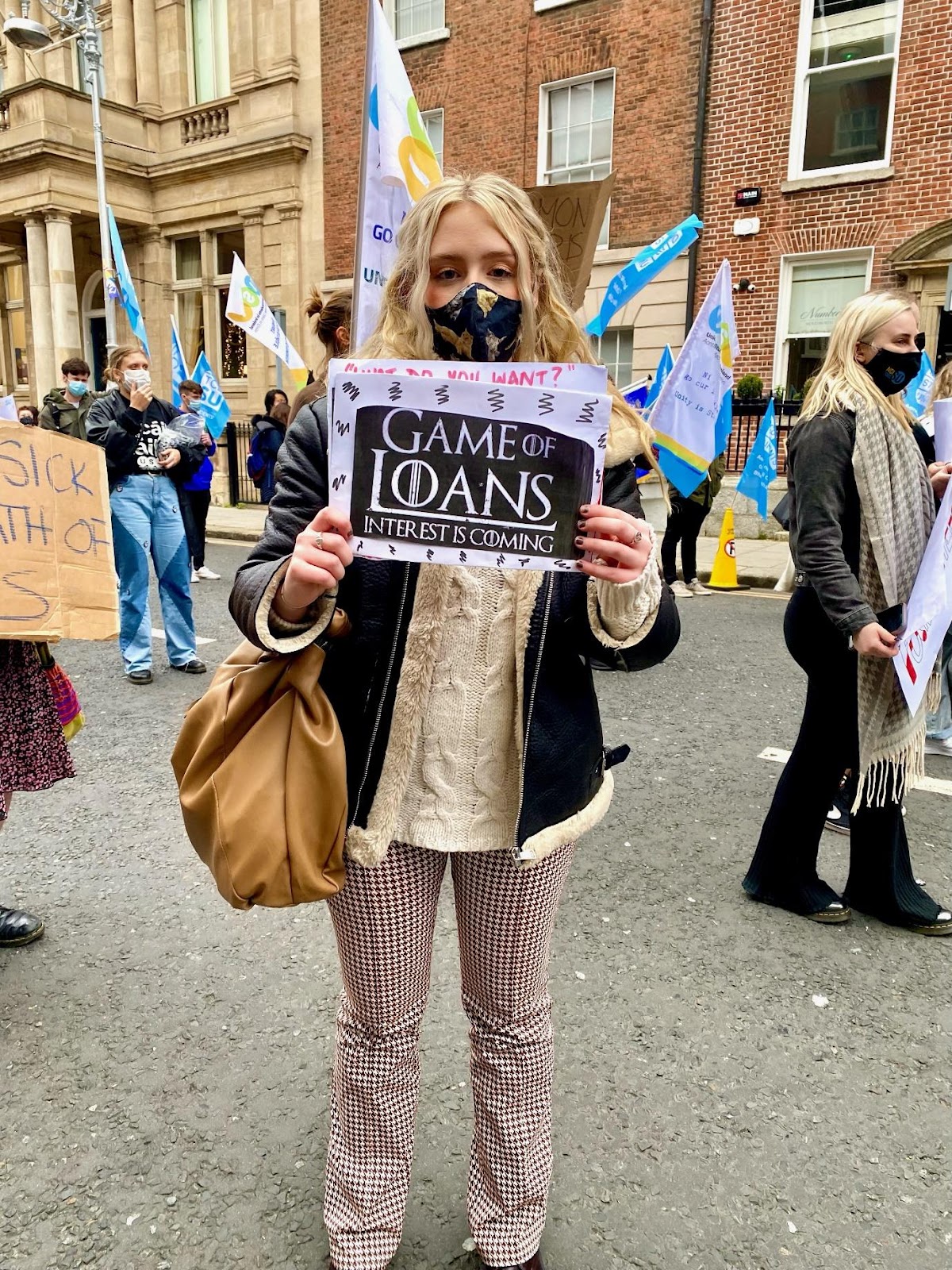
    SU’s from TUD, DCU and TCD are among some of the universities in Dublin who attended the protest demanding the Government to invest in education. Students holding signs containing the phrase “#F*ckTheFees” as well as speakers blasting music were outside Leinster House on Molesworth Street. 

    For Irish residents and those in the EU, college in Ireland are considered free but there is a contribution charge for up to €3000 for each person who wish to attend college. Due to these ‘fees’, students in Ireland are currently paying the highest college fees in the EU. The F*ck the Fees campaign aims to highlight the frustration felt by third-level students towards the Student Contribution Charge. Supports such as the SUSI grant is simply not sufficient enough to maintain a good living condition for these students.

    “The rising cost of living, I still struggle to pay for my transport and college materials with very little help from the Government,” admits Emily Carruthers, a student from NCI who attended the protest after being “let down by SUSI twice and had to fight for my placed to attend third level,” education.

    According to USI, recent research showed that the cost of getting through a four-year degree is at an average rate of €50,000 for students and their families. 

    “Students have been angry for some time about the huge cost of getting a higher education in Ireland,” Clare Austick, USI President stated. 

    “USI, SUs and students across the island feel that students were scapegoated and their sacrifices diminished, throughout the pandemic.”

    The main demands of the campaign include the abolition of the €3,000 student contribution charge, the reformation of the SUSI grant scheme to ensure that students are fairly assessed as well as funding to develop more affordable purpose-built student accommodation. 

    Earlier in the year, there was an online protest via Zoom campaigning for the same cause which was attended by hundreds of students. It is evident that students are fed up with the high fees, rising cost of living and the underinvestment in higher education. 

    “We’re angry about the cost of student housing, which continues to put higher education beyond the means of many in the country.  Meanwhile, property developers repurpose designated student rooms as fancy apartments for the wealthy,” USI said.

    “Yet again in Budget 2022, Government showed that it has no interest in reducing the €3,000 per year Student Contribution Charge, which is the highest fee for an undergraduate degree in the EU,” Beth O’Reilly, USI Vice President for Campaigns said. A picture containing building, outdoor, person, ground

Description automatically generated

    @emilyjcarruthers from National College of Ireland showing her support at the protest.

    “These three regional protests are a chance for students to get out and show the level of anger and frustration they are feeling.”

    As well as the soaring price of accommodation in Ireland, the recent Budget 2022 displayed no intention of introducing legislation or taking any necessary action to make housing more affordable. 

    “Students cannot get accommodation, and many have started this semester making long commutes, sleeping on couches, and staying in hostels or hotels not knowing if they will be able to continue with their courses,” Austick added.

    “Even after the miracle of getting through a very expensive four-year degree, we’re not even able to buy a home for ourselves because of the outrageous housing prices… no wonder so many of us leave,” said Jodie Chalkley, a second year law student in Maynooth University.

    New additions to the upcoming budget, however, have been praised by USI with funds for student mental health services being introduced.

    “The €5 million funding for student mental health and wellbeing services is vital to start to address the mental health difficulties faced by students that were already an issue before COVID and have only worsened as a result of the pandemic.”

  • COP26: Ireland’s future in tackling the climate crisis

    COP26: Ireland’s future in tackling the climate crisis

    By James Hagan

    The COP26 climate summit has finished with varying results of satisfaction. Taoiseach Michael Martin announced state plans for drastic changes in Irish climate action yet some question these announcements’ feasibility.

    The two-week long summit brought UN member states to Glasgow to discuss plans for dealing with the climate crisis within coming decades, with the main theme of the event to ‘keep 1.5 alive’.

    The ‘1.5’ in question refers to the global pact to keep the average worldwide temperature from raising above 1.5 degrees Celsius by 2100. Climate Action Tracker, a research group that follows international progress to tackle climate change, states that these ambitions must be followed through or there will not be nearly enough progress made to keep the 1.5 alive. 

    As reported by Sky News, Climate Action Tracker said that while these promises were environmentally beneficial, many of these targets had been previously promised and never achieved. 

    One Irish example of a previously announced project was the Taoiseach’s announcement to bring Irish carbon emissions down by 51% between 2018 and 2030, and be net zero by 2050, but such targets had already been set in the beginning of 2021.

    Some key announcements tied to Ireland includes the Taoiseach’s announcements to bring Irish carbon emissions down by 51% between 2018 and 2030 and be net zero by 2050. Ireland, along with over 100 other nations, signed a pact to cut methane emissions down by 30% by 2030. 

    Also announced by Martin was an increase to the climate finance commitment budget. Currently €93 million annually, the state announced a budget increase to €225 million over the next four years.

    RTÉ News reports that environmental blogger John Gibbons spoke to Prime Time on the Taoiseach’s announcements. Although he expressed support for the Taoiseach’s ambition, he explained that planning goals for a decade or longer leaves out the urgency of immediate climate action, claiming the 2030 targets “let the 2020s off the hook”. 

    Gibbons also spoke about the need for less dependence on beef and dairy, and to focus on organic agriculture. While this currently makes up 2% of Ireland’s agricultural industry, the EU wants it to be at 25% (via RTÉ News).  

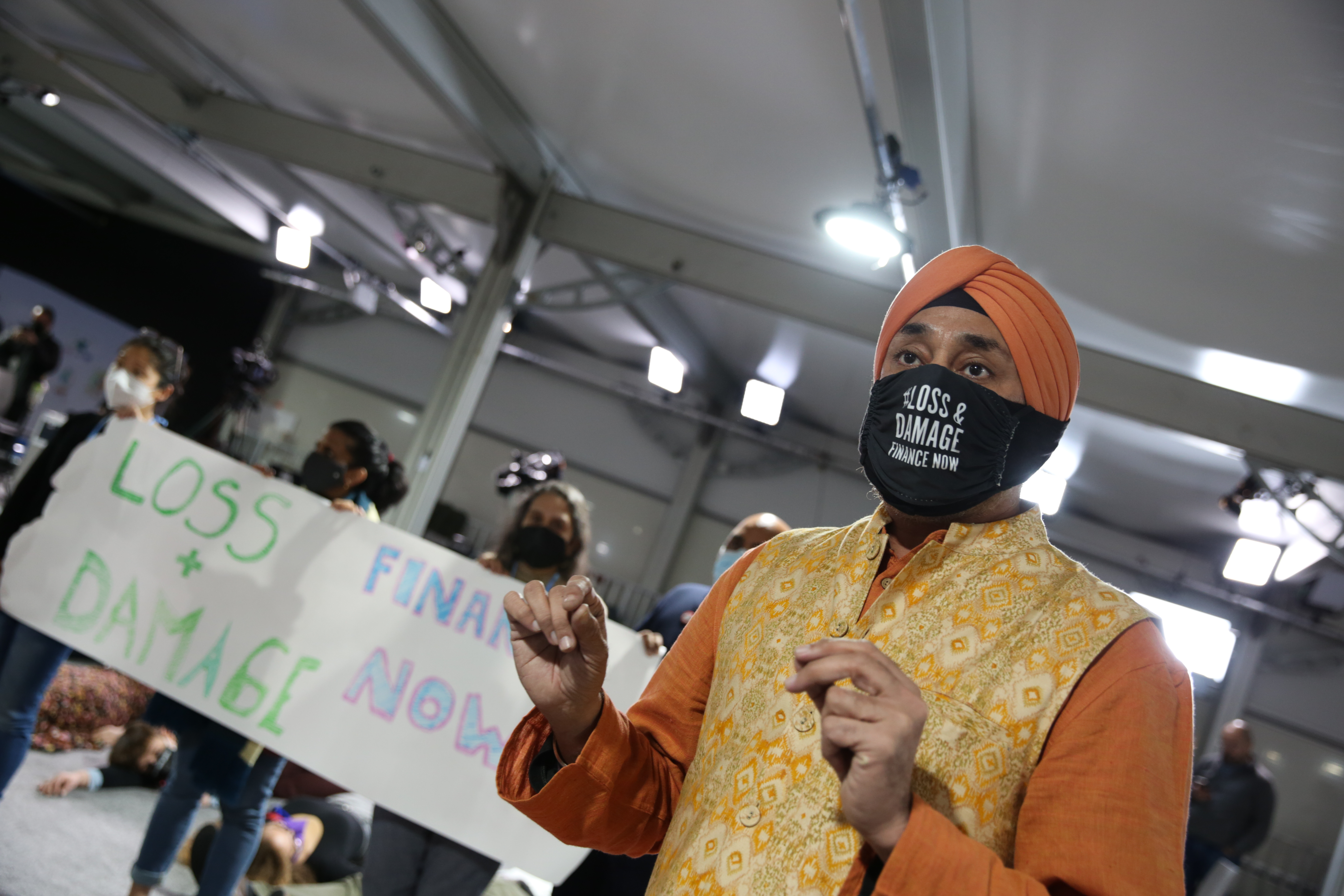
    (Above) While many governments claimed COP26 was a landmark in climate action, many environmental groups protested that these plans were not enough (image via U.N. Flickr) 

    The City spoke to Pat Barry, CEO of the Irish Green Building Council (IGBC), about his thoughts after the summit announcements. 

    When asked about his thoughts on COP26, Barry explained that the announcements met will be enough to keep firms like the IGBC busy. “We’ll be a part of this goal to be net zero by 2050, and we’ll have to figure out how we’ll do it practically. Construction amounts to around a third of all Irish emissions, from transport, to electricity, material usage, and the like” he told.

    According to Barry, the IGBC is an environmental solutions firm created to work with the government and businesses in the construction sector in order to transition industry practices to be more environmentally safe. They also ensure education and policy fulfillment in the construction sector.

    (Above) The 26th Conference of Parties (hence COP26) meet annually – however people are unhappy with promises made in the 2015 Paris Climate Agreement not being met (image via U.N. Flickr) 

    Minister for the Environment Eamon Ryan said there hasn’t been enough progress at any COP summit, saying nations have got to be “impatient for progress”. When asked on Ryan’s comments, Barry agreed. 

    “Politicians may find it difficult to win a vote if they show that they want rapid progress. A lot of them are afraid to tell the truth, and that is that we need to change how we eat, travel, and build. These climate needs require a total change in consumption, but if done properly, it shouldn’t impact everyday life too severely” he explained. 

    The Taoiseach also said that it was economically essential that Ireland addresses the climate crisis, as an “enormous disruption” caused by extreme weather would affect Ireland economically. Barry elaborated “that if Ireland doesn’t show that if the nation isn’t serious about the climate crisis, it will be found out, and quickly.” 

    “A bad reputation is bad for business, and that will affect (us) if we don’t make a change. It won’t just affect businesses; it’ll affect the public. Increased rainfall, more severe heat, and these more extreme weather conditions will cost home and property owners if its left unaddressed.” 

    The City concluded our interview with Mr. Barry by asking what both his and the IGBC’s thoughts on the COP26 summit. 

    “Unless politicians know they have their electorate’s confidence in serious campaigning for climate action, they won’t make serious actions to support change. People are going to need to accept that a change in lifestyle, for everyone, will have to be committed. This change is in diet, travel, and in the home. However, not everyone will be able to afford these changes, which is why the government needs to step in and support these changes. Once that’s done, we’ll notice a big difference.”

    All images were used with permission from the U.N. Flickr account.

  • ‘We will keep dancing’ – Uproar as government enhance night club restrictions

    ‘We will keep dancing’ – Uproar as government enhance night club restrictions

    By Leigha O Reilly Hughes 

    With the new restrictions hitting the hospitality sector once again, Leigha O’Reilly Hughes reports on the updates and how the nightclubs adopted new guidelines to keep their doors open.

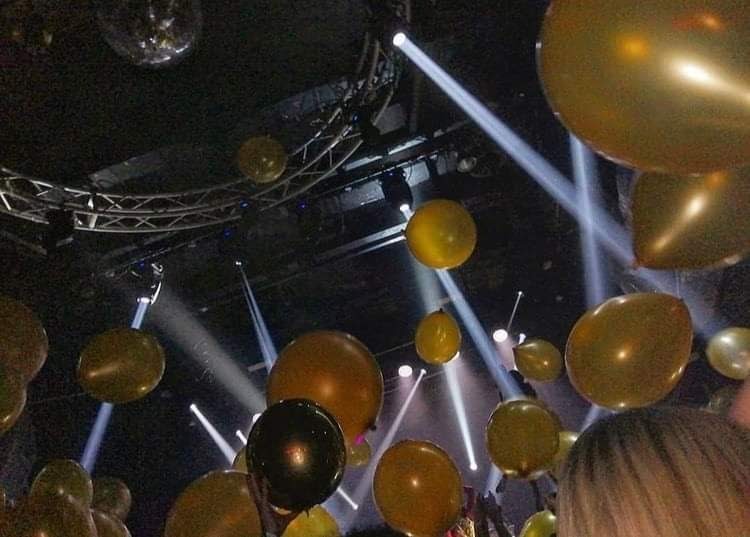
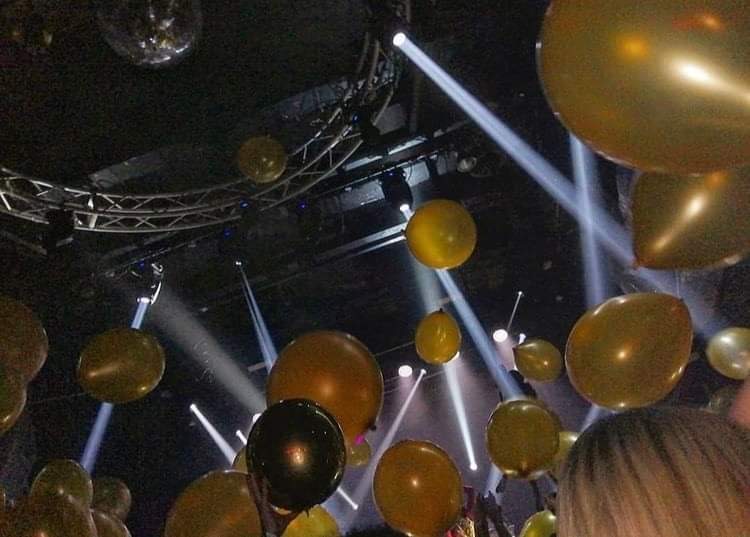
    Ceiling of a nightclub only recently opened back up – image by Leigha O’Reilly Hughes

    The government has announced new closing times for nightclubs, pubs and restaurants. From Thursday the 18th of November, they must close at midnight. This is due to the high number of COVID cases the country is experiencing.

    It has been less than a month since the curfew of 11:30 was lifted on pubs and restaurants and nightclubs were given the go ahead to open their doors.

    Nightclubs were the last to open since the pandemic hit in 2020. They were closed for more than 18 months. 

    Nightclubs were given specific guidance in order to open back up to the public. Covid passes are mandatory for entrance, face masks are to be worn except for when dancing, drinking or eating, and pre-bought tickets were also needed to gain entry. 

    These rules were put in place for protective measures to help avoid a surge in cases of Covid-19 cases. 

    The new restrictions were issued due to the high number of daily Covid-19 cases, as well as the hospital and ICU numbers. On the day the restrictions were announced there were 4,407 new cases confirmed by the Department of Health. There were 614 people in hospital, with 114 of them being in the ICU.

    The new restrictions have been a major hit for nightclubs. They were the last in the country to open and are now being forced to close their doors early. 

    Many nightclubs have taken to social media to announce the restrictions, while also showing how they feel about the situation. 

    Tramline, a nightclub located on D’Olier Street in Dublin took to Instagram to say “We will keep dancing.”

    “We are devastated at today’s government announcement. We have followed every guideline and put every safety measure in place. We have opened our doors and provided purpose to countless staff and artists over the past 3 weeks,” says the Instagram post.

    “We are devastated,” says Caoimhe, the creative director and social media manager in Tramline. 

    “In order to open, we had rules of queue systems, masks enforced in certain areas, tickets sold in advance and Covid isolation areas. This was all a massive change we had to take on as a team,” says Caoimhe. 

    “With the new restrictions, venues must close at midnight. This halves the shift times for our staff, lessens the experience for customers and limits any real progress we have made.”

    Caoimhe also expresses how closing the nightclubs early can be dangerous for those who enjoy nightlife. 

    “In Tramline we have toilet facilities, security, trained medical staff and access to emergency services. The above cannot be said about the illegal raves and after parties that will now happen. This is where our clubbers will go.”

    People have also taken to social media to express how they feel about the new restrictions for nightclubs. 

    People feel as though the hospitality and arts sector, as well as young people are being left behind by the government once again.

    Links to tweets:

  • Can’t pay? Move away

    Can’t pay? Move away

    By Leigha O Reilly Hughes

    With homelessness, young people leaving the country as they are unable to afford rent, families living in hotels and the lack of housing for those who need it, the housing crisis is one of the most prevalent and pressing issues that Ireland is facing. 

    There are many factors that make up the cause of the housing crisis in Ireland, and the government is one of the biggest problems. The government has a large share of the responsibility due to the fact that there have been years of housing issues in the country with not much progress to solve. 

    It is also the result of allowing Irish property to be placed in the hands of profit-seeking corporations rather than those seeking to provide housing for those who need it.

    Homelessness

    One of the biggest problems the housing crisis has caused is the number of homeless people in Ireland. 

    There are many causes to homelessness in Ireland, such as personal reasons like mental health and abusive relationships. However, the biggest cause of homelessness in Ireland is due to the lack of affordable housing available.  

    The Department of Housing releases monthly data that captures details of individuals in state funded emergency accommodations. 

    The monthly homelessness report of August 20201 showed that 6,023 homeless adults entered emergency accommodation. 4,220 of those individuals were from dublin. The number of homeless males made up 3,949 of this number, which is 66%. Females made up 2,074, which is 34%.

    Source: Department of Housing 

    There were a total of 953 families homeless in Ireland in August 2021. 723 of these families were from Dublin. This resulted in 2,189 total child dependents. 

    Ballymun, which is an outer city suburb of Dublin, is hit hard with homelessness. 

    “20% of Dublin’s homeless are from Ballymun,” says Dean Scurry, a homelessness activist from the Ballymun area. 

    Abandoned homes in Ballymun. Poster reads “this house could be a home”

    “With that there are about 90 vacant homes in Ballymun that could be used for families instead of leaving them in hotels for other organisations to make money,” says Scurry. 

    Abandoned homes in Ballymun

    The impact on young people

    The housing crisis has caused serious problems for the younger generation of Ireland. Younger people between the ages of 20-30 are paying higher amounts on housing for smaller and rented accommodation. 

    Ireland also has one of the highest rental costs in Europe. 

    According to the Irish Times, the average monthly price for rent stood at up to 1,477, while the average is now 2,035 euro. This is 100% up from the 742 euro a month that was seen in 2011.

    These high rent prices have resulted in young people living at home, unable to afford rent and save for mortgages. It has also caused young people to emigrate to different countries as affording rent is out of the question. 

    Eva Tiernan, 22 from Dublin who has a Level 8 in science degree from UCD, has had to emigrate to Whistler Canada for the foreseeable future. 

    “The renting prices in Dublin are unrealistic. I would love to be able to move out in my city surrounded by the people I love, but I can’t,” says Tiernan.

    “I feel like my only option is to move to another country so I can live a life where I’m not solely working to pay rent. I want to eventually come back to Dublin, but how will I ever be able to rent and save for a mortgage there?”

    In the last four years, 308,000 people have left Ireland – 125,000 of those aged between 15 and 24 years.

    The government’s new “housing for all” strategy intends to address the housing issue by expanding supply, promising to build 33,000 homes per year by 2030, a level of residential building not seen since before the financial crisis.

    A decade of escalating costs and severe undersupply has created a divide in Irish politics, isolating major parties from a growing number of young voters.

    When the Budget of 2022 was released, people were hopeful that the government would provide a solution to help put an end to the growing problem. However, the Government failed to commit to a target of 20% of all housing stock to be social housing, with an annual capital envelope of €3.3bn for social housing. The allocation of €1.7bn for a social housing build of 9,000 units and €224m for 4,100 affordable units in 2022 needs to be increased substantially

    If rent costs are not lowered and more affordable housing isn’t being built for those who need it, homelessness and emigration of Irish people will continue to rise. 

  • The Wonder Women Club Wicklow – the importance of supporting women

    The Wonder Women Club Wicklow – the importance of supporting women

    By Julia Brennan

    (Photo: Creative Commons license)

    A group of ladies proudly known as The Wonder Women from county Wicklow band together to chat about security in Ireland for women.

    A local women’s chat circle has opened up in the centre of Wicklow to both promote womens’ well-being and have frank and healthy discussions simply about what it is like being female. They have named themselves The Wonder Women Club, a local drop-in where women can support women through deep and meaningful conversations on female empowerment and self-love.

    The meetings consist of sitting, listening and learning intently about the different life journeys of the individual women present, the youngest being 20 and the eldest 65. Discussions can range from how social media affects the female body image to consent in sex to women’s safety in nightclubs. Every week, different topics can be discussed and experiences shared and empathised with. When entering the small room of twinkly lights and relaxing music it is like entering a new atmosphere, a safe space where no judgement could possibly be felt. 

    After many events involving numerous breaches of security for women in both the UK and Ireland came to light once again, it felt like a good opportunity to have a sit down and ask what real life women think of Ireland’s treatment of its female population.

    I spoke to Hannah and Sheenagh, two young aspiring women and co-founders of the Wonder Women Club. The intuitive pair came together to create a group of like-minded people who could chat through all of their similar experiences as women in Ireland.

    “The inspiration was essentially the fact that we needed a space for ourselves as much as we realised other people needed it,” said Sheenagh. “Both me and Hannah went through a series of events that genuinely felt targeted at us as women, for example different forms of sexual harassment, different forms of street harassment and we were sitting back saying that there is just nowhere we can go to sit and talk about this stuff,” she added. 

    Hannah, the other half of the brains behind the operation had herself experienced sexual assault a few weeks before the club was set up. “I really wanted to meet women that would support me, there can be a difference between talking to strangers and to friends, friendships can be very intense but with people who don’t know you coming to support you, it can feel very nice,” she said.

    I asked the group if they felt that Ireland was progressive enough in regard to security for women, all of them collectively said no. 

    “Sheenagh and I had a bad experience on the DART recently where we and another girl were harassed and it was not even that late at night or anything,” said Hannah. “I think there should be security guards on DARTs for people’s safety, it is such a scary feeling to be alone or even with a friend and be harassed like that,” she added.

    “It’s almost like there are more ticket inspectors than security guards,” said Clara. “There are plenty of security guards on the Red Line but it feels like they are there solely for intimidation rather than to be of help.”

    “Security guards come on the DART to intimidate but they are never there when something actually goes down,” added Sheenagh. Sheenagh also stated that Hannah texted the emergency number made available on board when anti-social behaviour occurs, no one responded. “Those who are supposed to help don’t care, and it’s awful because it can be such a comforting feeling that if something did happen to you, someone would care,” she said.

    Many of the members attending the chat circle all had varying reasons for taking part. Clara had voiced that finding a club after leaving school was challenging. “There aren’t very many places outside of school or college where you can go and meet people of different age groups that isn’t a sports club or a Slimming World group, there was no middle ground until this came along,” said Clara.

    Emily, another participant, told me that despite having a friend group with similar interests, chatting about female-orientated things proved tricky. “In my first year, I fell into my friend group who are mainly all guys. We all like the same stuff and we’re all kind of nerdy and get on really well together but there are just some things that I feel I can’t talk about with a group of all guys but that I can talk about with other women,” said Emily.

    “Recently we had gone on a holiday and bear in mind, they have known me for nearly a decade and they asked me why I wear so much makeup, I said it’s not for you it’s for me,” she said with a laugh.

    Joan, an older woman who had moved from Tallaght to Wicklow to be with her husband fifteen years ago, told me she had seen an advert for the support group on Facebook at a time when she had been feeling particularly low. “My husband has dementia and Parkinsons, and I feel very alone, I know nobody here, most people I know are back in Tallaght so I feel it is lovely to be able to come and talk to a nice group of women,” she said.

    The way in which the group brings up subjects that could be deemed ‘taboo’ or uneasy for others also seems to be a very positive factor for members. “For me to be around a group of like-minded women and be able to discuss topics particularly ones that are uncomfortable is great because a lot of the time you can think: am I the only one going through this or is there something wrong with me? And it can be nice to find out that there are other people going through the same thing,” said regular member Anzel.

    Colette, another regular member, had known Sheenagh and Hannah for years before the group started. “I thought it was an amazing idea, I felt it would be nice to hear other people’s perspectives and also talk about mine and maybe learn a bit from all of it,” she said.

    Another member, Róise, voiced that events in the UK drove her to search for a movement that felt similarly in her frustration. “I was angry about what happened to Sarah Everard, and my boyfriend suggested I join a movement as a way of putting my anger into something and all other movements appeared really big or too far away which felt overwhelming, then I found this and it seemed like a good mix of fitting it into the week while also being able to make friends,” she said.

    Upon meeting this group of unique individuals I realised that all it can take is just one small group of incredible and supportive women to make a powerful impact on society today.

  • Steady rise in fuel prices causes stress in Ireland

    Steady rise in fuel prices causes stress in Ireland

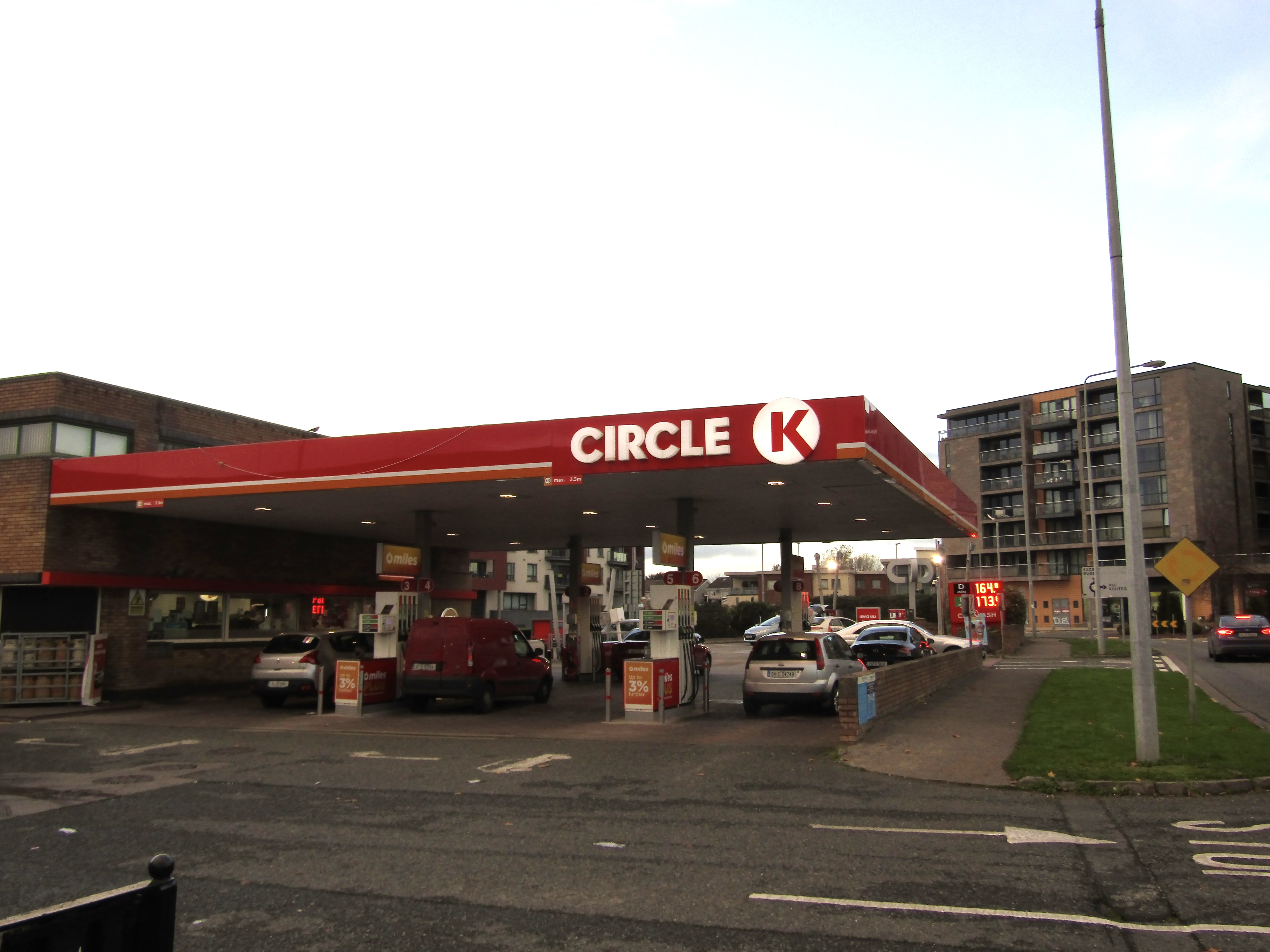
    Fuel prices continue to increase throughout the country. Photo credits: Shay Galon

    By Shay Galon

    Amid the rising fuel prices in the country, reporter Shay Galon looks at why the costs have increased this past year.

    With minimum prices at €1.70 per litre for petrol and €1.60 for diesel in several petrol stations, it is the highest fuel costs the country has seen in almost ten years.

    “Demand for oil dropped considerably during the Covid pandemic, which had a devastating impact on oil production as demand for the product dropped, and so consequently did supply,’ Anna Cullen, AA Ireland, stated.

    The demand for oil declined dramatically during the lockdown months in 2020 which naturally reduced the oil production. As the demand lessened, as did the supply. Cullen also outlined that the supply for fuel has not caught up to the demand for oil as traffic levels increase due to the reopening of the country. With more and more cars on the road, it is evidently more difficult for oil producing countries to catch up to the increasing demands, resulting in global shortages.

    As oil production fell last year, it had a positive effect on fuel prices for the consumer as there was a surplus of oil. This also had a positive effect on the oil industry as some reported evaporating profit, massive job losses and giant write-downs. 

    The AA decided to look further into the increase of prices and released a report on the annual fuel prices dating back 10 years comparing the prices of petrol each year. 

              2020
    Table

Description automatically generated

    2021

    Table

Description automatically generated

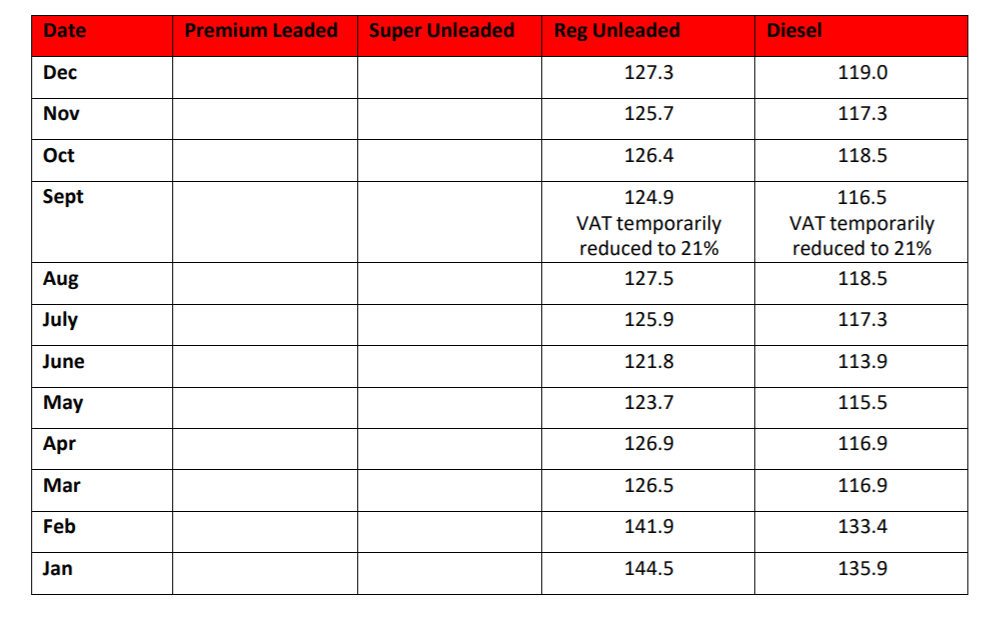
     As of September 2021, there has been a 24.8% increase in petrol and 24.8% in diesel prices compared to 12 months prior. 

    “This time 12 months ago the average petrol price was 124.9 cents per litre, while diesel was at 116.5.” 

    2019

    Table

Description automatically generated

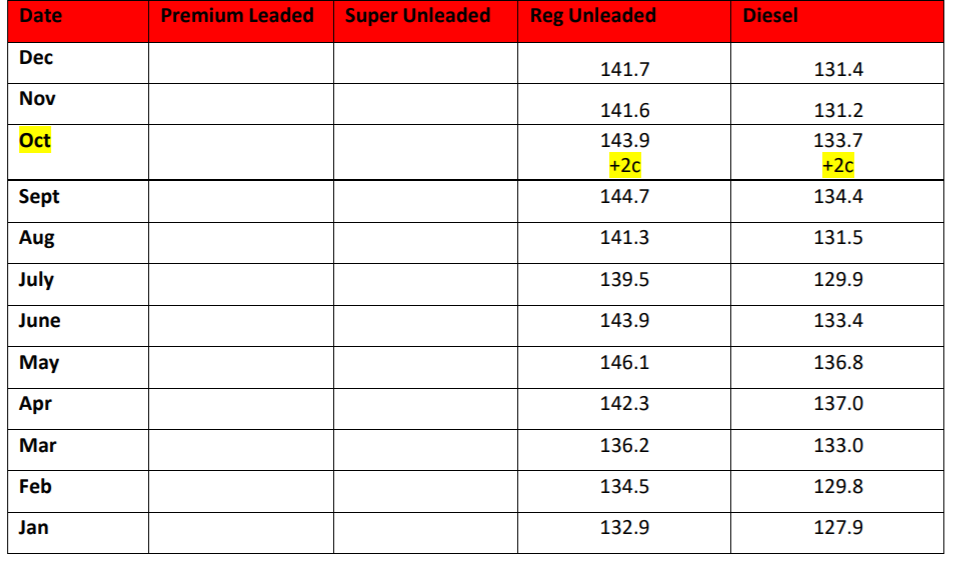
    Looking at the year right before the pandemic, the price for one litre of petrol was 144.7 cents while diesel costs 134.4 cents per litre. 

    The Head of the International Energy Agency said that 2020 represented the worst year in the history of the oil markets. Oil consumption fell by 9.1 barrels per day which equates to 9.3% last year.

    Not only has the pandemic affected the supply and demand of fuel, but the Government tax in the recent Budget 2021 of two cent on a litre of petrol and 2.5 cent on a litre of diesel, along with the annual escalating carbon tax, have left consumers struggling to pay for petrol, diesel or even heating for homes.
    Chart, line chart

Description automatically generated

    Source: https://www.globalpetrolprices.com/Ireland/gasoline_prices/

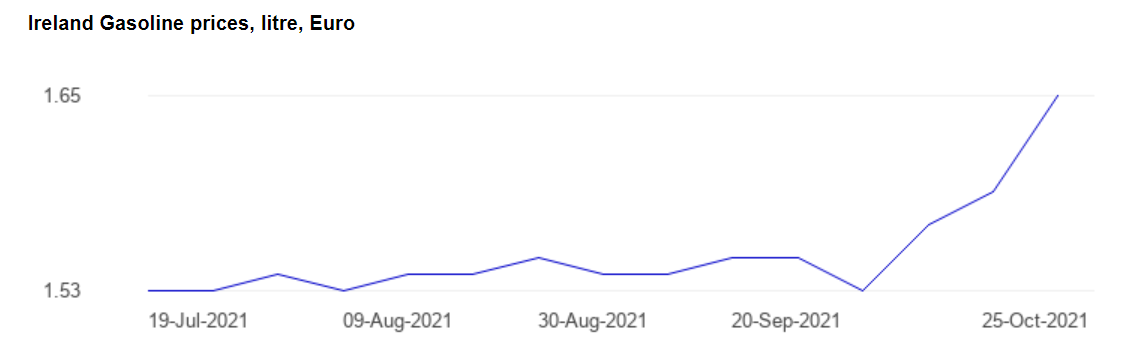
    These are the petrol prices for Ireland from July 19, 2021, to October 25, 2021. According to the report, the average value for a litre during that period was 155 cents with a minimum of 153 cents on July 19 and a minimum of 165 cents on October 25. 

    “With winter approaching us, temperatures are set to drop even more. Demand for oil has risen and will continue to rise even more.”

    The Organisation of the Petroleum Exporting Countries (OPEC) released an outlook report which said that global oil supply will continue to rise until it plateaus but not until 2035. Due to this, petrol prices will most likely continue for consumers as oil shortages resume around the world.

    However, with the popularity of electric cars in recent times, the demand for fuel could also lessen, allowing the supply to meet the demands. 

    Prices start at 173.8 cents per litre of petrol and 164.8 cents per litre of diesel. Photo credits: Shay Galon

    “So, in the future, one could argue that oil demand may drop as the world switches to electric vehicles and green energy,” adds Cullen

    However, the transition from petrol or diesel cars does not  necessarily rule out oil consumption for rural residents or at home heating. Oil will always be in demand, even into a greener, more sustainable future.

  • “She was on the floor unconscious. It’s an image that will never leave my mind.”

    “She was on the floor unconscious. It’s an image that will never leave my mind.”

    By Jane Byrne

    Reporter Jane Byrne looks at the new spiking trends in Ireland and the UK by examining the key part social media has played in bringing awareness to the issue and how it has affected one young woman from Dublin.

    Warning: Some readers may find the this article upsetting. Topics of rape, spiking and sexual assault are featured.

    With nightclubs and bars finally back open in Ireland for the first time in 19 months, partygoers are eager to attend. However, since their return, an alarming amount of drink spiking incidents have been reported in Ireland and the UK. 

    According to the HSE website, drink spiking is defined as ‘when someone puts drugs or alcohol into your drink without you knowing. The drugs used are mind-altering substances that affect how you behave.’ A person may find it difficult to know if their drink has been spiked because the drugs usually don’t smell or taste. 

    Someone may spike a drink to carry out sexual assault or rape, to carry out a theft, to carry out a physical assault or for amusement. Drink spiking has been reported as far back as 1903 and common drugs used are tranquillizers, ketamine or Xanax. 

    But the way in which drugs are covertly administered in the last number of weeks has changed. Reports of injection through needles are now on the rise. Therefore, even if people choose not to order any drinks when out, they are still at risk of being spiked. 

    The National Police Chiefs’ Council (NPCC) revealed there have been approxiamately 140 confirmed reports across September and October of drink spiking, and 24 reports of some form of injection within the UK. 

    Anger and frustration began emerging on social media and victims who had been spiked, notably young women, began sharing their stories on Instagram and Tiktok. Naturally, this gained a lot of attention which allowed the situation to escalate into a digitally-borne movement. 

    Petitions, warning signs, aftercare and protest information have circulated widely across Instagram in the last few weeks. 

    A group known on Instagram as ‘Girls night in’ set up a petition for safer nightclubs. The petition, ‘make it a legal requirement for nightclubs to thoroughly search guests on entry,’ which was set up at the end of October has already garnered over 172,000 signatures. On the 4th of November, Westminster Parliament debated the topic and discussion is ongoing.

    Source: Instagram

    Similar petitions were set up in Ireland. To date this petition on needle spiking has reached 5,000 signatures with growing numbers daily.

    Source: Instagram

    “Girls night in” also set up thirty different Instagram accounts that focused on specific colleges and areas within the UK. This allowed students within the UK to keep up to date on issues relating to spiking in their area. 

    On the 28th of October, ravers decided to boycott night outs in an effort for club and bar managers to implement better safety measures in their premises.

    Source: Instagram

    This was a movement that was seen across all social media sites with participants sharing stories and encouraging others to follow suit. Their mission was a success with thousands of young people boycotting clubs for the night.

    Source: Instagram

    Since then, Instagram, Tiktok and Twitter have been flooded with spiking stories, helpline information and safety precautions. 

    Elysia O’Neill and Della Clayton are two female students from Leeds who set up a spiking database where people can see where spiking has been prevalent. Victims can also report spiking incidents themselves. Their motto is “awareness is the best safety measure.” 


    The database is nothing short of harrowing with girls detailing traumatic and scary dark club nights where they have been spiked and woken up with no recollection of the night. They encourage everyone to use it because more reports and more information mean more awareness and hopefully prevention. The database can be accessed here.

    How would you know if your drink has been spiked? Changes to your drink that could indicate tampering. Source: Instagram

    With most of the noise on social media surrounding British nightclubs, Irish party goers might think our clubs and bars are safe. Unfortunately for young doctor Megan, * this couldn’t be further from the truth. 

    Megan just recently graduated with a degree in medicine and was on a night out in Dublin City with friends celebrating their graduation. Megan and her friends did not ‘pre-drink’ before heading into town and her first drink was at the club. She details what happened next. 

    “My friends and I were all at the bar dancing and celebrating getting through the last five years. I ordered a vodka soda lime. After that, I ordered another, eager to catch up with my friends. Unfortunately, that was the last thing I remember.” 

    She continues, “it’s easy for me and others to think that I was just drunk and hadn’t eaten that much that day, but the reality is I had been out with my family for a three course meal two hours before meeting my friends and I had two single measured drinks, it wouldn’t make sense for me to be that drunk.” 

    The next thing Megan remembers is being at home in her childhood bedroom. “I woke up and thought to myself ‘god did I really get that drunk that I had to be brought home, how embarrassing.’ Then I looked at my phone and saw messages from friends I had been with asking me to ring when I saw their call, texts saying ‘were at the dancefloor where are you??????’ At this point I panicked and called out for my Mum. She came in and told me everything.”

    The nightclub was packed, and Megan’s friends were all dancing. Soon they realised Megan wasn’t with them and they began searching the club. “We couldn’t find her, and the bouncers just kept saying she probably went off with a boy or is talking to someone she knows in the smoking area but we hadn’t seen her with anyone. We were calling her phone and there was no answer. After an hour of looking, I decided to put my head over the toilet doors and Megan was on the floor unconscious. It’s an image that will never leave my mind.” 

    Luckily Megan’s friends found her and were able to stay with her. They implemented safety measures and made sure her state didn’t deteriorate. Megan regained consciousness and was well enough for her parents to collect her. Her parents describe the situation as every parent’s worst nightmare. 

    The following day Megan went to the hospital to run blood and urine samples. “It’s so scary not knowing what happened and I will carry the trauma of it around for a long time. I’m lucky I had my friends with me and that I went to an empty toilet stall and not home with someone. It’s a very invasive feeling and I have reason to believe it was the staff who spiked as I wasn’t drinking anywhere else, and they were the only ones handling my drinks.” 

    If you believe you have been spiked, make sure to tell a friend, a medical professional or someone you trust straight away. If you are with someone who is acting drunker than usual or is suspected to have been spiked, stay with them, keep their drink if they still have it, report the incident to the Guards and if necessary, go to the emergency room. 

    The spiking movement sparked a larger conversation about safety for women in our communities. Following the murder of Sarah Everard earlier this year and the way in which spiking has developed whereby victims could have all safety measures in place and still be spiked, a broader discussion has developed. Many echo the response on Twitter that it should not be up to the victim to make sure they are not attacked but up to society to hold predatory behaviour and attackers accountable for their actions.

    *Names have been changed to protect identities.

  • TU Dublin’s association with Aramark catering

    TU Dublin’s association with Aramark catering

    By Sean Cuttle

    (Photo via Wikimedia Commons)

    On 4 June 2020, David Fitzpatrick, condemned all forms of “structural racism and discrimination in the strongest terms” in an email sent to students and staff. 

    Aramark Ireland holds the catering contracts for TU Dublin, and operates a number of popular food services operations, including Avoca cafe. As well as serving your iced latte in the morning, or your cottage pie at lunch, they also operate three direct provision centres in Ireland: Kinsale Road in Co. Cork, Lissywollen in Co Westmeath, and Knockalisheen in Co. Clare.

    TU Dublin has paid Aramark €2.2 million since 2015 for catering and food services across its City, Blanchardstown, and Tallaght campuses. In 2018, Aramark were paid over €56,000 for providing catering at graduation ceremonies alone and a further €280,000 for catering at internal events.

    Aramark Ireland owns nearly 50% of the market share of the food services industry in Ireland, with a number of subsidiaries operating under different names. The company is the Irish arm of the international Aramark behemoth — a global catering, cleaning, facilities, energy, property management and retail firm — which provides catering services for a large portion of the American prison system.

    The Immigrant Council of Ireland described direct provision as one of the few remaining cases of structural racism and many campaign groups have called it the “Magdalene Laundries” of the 21st century.

    Direct provision centres across the country have come under fire for their poor living conditions and lack of investment in improving their facilities, despite the substantial payouts by the state. A report commissioned by the Irish Immigrant Support Center (NASC) back in 2011, found the food served in a number of direct provision services was bland and lacking in nutrition. It also found that portion sizes were far too small.

    Aramark’s direct provision centre in Knockalisheen also received media coverage when a story emerged that a mother had been denied a slice of bread and some milk to feed her sick child because the staff had been instructed by management not to serve food outside the designated meal times.

    Regular inspections are conducted by the Reception and Integration Agency (RIA), the agency responsible for direct provision in Ireland, with the most recent reports from 2018 until 2020 currently online.  

    Most recently, the biggest issues noted by inspectors were around fire safety with cooking equipment and covered smoke detectors found covered in several bedrooms. Aramark said it has addressed the issues raised.

    Aramark, which trade as Campbell Catering LTD, received €6 million in 2018, and €6.5 million in 2019 from the Department of Justice for the operation of direct provision. Aramark Ireland reported €352 million in turnover in 2018.

    The tender records for TU Dublin’s catering contracts, also released under freedom of information, contain some of the criteria that Aramark needed to meet to be eligible for the contract. A turnover of €2.5m each year for the past three years and the completion of between two and five successful contracts of a similar size and scale were both required. Despite the document’s suggestion that smaller companies are encouraged to “explore the possibilities of forming relationships with other SMEs or with larger enterprises”, this criteria makes it very difficult for smaller catering companies to be awarded contracts.

    Aramark was chosen following the tender process because it was considered the “most economically advantageous” contractor that applied. There is no mention of Aramark’s other business interests as a consideration in the tender process.

    TU Dublin did not answer direct questions about their relationship with Aramark, and issued a statement that the university considers tender submissions “in conformance with the requirements of Public Procurement Policy and is not in a position to exclude bidders on the basis of their contracts with other third parties either in the public or private sector.”

    The National Public Procurement Policy, is a framework laying out the policy that governs the tender process for contracts offered by public bodies or private companies with more than 50% public funding. This legislation is a combination of national and EU law.

    The PPP currently only allows for exclusion of potential tenders if there is evidence of Corruption, organised crime, human trafficking, terrorism, fraud or money laundering. It does not allow for the exclusion of a contractor on any other grounds.

    Aramark Ireland declined could not be reached for comment.

    CORRECTIONS:

    Knockalisheen is in County Clare, not Limerick, and Lissywollen is in County Westmeath, not Meath, as previously stated.

    A previous version of the article cited inspection reports from 2013 to 2017 on the Knockalisheen facility. The currently available reports are from 2018 to 2020 and do not cite major issues around cleanliness.

    Aramark Ireland owns nearly 50 per cent of the market share in the Irish food services sector, not 50 percent of the businesses in it.

  • Women victims of domestic violence threatened by the lack of accommodations

    Women victims of domestic violence threatened by the lack of accommodations

    By Fantine Carron

    Fantine Carron reports on why the COVID-19 pandemic has made the issue of domestic violence the worst it has ever been and that organisations are struggling to help the victims.

    The pandemic is having dramatic consequences on domestic violence. [Source – Pixabay]

    Last year, a report published by Safe Ireland highlighted the main problem that domestic violence organisations are facing; the lack of available space in emergency accommodations. The data shown in this article has been gathered by Safe Ireland with the help of 32 Irish domestic violence services.

    Nationwide, there are only 144 spaces available to women in refuges, including 31 in Dublin. Nine counties do not have refuges. There are also no refuges at all for men in the country.

    In total, between March and December 2020, 2,159 requests for emergency accommodations for women, (that includes refuges, safe homes and supported housing), could not be met. This situation is putting women and children at risk every day as they are stuck in abusive homes.

    Figure 1

    The problem is not new. In 2018 already, 3,256 requests for accommodation were not met due to the lack of space available in refuges.

    Domestic violence organisations are forced to face this problem every day without being able to do anything about it.

    Priscilla Grainger, the founder of Stop Domestic Violence in Ireland said that even when a victim has reached out, it is hard, sometimes impossible to help her actually leave her abusive situation.

    “Right now, all of the refuges are full”, says Grainger. “Sometimes, we get help from homeless accommodations but they are struggling too. Airbnb also helped by offering some hotel beds at some point but that is still not enough.”

    “The majority of the women who call us have children with them.  So it is more complicated for them to move in with a relative or friends. Accommodations are only available for a limited time and some victims were also financially abused so they are left without any resources. It’s a vicious cycle.” she explains. 

    Grainger founded Stop Domestic Violence in Ireland in 2014 with Ainie Grainger, her daughter. After suffering years of abuse and managing to escape, they decided to take what they learnt from their experience to help other people in the same situation. They mainly help the victims to gather evidence to take their case to court.

    Figure 2

    According to Figure 2, on average 1,985 women contacted a domestic violence service each month from between March and December 2020. On average, 589 women were doing it for the first time. In nine months, helplines received more calls than they did in the entire year previously. 

    The victims were seeking a range of different support from call of help, a place in a refuge, simple information, etc. A large majority of them were contacting them via a call, probably outside their house in a safe place.

    The situation with domestic violence in Ireland was already bad and the pandemic did not help reversing the trend that had been going on for a decade now (see Figure 3).

    Figure 3

    Women’s Aid said in its 2020 Annual Impact Report that there was a 43% increase of contacts to the organisation compared to 2019 (from 20,673 to 29,717).

    ” ‘Stop Domestic Violence in Ireland’ is a small organisation compared to Women’s Aid for example but we still noticed an increase in calls after the pandemic started”, says Grainger.

    For Grainger, the issue of domestic violence cannot be solved without first bigger funding from the government. Domestic violence needs to be made a priority and there needs to be new refuges and accommodations getting built to protect the victims as much as possible.