
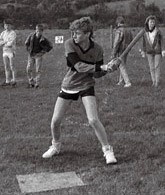
Sports like hurling, football, and rugby are considered most popular in Ireland. Most athletes learn the rules and how to play at a young age. Ireland’s deep-rooted passion for sports stems from a long lineage of physical activities that date back to as early as the 19th century. While the Gaelic Athletic Association (GAA) keeps traditional sports like hurling and Gaelic football at the heart of local communities, other traditional sports have long been forgotten, while some are making a comeback in other counties or rural areas.
One sport that is gaining popularity in Ireland is rounders.
This type of sport was played long before the term rounders was coined; its origins can be traced back to medieval Europe.
Sport historian Professor Paul Rouse said,“Hitting a ball with a stick is going out all across the world, and there are variations of this big game that can be seen in different cultures”.
In Ireland the history of rounders goes all the way back to 1744, where versions of the sport had been played for generations.
Rounders is considered a traditional Irish sport and is one of the sports included in the GAA charter since 1884.
Shirley Lennon, secretary for GAA rounders, told The City, “When the GAA was first set up in 1884, there were four sports: hurling, football, handball, and rounders. The organization changed greatly over the years, and rounders was revived in the 1950s.”
Rounders is a bat and ball game team sport where two teams alternate between batting and fielding.
It’s similar to baseball and softball but it’s different in terms of mechanics and equipment.
“We would have more space between our bases… the ball we use is different; we use the slither, which is the same ball they use for hurling,” Lennon explained.

Currently, there is no official team for rounders, “just like all GAA sports, it’s all part-time volunteering,” Shirley Lennon said.
Despite this, rounders is slowly gaining popularity, especially in Dublin.
“I think we definitely are gaining in popularity, especially since COVID. During 2021 to 2022, there’s been quite an explosion of rounders clubs,” said Lennon.
Rounders is also the only sport in the GAA that features mixed teams, with both male and female players competing on the same team.

Rounders is expected to be one of the games to be included in the upcoming 2026 Tailteann games, that is to be held in Kilkenny in the spring of next year.
Another sport that has made a comeback in Ireland in recent years is road bowling.
The origins of road bowling are unknown, but it is believed that stone-throwing traditions existed across Europe during the pre-1600s.
The earliest record of road bowling in Ireland started in the late 17th century to the early 18th century. The sport was commonly practiced in County Cork and Armagh.
Road bowling slowly faded during the 20th century due the fact that some impromptu gatherings with occasional betting led to the game to be banned by authorities, but the game was kept alive by small communities in rural areas.

The Road Bowling Association kept the sport alive throughout the years.
Seamus O’Tuama, public relations officer for the Road Bowling Association, told The City that “when the association was set up in 1954 it created competitions for players using the standard rules”.
The association also included competitions for women and under 18s. “Then over time team competitions started, then in 1963 the association of Ireland got involved with two international road bowling associations, Germany and the Netherlands, which established European championships,” O’Tuama added.
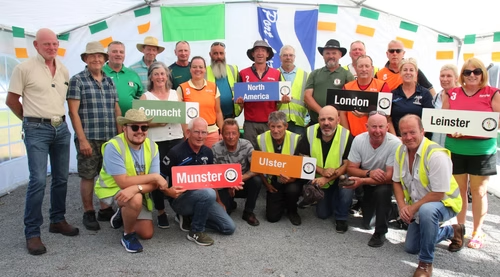
Today, thanks to the influence of social media, road bowling is slowly making a comeback in Ireland; games are now being organized in County Cork and Armagh.
Paul Rouse said, “Road bowling is gaining its popularity because it offers something different and it’s incredibly compelling viewing.” This comeback is no surprise because “games go through queues of popularity and that’s normal. It’s not unusual,” Rouse added.
Road bowling competitions are continuously being held in Cork.
Sports are an important aspect of Irish culture, and it’s a factor that shapes identity in Ireland.
“Sports are something that thrive both at the local level and at the international level. People have traditions in their lives, and one of the traditions is to play those sports; it’s about family, it’s about heritage, and it’s about locality… so the comeback of these sports would add to what’s there already,” said Rouse.
You must be logged in to post a comment.