Author: The City’s Newshound

  • Is Female Healthcare Taken Seriously in Ireland? 

    Is Female Healthcare Taken Seriously in Ireland? 

    By Molly O’Reilly

    Polycystic ovary syndrome (PCOS) can affect a woman’s health in more ways than one.  

    As more people are becoming aware of PCOS as a disorder women experience, there is more questions to answer as we discover female health continues to be more complex. 

    For instance, there are four categories of PCOS. Healthcare professionals try to avoid diagnosis until a person’s menstrual cycle has become regular or fully formed.  

    PCOS is characterised by irregular periods, high testosterone levels and ovarian cysts. The average age of diagnosis is around your late 20s.  

    However, there is not a long-lasting solution to help with PCOS.  Different life occurrences can alter the symptoms of the syndrome, such as childbirth, excessive exercise and stress.  

    Shirley McQuaid, who works with Dublin Well Woman Centre as a medical director, spoke about PCOS in Ireland and attitudes to female health in Ireland. 

    “PCOS involves certain changes to the cycle,” she said.  “If someone has very irregular periods, then it’s worth looking at whether or not that is due to polycystic ovary syndrome.”  

    Laoise Cruise, now 23 years old, spoke to The City.ie about her experience of getting diagnosed with PCOS at the age of 15, which is very unusual. 

    “It was like I had given birth because I had stitches, and I couldn’t stand up straight,” said Cruise. 

    In March 2016, Cruise thought she was getting her period for the first time. In reality, a cyst that was sitting and killing her ovary was causing her to bleed. After experiencing side effects such as extreme bloating, tiredness and intense cramps, Cruise went to her doctor and had to have surgery. 

    “It was basically the size of a melon is what I was told – they told me this is so strange for a 15-year-old.”  

    However, due to the size of the cyst, one of Cruise’s ovaries also had to be removed.  

    “It has affected my life completely – 50% of my chance of fertility gone,” she said. 

    Cruise also spoke about the lack of services provided during this time at 15 years old. 

    “I had my surgery in a general hospital, but it was under my insurance. Then I had to go privately for nearly a year after to go see the same surgeon that took out my ovary [in their private practice]” 

    “I wish it was more accessible; I’m hoping there will be more PCOS specialists in the future, who are more accessible for women who are younger.” 

    The process of getting diagnosed can be a stressful experience. 

    Katlyn Connolly, who is 22 years old, is currently on the journey of being diagnosed with PCOS.  

    “I started looking for help and advice on my female health around 14 months ago and since then I have been referred and sent to person after person,” said Connolly. 

    “I feel If I had backed myself up and was confident in my knowledge 14 months ago, I might be on a very different journey now. I am thankful that people are now talking about female health and fertility. It’s lovely to hear other people’s stories and tips and tricks regarding these issues.” 

    Female health issues continue to be a complex issue. 

    In terms of the long-standing ways of managing PCOS, McQuaid said there unfortunately isn’t one. 

    “There are a few things to manage PCOS but there isn’t a pill that they can take long term to deal with PCOS. It’s just as life events happen, we can help along the way with various things.”  

    Despite an enduring question over how serious female healthcare is taken within the Irish healthcare system, McQuaid said the introduction of the free conception has been a positive change. 

    “In the past a lot of women just were on the pill simply because that what was all available for them or they couldn’t afford to use coils and implants. But now they’ve got a huge choice,” she said.  

    Although there has been a positive progression for female healthcare in Ireland there is still a long way to go as many women continue to go undiagnosed.  

    “It’s not just four letters it’s your life,” said Cruise. 

  • Why are electric car sales continuing to decline? 

    Why are electric car sales continuing to decline? 

    By Luke Hurson

    2024 has been a disappointing year for the electric vehicle market, so far.  

    Latest figures from The Society of the Irish Motor Industry (SIMI) revealed that in September 1010 new electric cars were registered which was a massive 30.8% lower than the 1,460 that were registered in September 2023.  

    16,133 new electric cars have been registered so far, this year, as of the end of September. This is a 25.8% decrease compared to the same period in 2023 when 21,726 electric cars were registered. 

    Brian Cooke the Director General of SIMI commented: “The new electric vehicle segment has experienced another month of decline in registrations, marking the eighth consecutive month of this trend.” 

    “It is vital that we see positive measures from the Government to support the EV project and help reverse this drop in demand for EVs. Reinstating and extending EV supports, as well as investing in a reliable charging infrastructure, can help regain lost momentum in the electric vehicle project. The industry remains committed to supporting the transition to electrification,” he said.   

    An electric car charging at a charging station. Credit: Pixabay

    So why has there been such a steep decline this year? 

    In January 2022, the Irish Government got rid of the €2,500 grant for new plug-in-hybrid-electric vehicles (PHEVs). This resulted in a reduction in PHEV sales and an increase in battery electric vehicle sales (BEVs), which was the intention.  

    In July 2023, the Government reduced the grant for new BEVs from €5,000 to €3,500. Although there wasn’t a sudden impact, there is now a slowdown in sales of BEVs, whereas PHEV sales are increasing again. 

    Many people in the EV scene find that it is harder to get the mass market to make the switch to electric compared to the early adopters.  

    The early adopters tend to be more comfortable with risks like range anxiety or queuing at charging points – whereas the mainstream adopters are less likely to be wealthy and are not as comfortable with the same risks. 

    Luke Donnellan, a mechanic for Renault spoke to The City. “A lot of the cars we sell are either hybrid electric or petrol. Not a lot of people are ready to make that change to fully electric yet. 

    “A lot of people are still very reliant on diesel and are very unsure of the range of electric cars, as well, because with a petrol or diesel cars, when they run out of fuel, it’s not a big deal, you can just fill it up and away you go but with an electric car you’re almost stranded. 

    “A lot of people do have that range anxiety and It’s also made harder when there isn’t the infrastructure there to charge all these cars. 

    “A big thing that we’re seeing as well is people trading in their brand-new electric vehicles because they buy the electrics and realise there’s nowhere to charge them and how much it is to charge them. A lot of them realise they can’t charge the cars at work, so then they’re left with these cars where they have to plan everything. You can’t just go do something; you have to plan your entire trip from start to finish and it’s a lot,” he said. 

    An electric car plugged in at an integrated charging station parking space. Credit: Unsplash

    EVs can also provide different mechanical problems to that of a petrol or diesel car.  

    “One thing that we are noticing is because all these electric cars use regenerative braking systems, where they don’t actually use their brakes and they use the slowing down of the wheels to try to charge the battery up – the brakes are getting completely rusted out,” said Donnellan.  

    “Even though they’ve only used 20% of their brake pads, their brake discs are so badly corroded, they need to change their brake pads and discs more frequently than a petrol car, so there’s more maintenance in that sense,” Donnellan added. 

    Hybrid vehicles, however, are rising in popularity. There has been a 12% increase in regular hybrid sales this year, totaling 26,079 new registrations at the end of September.  

    Similarly, there has been growth in plug-in hybrid sales, now amounting to 10% of total sales with 11,766 registrations. 

    Petrol remains the most popular choice for Irish buyers, with 36,339 registrations, followed by diesel with 26,947. 

    More support and infrastructure are needed if the Government has any hope of reaching their target of 845,000 EVs by 2030. 

  • Richmond Park: The Home of Saint Patrick’s Athletic 

    Richmond Park: The Home of Saint Patrick’s Athletic 

    By Derek Price

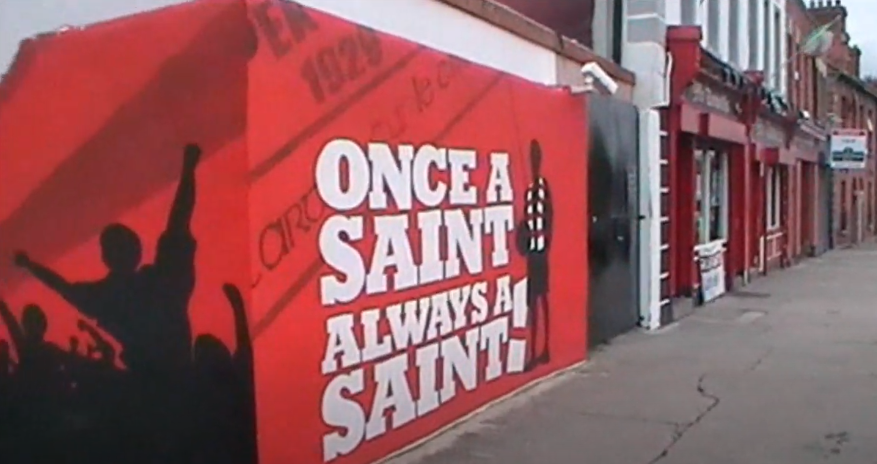
    Richmond Park is the well-known venue, pitch, and home, of St Patrick’s Athletic football team in Dublin, in the heart of Inchicore in Dublin.  

    Photo: Derek Price

    According to the team’s website, the ground was originally used as a recreational area by the British Army, from Richmond Barracks. This barracks has since been demolished many years ago. 

    The pitch was then unused for 3 years.  

    Brideville Football Club, originally based in The Liberties, Dublin. then began using the ground in 1925. 

    Although St Pats were founded in May 1929, back then they played their home matches in the Phoenix Park. 

    In 1930 Brideville F.C. moved from the Richmond Park football pitch to the Harold’s Cross Greyhound Stadium, as St Patrick’s Athletic then took it over and moved in. St. Pats used the ground until 1951, and then entered the League of Ireland, but the league declared the pitch inadequate, and for the best part of 9 years, St. Pats had to play on different pitches in Dublin, while they redeveloped Richmond Park. 

    In 1960, the team returned to the Inchicore pitch. The ground then closed for a upscaling in May 1989. Due to St Pats suffering financial difficulties, the team did not return to the site until 5 December 1993. 

    The ground is situated behind a row of terraced houses in a natural valley off Emmet Road, and is regularly used for the Republic of Ireland youth teams, and women’s soccer matches.  

    Richmond Park also is usually the venue for the non-league clubs in surrounding areas if they qualify for the FAI Cup. 

    Some music acts such as the 1970s and 80s rock band Thin Lizzy, have also used the venue to stage their concerts in the past. 

    In 2020, St Patrick’s Athletic used Richmond Park as a hub for donated items, and a food bank to provide aid to the needy during the COVID 19 pandemic, which was reported on the St Pats website, and in The Irish Times. 

    There are numerous shops, restaurants, cafes, and pubs in the area, which one could imagine, must enjoy the influx of football supporters and their families, buying lots of food and items, and increasing their business and livelihood.  

    There is also a high level of security provided by An Garda Síochána, at every match, to ensure that law and order is maintained, with several Garda squad cars, vans, and motorcycles present, to keep the fans and patrons on the straight and narrow. 

    The St Patrick’s Athletics’ fans have been very enthusiastic about their team staying in Inchicore village, but how do the locals feel about the soccer fans etc., being around the surrounding area? 

    “I’m not a Pats supporter myself, but I drink in the pubs around the area, and I’m usually there on the weekends. The atmosphere is great because of the matches, and I for one am in favour of it. It wouldn’t be the same without it,” said Johnny Byrne (48) from Inchicore. 

    Susan O’Donnell from Bluebell is a fan of soccer. 

    “I drop down to some of the home games in Richmond Park. I’ve not seen much of any serious trouble at the matches, I have to say. A bit of monkeying around at times, with some young fellas messing, shouting at, and slagging the other team’s fans, but nothing that would stop me from turning up at the matches. They’re a good bunch of lads overall, as far as I’m concerned.” Susan said. 

    Patrick Evans (55) said: “I don’t live around here these days, but my parents do. I’m not a football fan myself, but I do watch the odd match when it’s on TV. I come up on the weekends when most of the matches are on. The buzz here on match nights is great and livens up the area. The supporters seem so loyal and mad into it. I’d recommend any football fans to drop up and take in the experience, and see it for themselves, whether they’re from Dublin, Ireland, or abroad,” he said. 

    Several shop workers from the Inchicore area where also asked for comment regarding this article, but unfortunately all declined to voice their opinions, and participate on the day. 

  • “I Would Rather Die Here Peacefully, than be Killed There” – South Africans Living in Direct Provision on Hunger Strike Outside Dáil

    “I Would Rather Die Here Peacefully, than be Killed There” – South Africans Living in Direct Provision on Hunger Strike Outside Dáil

    By Jamie Ryan 

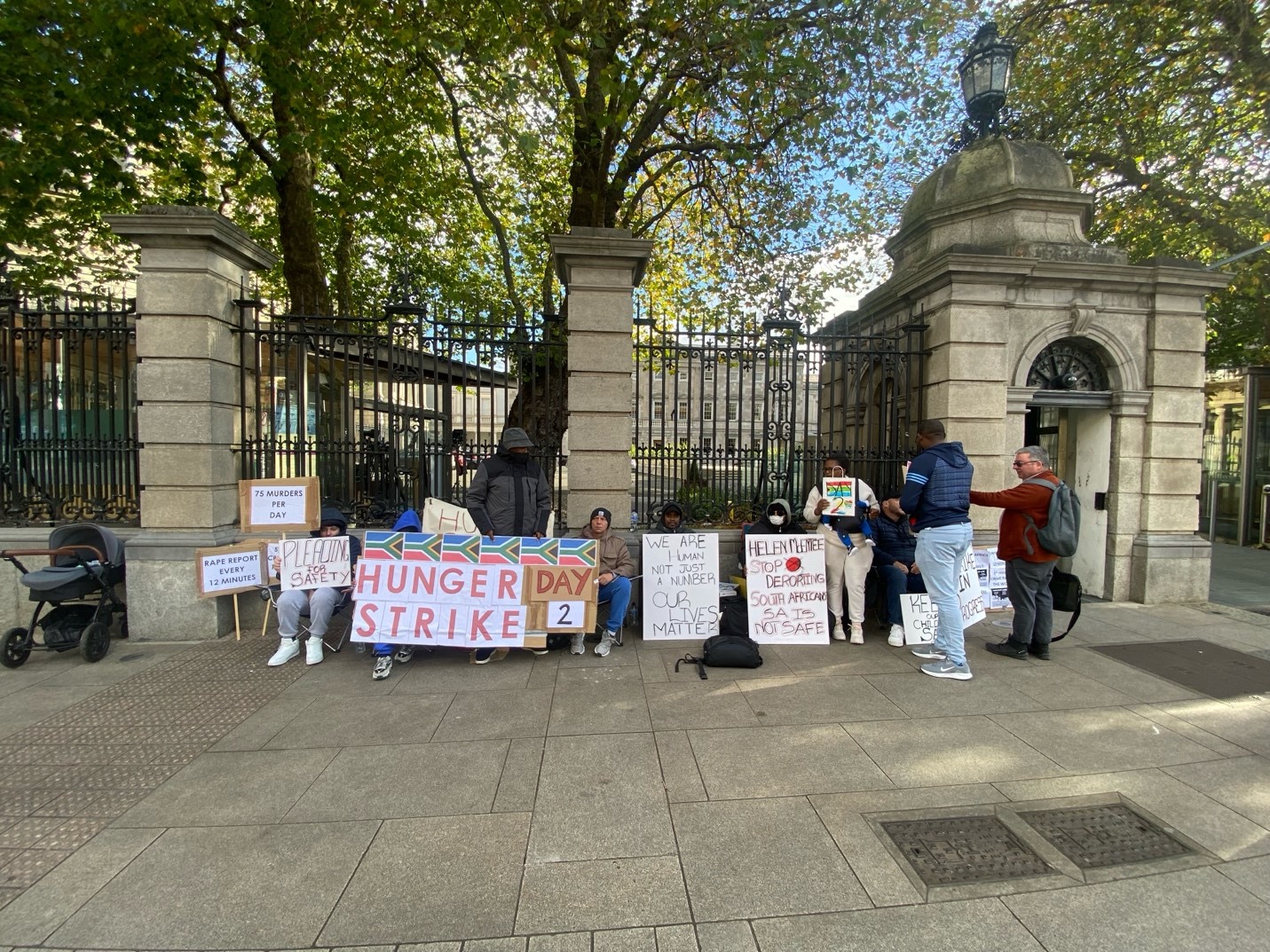
    Since Monday 21 October, these South African men and women who are living in Direct Provision have gone on a hunger strike in the hopes that the Irish Government will reconsider having South Africa listed on Ireland’s ‘Safe Countries’ list.  

    The EU and Irish Government define a ‘safe country of origin’ as a country in which: “there is generally and consistently no persecution, no torture or inhuman or degrading treatment or punishment and no threat by reason of indiscriminate violence in situations of international or internal armed conflict.” 
    Neels Heystek – a South African that are taking part in the hunger strike. Heystek told TheCity.ie his daughter is suffering from PTSD and is having regular panic attacks at school as a result of what has happened to their family in South Africa.

    “This is our last resort now.”

    Neels Heystek
    Passersby and sympathisers have donated water to the hunger strikers.
    On the otherside of Dáil Éireann’s gates, was a protest held by Irish Healthcare Workers for Palestine. Some of these protesters came over to the hunger strikers in support when a far-right agitator arrived.
    The Irish Healthcare Workers for Palestine lending their megaphone to the South African hunger strikers to drown out the far-right heckler. 
    A collection of the protester’s signs 
    • ‘Rape Report every 12 minutes’ 
    • ‘75 Murders Per Day’ 
    • ‘Pleading for Safety’ 
    Hunger strikers displaying their respective signs telling those passing by why they are on hunger strike.
    One of the protesters, down on their knees sticking together another sign for passersby and government officials coming through the gates of Dáil Éireann to see and take notice of.
    Brian Mogotsi is another of the hunger strikers.
    He is taking part in this protest in the hopes that the Government will engage in a dialogue with South Africans that are living in Direct Provision to reconsider their position on deeming South Africa as a safe country

    “I fled South Africa in need of safety.” 

    Brian Mogotsi

  • Filled to the Bram… Stoker festival 

    Filled to the Bram… Stoker festival 

    The October chill has hit which means the Bram Stoker festival has begun. It’s Dublin’s time to celebrate and honour Bram Stoker, the author of the most famous vampire around- Dracula. Events over four days and four nights lead you all around Dublin City, from the Casino of Marino to Dublin Castle, you are sure to learn all about Stoker and Dracula’s life.  

    On Friday the 25th of October a fantastic family friendly spectacle ‘Frank and McSteins Monster Laboratory- Out of the Lab and into the Fire’ took place in Dublin Castle.  

    Starting the evening early- queues had begun building up half an hour before the event started. 
    Groups of people entering the grounds at 6pm sharp- the tower highlighted red for Dracula himself 
    People were starting to warm up to the spooky ideas with interactive games and flames 
    Frank and McSteins helpers putting out the fire 
    Fire and crazy scientists meet art and street theatre for Halloween 
    Frank teaching the youth of today his evil ways
    Where there’s smoke there’s fire 
    Getting gothic at Dublin Castle
    Frank gave us a wave before the big show- little did we know what was to come
    Frank led the crowds through bringing this animatronic to life, many attempts were made, and many arguments were had with the other mad scientist McStein. Eventually, the two scientists pulled it together. 
    There he is, slowly coming to life
    And after a long day of creating life, fighting fire… and lighting fire, witches and ghouls alike skipped home ready for bed.
    These guys had seen enough madness to last them through Halloween  

  • Ireland U21’s European Dream Ends, but Strong Foundations Are Set for the Future 

    Ireland U21’s European Dream Ends, but Strong Foundations Are Set for the Future 

    By Sandra Dudkiewicz

    Ireland’s hopes of qualifying for the UEFA U21 European Championship were dashed after a 1-1 draw against Italy in Trieste.  

    Ireland previously drew 1-1 with Norway on October 11, with Sean Roughan scoring for Ireland, only to see their lead vanish with a last-minute equaliser by Andreas Schjelderup. This result added more pressure as the Irish needed a strong finish against Italy.   

    Ireland’s Andrew Moran scored the crucial equaliser in the 66th minute, after Italy had taken an early lead through Cesare Casadei. Despite the draw, Italy booked their place in the 2025 European Championship that will take place in Slovakia. 

    Italy’s missed penalty in the first half by Gnonto, along with other squandered opportunities, gave Ireland hope, but they were unable to find that crucial second goal. 

    Ireland’s U21 team may have missed out on qualification for the 2025 UEFA European Championship, but their journey was filled with standout performances. 

    The boys in green opened the qualifiers with a 3-0 victory over San Marino in September 2023, with Sean Roughan and Sinclair Armstrong contributing key goals and a 3-2 win over Turkey in June. 

    Scoreboard: RTE

    The Republic of Ireland U21 team concluded their UEFA European Championship qualifying campaign in third place, level with Norway on 19 points, but missing out on the playoffs due to goal difference. 

    They recorded 5 wins, 4 draws, and 1 loss across 10 matches, scoring 24 goals and conceding 12, for a goal difference of +12. 

    Bristol City player and Republic of Ireland international, Sinclair Armstrong said: “The unity and mentality within the group was incredibly strong, largely due to the belief that Jim Crawford instilled in us which is that we could win every game.” 

    “We went toe-to-toe with big nations, and we didn’t shy away from any challenge, from any fight and we gave it 100 percent. For the experience to end so early is very disappointing but it has been unbelievable, we got to travel to so many different countries and experience different cultures in the process and it’s something I will never forget,” he continued. 

    Sinclair Armstrong (9)  Photo Via Instagram

    Armstrong received his first call-up to the senior Republic of Ireland squad on September 8, 2023, for their UEFA Euro 2024 qualifier against the Netherlands and made his senior debut on September 10, 2023. 

    While the Republic of Ireland team fell short of qualification for the UEFA U21 European Championship, their solid third-place finish and impressive performances throughout the qualifiers sets a promising foundation for the future. 

  • Cuala triumph in first Dublin final since 1988 

    Cuala triumph in first Dublin final since 1988 

    By Oscar Lawlor Plazas 

    A nail-biting end to a dramatic game on a windy day in Parnell Park saw Cuala overcome local rivals Kilmacud Crokes with a last gasp hand passed point by Eoin Kennedy, after Luke Keating’s freekick fell short with seconds to go on Sunday afternoon. 

    This put a stop to Kilmacud’s hopes of winning 4-in-a-row for the first time since the 1960s and gave Cuala their first ever Dublin Senior Football Championship win, in their first finals appearance since 1988. 

    Players appeared to struggle to determine which way the wind was blowing. In the first half, it appeared to benefit Crokes, but that didn’t last long. It was evidently blowing in the main from the church- end and behind Cuala’s backs but was equally indiscriminatory and unpredictable throughout the afternoon. 

    Crokes tried to smother Cuala’s strong first half and contain the damage until they could make use of the wind in their favour, but they were guilty of a few hurried attempts at goal and, predictably, bad choices considering the difficult conditions. 

    With their ace attackers Paul Mannion and Shane Walsh each scoring one point in the first half, Crokes missed six opportunities, blowing attempts at the uprights wide or short into goalkeeper Skollard’s hands. 

    During this period, Cuala’s offensive style was much more direct and focused. They made fewer poor attempts and had some well worked teamplay as they repeatedly drove up the pitch in packs to take a healthy lead going into halftime.  

    Dublin defender Michael Fitzsimons contributed to their onslaught, by fist passing a smart point and following it up by hitting another creative score after flicking the ball over Walsh’s head and collecting it on the other side.  

    Cuala’s five-point advantage at the half was only cheapened by the fact that two goal scoring opportunities had escaped them in the first six minutes of the second half. 

    Con O’Callaghan had the first but was denied by brave defending. This was followed up by Niall O’Callaghan’s excellent strike at the top corner being elegantly tipped over the bar for a point by Devon Burns. 

    Within a frenzied few minutes though, everything looked as though it might change.  

    Cuala fans rush onto pitch after final whistle 

    The Dalkey men kept Crokes at bay with the odd score and some outstanding defending but couldn’t stop a more experienced Crokes side from cutting the margin to three points between the forty- and fifty-minute marks. This was then made worse for Cuala when after just a few minutes in play as a blood substitute, Kilmacud’s Luke Ward scored the game’s first goal to tie the score for the first time since the fourth minute, when Mannion found him with a sweeping pass across Cuala’s last line of defenders. 

    Then, during the break in play, there was drama at the opposite end of the ground when Con O’Callaghan was shown a straight red card by referee Sean McCarthey at Stillorgan sides goalmouth, for an elbow on Crokes goalkeeper Devon Burns. This made for a tense end to the finals for both sets of supporters, but the purple and gold of Kilmacud Crokes didn’t have enough in the end to halt a history making day for the red and white of Cuala. 

    The team’s victory was well-earned, handling the match and Storm Ashley with skill and caution. They now progress to the quarterfinals of the Leinster Senior Football Championship and will take on whoever comes out on top between the Wicklow and Longford Championships respectively. 

    Scorers for Cuala: L Keating (0-3, 0-2 frees); C Doran (0-3); M Fitzsimons (0-2); E Kennedy, C McMorrow, P Ó Cofaigh Byrne, P Duffy N O’Callaghan and C O’Callaghan (all 0-1). 

    Scorers for Kilmacud Crokes: P Mannion (0-4, 0-1 free and 0-1 mark); S Walsh (0-3, 0-1 free); L Ward (1-0); H Kenny, C Dias, D Mullin (all 0-1). 

    CUALA: R Scollard; D Conroy, M Fitzsimons, E O’Callaghan; E Kennedy, C McMorrow, D O’Dowd; P Ó Cofaigh Byrne, P Duffy; C Dunne, C Ó Giolláin, C Doran; L Keating, N O’Callaghan, C O’Callaghan. 

    Subs: C Groarke for Ó Giolláin (43); C Mulally for Dunne (48); L Ward for O’Brien (blood, 54) and for Murphy (56). 

    KILMACUD CROKES: D Burns; M Mullin, T Clancy, D O’Brien; M O’Leary, A McGowan, J Murphy; B Shovlin, R O’Carroll; H Kenny, C Dias, D Mullin; P Mannion, P O’Connor, S Walsh. 

    Subs: C O’Connor for O’Leary (43); T Fox for Kenny (45); M Conroy for D Conroy (56); S Cunningham for O’Connor (71). 

    Referee: Sean McCarthy (St Vincent’s). 

  • Big wigs, Fake Tan, Cakey Makeup and Bedazzled dresses.  

    Big wigs, Fake Tan, Cakey Makeup and Bedazzled dresses.  

    By Molly O’Reilly

    Irish dancing is an underrated sport in Ireland that has multiple aspects to it including pressure for success, emotional strain, sense of community, politics and beauty expectations. 

    Aoibhinn Gannon from Sligo a former Irish dancer from the ages of three to seventeen spoke on the interlinked nostalgia and unspoken realities of the Irish Dancing world. 

  • The Silent Champions: The Battle for Recognition in Women’s Sport 

    The Silent Champions: The Battle for Recognition in Women’s Sport 

    By Áine McKeon

    Despite breaking records, winning major championships and motivating generations, female athletes are frequently overshadowed by their male counterparts.  

    Even though their performances on the field, court or track are on par with that of any male athlete, they are continuously having their achievements overlooked, and they receive an unfair level of media coverage, sponsorships and public attention that they receive. 

    This not only downplays these women’s achievements, but also worsens the restrictions that have prevented women up until now from participating in sports, especially in Ireland. This begs the question; why does this disparity still exist today, and how can it be improved?  

    Media Coverage: The Numbers Tell the Story 

    According to a survey carried out by HerSport, gender disparity in sports participation is only at 3.4% in Ireland, with women’s sporting efforts receiving only 6% of the country’s sports media coverage. Despite this, the study also found out more than 60% of Irish people wanted to see women’s sports receive greater attention. 

    Less than 20% of all sports coverage goes to women’s sports, according to the Irish Sports Monitor. This coverage is typically saved for high-profile events, or when women’s teams accomplish something remarkable, such as their historic 2022 World Cup run. 

    In contrast, regardless of the importance of their games or events, male sports receive regular and everyday attention. For instance, the success of local or national women’s teams frequently remains unrecognised until they hit a significant milestone, while men’s club football or rugby matches frequently receive media focus.  

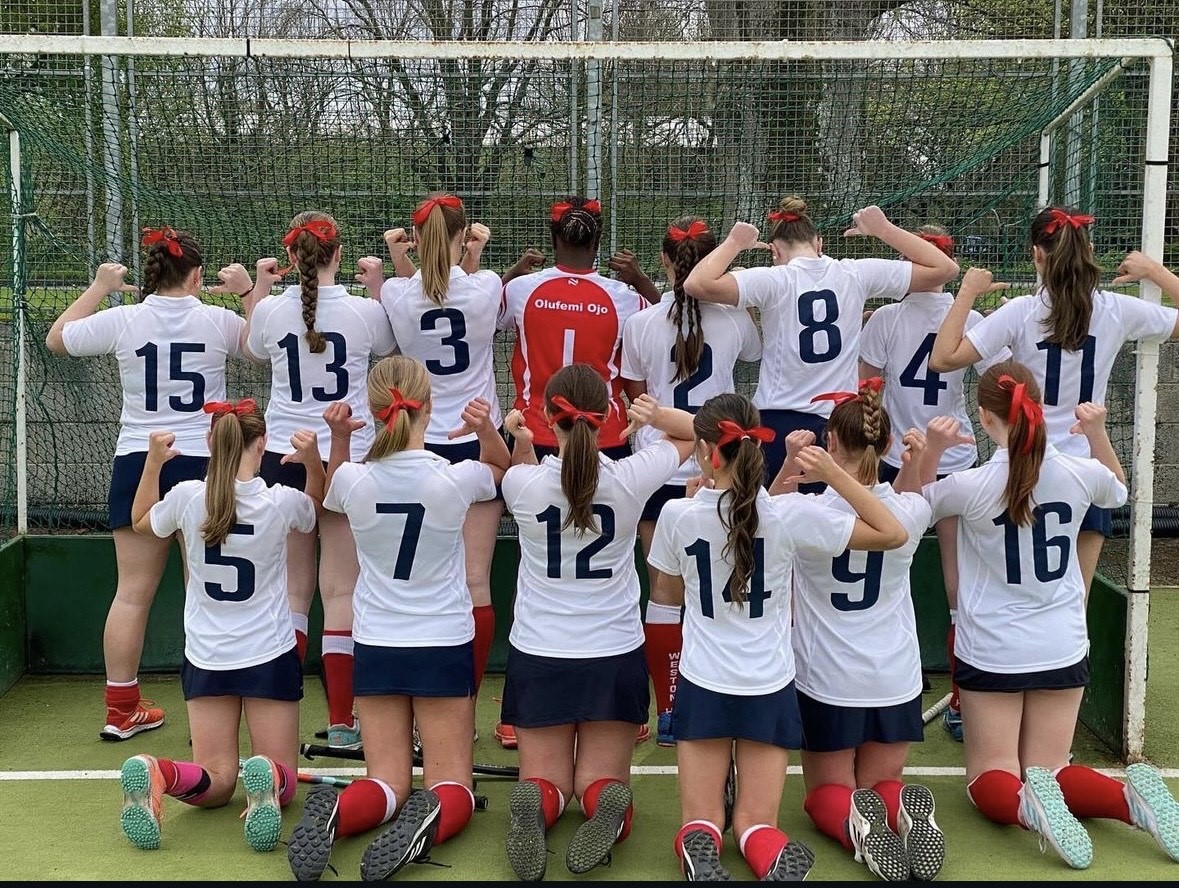
            Photo credit: Weston Hockey Club 

           “We have to do more to be seen”

    Síofra Ní Dhonghaile, a midfielder for Lucan’s Weston Hockey Club, has been playing the sport for several years. Despite her team’s consistent effort at a senior level, she feels the media attention that their achievements receive is only a fraction of what the men’s hockey team get. 

    “Even when we do win a major championship, it’s nothing more than a little headline in the occasional publication – but when compared to the men, it’s disappointing,” she admitted. “We seem to have to put in twice as much effort just to get noticed, I’ve seen my male counterparts receive attention for much less.” 

    Many Irish female athletes in a variety of sports feel the same as Ní Dhonghaile. Women’s sports are frequently confined to smaller portions and are only highlighted during significant international achievements, while men’s sports like hurling and Gaelic football receive hours of coverage throughout radio, television, and print media. 

    TheCity.ie spoke to Brian Percy, who has been coaching both men and women’s field hockey teams for over a decade now.  

    “To be honest, the gap is pretty clear,” he said. “Even for smaller matches, our men’s team receives significantly more media attention than the women’s team, who may win a major tournament and yet not garner a lot of buzz. The ladies put in just as much work, if not more, which is frustrating.” 

    Women’s sports lack sponsorship, which creates an endless cycle whereby companies are reluctant to make investments when there is no media attention, female athletes find it difficult to gain recognition. When the Irish women’s soccer team went public with their complaints in 2017, it became apparent that they were forced to share kit bags and change in airport restrooms. While improvements have since been made after their strike, sponsorship and money are still major problems 

                 Photo credit: Maynooth University Volleyball team via Trisha Zaragoza 

    Despite the challenges, there are signs that change is on the horizon, and the media is slowly starting to catch up.  Sports such as volleyball are mainly female dominated, although more male teams are forming. 

    Kildare native, Trisha Zaragoza, plays volleyball for Naas Cobras, Maynooth University and Valkryies. 

     “I’ve been playing since I was 11, for nearly 10 years now, because volleyball is a female dominated sport in Ireland I haven’t felt left out – although there are many male teams beginning to form,” Zaragoza said. 

    “Regardless of gender, sport to me is my outlet, my way of blocking out reality and stress. I’ve made many friends through volleyball and that’s been the most rewarding part for me,” she added. 

    What needs to happen next? 

    Experts, campaigners, and female athletes all concur that prioritising funding for women’s sports should begin with equitable access to sponsorship opportunities, more regular media coverage, and structural adjustments within sports organisations. 

    “We’re not asking for favors, we’re asking for fairness,” said Zaragoza. 

    Irish female athletes will continue to work hard, achieve success, and break down barriers even if the spotlight isn’t always shining as brightly on them as it should be. 

  • Surge in Off-the-Ball Incidents in GAA Sparks Concern at Underage Level 

    Surge in Off-the-Ball Incidents in GAA Sparks Concern at Underage Level 

    By Jason Quigley

    In recent months, GAA matches across the country, particularly at juvenile level, have seen a worrying increase in off-the-ball incidents.  

    These occurrences, ranging from pushing and shoving, to more aggressive acts – have marred what should be a showcase of youthful talent and the spirit of fair play.  

    As tensions rise, so too has the involvement of parents and spectators, often leading to chaotic scenes on the sideline. 

    One individual who has witnessed this growing issue firsthand is John O’ Shea, former Public Relations Officer (PRO) for West Tipperary GAA. 

    John, a well-respected figure within the GAA community, believes that this current trend is deeply concerning and calls for immediate action, both from the GAA and the coaches overseeing these young teams. John expressed his frustration over the lack of concrete measures to curb these incidents. 

    “What we’re seeing now is not just the odd scuffle or disagreement. It’s consistent, particularly in juvenile games. I’ve seen parents running onto the pitch, furious over a referee’s decision, and that only escalates the situation. The referees are doing their best, but they are often left vulnerable.” 

    He recounted several matches where tempers flared beyond control, not just between the players but also among the supporters.

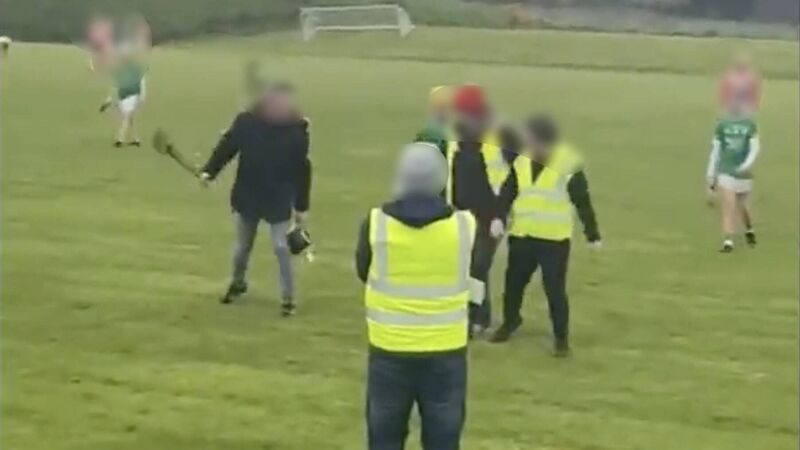
    Under 14 Hurling match fight. Mitchelstown v St Vincents. Pictures: @CraicOfTheAsh on twitter 

    “I was at a minor match a few weeks ago,” John said, “and after one controversial call by the referee, a parent stormed onto the field. It led to complete chaos—players were getting distracted, coaches were shouting, and the focus shifted from the game to the argument. This shouldn’t be happening, especially with kids on the field.” 

    John believes that a lack of discipline and respect for match officials is a core reason behind the rise in such incidents. However, he also feels that the GAA itself needs to take a firmer stance. 

    “The GAA has been slow to address this. We need more accountability from the top down. Stronger penalties for violent conduct and off-the-ball incidents need to be enforced consistently across all levels of the game. It’s not enough to just talk about it anymore. We need action.” 

    However, John is quick to point out that responsibility also lies with the coaching staff. He believes that some of the pressure to win, particularly in competitive juvenile games, is being projected onto young players in a negative way. 

    “Coaches need to remember that their role is to develop these players—not just in terms of skill but also in terms of attitude and sportsmanship. When coaches are constantly shouting and criticising officials, that behaviour gets transferred to the players, and they start seeing it as acceptable. It’s a vicious cycle, and it’s happening far too often,” John said. 

    Patrick Ryan,  who has been refereeing GAA games for over 30 years, says he’s very concerned about the rise of violence at matches. 

    Referee Patrick Ryan (middle) at a semifinal county minor game. Picture: West Tipperary GAA 

    “There’s a shortage of referees at the moment, and this kind of behaviour only discourages them further. If we lose more referees, we lose games. It’s that simple,” he says 

    While the GAA continues to promote respect, discipline, and a love of the game through its “Give Respect, Get Respect” campaign, Patrick insists that more needs to be done at the grassroots level. In particular, he suggests that educational programs for both coaches and parents should be implemented, alongside increased security measures at games to ensure safety for all involved. 

    “As the GAA community reflects on the escalating issues, the message is clear: the future of the sport at minor and juvenile levels is at stake, and immediate action is required to preserve the core values of the game.”