The City caught up with the ‘Bray Beach Bathers’, who are a group of men and women who all share a common love for swimming in the ocean, as they brave the cold water on a brisk, but beautiful October morning – which made for perfect swimming conditions.
In seaside towns across the country, sea swimming has become a rapidly rising phenomenon – but for many, it’s become much more than just a hobby – it’s become a way of life.
As part of their now daily routines, sea swimmers have formed several groups who come together for their daily dips into the Irish Sea all year round.
While every swimmer has their own respective reasons for being involved in taking part, one thing is for sure – no matter the weather, sea swimming is here to stay.
As people journey through life, independence can grow and thrive – however, sometimes, in life, and especially as some people get older, independence can unfortunately decline.
With a decline in a person’s ability to be independent, comes dependency with everyday issues, that can begin to overpower, to the point where living at home might prove to be unsustainable.
Long-term care facilities are a beacon of hope for a person who needs 24/7 care – allowing the person to still be able to indulge in their own life experience, all while in the hands of professional care givers.
However, it’s not always an easy journey into long-term care as established nursing homes are more than often full and have waiting lists for potential future admissions.
In August 2024, research involving 1000 people was conducted by Coyne Research and commissioned by Nursing Homes Ireland (NHI) and found that six out of 10 people fear for their loved ones being able to find a place in local nursing homes.
It was a nursing home in Kinsealy, Co. Dublin, that had the advantage of space and more accessible admissions, for a time – as it was only recently opened, with no waiting list, and with rooms available for anyone in its local community, looking at long-term care options.
A short distance from coastal towns, Malahide and Portmarnock, in the tranquil countryside setting of Kinsealy, Woodlawn Manor opened its doors in February 2024 to less than 10 new residents requiring care facilities.
The entrance to Woodlawn Manor on the grounds of St. Doolaghs Park in Kinsealy, Co. Dublin. Photo: Gary Petrov
With a maximum capacity of 97 residents, Woodlawn Manor had space for new residents for a total of nine months, before reaching its maximum capacity earlier this month.
Teagan MacAodhagáin is the Director of Nursing at Woodlawn Manor and has worked exclusively in elderly care since graduating as a nurse, and has been a Director of Nursing since 2018.
“We’re very passionate about what we do,” said MacAodhagáin. “The core team, myself, the clinical nurse managers, reception administrators and that – we really live by our motto ‘Care is what we do’.”
Teagan MacAodhagáin, Director of Nursing at Woodlawn Manor. Photo: Courtesy of Woodlawn Manor.
“I always tell my staff that the standard of care is what you want for the person you love most and anything less than that is falling below the standard that we should have. I think that’s important, that that’s what you aim to deliver – you try and achieve that.
“Some days the tea might be cold when it arrives, or the laundry might be a bit delayed. Things will happen with human error and various things, but if you’re aiming for something you would like for the person you love most, then I think you’re going to do a good job, nine times out of 10.
“We have filled up remarkably fast. I’ve been involved in a number of new nursing homes, and I would be familiar with nursing homes opening up. It was faster than what would’ve been expected, perhaps, given the number of nursing homes in the locality. What has led to that? Definitely, I think the setting, the setting is beautiful. The countryside and sea-views. Having a brand-new purpose-built facility was also very helpful. That had a big attraction, early on.
“Internal factors – assembling a good core team at the beginning. I hired people I was familiar with and people I worked with before – people I knew. It wasn’t a brand-new venture with lots of people pulled into it. It was a team that knew each other and worked together before. We knew one another and knew how we worked together.
“Having a dedicated admissions nurse helped, a role I created for the first year – which was really important and instrumental in filling the place up. Someone who was out doing assessments, being a point of contact for all.
“It was a little bit daunting to have 97 rooms and the onus to fill them, but not having to have a waiting list, it was really nice. It was great to not have to turn anyone away. To be able to take people for respite, short-term care, to take people who were at the end of life and needed a few days of care while passing. It was nice to be able to do that,” he said.
Staff from the dedicated team at Woodlawn Manor. Photo: Courtesy of Woodlawn Manor
Since reaching maximum capacity this month, MacAodhagáin discussed the inevitable shift in the admissions process saying that they are starting their waiting list now and new admissions will only be selected from the waiting list when a room becomes available.
MacAodhagáin said he must “give credit” to Woodlawn Manor’s admissions nurse Camelia Ganea, who is also a clinical nurse manager in the facility – for her “marvellous” hard work all year as they welcomed their new residents.
Staff at Woodlawn Manor during a fire brigade visit, where they discussed safety procedures for their residents, in case of emergencies. Photo: Courtesy of Woodlawn Manor
Since 2018, at least 77 nursing homes have closed around Ireland. Of that number, 10 closed in 2023 and seven have closed this year to date. Last month, Nursing Homes Ireland said that this is due to a mixture of rising operational costs and Fair Deal Scheme pressures.
When asked about the issues and worries surrounding nursing home closures in the country, MacAodhagáin said, “From what I know, the nursing homes that have closed down have been smaller, family-run nursing homes.”
“Standalone nursing homes, or the building might be old and isn’t up to the current regulations. Fire regulations and things like that have become, and rightly so, more stringent and more in depth of what’s required. For older buildings, they can be a very large cost implication, to bring them up to the standard that’s required.
“I’m also aware of lots of larger companies opening more and more homes or buying homes. I do think there are homes out there, all-right,” he said.
Woodlawn Manor’s new purpose-built facility was built adjacent to an existing manor on the grounds of St. Doolaghs Park. Photo: Gary Petrov
Something that can naturally accompany a person being placed into long-term care is the emotional element for their family, ending their chapter of life with their loved one in the family home.
Patrick Maguire recently placed his spouse into long-term care and chose Woodlawn Manor. “When the time came to put my wife into long-term care, my family and I, while coping with the emotional aspect of it, feared it would be a race against time with her individual case, to find a nursing home in the local community that tended to her needs, with a vacant room available as soon as it was needed for her,” he said.
“With all of the organising and preparing of affairs that comes with this difficult choice of accepting that your spouse can no longer live independently at home, it was daunting for my family and I to go and view nursing homes in my local area and be told that they are currently full and that they have waiting lists that I could add my wife’s name to.
“Not everyone has time for waiting lists and we didn’t. Woodlawn Manor was a God send. After enquiring about several nursing homes, my family and I rushed to view it as soon as we were made aware of it having less than 10 residents, at the time.
“We were very impressed and acted quickly. We were then able to have my wife in their care within a few days, after the necessary admission paperwork was done. The process worked out well for us in the end, and I say that delicately, because her condition proved for living at home to no longer be an option. However, luck played a huge part as firstly, we liked the nursing home for my wife, and secondly, the nursing home had room.
“The difficulty of finding a local nursing home with a vacancy, and one that is suitable for your loved one’s needs, is a task in itself – on top of all of the emotions and pain that comes with accepting the reality of it all.
“We were lucky to have a difficult journey made easier with Woodlawn Manor not being full, but when the time comes for people nationwide, not many will find themselves with a new nursing home nearby, full of rooms at their convenience for them or a loved one,” he said.
The exterior of the newly built facility in St. Doolaghs Park. Photo: Courtesy of Woodlawn Manor
Asking the Director of Nursing what he would say to someone looking at Woodlawn Manor as a long-term care option for a loved one, he referred to their motto and the feedback they have received since opening, and said, “Our motto is ‘Care is what we do’, and I came up with that motto because care is what I’m really passionate about. Firstly, we’ve been told that it’s a very calm and homely environment. Secondly, people most commonly say that the staff really care.”
“As the Director of Nursing, it makes me very very proud that people can see that the staff genuinely care about the residents. I think that’s what we have to offer. When you care, you go the extra mile for the residents. This is their home and their time with us is perhaps the last time they’ll have anywhere – and we want it to be good, we want people to feel at home. We want people to be cared for and cared about,” he said.
Woodlawn Manor offers residential nursing care, respite care, convalescence care, dementia care and end of life care.
Useful resources from Nursing Homes Ireland on choosing a nursing home can be found here.
On April 26th, 1986, the most devastating event in the history of nuclear power took place at the Chernobyl nuclear power station in Ukraine.
The UN estimated that 50 deaths could be attributed to the immediate explosion and that up to 4,000 people would eventually die due to medical issues attributed to the radiation released after the explosion.
Through new documents (marked DFA/2023/47/6737) obtained from the National Archives of Ireland, we explore Irelands relief response and broader role during the Chernobyl disaster.
Correspondence between the UN Secretary General and Michael Gaffey. Photo: Sean Norman
On the 28th of September 1993, the United Nations Under-Secretary-General for Humanitarian Affairs at the time, Jan Eliasson, sent a letter to, Michael Gaffey who at the time was the Director General of the Development Cooperation Division within the Department of Foreign Affairs.
This came after a meeting of the Governments of Belarus, the Russian Federation, Ukraine and the United Nations Coordinator of International Cooperation on Chernobyl, held at Minsk on the 26th of May 1993.
After meeting with the UN’s Humanitarian Liaison Working Group, Eliasson, who would later become the president of the United Nations General Assembly, selected Ireland to help in a list of projects, “for priority action to address the consequences of the Chernobyl disaster.”
The projects included help in four “priority areas,” that of “health; food, agriculture, and the economic environment”. Ireland was also asked for assistance with “social rehabilitation and socio-psychological rehabilitation.”
These projects corresponded to the needs of three affected states Belarus, the Russian Federation and the Republic of Ukraine – and had been “officially endorsed” by the nations. They promised to provide a solid basis for “future activities in the medium and long-term.”
The UN proposed a list of individual projects that could be funded independently of one another. In mid-November of 1993, the 48th session of the General Assembly took place and was an opportunity for all donor countries to present their official response to the request and “where necessary, to allow further discussion of the projects directly with representatives of the proposing United Nations agencies”.
They hoped that Ireland would view the requests, “in a favourable light and respond generously to the plight of those, who continue to suffer from the consequences of the Chernobyl disaster.”
On the 7th of December 1993 Ireland put forth its relief project proposal to the European Community Humanitarian Office (ECHO) and stated the countries to be receiving the aid. This included both the Russian Federation and the Republic of Ukraine but not Belarus.
The disasters described in the document include tuberculosis epidemics, the collapse of both countries healthcare systems, the destitution and displacement of the populations of the countries, conflicts in the North Caucasus region and radiation.
According to the documentation, Ireland provided 4 million euros worth of relief items to the disaster-stricken countries, including “medicines and medical materials, medical assistance, food parcels and other basic relief items”.
The supplies were delivered through a variety of means including intermediaries for contributions such as, the United Nations High Commissioner for Refugees (UNHCR), the International Committee of the Red Cross, the Netherlands Red Cross, Les Enfants De Chernobyl, Associazione per la Partecipazione Allo Sviluppo and another European NGO chosen by the Moscow Delegation to help with tuberculosis cases in Tomsk.
In the Russian Federation aid was sent to Moscow, Tomsk Oblast, Vornej, St. Petersburg and North Caucasus. In the Republic of Ukraine aid was delivered to Chernobyl and Rovno. The relief packages were expected to arrive in the countries throughout December and February.
The City.ie spoke to Professor Gearoid Ó Tuathail, who is Professor of Government and International Affairs at Virginia Polytechnic Institute and State University.
We asked him about his thoughts on the documents we had acquired and his view on how Ireland fit into the broader narrative of the Chernobyl disaster.
What is your view on Ireland’s initial response to the disaster?
“In my view, Ireland has always been on the periphery of Europe, we’ve been wary of bigger nations simply by nature, and it must be understood that Chernobyl was not as simple as the meltdown. It has and still does shape geopolitical views on nuclear power, and at the time that was something Ireland was already sceptical about, even today we’re resistant to the idea of nuclear power stations being built in the country.”
Do you think these documents reflect that scepticism?
“These documents show that reserved nature I think rather well, at least in the political sense. We sent the most urgent items and spread them out as best we could. From other documents on relief efforts I’ve studied in the past these are fairly typical.”
So, you believe Irelands response to the disaster was entirely standard?
“I’ve always found that we’re unique when it comes to responding to human suffering, not just with Chernobyl, look at our response to the war in Gaza, or, and this of course relates well, our response to the war in Ukraine.”
Recent figures from the Central Statistics Office reveal that 109,566 Personal Public Service Numbers (PPSNs) were given to Beneficiaries of Temporary Protection (BoTP) from Ukraine between 04 March 2022 and 29 September 2024.
Source: CSO. Chart showing the number of Ukrainians given PPSNs after receiving temporary protections
“The documents show the numbers to the story sure, but I was still living in Ireland during the disaster and the outpouring of support really had to be seen to be understood, you had Irish parents reaching across oceans to help children in Chernobyl bringing them into their own homes for recuperation.”
Since 1986 Chernobyl Children has brought, 25,600 children from radiation zones to Ireland for rest and recuperation. The clean air is believed to add an extra two years onto the lifespans of those suffering from the effects of radiation.
We also reached out to multiple organisations such as Irish Refugee Council and Ukrainian Action in Ireland for comment but did not receive a response.
It has been a successful season for Irish fashion designers in the Spring 2025 fashion shows.
Fashion month this September featured many Irish designers such as Simone Rocha, JW Anderson, Róisín Pierce, Michael Stewart, and Sean McGirr, the new creative director at Alexander McQueen, who made his debut in Paris.
This successful fashion month had Irish designers featured in both the London and Paris fashion weeks.
Katy Perry performing in Rio where John Mangru worked on the costume design – Photo: @OmDivaboutiques Instagram
However, the Irish representation doesn’t stop there as Taylor Swift was spotted wearing a skirt designed by Sibeal Crehan, an Irish designer now based in New York. The media attention continues with John Mangru, also an Irish designer who worked on Katy Perry’s performance outfit for Rock in Rio music festival.
Taylor Swift out with Gigi Hadid wearing Irish designer Sibeal Crehan’s plaid skirt. – Photo: @OmDivaboutiques Instagram
“It is really inspiring to see the incredible works by Irish designers being recognised in international media,” said Ciara O’Gorman, 20, an independent fashion designer.
“When I was growing up, I would never see Irish designs in mainstream media, it was all American or English designers,” she said.
O’Gorman has been designing clothes for 13 years and finds it “really heartwarming and reassuring” to know that people like her can get out there and make it in the fashion scene.
“Irish designs are so unique. I know myself, I take a lot of inspiration from our nature, culture and intricate details, for example, the Triskele (this is the triple spiral also known as the three-legged-man),” said O’Gorman.
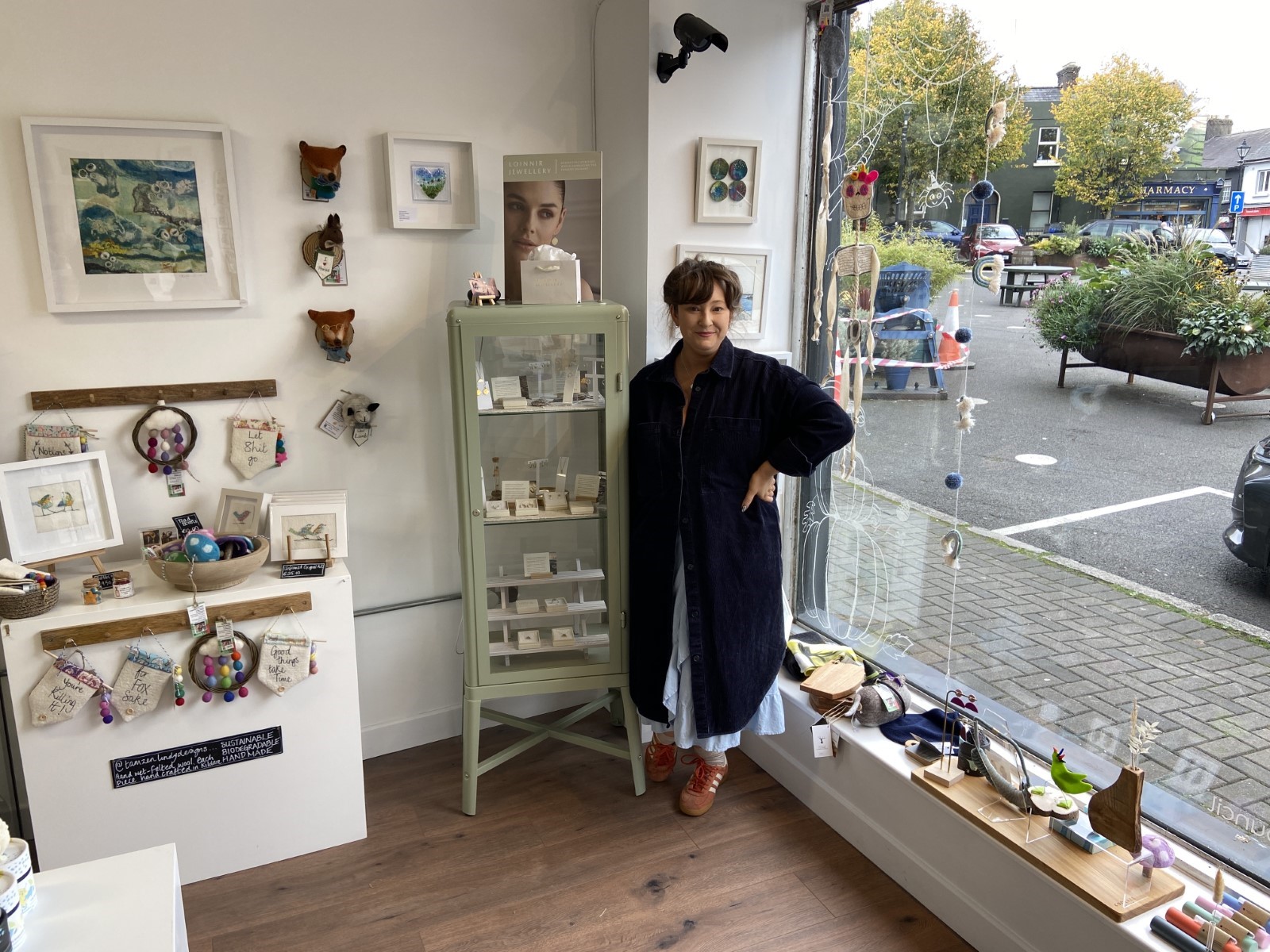
Similarly, Cara Sturgess, 33, of Loinnir Jewlery believes that this was inevitable. Her designs are inspired by old Irish jewellery, similar to the pieces on display in the Irish Archaeological Museum like the “rich, impressive torc neck collars”.
Cara Sturgess, standing with her pieces. Photo: Eimear Phelan
“It’s making a piece of Ireland that you can take with you and be proud of – a modern take on what has come before you,” Sturgess said.
“Ever since COVID, I really feel that people are buying locally and supporting the community.
“A lot of young people especially, have an understanding of the significance of shopping sustainably and many, if not most, Irish designers I know of are incredibly sustainable in the way they make their clothes,” O’Gorman said.
Sturgess’ jewelry is wrapped in FSC-certified cardboard paper and recycled PET inserts, with 100% compostable padded envelopes. Sturgess is very eco conscious and believes that if you start sustainable, it’s easy to stay sustainable, as your business grows.
“Seeing celebrities wearing Irish pieces and Irish design has a massive impact on young girls and boys in Ireland, who might not have even though designing or fashion was even an option.
“There are more classes and workshops available for younger people now which we wouldn’t have had before. This really helps nurture the creativity in young people now,” O’Gorman said.
The Kildare Town retailer ‘Gather’ offers workshops in the different crafts that are on show in their retail shops. Classes like painting, jewellery making, and different art mediums are all available for people to take part in to encourage people to tap into their own creativity.
Sturgess started her business in 2015 and has made use of the government incentives and advises anyone starting a small business to go to their local enterprise, and do the courses provided.
She participated in the ‘12 week start your own business course’, availed herself of the training online voucher to start up her website, and went to her local Craft Council who give training in areas that you might not be comfortable in.
“I’m more on the creative side but when you run a business you have to learn to deal with taxes, online media, legal works, and networking,” she said.
Since starting her business, Sturgess is currently set up in ‘Gather’, her retail site for Kildare-created brands. Set up by Kildare County Council’s Enterprise and Economic Development Department, it will last for a period of 18 months to showcase and sell local art and designs.
The interior of ‘Gather’ in Kildare Town. Photo: Eimear Phelan
Irish designers have had a successful run in the media lately leaving the younger generation with a very strong light to follow. It is evident that the Irish fashion industry is in safe and creative hands.
The latest Tesla product announcement saw the company reveal their new self-driving car dubbed ‘Robotaxi’, a vehicle capable of transporting 20 people nicknamed ‘Robovan’ as well the latest iteration of Tesla’s humanoid robot given the moniker ‘Optimus’.
Reaction to the announcements made at the ‘We, Robot’ event has been mixed with consumers and experts displaying a combination of excitement and scepticism.
Tesla’s new robot on display at ‘We, Robot’ event. Picture credit: Tesla website
One thing that has not been mixed however, is the Tesla share price. At the time of writing the stock sits at $219.57, which is 9.94% lower than what it was on the day of the ‘We, Robot’ event.
The market has not responded favourably to the lack of clarity shown at the event with one major criticism being that the event was more a showcase of what Tesla dreams to be, rather than what it can currently deliver.
There was a serious lack of short-term opportunities on display – with the self-driving car not entering production until 2026 or 2027, the ‘Robovan’ not having a price point or time frame for availability and ‘Optimus’ being remote controlled by humans which would indicate the product being years away from commercial viability.
All of this leads to investors being cautious about Tesla’s ability to turn annual profits over the next few years, especially given that the company had less than 50% of the American electric vehicle market for the second consecutive quarter.
Despite this, there is reason to be optimistic regarding electric vehicles in Ireland specifically with the Minister for Transport Eamon Ryan announced on October17th, a new National Road Grant scheme to improve the electric vehicle charging infrastructure across the country.
This is good news for companies like Tesla as electric vehicles will become more desirable as the environment surrounding their usage becomes more appealing. Minister Ryan stated that: “Electric vehicles are an important part of our transport mix going forward and we want to make it easier for people to make the switch. Providing comfort of mind with more choice and availability of charging infrastructure is key to this.”
The international view though is not so optimistic with one of Tesla’s most famous investors, Ross Gerber, CEO of a wealth management fund expects the stock to decline from current levels stating that: “I see the stock as really overvalued right now because I don’t think they make any of their numbers.”
“I just thought that their basic strategy is flawed, and I think that became pretty glaringly evident last night by completely pivoting to robots and trying to basically shun their EV sales business, which is really 95% of their revenue.”
With market experts such as Gerber pessimistic and public reactions mixed, the upcoming quarterly earnings report expected to be released on October 23rd is going to be crucial for the future of Tesla’s place in the stock market.
However, this is not the first time the company’s stock has gone down in 2024, with April being the low for this year at $142.05. This fall came after price reductions to the company’s vehicles as well as a voluntary recall on the Cybertruck.
But given how the share price has rebounded since then it would not come as a surprise to anyone should this latest slide be reversed over the next fiscal quarter.
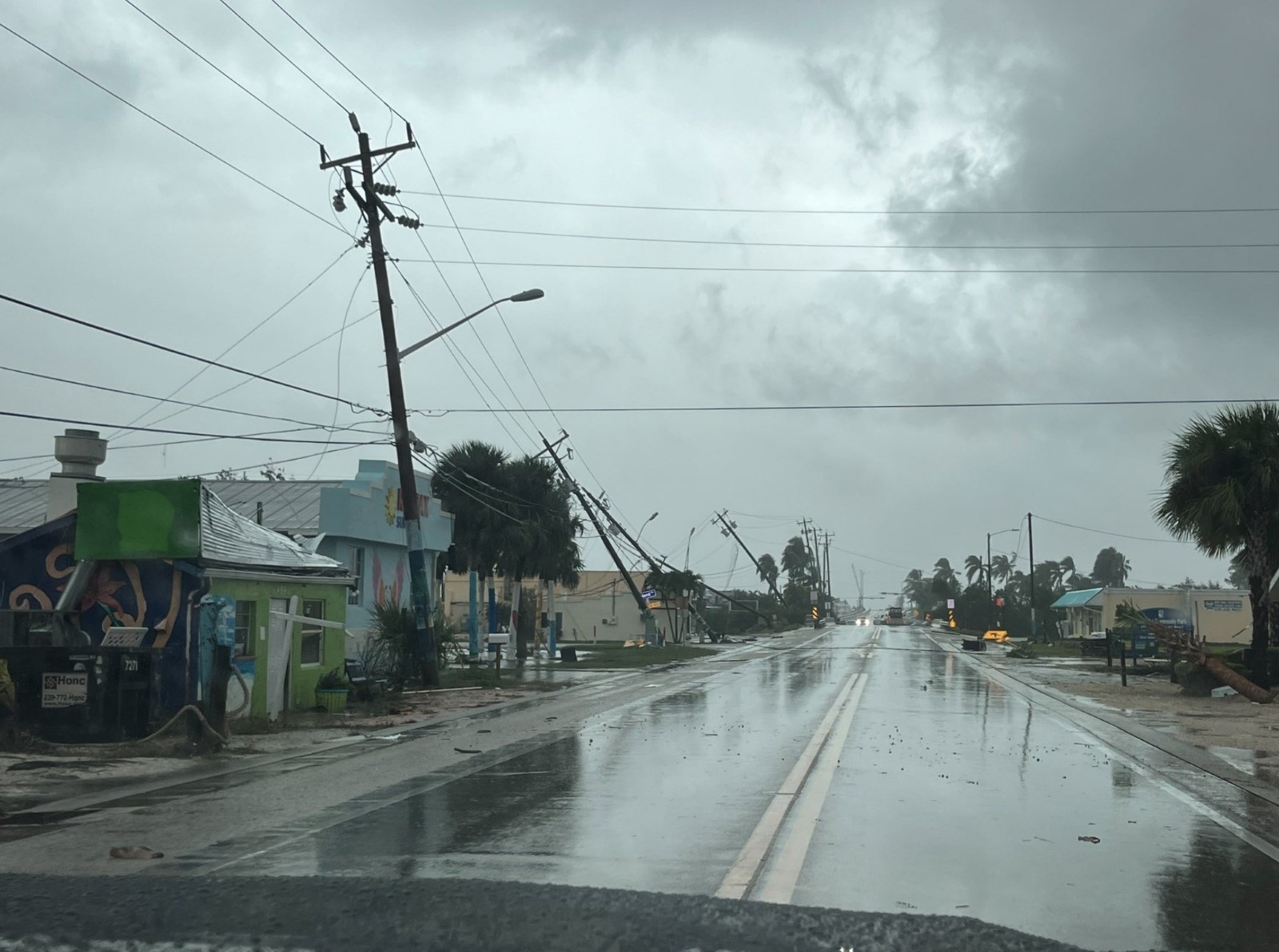
Hurricane Milton made landfall in Florida as a Category 3 storm on the night of Wednesday October 9th. The hurricane made its way across the coast of Florida- downing trees and power lines, flattening homes and flooding roads.
This hurricane comes just days after Hurricane Helene devastated the southeastern coast of America and claimed the lives of 230 people, the largest loss of life in the US from a natural disaster since Hurricane Katrina.
The death toll for Hurricane Milton has increased to 16 people, with the number climbing as more bodies are recovered.
Evacuation orders were in place for over one million people living in the coastal areas of the state of Florida and 3 million people are currently still without power.
The hurricane caused so much rain to fall in the Tampa Bay region of Florida, it is being considered a once in a thousand-year rainfall event.
Radar map of Hurricane Milton. Source WMTV News
Mayor of Tampa Jane Castor issued a stark warning to Floridians in mandatory evacuation zones who chose to stay put in their homes; “I can say this without any dramatisation whatsoever: If you choose to stay in one of those evacuation areas, you are going to die.”
Despite this warning, some residents chose to stay in their homes- many of whom had nowhere else to go.
Images spread on social media of people writing their names and date of birth on themselves and their children’s arms in permanent marker in order to be identified if they were killed as a result of the hurricane.
A mother writes on her child’s hand with identification details. Source Ashten Lee on Tiktok
Sinéad Gleeson, an Irish woman living in Florida told the City about her experience staying in her home during the hurricane.
“I had no choice but to stay in my house, I was not in a mandatory evacuation zone, but it was strongly encouraged by the mayor. I had nowhere else to, I didn’t have the money to fly somewhere…I just had to stay put and hope for the best.”
“Thankfully, it was not as bad as it was thought it would be but there was still a lot of damage done, we just hope this is the last hurricane of the year,” said Sinéad.
Damage caused by Hurricane Milton in Lee County, Florida. Source: Lee County Sheriff’s Office.
Despite warnings from President Biden and meteorologists alike, Hurricane Milton was not as severe as feared.
Although the hurricane spared much of the western coast of Florida, airports in the region including Tampa and Palm Beach have remained closed.
According to analysis by the National Hurricane Center, the storm surge spiked to 5 to 10 feet above ground level in some areas. However, it was initially estimated that the surge would reach 15 feet.
So far this year there have already been 13 named Atlantic storms. With more than six weeks left of Hurricane season there are fears that another severe weather event will occur.
At just 19 years old, Rashid Omondi is on the brink of fulfilling a lifelong dream—studying medicine at an Irish University, University College Cork (UCC). Hailing from the coastal town of Pangani, Tanzania, Omondi details the inspiring story of not only his personal ambition, but the unwavering support of his community.
Omondi’s passion for medicine began at just seven years old, when he witnessed local doctors helping his sister after she suffered a stroke. The young man describes this as “the moment he knew he needed to pursue higher education”.
Together with his parents and teachers, Omondi soon discovered that Ireland was the place to be when it came to medical education.
“I didn’t know where to start but my teachers told me it would not be easy, especially for someone from my situation,” said Omondi.
In fact, the financial burden of moving to Ireland nearly forced Omondi to abandon his dream, but he was met with support from his family.
“My father told everyone about our situation and immediately my wonderful community started to help,” Omondi said.
Omondi’s family bike. Photo: Rashid Omondi
To fund his dream, Omondi made a heart-wrenching decision: he sold his family’s only mode of transport, a beloved motorbike.
“It was a tough choice, but my parents knew it was necessary for my future,” he said.
For the next two years, his community rallied around him. Friends and family organised fundraisers, offering rides to tourists who were visiting the coastal town, as well as selling handmade jewellery and carved wooden animals.
Handcrafted items for sale in Omondi’s town. Photo: Rashid Omondi
“The support was and still is incredible,” Omondi says. As the funds began to accumulate, Omondi worked tirelessly on his studies and became the top-performing student in his region.
“When I applied for UCC, I had no idea how it would go,” he said. “I was told not to get my hopes up because there are thousands of smart kids out there. But I believe God was guiding me through.”
Omondi explains how he was not accepted into any Irish universities the first
time around, but that did not discourage him from applying again: “If anything, it was a relief to know I had some more time to learn about life in Ireland and to raise as much money as possible.”
The following year, Omondi’s dream became a reality when he was officially accepted into UCC.
The decision to uproot his life was one that took some time and reflection, leading the young student to defer his studies for a year. Until he begins his medical degree in Cork next September, Omondi plans to learn as much about Irish culture as possible.
“I felt nervous at first but now I have heard from many of the tourists here that the Irish are very welcoming,” he said.
Omondi continues by expressing his gratitude to his friends and family for making his lifelong dream a possibility. “Every class I attend, I will think of them,” he said. “I want to make them proud. My success is their success.”
Looking ahead, Omondi envisions a future where he can return to Tanzania, equipped with knowledge and skills to improve healthcare in his community.
Rashid Omondi’s story is a powerful reminder of the impact of community, illustrating that with determination and support, anything is achievable.
“Free, free Palestine!” students chanted through the halls of TUD Grangegorman. Teachers and students rallied together sporting signs and banners to make a stand on campus and make their voices heard.
One of the organisers of the protest was Jim Roche, a leading figurehead and spokesperson for Palestinian human rights and the Irish movement against the Israeli regime.
Jim Roach, Secretary of the Irish Anti War movement and Co-Founder of Academics for Palestine, discussed his extensive involvement in advocating for Palestinian rights.
Also a lecturer at TU Dublin and vice chair of the TU Dublin colleges branch, Roche co-founded Academics for Palestine in 2014, which was the first academic union to pass a motion for academic boycott.
TU Dublin was the first academic union to pass an academic boycott including divestment and sanctions. Jim Roche was instrumental in setting this up following his experience of trips to the West Bank.
Roche said: “It was an incredible, eye-opening trip. When we came back, I brought a motion to TUI Congress about boycott, divestment, sanctions, about academic boycott in April 2013 after our trip to Gaza. That passed, and we were the first academic union to pass a notion of academic boycott.”
Roche has been heavily involved in the Irish Palestine movement for over 20 years. Jim and his colleagues faced backlash, including hate mail and phone calls, but they received support from the IPSC and received media coverage.
The Academics for Palestine pledge call for the boycott of Israeli institutions formed academics for Palestine. “We hold meetings, we write letters, we ask people to sign our pledge, and we campaign across academia,” Jim said.
The pledge reads as follows: “In response to the call from Palestinian civil society for an institutional academic boycott of Israel, we pledge not to engage in any professional association with Israeli academic, research and state institutions and with those representing these institutions, until such time as Israel complies with international law and universal principles of human rights.”
Jim took the time to acknowledge the emotional toll on activists, advising others to take breaks and protect themselves. “For the first few months I was spending on average two hours a day writing and canvassing and it wears you out. You have to take breaks and be there for each other. I feel like I’ve just been crying since the seventh of October (last year), I just feel completely drained.”
The National Transport Authority (NTA) has approved a nine per cent increase in the National Maximum Taxi fare. This increase is due to take effect from the 1st of December.
This adjustment is to ensure that taxi fares reflect the rise in inflation and costs of operating a taxi service in Ireland.
“I’ll just take the bus, I have a 24-hour bus that I can get home after being out, but for people who don’t, it’s just going to break their banks,” said Niamh Linnane, a 22-year-old student.
“The cost of a taxi in Ireland is extortionate if you aren’t sharing with people,” said Linnane.
We will also see a change to the ‘Special Rate’, which a rate charged only for journeys taken between Christmas Eve, Stephen’s Day, New Year’s Eve and New Year’s Day during unsocial hours.
The Special Rate will now cover the weekend peak hours from midnight to 4:00 AM on Friday night into Saturday morning and Saturday night into Sunday morning, year-round. The fare will be higher rate, and this change aims to encourage more drivers to support the nighttime economy.
There also will be an increase in pre-booking fees. During weekend peak times it will rise from €2 to €3.
Photo by Naseem Buras / Unsplash
“With the cost of petrol, diesel and all that goes into owning a car, never mind a taxi, I am happy to see this fare increase,” said Paul Murphy, a taxi driver of nearly 20 years.
“I know it sounds bad to customers but with the cost-of-living crisis it’s just something that needs to happen,” said Paul Murphy.
This National Maximum Taxi Fare Review takes place every two years to ensure the fares match the costs of maintaining a good quality taxi service and the cost of living within Ireland.
The 2024 Review, published in July, revealed that taxi operating costs increased by approximately 9-11% between 2022 and 2024. Following public consultations regarding these rising costs for taxi drivers, the Taxi Regulation (Maximum Fares) Order 2024 implemented an average fare increase of nine per cent, adjusted across different time bands and distances.
‘Numbeo’ has ranked countries in order of the highest fare of a taxi per kilometer. Switzerland was ranked 1st with the average fare per kilometer being €4.15. According to ‘My Swiss Company’ the average salary in Switzerland is relatively high, reflecting the country’s strong economy, with figures around CHF 78,000 per year as of 2024, which is equivalent to around €83,000.
Ireland placed 13th out of 97 countries with an average of €2 per kilometer.
Taxi fares should reflect the country’s cost of living. Given Ireland’s cost of living crisis and high inflation, this has led to the increase on the taxi fares.
However, with the inflation rate falling to 1.7% in the month of August, figures from the Central Statistics Office (CSO) have shown. This is the first time the inflation rate has lowered since June 2021.
Despite this, The Budget 2025 informed us that the rate will increase from €56 to €63.50 for petrol and diesel. This means an extra €1.20 per full tank for motorists. Potentially meaning this increase taxi fare will not be changed.
“This increase will be in place for the next two years, if inflation continues to decline, then it will be considered and there may be a decrease in taxi fares, but it must match the cost of living at that time,” said The NTA press office.
A recent study from The Irish Longitudinal Study on Ageing (TILDA) in Ireland shows that about one-third of adults over 50 in the Republic of Ireland have experienced emotional loneliness at some point, with 7% feeling lonely often.
The research found that loneliness tends to decrease between the ages of 50 and 67 but rises again after that.
People over 75 are more likely to report feeling moderately lonely compared to younger groups. Factors like lower education, living alone, poor self-rated health, physical limitations, and chronic health conditions were linked to higher levels of loneliness.
Ireland is currently ranked number one in Europe for people suffering grom loneliness as of last year, with the coronavirus pandemic forcing generations to feel isolated.
Source: Institute of Public Health
Men above 65 years old saw a 25.1% increase in living alone, while women over 65 saw an 18.4% increase in the last six years. “The numbers are only going to continue rising,” said psychotherapist Maggie Molloy.
“I often deal with young people suffering from loneliness, so I know how bad it must be for the elderly who have far more reasons, most of which are out of their hands for feeling lonely.”
Last year The World Health Organization (WHO) declared loneliness to be a pressing global health threat, with the US surgeon general saying that its mortality effects are equivalent to smoking 15 cigarettes a day.
Anne Butler is a woman who knows the effects of loneliness all too well, inspiring her to commit her life to helping the most vulnerable in her community.
“Loneliness is a big issue for older people, and I don’t think the general public realises this enough,” said Mrs. Butler, who is the manager of Walkinstown Social Service Centre.
“It is dangerous to the elderly, we are social creatures that need to interact and get out of the house, but for some people that’s just impossible. It is heartbreaking because some of the faces around here were stuck in nightmare cycles of being upset, refusing to eat, or turning to drinking alcohol at home. It’s stories like these that make me so happy that we’re making an impact in the community and the bigger problem,” she says.
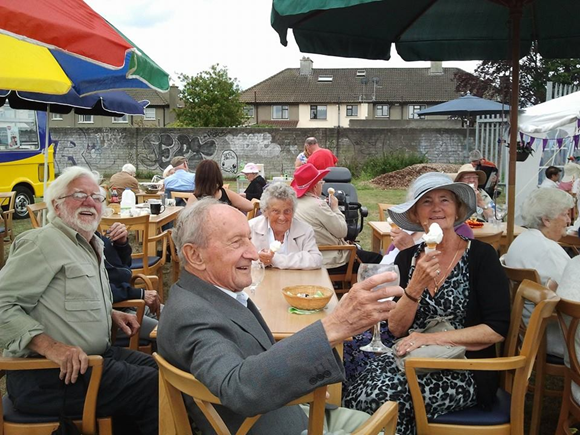
The centre takes in 60 people daily between lunch and dinner with some walking and others taking the centre’s bus that collects them from their houses. The centre charges €10 for transport, a meal, and bonus activities, whether that is a game of bingo, or a fitness instructor to get them exercising.
Group day trips around the country are organised and voted on. Special events happen year-round with ‘Strictly Come Dancing’ watch parties and even live shows with staff members performing dances.
“I’ve been coming for the last few years now and it’s just brilliant,” said Monica Walsh, age 72.
“I’m not great on my feet any more so going out wasn’t really possible unless I waited for my kids to come and bring me out somewhere. The centre is great because I get a sense of independence back, able to go out on my own.
“I feel like a kid again, going out with friends, singing songs. This place has given me some of the best moments I’ve had in years. All the staff are true heroes.”
The centre’s staff is made up of half full-time workers and half part-time voluntary workers from the local area such as Amanda Nic Fhannchaidh.
“I don’t work on Thursdays or Fridays, and I’d just be watching the Telly all day, so it’s really a no-brainer for me to come here, have a laugh, and feel good about myself for helping out where I can,” said Amanda.
Both local schools, the Assumption Secondary School Walkinstown and Drimnagh Castle Secondary School, have included helping out at the centre as a part of the transition year experience.
“It’s the right thing to do, so it’s what the lads will do. It gives the school a good name in the community and a chance for the boys to see how far a little help can go,” said Drimnagh Castle Secondary School principal John Haze.





















You must be logged in to post a comment.