O’Connell Street, once the heart of Dublin’s city centre and a vibrant hub of activity, has seen noticeable neglect and signs of urban decay in recent years.
This iconic thoroughfare, known for its historic monuments and central location, is now marred by a range of issues including vacant and derelict buildings, deteriorating facades, and an increase in anti-social behaviour.
The lack of consistent investment and urban management has allowed the street’s architecture and infrastructure to fall into disrepair, which has contributed to a feeling of abandonment and insecurity among visitors and locals alike.
The following images capture the true extent of this decline. From damaged facades and boarded-up windows to graffiti-covered walls and poorly maintained shop fronts, these photographs reveal the scale of neglect that has impacted O’Connell Street.
They highlight the deteriorated state of once-vibrant buildings, showing how years of minimal upkeep and insufficient investment have led to visible decay. These images serve as a stark reminder of how urban neglect can transform even the most historically significant areas into spaces that feel unwelcoming.
The following images give a compelling case for an urgent need to restore and revitalise this once-proud avenue in Dublin’s city centre.
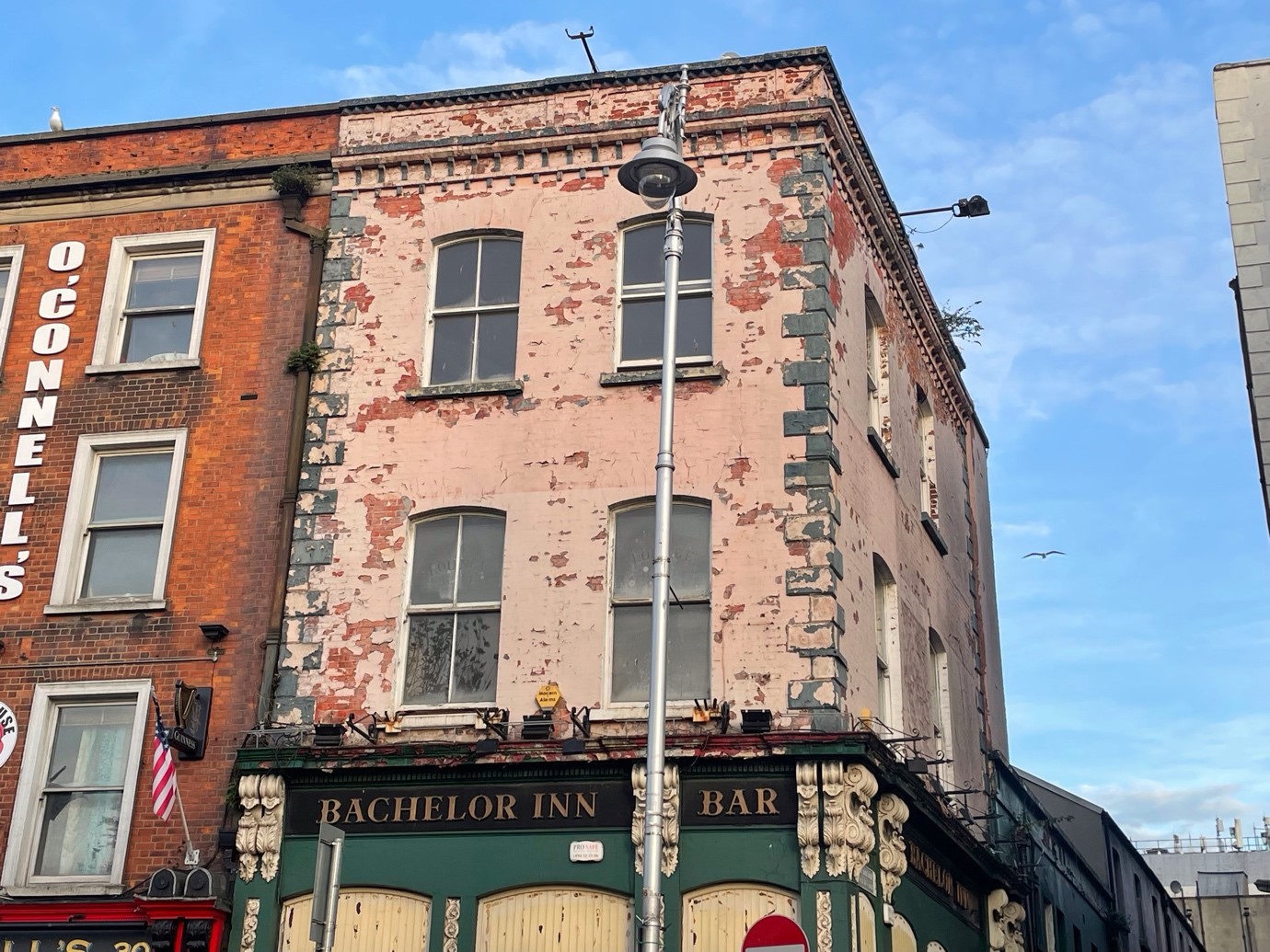
The Bachelor Inn Pub failed to reopen after closing during the Covid-19 pandemic. The building remains empty with visible exterior damage. An empty shop at O’Connell Street lower with extremely damaged windows and façade in a grave condition. Facing The GPO, the roof top of this large empty retail unit shows no visible signs of care, with roof titles damaged and rotting away. Weeds can be seen growing from the roof titles.
The previous 3 images show 3 empty and derelict buildings all within 300 metres of each other, with cracked and damaged concrete on the facades.
The final 4 images are at O’Connell Street upper and show the true dark colours of this capital’s Main Street. Major neglect with no proper treatment of structural integrity.
Recent figures from the company Optical Express state that over 750 million plastic lenses are being flushed down drains or dumped in landfill every year.
These lenses then form microplastics, pollute the seas and oceans. Once dumped in a landfill, microplastics can take up to 500 years to decompose and biodegrade, polluting the soil and water, according to many authorities, including the World Wildlife Fund Australia, and the United Nations.
Also, as contact lenses travel through sewage systems, they break down into smaller particles and then form microplastics.
Photo: sciencestockphotos.com
The situation is now thought to be far more serious than had previously been suspected.
According to the findings of Optical Express using information from the Association of Contact Lens Manufacturers, almost 800 million plastic contact lenses are used by more than 4 million people in the United Kingdom and Ireland every year, and this has an enormous, but often unobserved, impact on our environment.
In an Optical Express survey of over 3,000 UK contact lens users, it was found that 97% are polluting the environment by throwing them down their drains, or putting them in their bins, and barely 3% of people recycle their lenses.
More than 1 in 4 people (27%) admitted to getting rid of their lenses by throwing them down their sinks and toilets.
While most websites of contact lens manufacturers and shops have information on how to dispose of them responsibly, it is usually only mentioned on a seldom viewed sub-page.
Another study by contact lens manufacturer Johnson & Johnson found that 1 in 5 people (20%) were flushing their used lenses.
A study by the University of Exeter, concluded that every seal, dolphin and whale, which were beached on shores in the UK, had plastic in their stomach.
Over the last decade, the use of softer plastic contact lenses has increased with people wearing daily, weekly, or monthly disposables in greater numbers than ever before.
A major contributing factor to this problem is that most of the shops and manufacturers phased-out yearly contact lenses many years ago, for the far more lucrative daily, weekly, and monthly disposables.
A spokesperson for Vision Express opticians said: “We always instruct our opticians to inform our customers of how to dispose of contact lenses responsibly, but I cannot tell you 100% for certain that this is always put into practice by all of our employees every time they talk to our customers.”
Several contact lens manufacturers, websites, and shops were contacted by The City.ie for comment. These included Acuvue, Johnson & Johnson, Coopervision and Bausch + Lomb.
The question posed to these companies was: “Would your company consider phasing out, and discontinuing the manufacture and sale of daily (and maybe also monthly), contact lenses, and perhaps only selling yearly lenses instead?”
A reply from Kristy Marks, Senior Director, Corporate Communications from Bausch & Lomb, only stated that they have a disposable programme.
A question was posed to the former Green Party Leader Eamon Ryan, and their most recent Environment Spokesperson Brian Leddin which was: “Would your party consider influencing companies, websites, and shops to consider phasing out, discontinuing, and banning the manufacture and sale of daily (and maybe also monthly), contact lenses, and perhaps only selling yearly lenses instead?”
A reply was returned in regard to this issue, by an individual called Albert Morris, on behalf of the Green Party, which expressed a general statement about their ‘Waste Action Plan for a Circular Economy,’ but did not address this specific question that was queried.
It can only be hoped that plastics and microplastics will be dumped a lot less by humans, for the sake of birds and marine life in the future.
November is Men’s Health month which focuses on mental health, suicide prevention, prostate cancer and testicular cancer.
The purpose of this is to try and get men talking about their health. One of the initiatives for men’s mental health in November that has become a household name is “Movember”. This involves men growing moustaches to raise money for suicide prevention.
Despite the multiple efforts made to combat suicide it is unfortunately not uncommon in Ireland in men especially in the farming community.
In September 2023 the HSE released a report called “Dying to Farm: Developing a Suicide Prevention Intervention for Farmers in Ireland”
According to the report, over 20% of the farmers that were surveyed were considered at risk of suicide.
Photo Credits- Molly O’Reilly
The report also said 55.5% of farmers reported experiencing moderate to extremely severe depression, 44.1% of farmers reported experiencing moderate to extremely severe anxiety, and 37.9% of farmers reported experiencing moderate to extremely severe stress.
In addition to this there was multiple recommendations in the report to help combat mental health issues within the farming community in Ireland.
However, a year on, and the issue of mental health and suicide is still increasingly prominent in the Irish farming world.
However, Alice Doyle the now deputy president of the IFA and former Director of Mental Health Association, said information in these reports about mental health with farmers can often be inaccurate.
“You must be careful with the information provided. t’s an indicator (the statistics) but we should only see it as an indicator not as a definitive piece of information,” said Doyle.
Luke O’Reilly, a 61-year-old farmer from County Cavan who has lost extended family members to suicide, spoke about the importance of better mental health infrastructure for farmers.
“It can be very lonely in dark cold evenings in the winter, a lot of the time you are on your own with just your thoughts, which can be difficult for some. It’s important to speak up and get help,” he said.
O’Reilly recalled the era before the online streaming of marts, when you could go to the mart and get someone to check your blood pressure.
“It was great for socialising and for checking on older farmers that lived on their own and wouldn’t go to get checked,” said O’Reilly
The stigma surrounding mental health in Ireland can hinder people from asking for help. This can be seen in the agriculture industry as there tends to be a stereotype of farmers to fall into – to be strong, quiet and to simply get on with things.
The fact that the issues in work within agriculture are harder to walk away from as it becomes a lifestyle as well as a job makes it easier for people in agriculture to unfortunately experience mental health issues.
Photo credits- Molly O’Reilly
For instance, their hours are not structured and a problem arising can alter their career and income significantly.
The agricultural voluntary youth group Macra na Feirme also sent an email to its members for the month of November with the title “Rural Youth- Mind Our Men”
The purpose of the email is to reflect the importance of praising the work the men do within these communities and in the Macra group itself.
There was also a suggestion to organise events such as speakers to further reflect the importance of opening such conversations for men’s mental health and physical health.
“We encourage clubs and counties to consider the great role of many of the men in our organisation and we encourage you to celebrate their contributions during the month.”
IFA Deputy President Alice Doyle is originally from Carlow and now works with her husband on their farm in Wexford. She spoke about how important it is to have these conversations;
“They’re part of society (farmers) and they suffer from the same pressures that come from society as do and as anybody else. And then they have their own added pressures as well because of the sector that they belong to,” said Doyle.
Doyle explained how the services are there, but it is a matter of applying the services to those who need them.
“I had a girl who rang me to ask where she could find someone to speak to her dad, he is 70 years old and told her he felt a bit low,” she said.
An unfortunate reality of farm life is accidental deaths which can lead to mental health problems for surviving members of the family. Organisations such as “Embrace Farm” offer support for families grieving from accidental deaths.
“We think of the guy that’s driving the tractor but not necessarily the person who has been left behind,” said Doyle.
An initiative that has taken place to check the mental and physical health of farmers was a survey that was issued across 20 marts over Ireland.
Throughout the survey the farmers were asked questions about their well-being and then were followed up with support.
Doyle explained that there are services and infrastructure for farmers in Ireland, but the issue now is to make them accessible and enticing for farmers.
“Farmers like to talk to someone who understands their way of life is different to a nine to five job- they like to be able to talk to someone who understands farming.”
An inspection of the Cliffs of Moher walking trail carried out by Sport Ireland has found that some visitors were not equipped for conditions and engaged in reckless behaviour close to the cliff edge.
The most recent incident at the cliffs happened on November 9 after a woman’s body was recovered from the base of a cliff in Co Clare following a multi-agency operation.
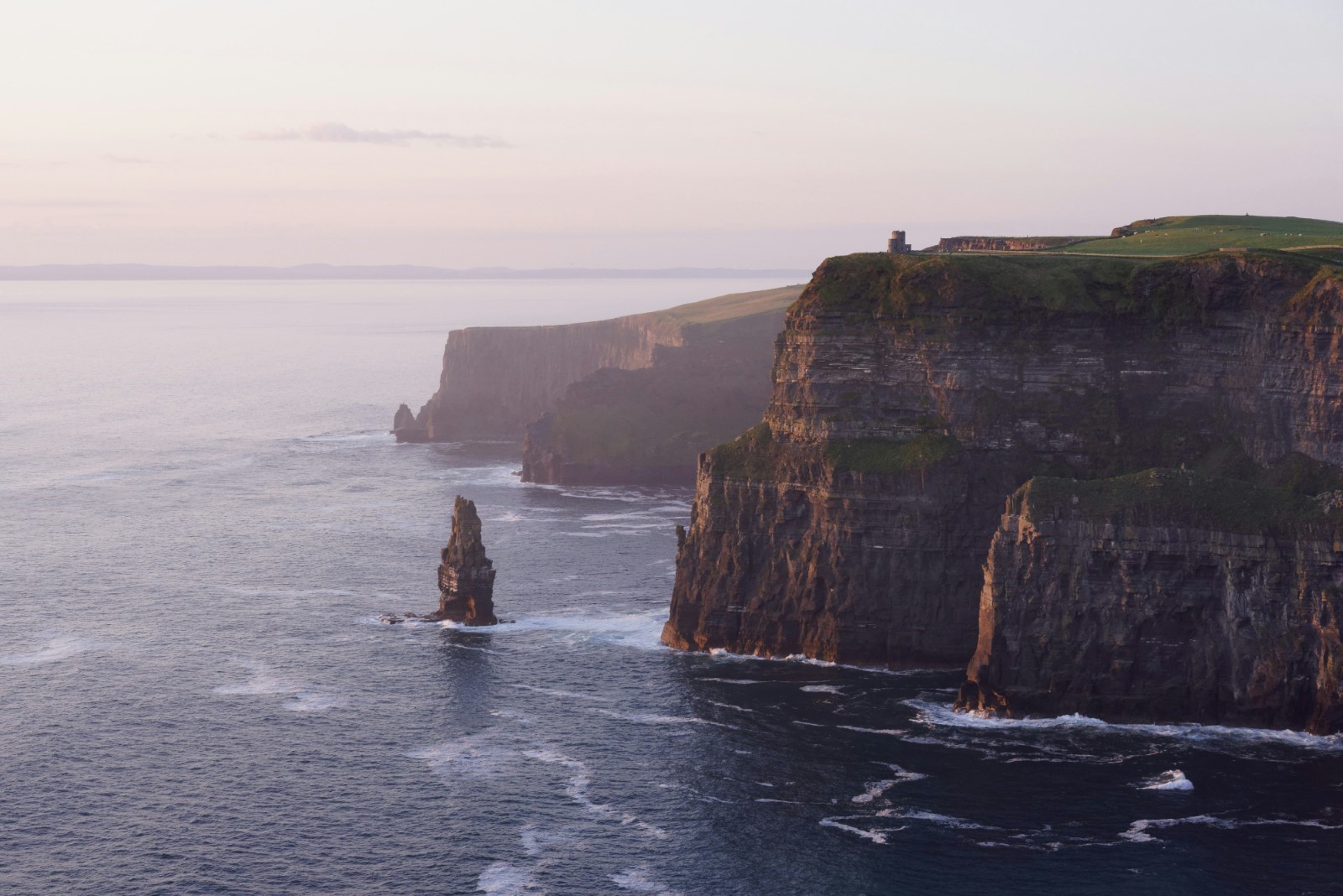
Featured Image: The Cliffs of Moher. Credit: Unsplash
Sport Ireland has a responsibility for developing walking trails across the country, and for promoting a variety of outdoor and recreational activities to encourage people to become active outdoors. The organisation conducted the inspection in mid-August.
The inspection happened after two young people tragically lost their lives in the area in July.
Sport Ireland discovered that a large amount of visitors were choosing to ignore the warning signs and walk dangerously close to the edge.
Many of the visitors were straying off the official path due to sections of the walk that were too narrow to cater for the number of visitors walking in both directions. In one case attendees of a humanist wedding were found to be standing close to the cliff edge with their backs to the edge and the water below.
The report also found the trail was unsuitable for the type of people it was attracting and that the inspector saw multiple examples of dangerous or risky behaviour.
The inspector’s view was that the trail “be closed immediately” to make it safe, according to a copy of the report that was released under freedom of information laws.
In a statement sent to The City Sport Ireland said; “Following Sport Ireland’s recent inspection of The Cliffs of Moher Coastal Trail, several safety issues were identified along the trail.
In agreement with Clare Local Development Company, which manages the trail, these issues were deemed serious enough to require urgent attention.”
The visitor centre at the famous cliffs, along with 800m on either side, is managed by Clare County council, but it does not manage the cliff walk.
The coastal walk is managed instead by Clare Local Development Company (CDLC), which is responsible for its maintenance and negotiates with local landowners.
Cliffs of Moher. Credit: Pixabay
Sport Ireland added: “The Cliffs of Moher Coastal Trail is included on the National Trails Register and is on the connected Public Liability Insurance Policy, which is managed by Sport Ireland Outdoors. Sport Ireland Outdoors inspects the trails on the National Trails Register periodically to ensure they continue to meet the required standards.
To remain on this register, any safety issues reported during these inspections must be resolved within 30 days of the inspection date.
The Cliffs of Moher are a key tourist attraction in Ireland, with the connected coastal trail attracting hundreds of thousands of visitors each year. Therefore, in managing these remedial works, Clare Local Development Company have structured their plans to allow sections of the trail to remain open while other parts are closed for renovations.
Clare Local Development Company have successfully addressed all safety issues in the areas of the trail that remain open.”
They concluded: “Sections of the trail with unresolved safety issues are now closed to the public until they are addressed.”
So how can people be safer when walking along coastal trails?
The Royal National Lifeboat Institution (RNLI) is a charity that saves lives at sea in the Ireland and the UK and The City reached out to them for coastal waking advice.
A spokesperson from RNLI said; “be wary of all edges around the sea and waterside. Slips and falls happen in all locations; it is not just high cliff edges that are a risk. Always let someone know where you are going and when you expect to be back.”
“Take care when walking in dark and slippery conditions. Always take a means of calling for help and always check the weather and tides. Getting cut off by the tide is a common cause of lifeboat launches. Should you get into difficulty or see someone else in trouble, call 999 or 112 and ask for the Coast Guard.”
The Irish Coast Guard is another group that saves lives at sea. They are a part of the Department of Transport. The Coast Guard main roles include maritime safety and search and rescue.
Below is a clip of the Coast Guard carrying out a rescue on a cliff edge, courtesy of Irish Coast Guard on X:
Inclusivity and providing a safe space for all participants are core values of sport, especially when it comes to identifying as LGBTQ+.
A basketball club in Dublin has been set up this year – aimed at being an inclusive sports environment for members of the LGBTQ+ community, wishing to partake in basketball.
The basketball club in question is Shamrock Sióga. Set up in May of this year, it became the first LGBTQ+ basketball club in Ireland.
Shamrock Sióga had their first game of the season, last month, against Renegade and won 38-35.
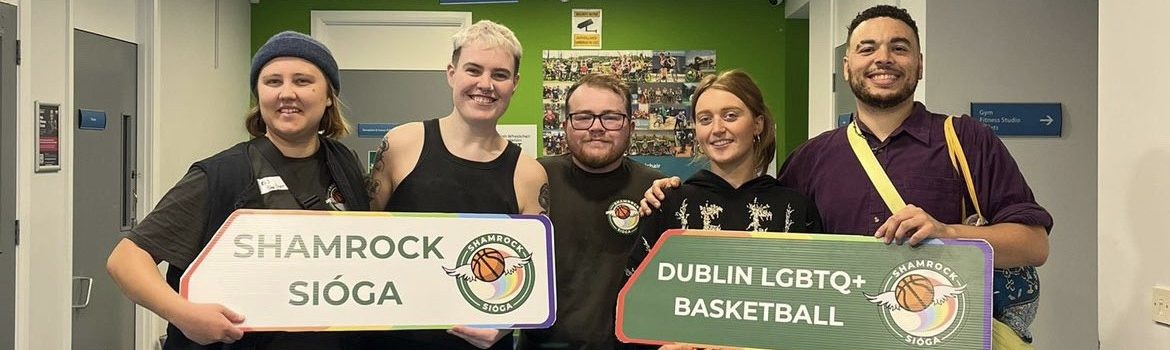
The Shamrock Sióga team and committee before their first game against Renegades. Photo: @dublinlgbtbasketball
Tatiana O’Brien–Santos (She/her) is the coach at Shamrock Sióga and gave The City an insight into her experience in the LGBTQ+ inclusive club.
“Being the coach of Shamrock Sióga is so rewarding, all of our players are so hard working and give it their all at every session. There is nothing but respect both ways,” she said.
Speaking about what Shamrock Sióga means to her, she said, “LGBTQ+ people face their obstacles in life and many times these are in a sports setting. For women and LGBTQ+ people, there is almost always justification needed for their participation and I have felt this personally almost all of my sporting life. I want to eliminate that for everyone.”
The coach refers to Shamrock Sióga as the “beginning of history”. She said, “As the first LGBTQ+ basketball club in Ireland, it’s an example – a statement that’s paving the way for all and any LGBTQ+ athletes and any other minority communities, and sometimes you just have to create that space yourself.”
Coach Tatiana O’Brien-Santos in her element at a recent training session. Photo: Tatiana O’Brien-Santos
When asked about the club’s success since its formation, she said, “Our growth rate and the feedback from our members on how impactful the club has been in terms of helping people feel like they belong and feel confident in a sports context is something I’m so proud that the club has been able to achieve.
“We have been featured in national media three times over the last 6 months. We have over 140 people in our club, our followers on our socials have tripled. We played our first ever basketball match and won, we are about to host the first exclusively LGBTQ+ basketball match in Ireland. I couldn’t be happier to see the support we have received.
“Being involved in basketball for so much of my life, I wanted to use my knowledge to help fuel growth for the club and get it to where I knew it could be. Within 3 months, we were a fully established basketball club with registered members, a clear structure and a great club culture, something made possible in collaborating so well with the committee of the club who truly work so hard for Shamrock Sióga,” she added.
Along with O’Brien-Santos, Shamrock Sióga thrives in its current success thanks to several additional members of a dedicated committee.
The Shamrock Sióga committee. Left to right: Kris Kalniņa, Jess Devine, Fionn Collins, Tatiana O’Brien-Santos and Danny Carby-Robinson. Photo: Tatiana O’Brien-Santos
DannyCarby-Robinson (He/Him) is the treasurer and registrar at Shamrock Sióga.
Carby-Robinson thrives on “connecting with others” and believes in the “power of small-scale community changes – to create a larger impact.”
“Being part of Shamrock Sióga has been such a fabulous experience. Having an LGBTQ+ basketball club is super important because it creates a safe and supportive space for people to enjoy the sport without fear of discrimination, judgment or shame,” he said.
He believes that everyone brings diverse aspects of being LGBTQ+, which will help ensure their work remains “inclusive, multifaceted, and representative of all walks of life.”
He attributes homophobia, transphobia and toxic masculinity in traditional sports environments as factors when considering LGBTQ+ hesitancy with engaging in sport.
“As a closeted teenager, I joined a rugby team but quickly became discouraged by the negativity around me during an impressionable time in my life. These experiences left a lasting impact.
“Joining an inclusive club has helped me rediscover my love for sports and has shown me the importance of creating supportive environments for LGBTQ+ individuals,” he said.
Carby-Robinson hopes for Shamrock Sióga to participate in the EuroGames 2025 in Lyon as the first ever Irish basketball club to do so.
“I also want to focus on building a stronger community. I hope to connect more with other queer organisations in Dublin on collaborative events, fostering relationships that strengthen our impact in the broader LGBTQ+ community,” he added.
Jess Devine (They/Them) is the club secretary and PR officer at Shamrock Sióga.
Devine calls their experience with Shamrock Sióga “life changing”. They said, “It’s a club I didn’t know I needed in my life. Now that I’m part of it, I can’t imagine my life without it. The community that has been built through this club is fantastic. I can’t wait to see this grow and flourish with more LGBTQ+ people.”
Speaking about inclusivity in sports, they said, “I think a lot of queer folk in sport would’ve played when they were younger and as they grow up there is no inclusive space for them anymore and they fall out of love with the sport.”
“I’ve felt this way in past basketball teams as a non-binary person on a women’s team. I didn’t feel included due to the language, the gendered terms in sport and not feeling safe to come out as non-binary.
Devine calls it “crucial” for people to have a safe space where they can be their 100% authentic self, and believes this should apply to sports clubs.
Devine’s future hopes for the club are to grow bigger and have an U18s division for queer kids. They’d also “love” to get into “as many tournaments as possible” and represent Ireland.
Fionn Collins (He/Him) is the chairperson at Shamrock Sióga.
Collins wanted to create a basketball team that “catered for all” in the LGBTQ+ community. He said, “The community we have created is amazing – a safe space for all the community in sports.”
Collins feels the club is opening doors for conversations about the LGBTQ+ community in sports. He sees it as a chance to educate people and show that sports is for everyone.
In relation to LGBTQ+ people staying away from sport, he attributes this to toxic masculinity – but believes things are “slowly changing” with the help of Sporting Pride and other organisations.
Collins believes it’s “super important to have an inclusive sport” – to have “all parts of minority communities” feeling recognised and seen in the sport they want to play.
Collins feels that improving inclusion in sports will reduce poor mental health in the LGBTQ+ community.
Collins’ future hope for the club is to become as big as other LGBTQ+ clubs in Ireland like Emerald Warriors and Na Gaeil Aeracha.
“I want us to also help push policies for our trans siblings within the basketball community, to allow them to be safe and play in the sport,” he added.
Kris Kalniņa (She/Her) deals with fundraising and court bookings at Shamrock Sióga.
Growing up in Latvia, where the sports culture is “rooted in the rigid traditions of the USSR,” Kalniņa felt isolated there as an LGBTQ+ athlete “as there was little room for openness.”
She claims being part of Shamrock Sióga’s committee has been “transformative”. She said, “It’s allowed me to help build a community that prioritises inclusivity and support for LGBTQ+ athletes – fostering connections among diverse individuals who share a love for basketball and sport.”
Kalniņa attributes “experiences of exclusion” to LGBTQ+ people avoiding sports and personally felt this way growing up. She said, “The fear of rejection often overshadowed my passion for athletics. Addressing these barriers is essential for fostering acceptance.”
“An LGBTQ+ basketball club is crucial for creating a safe space where individuals can express themselves freely while enjoying the sport,” she said.
Kalniņa’s future hope for the club is to “challenge the status quo by advocating for inclusivity and equity in sports,” and envisions “participating in competitions, proposing fair rule changes, and inspiring positive change.”
“It is something I’m incredibly passionate about. My experiences in sport have shown me the power and impact of creating a space where everyone feels they belong,” she said.
Unity Sports builds on the basketball coach’s mindset and approach, by “aiming to foster inclusivity and growth in sports,” particularly for women and the LGBTQ+ community.
O’Brien-Santos’ plan with Unity Sports is to “provide opportunities for people to be their best selves in sport, and to educate coaches, teams, and organisations on creating environments that truly welcome all athletes – all with the intention to grow the audience of women and LGBTQ+ sports events.”
“Whether it’s helping women feel valued in traditionally male-dominated sports or supporting LGBTQ+ athletes who’ve often felt overlooked, we’re focused on building leaders and advocates who can bring real change to sports culture.
“I’m creating Unity Sports to break down barriers and reshape what sport can look like for everyone,” she concluded.
Irish boxing superstar Katie Taylor is due to fight Amanda Serrano in their highly anticipated rematch on tomorrow night, November 15.
The duo first met in Madison Square Garden in 2022, where the Bray native secured a split decision win in what’s been deemed the biggest ever fight in women’s boxing.
However, this time the pair will meet in Dallas, Texas, in the 80,000-seater home stadium of the Dallas Cowboys, on the undercard of Jake Paul and Mike Tyson.
Taylor’s influence in the boxing scene overall has been huge, but in particular, her impact in women’s boxing has seen the number of female fighters grow in ways no one could have predicted.
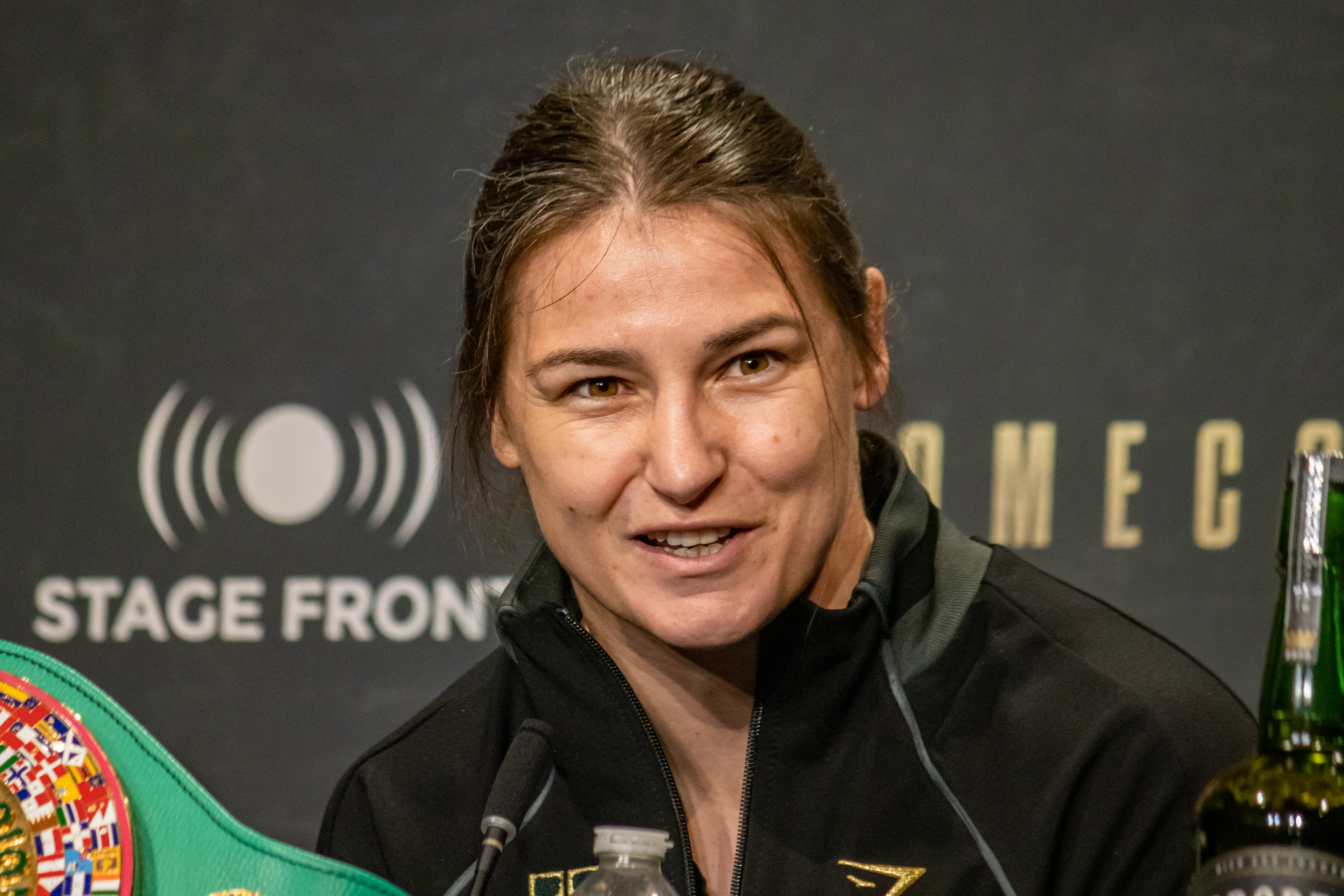
Katie Taylor speaking at the weigh in ahead of her fight against Chantelle Cameron in May 2023 – Photo: Liam Murphy
“Katie is my hero, my idol, and my inspiration,” Ella Thompson, an amateur boxer from Meath, said. “She has kicked down doors and paved a pathway for up and coming and present champions and has inspired young female amateurs like me”.
Ella Thompson, or Joyful as she goes by, was named as the All-Ireland Champion in 2022, fought in the 3Arena back in September, aims to get to the Los Angeles Olympics in 2028, and has trained with Taylor in the past.
“She is an idol and hero to me inside the ring, but more importantly outside the ring.
Ella Thompson
“It was amazing to share the ring with the greatest female boxer of all time,” Thompson said. “To look, learn, but most of all chat to Katie was amazing. I’m truly humbled and blessed.”
Big smiles from Katie Taylor in the ring at a public workout in Dundrum – Photo: Liam Murphy
It was only in 2012 that women’s boxing debuted at the Olympics. This moment was seen as the turning point, as Bray boxer Katie Taylor took home gold for Ireland in the lightweight division.
But it was also Katie Taylor that fought in the first ever women’s boxing fight in Ireland.
Despite voting to allow women’s boxing in 1997, the first women’s competitive bout took place four years later in Dublin’s National Stadium on October 31, 2001, between a 15-year-old Katie Taylor, who won on the night, and Belfast’s Alanna Audley.
Since then, Ireland’s become one of the Olympics’ strongest nations for women’s boxing contingents, with six of our 10 boxing hopefuls this year being female, with Dubliner Kellie Harrington taking home her second gold following a 4:1 split decision win against China’s Yang Wenlu in Paris, along with a successful run at the Tokyo games.
Acknowledging the success of a fellow pioneer, Katie Taylor tweeted following Kellie Harrington’s gold medal win, claiming she had sealed her place “as an icon of Irish sport and going down in history as a legend”
Kellie Harrington greets fans at her Portland Row homecoming following Ireland’s most successful Olympic games ever Photo: Liam Murphy
The history of women’s boxing is one of struggle; being rejected from clubs, fighting male opponents due to disparity within clubs, having to hide your long hair under a headguard and registering for fights under pseudonyms (Such as Taylor’s ‘K Taylor’ name when she was fighting male opponents), but it seems now the success has been worthwhile.
This week’s rematch bout, available to stream on Netflix, is set to be the biggest payday of Taylor’s career, with Boxing Kingdom reporting an estimated payday of $6.1million (€5.7m).
For those wanting to watch the fight, the Irish boxer is due to take to the ring at approximately 3am Irish time, followed by a main card bout of Jake Paul and Mike Tyson at 4am.
Irish pride is never too far away in New York City… and neither is a drink.
By Katie Shadlow
Talking about the accomplishment and reward in owning an Irish pub in the city that never sleeps with Blaggards Pub owner Liam Lynch is enough to make you realise that Irish pride is alive and well in New York, and Irish craic is only ever a block away for the homesick.
Originally from Celbridge, Co. Kildare, Liam Lynch moved to New York and has been running his business on 8 W 38th Street for 26 years, and though he misses home, he has no regrets.
While there is evidence of Irish workmanship throughout the city in forms of architecture, cultural influence and more, it seems only fitting that the Irish bring great pubs and great craic to New York City, and here’s just a few.
All photos taken by Katie Shadlow
Blaggards Pub, opened on 8 W 38th Street, New York, in 1998 by Liam Lynch. Run by an Irish man, this pub really offers the piece of Ireland that the homesick are missing.
McGee’s Pub, located in the heart of Hell’s Kitchen, was the pub that posed as the inspiration for the iconic ‘McLaren’s Pub’ in the hit TV series ‘How I Met Your Mother’.
The Keg Room located on 53 W 36th Street, is an upscale Irish- American sports bar, which offers the perfect blend of cultures for those who miss home but not enough to want to feel at home. They also delightfully welcome you to their website with some comforting Irish words, ‘Céad Mile Fáilte’, meaning ‘One Hundred Thousand Welcomes’.
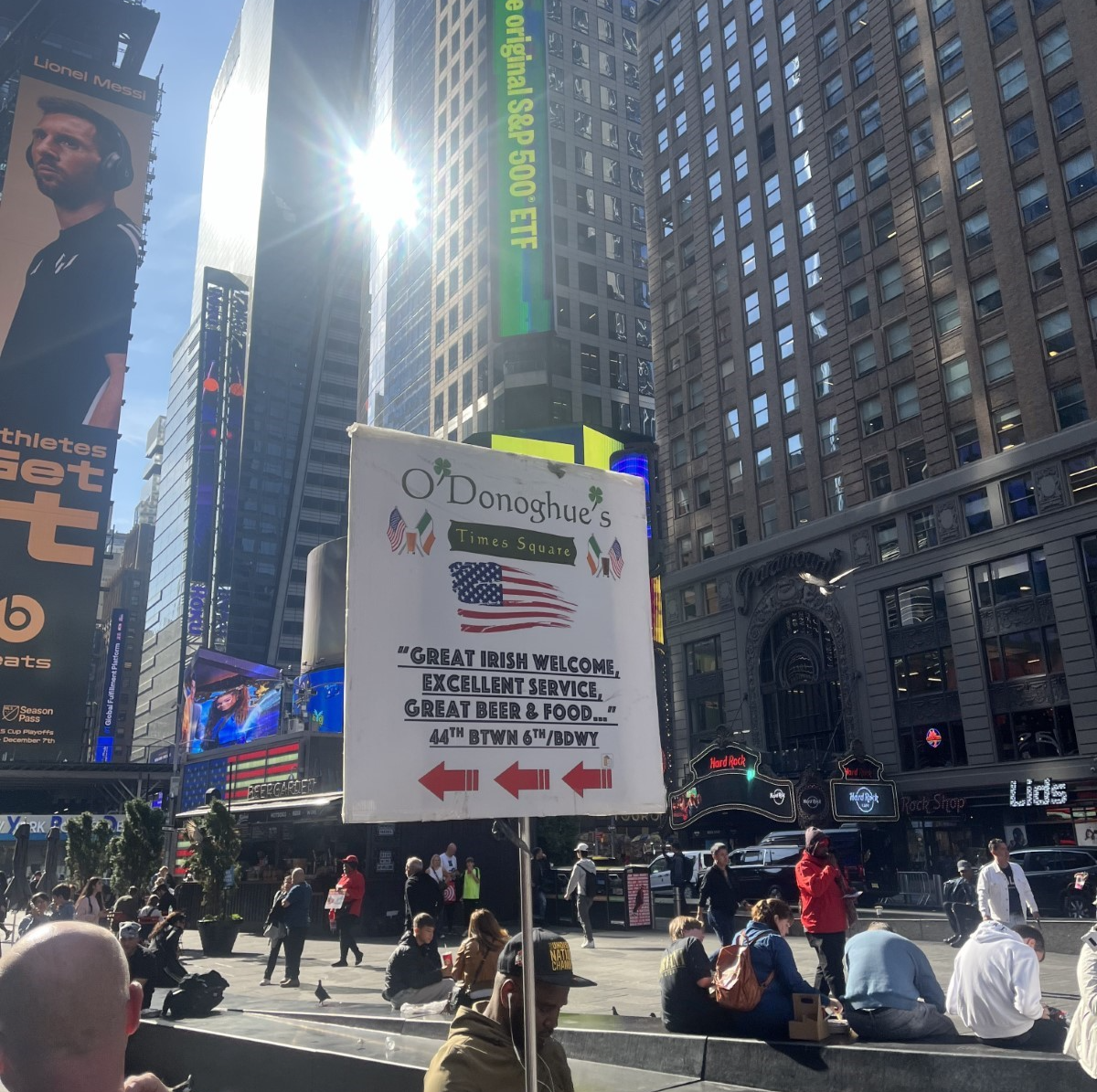
O’Donoghue’s blends the excitement of the Big Apple with the old Irish warmth right in the heart of Times Square.
The Long Acre Tavern is a contemporary Irish American pub, located on 146 W 47th Street is more in tune with its traditional American roots, but makes a nod to the Irish with its flag outside and their frequent use of their Instagram page to advertise Irish sporting events that they show in their bar.
The Playwright Irish Pub and sportsbar, located between 5th and 6th avenue, is owned by John Doherty, and while it may not have the most authentic Irish atmosphere, many reviews raise their glass to their great pint of Guinness!
Nobody does advertising like O’Donoghue’s, with this nod of appreciation to both the bar and the Irish, with the words “Great Irish Welcome” waved for everyone to see in Times Square, New York City.
The AV Club is a new art collective seeking to promote Black alternative culture in Ireland, by curating events that celebrate Black individuals in subcultures, such as punk, goth, rock, metal.
Founders Tina Wekare and Jasmine Odabi described their creation as an aim to “return these subcultures to the control of their original creators.”
They have also said they are “dedicated to creating a welcoming and inclusive environment, where everyone can express themselves authentically and connect with like-minded individuals, fostering a sense of community and empowerment within the vibrant subcultures we champion.”
The new art collective opened their doors to the public for the first time this month with their inaugural event, ‘BLACKOUT.’ The event included a headline performance from band Cable Boy, as well as pop up stalls for various Black Irish artists.
Cable Boy performing at BLACKOUT event – Photo: Lucia Burke
According to organisers Wekare and Odabi, this event was created to “foster a burgeoning Black Irish alternative scene, which is only now starting to reach mainstream. It was created in a response to the constant racism within alternative spaces, which for the longest time, has been predominantly white.”
However, the aim of these events is not only to benefit Black people seeking community in Dublin. A portion of the proceeds of ‘BLACKOUT’ ticket sales were donated to Friends of the Congo, a nonprofit organisation who strive to “bring about peaceful and lasting change” in the Democratic Republic of Congo (DRC).
Event organisers said the reason behind making the event a fundraiser was to start a conversation.
“We need people to join the dialogue and the fight. We want people to leave with a sense of empowerment; to feel like they too can help out – no matter how small the impact. Every little helps,” they said.
When asked about plans in the works for more events like this for the Black Alt community in the future, Wekare and Omondi said, “Absolutely! There is a need for more events and safe spaces for Black alternative people in Ireland. AV stands for ‘Audio Visual’. And we plan to have a lot of events that explore alternative art in all its mediums, from music to fashion to films to visual art etc.”
Eventgoer Ani Dhore said the event evoked “a sense of belonging” and was “inspiring” for her, which organisers said was one of their many goals.
DJ Booth at BLACKOUT Event – Photo: Dearbhla Kiarie
“We want people to come out feeling like they’ve found like-minded alternative people,” they said. “And we want others to feel like they have a safe space to be loud as well. To be truly heard. To feel seen.”
The AV Club has plans to host a movie night as one of their next projects in December, as “Christmas time is notoriously a lonely time for the outcasts. It will hopefully be a great time, having people just hang out and get to enjoy being weird and free and together.”
What the event organisers want people to take away from their collective is that “Black people aren’t a monolith. We fit into a vast variety of subcultures which is why intersectionality is so important to us; and why we are dedicated to curating a safe space for people all over the diaspora.”
The Red Line Book Festival held a book conference for influential Black Women in Ireland to celebrate Black History Month.
The Red Line Book Festival is a cultural event that happens once every year.
It is held to appreciate and celebrate literature, storytelling, and creativity.
It aims to bring people together from across Dublin and Ireland, spark conversations, and inspire the next generation of writers and readers.
The Red Line Festival is normally held throughout an entire week with multiple events happening throughout the week. and one of the events was ‘Stories of Black Women in Ireland’.
Luas Red Line in Tallaght. Photo: Mene Agbofodoh
Dr. Ebun Joesph, a special rapporteur for racial equality and racism Ireland and founder of Anti-Ireland and Black Studies was also in attendance for the talk.
Melissa Bosch, (Head of Diversity, Equity, and Inclusion at where?, Eya Lawani, a Special Needs assistant who has a background in assisting charities for Black Irish children, and Carline Thompson, a nurse, researcher, entrepreneur, and activist, also attended to talk about their new book, ‘Equity in the Workplace Stories of Black Irish Women in Ireland’.
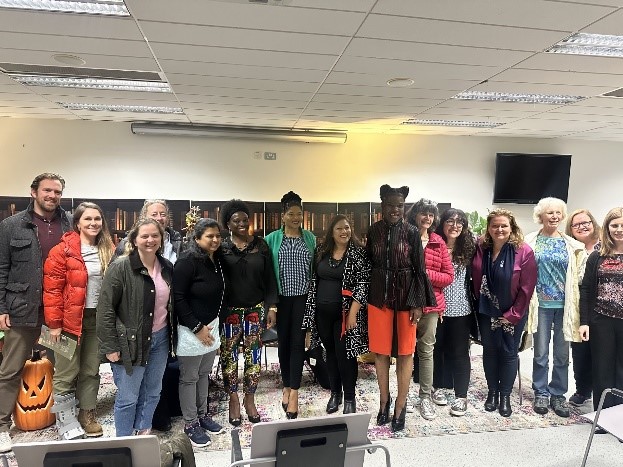
Left to Right- Eya Lawani, Carline Thompson, Melissa Bosch, and Dr. Ebun Joesph speaking at their Red Line Book Conference. Photo: Mene Agbofodoh
The purpose of the book was to amplify the voices of black Irish women and examine their experiences within the Irish labour market.
It aims to uncover the challenges they face and their perceptions of achieving equity in the workplace.
Despite progress in gender parity, disparities still exist, with women being underrepresented in leadership roles and facing lower pay, poor working conditions, and instances of bullying and harassment.
Dr. Ebun Joesph spoke about the importance of women finding their voices within the workplace.
“I think it is important that us women find our voice especially us black women, so that our stories can be heard, to be told and not told from a perspective that doesn’t truly represent us,” she said
Melissa Bosch talked about understanding the power your voice has.
“When you see something that is wrong along the lines of racism and discrimination, your voice is so powerful and when speak out against these things, it can drive change,” she said.
“If we do not speak about things like this and if we don’t open our minds, our hearts to create those spaces for this kind of level of dialogue, we are not going to change anything. Ireland won’t be able to move forward”.
Melissa Bosch’s chapter in the book revolved around trying to help people see their place in the world and what they can do to help marginalized people.
“Whatever ethnic background you come from, whatever demographic background you come from, you have the power to make that change, it’s about understanding your privilege and position in this world.”.
Carline Thompson spoke about the challenges of writing her chapter in the book.
“One of the challenges I had when writing my chapter wasn’t the 2,500-word count even though I only had a week to do it, it was how do I write so much about this topic without exceeding the limit?”
“People think racism only happens in the workplace however, it’s everywhere around you. It’s in the supermarket where you feel you’re being watched by security whilst you’re shopping, it’s in the library, it’s in the restaurant when you’re going out to eat with family and you get stares throughout the night”.
Eya Lawani also spoke on her challenges when she was writing her chapter.
“My problem or challenge about writing my chapter was I didn’t know how I was going to convey the message that systematic racism is the problem in our society without blaming white people as a whole.”
“It was a very difficult topic to write because I had to relive certain moments in my life that made me feel belittled, moments when applications were rejected despite having my bachelor’s degree from Nigeria but because it wasn’t an Irish degree it wasn’t good enough”.
“I struggled with the fact people in society were willing to accept I could be discriminated against because I was a woman but If I said I felt discriminated against because I’m black suddenly it couldn’t possibly be because I’m black and having to convey that in my chapter was very challenging.”
Black History Month is observed in Ireland from the 1st of October until the 31st.
Last month, marked the 170th birthday of Oscar Wilde. The City.ie took a visit to the famous poet’s childhood house where the event Oscariana was taking place, while also going to see key locations around Dublin associated with the poet’s life.
Some of the key items in Oscar’s life were on display in the home where he grew up. Many people attended the open house tour at 1 Merrion Square, which occurred over the weekend.
A walk on the Wilde side showed off aspects of his life, from where he was baptised to when he studied at Trinity College at the old library. Each stop showed a vital part of the poet’s life from early places to memories of his later life.
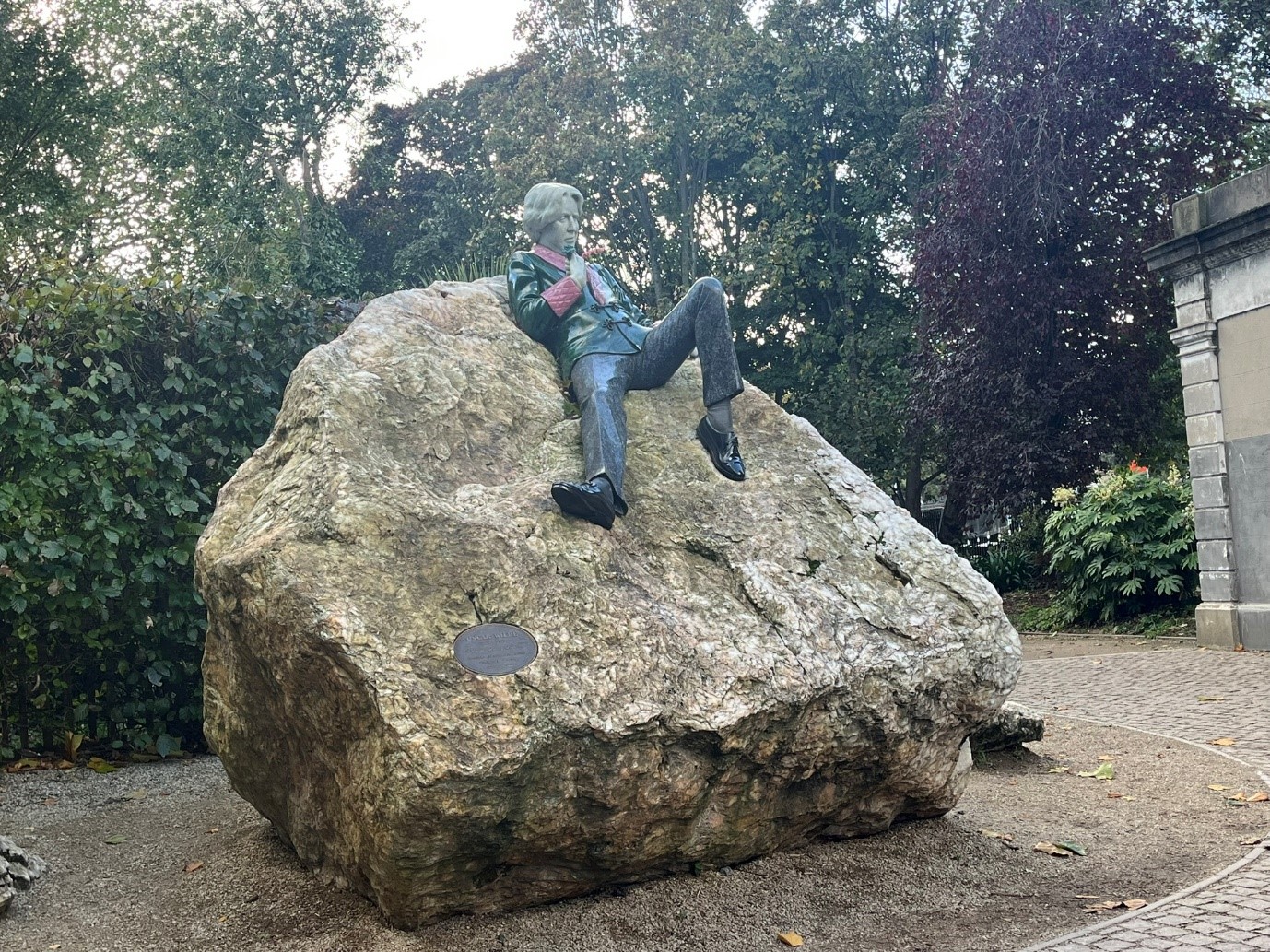
The Oscar Wilde statue in Merrion Square opposite the Oscar Wilde house. A statue of Oscar Wilde by Melaine lo Brecquy The outside of Wilde’s family home from 1855 to 1879An image published in Harper’s Bazaar during Oscar Wilde’s tour of America. A portrait of Oscar Wilde in his childhood bedroom A portrait of a young Oscar Wilde in a dress hung in his childhood bedroomOscar Wilde’s birth and baptism certificate and a copy of his parent’s marriage certificate. Some books that were written by Oscar Wilde and an Oscar Wilde action figure A portrait of Oscar Wilde hanging at his house. Some of Oscar Wilde’s published worksThe outside of Oscar Wilde‘s house at 1 Merrion Square The outside of the Old Library at Trinity College, Dublin, where a young Oscar Wilde studied.

















You must be logged in to post a comment.