Author: The City’s Newshound

  • ‘It is the charities job to ensure that they get good value for them’: Why Charity Retailers have priced-up its clothing items 

    By Renee Melia

    Today Charity retailers consider themselves high street retailers as the standards of the shops have improved to attract buyers looking for a pocket-friendly second-hand piece of clothing and more. Chairperson of Charity Retail Ireland, Mark Sweeney explains the reasons behind the increases and confronts misconceptions surrounding charity retail.  

    A common misconception about charity retailers is that it doesn’t pay rent or have the same overhead costs as other high street retailers, according to Mark Sweeney, Chairperson of Charity Retail Ireland, a representative body for charities that operate retail spaces for its charity on the island of Ireland.  

    “Most charity shops will have a paid manager and/or deputy manage.  With the nature of volunteering, not as many people are interested in volunteering as once used to be. We do have to put in staff to ensure that the shops are run correctly,” he said.  

    “We’re in a period where charity shops are trading very well, and that goes across the island,” Sweeney said.  

    Photo: Renee Melia

    In 2022, clothing sales accounted for the biggest proportion of sales at 66% or 7.2 million garments sold according to Charity Retail impact report. The report stated clothing sales are expected to increase due a move to a more circular approach to fashion-giving clothes and materials a extended life. 

    62,230 tonnes of carbon equivalent emissions were avoided through its members shops in 2022, stated the report.    

    In 2023, almost half of Irish consumers report that they are either extremely (19%) or very concerned (26%) about their personal financial situation. Over three-quarters said that they changed their non-essential spending. 15% have stopped non-essential spending altogether according to PwC report Irish Consumer Insights Survey.  

    Many Irish consumers are willing to pay a higher-than-average price for sustainable product types, despite Irish consumers not feeling confident in their financial situation at 77%.  

    In an article by The Irish Times buyers of clothing in charity retail said they noticed the price increases within the stores. 

    “We are there to raise money. And that’s why our pricing is reflective of that,” Sweeney said 

    Staff at St Vincent De Paul and Oxfam have said that items are priced according to the material that it is made from and the brand. And within Oxfam the charity retail is open to negotiate prices with customers. 

    “All charity shops sell really good value clothing. There are items in a charity shop, from trousers to jackets, to jumpers that are priced at a low price, that are affordable to all.  When a charity shop is donated a good piece of clothing, a high-end piece of clothing and designer piece of clothing, or a good high street piece of clothing. It is the charities job to ensure that they get the value for them. 

    “Because somebody that donates to a charity or given something from their wardrobe in hopes that whatever they they’ve donated will raise funds for that charity. And the charities have an obligation to ensure that we price that correctly and we do price things correctly,” said Sweeney.  

    Another misconception Sweeney points out about charity retail is, “that they’re mostly old, smelly, dusty and disorganised. They’re not.” He continues to add that nowadays someone shopping in a charity retail today will find “a much more organised and commercially viable retailer”.   

    “There are over 500 charity shops on the island of Ireland, and we have been one of the biggest preserves of sustainability and circular fashion without even knowing it.  And my ask of people is to go back to our roots. Repair your clothing. Reuse your clothing. Recycle your clothes and give them a second life,” concluded Sweeney.                                                                                                                                                                                                                                                                                                           

  • The Budget 2024 – Dublin reacts

    By Ruben McCarthy

    The Irish Government unveils the 2024 Budget which includes: childcare fee cuts, landlord tax breaks, energy credits, and a €1.40 boost to the minimum wage. Dubliners weigh in amid the housing crisis and soaring living costs. Are these measures enough?

    Video by Ruben McCarthy 
  • TU Dublin feeling the rise in violence happening in Dublin. 

    TU Dublin feeling the rise in violence happening in Dublin. 

    By Mia Waterhouse

    In recent months the violence in Dublin City Centre has been top of the news agenda and it seems that violence has reached the university TU Dublin’s campus.  

    TU Dublin president, Professor David Fitzpatrick, wrote directly to the minister for justice Helen McEntee, appealing for more security around the campus for the safety of all students and staff.  

    In the letter earlier this year to then minister for justice Simon Harris, Fitzpatrick wrote to report about the anti-social behaviour and the lack of safety for students, “we have received reports that the response is slow and are also constrained by the fact that the University’s Estates and Security team cannot respond to off-campus incidents.” 

    The incidents have not been one-off attacks but have been regularly happening at the Broadstone Luas stop just outside campus.

    Luas tram in Dublin City Centre. Image: Louis Hansel/Unsplash.com

    “The Union has received increasing reports of anti-social behaviour in the Broadstone Plaza, right beside the Broadstone Luas stop, as well as the ‘main entrance’ to our Grangegorman Campus. Students do not feel safe entering and leaving the campus, particularly in the evening time,” said Brian Jordan, president of TU Dublin Students’ Union.

    The attacks have also appeared to not be random students from the college as there has been a racial element. While it appears that ‘nobody is safe’, there appears to be a distinct racial element to many of the incidents. It’s also very possible from what I’ve heard and seen that these students are targeted specifically because of their race and/or ethnicity. Several victims of attacks here have reported that racial slurs were thrown at them during the incidents for example,” Jordan added.

    With this still going on and no sign of any measures being taken by the college itself, the TU Dublin Students’ Union took matters into their own hands and held a demonstration at the Luas stop.

    TU Dublin Student Union members held a demonstration to send a message to the Government. Source: @tudublinsu

    The union said the reason they held the demonstration was to ‘show solidarity with the students who consistently feel let down by the government’ and the second reason was to apply more pressure on the government and McEntee to coordinate a far better response between the Gardaí, Transport for Ireland (TFI), and TU Dublin.’ 

    “There were several speakers, including myself on behalf of the SU, Nekesa who is our VP for Welfare & Equality, who also happened to be a mature and international student in TU Dublin, several local ‘opposition’ politicians, as well as current students within the University who felt more needs to be done. 

    We received very little communication from the University about steps being taken (an unfortunately common trend). However, after a particularly ‘viral’ incident last semester, media reported that the President of TU Dublin wrote to the then-Justice Minister requesting more policing in the area,” said Jordan.  

    The previous attacks saw some students getting pelted with eggs and racially abused and another getting her hair pulled. This all happened at busy times in the evening when students were waiting at the Luas stop. Witnesses described the offenders as all boys aged around 15 years.  

    When asked what the desired outcome Jordan said, “We want Justice Minister McEntee to provide adequate governmental support to improve the safety of the Broadstone Plaza. This means improving resourcing to policing in that area like more of a garda presence, as well as a collective response from TFI and TU Dublin. It should not be the role of the Union to constantly try to coordinate these stakeholders when we have an incredibly well-paid Government whose role that is.”

  • No New Nuns – How Ireland’s convents have handled declining numbers 

    No New Nuns – How Ireland’s convents have handled declining numbers 

    By Aoife Daly 

    Religion used to be at the core of Irish society. Despite the Church scandals and abuses that have come to light in recent years, the organisations impact on Irish society can be seen to this day. Most primary schools still have a Catholic ethos, at 88.6% in 2021, and an Irish Times poll from 2015 indicated that 93% of parents have their children baptised. A 2023 survey by Amárach Research found that, despite dwindling mass attendance numbers, about 50% of Irish adults still believe in God. 

    Image source: Landgeist. Sourced from the following article: https://landgeist.com/2022/07/30/importance-of-religion-to-europeans/ 

    All of this makes it impossible to ignore the remaining pillars of the Catholic Church in Ireland today. Clearly, religion is still relevant in the current age. But how is this religious community adapting to a modern, increasingly secular, Ireland? 

    “Where the sisters are elderly and aren’t able to work, it’s the pensions keeping them going” 
     

    “There’s very, very few people entering religious life today,” said Sister Bríd Geraghty, the delegation leader of the Disciples of the Divine Master in Blackrock, Dublin.  

    “I was only 17 when I joined, I had just finished my Leaving Cert,” she said. “There were four in my class, three became Sisters of Mercy, [and I] chose the Disciples of the Divine Master.” 

     “It was a beautiful experience, because we were many together,” she continued.   

     “You had great company,” she said. “That’s one thing that would be lacking today, if a young girl decided to enter the convent.”  

    Image: Unsplash

    In 1950, the number of female religious figures in the diocese of Dublin was 3,031. In 2021, that number had dropped to 1,022. During this time, the overall population of Dublin rose from around 632,000, to well over a million.  

    The impact this has had on religious communities is palpable. It is no longer possible for nuns to remain in convents as they age, as the support system that previously surrounded them has shrunken to a fraction of what it once was. Many are sent to nursing homes, against their better wishes.  

     While Sister Geraghty’s convent manages to generate income through hospitality, other orders would struggle to sustain themselves. 

    “We have about four rooms where people would come on retreat,” she said. “For full board here, it’s €70… So that helps us, but in other orders, it would be the pensions… Where the sisters are elderly and aren’t able to work, it’s the pensions keeping them going.”  

    Image source: Unsplash 

    Sister Geraghty believes the best way for the Church to mitigate these issues is to expand the range of people it appeals to.  

    “There’s a lot of talk now about whether they should be blessing gay marriages, or whether there should be women priests,” she said. “People have sat down and said, ‘how would we like to see the Church today?’ It has to change.”  

    “The Church as it is now, is not attracting young people,” she continued.  

    “The younger generation have changed, culture has changed, but unfortunately, the Church hasn’t changed,” she said. “And it’s not going to change a great lot if we’re going to depend on all older priests, older men.”   

    “I think at the moment, women will be more involved in the Church, and given a different place, a more important place, in the Church, where they feel like they’re contributing,” she said. 

    “People have it be invited to help in the Church today, and that’s missing” 

    Sister Geraghty also believes the Church must join forces with those who may not be religious, but would still appreciate the community the Church could offer.  

    “There’s no need for so many religious [people] today. It’s the lay people, like yourself, that should be more involved with the Church, given a chance, encouraged, invited. They’re not invited… People have to be invited to help in the Church today, and that’s missing. Like, my own nephews and nieces, they don’t feel that they’re part of the Church,” she said. 

  • The end of disposable vapes- How vaping has been normalised among students 

    The end of disposable vapes- How vaping has been normalised among students 

    By Wiktoria Sobczak

    Due to the negative environmental impact, TD Paul McAuliffe wants to ban disposable vapes. 

    The use of vapes among young adults is increasing at a rapid rate.  

    Greenpeace writer Kirsty Scheiby states that disposable vapes are harmful for the environment as they are powered by a battery which is made from lithium, a precious metal which is already facing global shortages.  

    Disposable vapes were first released in the early 2010’s and have grown in popularity quickly, especially amongst young people. Disposable vapes are sold in a variety of flavours which makes them appealing to young people. 

    Vaping has also raised multiple health concerns. In 2019, The Centers for Disease Control and Prevention found that people who vape had common symptoms such as respiratory symptoms, shortness of breath, cough, and chest pain.  

    Other vaping side effects include fatigue, sore throat, irritability, dizziness, nausea, and sleepiness. Although some experts consider vaping less harmful than smoking, there is still a lot to learn about its long-term effects. 

    Photo- iStock  

    TheCity.ie conducted a survey of 50 college students all around Ireland has shown that smoking disposable vapes is normalised within their friend groups.  

    William O’Hara, manager of Hale Vaping on Parnell Street, says most people who come in to buy disposable vapes are college students in their 20s.  

    “Most people who pop into the shop are students, I think when disposable vapes are banned, people will start smoking cigarettes again. I do not think vape shops will lose business, normal vapes are still making more money than disposables,” he adds.  

    The student survey has shown that in the case of disposable vapes being banned, 36% of students will move onto cigarettes, 32% will move onto regular vapes and 28% will stop smoking altogether. The survey has also found that 56% of students didn’t smoke at all before disposable vapes.  

    The growth of disposable vapes has also made littering a bigger problem, especially in nightclubs.  

    “I work in a nightclub and at the end of the night there is close to a hundred vapes laying on the ground, most of my colleagues vape themselves,’ says Darragh Casey, a student from University College Cork.  

    According to Irish Vape Vendors Association (IVVA), the main argument in favour of banning flavoured e-liquids is the potential risk of making vaping products more attractive to minors with child-friendly flavourings and packaging. However, the association between vaping flavours and subsequent smoking initiation is not backed up by evidence. 

    “Working in a club, I can see how popular vaping is, way more people have elf bars in their hand in the smoking area than actual cigarettes, I don’t smoke, but I find myself occasionally buying a disposable on a night out,” Casey adds. 

    Here are some of what people on X (formerly known as Twitter) have to say about the potential ban:

    “Disposable vapes should have been banned long ago,’’ says Joe Mullery. 

    ‘’They are an environmental nightmare due to all the materials in them, and people don’t dispose of them properly,’’ says Anne-Marie Fuller. 

    “I’m seeing them more and more dropped on the street lately, it seems like a terrible waste of battery/electronic materials,’’ says Derek O’Keeffe.  

    There have also been reports of hundreds of disposed vapes found during the Big Beach Clean weekend in Cork on the 28th of September. 

    “The Big Beach Clean weekend just shows the dire need for a legislative ban in Ireland,” adds Niamh Guiry on X. 

  • Focus on peace: Ireland’s pro-Palestine demonstrations  

    Focus on peace: Ireland’s pro-Palestine demonstrations  

    By Leon Thompson

    Ireland’s support during the Gaza crisis has extended following the announcement of €13 million in aid being sent to Palestine.

    Tánaiste Micheál Martin announced the aid in Dáil Éireann as an acknowledgement of the escalated violence in the Middle East. 

    Mr Martin hopes “a lasting and sustainable peace” can be achieved following Israel’s declaration of war on Hamas when Israeli citizens were attacked two weeks ago. Mr Martin has also said the Irish government unequivocally condemns the attacks made by Hamas and expresses their deepest condolences for the Israeli people affected.  

    The Ireland-Palestine Support Campaign (IPSC) is supporting demonstrations nationwide, while the national demonstration to end the slaughters in Gaza will take place in Dublin tomorrow afternoon. 

    Cork, Cavan, Clare, Kerry and Belfast will also see demonstrations tomorrow. 

    The Garden of Remembrance in Dublin 1 should expect demonstrators at 1pm on the 21st of October following IPSC’s announcement saying, “As Apartheid Israel continues pounding the captive and besieged people of Gaza with indiscriminate bombing and gets ready for a full-scale invasion, all with the blessing of Western powers, we ask you to join us at an emergency solidarity rally in support of the Palestinian people.” 

    Crowds are expected to attend while TD Mr Paul Murphy has announced his support and attendance saying, “When does Palestine get the right to defend itself? 75 years of ethnic cleansing and apartheid…17 years of a brutal siege on Gaza…10,000 Palestinians killed in the last 15 years. Stop the slaughter!”

    Demonstrators at a protest. Image: unsplash.ie

    Other counties such as Tipperary and Antrim saw protests yesterday, October 19th while counties such as Louth, Longford, Cork, Down and Armagh will hold more demonstrations throughout the month of October. 

    The last demonstration supported by the IPSC is anticipated for Co.Mayo on the 25th of October. 

    Campaigners were outside of the Dáil on October 18th with Diarmuid Breatnach in attendance calling it “a duty and a pleasure” as he anticipated the outcome of the debate happening inside.  

    In Cork, one demonstrator Patrick Hobbart said: “…it’s deeply distressing to witness the enduring hardships faced by the Palestinian people who have carried the heavy burden of apartheid and colonialism for generations. It’s imperative to acknowledge that Hamas doesn’t speak for all Palestinians. The Israeli government must heed this plea and halt their relentless assault on innocent civilians. In this conflict, there are no victors…the international community must unite to demand an immediate ceasefire.” 

    Kevin Callinan, General Secretary of Fórsa Trade Union echoed Mr Martin’s sentiments, “The killing of Israeli civilians by Hamas and the collective punishment of the people of Gaza by the Israeli government will do nothing to end the occupation and bring about peace,” he said. 

    President of the EU Commission Ursula von der Leyen’s statement declaring “Europe stands with Israel” has led to a lot of pushback from members of the European Parliament (MEP) especially  

    MEP Clare Daly commended protesters that occupied the European Commission’s Office in Dublin saying: “So proud of friends and comrades…currently occupying the European Commission offices in Dublin as we here in Strasbourg go in to vote on a shameful Parliament motion that fails to condemn Israel for its ongoing crimes against humanity in Gaza.”

    Protesters outside of Dublin’s European Commission’s Office. Image: X

    The office was occupied by concerned citizens organised into a group called Dublin for Gaza, with one member Lamia Tadjine saying: “Let us be clear—blood is on the hands, not just of the Israeli military and leadership, but on the hands of those states and institutions who have provided cover for these atrocities, such as the European Union.”

  • Muddy Hell!

    Muddy Hell!

    by Diana Lazar

    Source: Diana Lazar

    Hell and Back is an 8k run and obstacle course that tests your physical limits. The weather conditions made their name to be taken quite literally at their last event on Saturday in Wicklow. 

    Many food and drink vans were set up at the event, but the heavy rain made their customers scarce.  

    Some of the spectators and participants chose to use umbrellas while others chose to embrace the weather as it was.

    Participants changed clothes at the back of the event, through some woods.

    Source: Diana Lazar

    Some decided to wrap their belongings, as well as their shoes, in plastic bags to battle the mud and rain.  

    Before the competitors started the run, they had a high-spirited warm-up to prevent injuries.

    Source: Diana Lazar

    “The warm-up also helped me with the freezing cold. I was shaking before it,” said participant Liliana.  

    Source: Diana Lazar

    They made promises to honour the competition followed by one last celebration before beginning the course.

    Source: Diana Lazar

    The participants burst over the start line and helped each other to pass through the obstacles from start to finish.  

    The last obstacle was going down a slide, straight into a pool of mud, just in case the rain didn’t get people wet enough.  


    Source: Diana Lazar

    The finish line brought out the best emotions and bonded friends together. 

    Source: Diana Lazar

    Despite the conditions that would have others staying indoors, everyone made the most out of the experience.  

  • Trinity spotlights AI innovations for European Researchers’ Night  

    Trinity spotlights AI innovations for European Researchers’ Night  

    By Ruben McCarthy 

    Start Talking About Research Today (START) landed into Trinity College, with artificial intelligence (AI) at the forefront of discussions and exhibits. 

    In celebration of European Researchers’ Night on September 29 — interactive demos and discussions highlighting the most recent developments in research opened to the public for one night only. 

    “It’s a really fast-moving area … It’s about keeping up to date with the cutting-edge research, but also always trying to keep the human-centred approach to it.” 

    Emma Clarke, Education and Public Engagement Officer at ADAPT

    The Science Foundation Ireland Research Centre for AI-Driven Digital Technology (ADAPT), showcased their own exhibition, ExploreAI, at the Douglas Hyde Gallery. 

    “ADAPT is a research centre that focuses primarily on artificial intelligence, with the real focus on human-centric AI. So, we look at the impact of AI on society, on people and on our lives in general,” says Emma Clarke, Education and Public Engagement Officer at ADAPT Centre. 

    Clarke adds, “It’s a really fast-moving area, especially now with generative AI, like ChatGPT. It’s about keeping up to date with the cutting-edge research area, but also always trying to keep the human-centred approach to it”. 

    Among the exhibits were: 

    Art or AI? 

    A mind-bending showcase challenging visitors to distinguish between artworks created by human hands and those crafted by AI algorithms. The aim was to show the blurred lines between human creativity and artificial intelligence and what the future of art may look like. 

    Art is mounted onto walls, with QR codes beside them for people to see if they guessed correctly on whether they are human-made or AI-generated. Image: Ruben McCarthy

    From virtual to reality … and back! 

    Attendees had the opportunity to step into an immersive world of virtual reality (VR). Wearing a VR visor, people could experience how it can play tricks on your body and mind into thinking you’re moving while still sitting in one position.  

    People testing out the virtual reality experience in the Douglas Hyde Gallery. Image: Ruben McCarthy

    AI Dilemma Café 

    The café provided the space for many discussions and for people to relax, grab a free coffee and reflect on how technology shapes interactions and daily life. 

    A crowd gathers in the AI Dilemma Café to listen to a talk about the development of translation technology for the Irish language. Image: Ruben McCarthy

    Attendees could also check out other exhibits in the main square of Trinity College, a short stroll away from the Douglas Hyde Gallery. Researchers from universities across Ireland had the opportunity to show the public what they were working on. 

    “They are eager to learn, I think it’s our duty to show them, and this has been a really great platform to translate how our research impacts their daily lives,” says Akasha Shafiq, a first-year cybersecurity PhD student at University College Cork. 

    Shafiq and Murat interact with the public. Image: Ruben McCarthy

    Shafiq worked at the exhibit for CRT-AI, the Science Foundation Centre for Research Training in Artificial Intelligence, alongside another PhD student, Anaïs Murat. 

    Murat, a third-year PhD student at Trinity College, specialising in AI and human interactions said,

    “Doing research can be a bit of a lonely experience and very often we question what we are doing. When we see people’s responses and that they’re getting really involved and interested in it, it’s good for us.”

    “I think AI can be an amazing tool for lots of people, it might make technology a bit more human-centred and more accessible. But it still comes with a lot of challenges, like with ChatGPT and we are all trying to figure it out,” she added. 

    A video made by Linda Doyle, the provost and president at Trinity College Dublin, on X.
  • “Five percent for the future of Ireland”: Students rally for affordable living 

    “Five percent for the future of Ireland”: Students rally for affordable living 

    By Leonardo Parada Borda

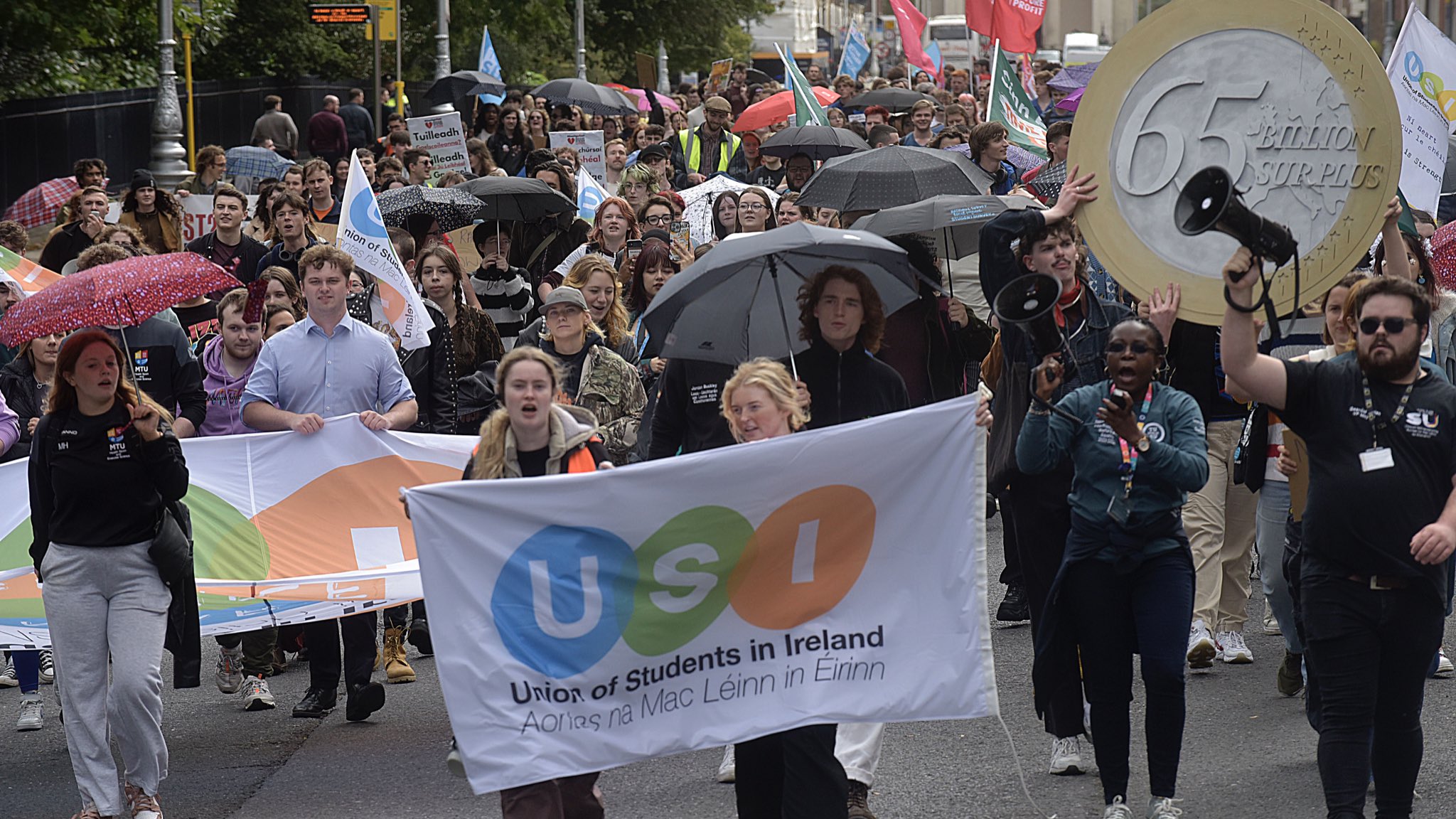
    University students took part in a national demonstration, organised by the Union of Students in Ireland (USI) last Wednesday, where they protested the €65 billion budget surplus the Government is said to accumulate over the next three years. Students nationwide were outraged to hear the surplus would be used for a ‘rainy-day’ fund instead of the cost-of-living crisis. 

    The protest began at the Garden of Remembrance and made its way down to the Dáil with students chanting and singing about the issues they face while studying in higher education. 

    The student-led demonstration was organised to highlight the issues surrounding third-level education and to offer the Government solutions to fix these problems. 

    Brian Jordan, president of the Technological University Dublin’s Student Union said, “This is a national demonstration organised by USI […] The reason we’re protesting is because we’ve seen a lack of student accommodation. The Government has failed to give [students] capital investments, even though that is a clear solution.” 

    “We have a huge amount of private rented accommodation all over Grangegorman. Students are paying up to €1,100 [monthly], and that’s because the university hasn’t built their own accommodation,” he added.


    Brian Jordan and the TU Dublin SU at the Garden of Remembrance. Image: @theusi/X

    Environmental science student, Megan Tynan described how stressful it was to find accommodation closer to college. 

    “For my second year, I was commuting an hour and a half from college. By the time you get home, you’re wrecked,” she said. 

    “I was staying at a hostel for a few days during exams because my landlord decided to sell [the accommodation].” 

    “I was staying in a room with nine people, who were all strangers. It affected me negatively because it’s embarrassing to admit that you are struggling to find a place,” she added.

    “It didn’t just fall out of the sky; it did not just happen. It was caused by Government policy.” 

    Dr Rory Hearne, Assistant Professor of Social Policy at Maynooth

    According to the Pre-Budget Submission for the Budget 2024, submitted by USI, 33% of the total student population says they are experiencing serious financial issues. In 2019, that percentage sat at 26%. 

    President of Maynooth University Student Union, Alex Balfe said that “hundreds of students”, many of whom come from Donegal and Cork, are struggling to find accommodation on campus which is not “sustainable” for students. 

    “Students are waking up at five o’clock in the morning for their commute and they’re not getting home until very late in the evening,” Balfe said. 

    “There’s absolutely no accommodation in Maynooth, considering we’re a university town with more students than residents at the moment,” she added. 

    Third-level students march to the Dáil in protest of the accommodation crisis. Image: @rosspjboyd/X

    The latest figures on Funding the Future — a document released by the Government in August 2023, mentioned that full-time student numbers are increasing and are expected to “peak” at 233,000 in 2030. It is also mentioned that there are currently 29,773 “oversubscribed” students who will not get accommodation in the 2023/2024 academic year. 

    The document mentioned that Minister Simon Harris confirmed “Government approval” for a new policy to be introduced that will provide “state assistance” to the “development of new and additional student accommodation for higher education institutions”. 

    The Government also “approved €62 million in additional funding” for 1,072 additional beds in universities like the University of Limerick (UL), Maynooth University (MU), University of Galway (UG), and Dublin City University (DCU). Assessment is still ongoing for all five Technological Universities (TUs). 

    Dr Rory Hearne, an assistant social policy professor at Maynooth said, “The housing crisis is forcing students to drop out of college, forcing them to pay unaffordable rents and to live in hidden homelessness. College days are supposed to be the best days of your life, but now, it’s a nightmare for many students.” 

    “It didn’t just fall out of the sky; it did not just happen. It was caused by Government policy.” 

    “Rents have increased by 100% since 2011, and 60% since 2020. Here’s a radical idea, in Berlin, in 2020, they reduced rents and put a five-year rent freeze in place. Why doesn’t the Government reduce all rents by 20%, back to the level they were in 2020?” Hearne said. 

    In 2021, Berlin’s Mietendeckle — a rent control law in Berlin, was declared ‘unconstitutional’ and was replaced with Mietpreisbremse — a new rent control law that limits how much rent the landlord can ask for. It is also possible to claim money that was overpaid for rent.

    Video: Elio Bonelli

    President of USI, Chris Clifford said, “How far away from reality is our Taoiseach when students and graduates are leaving the country by the plane load, when students have to decide between food and printing, and when a student’s room is the front seat of their car? That is the reality that this country has created for students.” 

    “We’re looking for the Government to fund the future of this country […] There’s a ‘rainy day’ fund of €65 billion and we’re asking for five percent of that. That five percent reduces waiting lists in hospitals, that five percent means that there’s enough childcare practitioners in this country, and it also means that there are enough civil engineers out there to get these houses, that not only students, but the public are crying out for.” 

    “Five percent for the future of Ireland,” Clifford added.

  • Office for Public Works extends consultation period on gigs at the Iveagh Gardens 

    Office for Public Works extends consultation period on gigs at the Iveagh Gardens 

    By Elio Bonelli

    Irish comedians and musicians are speaking out at the prospect of commercial events at the Iveagh Gardens being shut down. 

    According to event organisers and locals in Dublin, a small group of people are campaigning against events being held in The Iveagh Gardens, which is already having a negative effect on the use of this space. There were no clear reasons as to why they were campaigning against them. 

    The Office for Public Works (OPW) is running a consultation into these events happening and will run until Friday, 6 October, having been extended from its original date of 29 September. 

    In the deadline set by the OPW, words of support must be sent to them by this date. 

    Source: Office for Public Works

    Stuart Clark is the Deputy Editor of Hot Press, and he took to X, formerly Twitter, to voice his opinion.

    Sharon Mannion is a comedian, actor and improviser and she echoed the same sentiments. 

    “We will definitely miss the events at this venue. It would be such a shame if one of Dublin’s best gigs were to go. The festival here is a highlight for the community and a highlight for comedy.” 

    “It would be a loss for the comedy scene in Ireland if gigs stopped here and what would that mean for us?” she concluded. 

    “I will miss coming here if the gigs are cancelled, especially with how easy it is to get to.”

    Nellie O’Neill, Social care worker

    Nellie O’Neill is a social care worker and has attended events at the Iveagh Gardens at least once a year over the last decade.  

    He said, “The gigs have become part of my summer with a lovely venue in the city centre of Dublin. There is great public transport with great access to the heart of the city.” 

    “The thoughts of that venue not being allowed to run just because some small group of people had other ideas of what this park should be used for, worries me. Stephen’s Green is just over the road and there are no problems there!”

    “I will miss coming here if the gigs are cancelled especially with how easy it is to get to,” he added. 

    In a statement, the Office for Public Works (OPW) said: 

    “A public consultation about how the Iveagh Gardens accommodates all visitors is taking place. This consultation has been extended to Friday, 6 October.”

    “This consultation is inviting all visitors to share their experiences of the gardens and their views on how the gardens are used. We are seeking to gather a wide range of views on how visitors enjoy the Iveagh Gardens to balance the needs of all visitors.” 

    “This is to ensure that all visitors can share their views on our events. The views received will help inform the role this wonderful historic garden plays in Dublin in the coming years,” the statement concluded.